
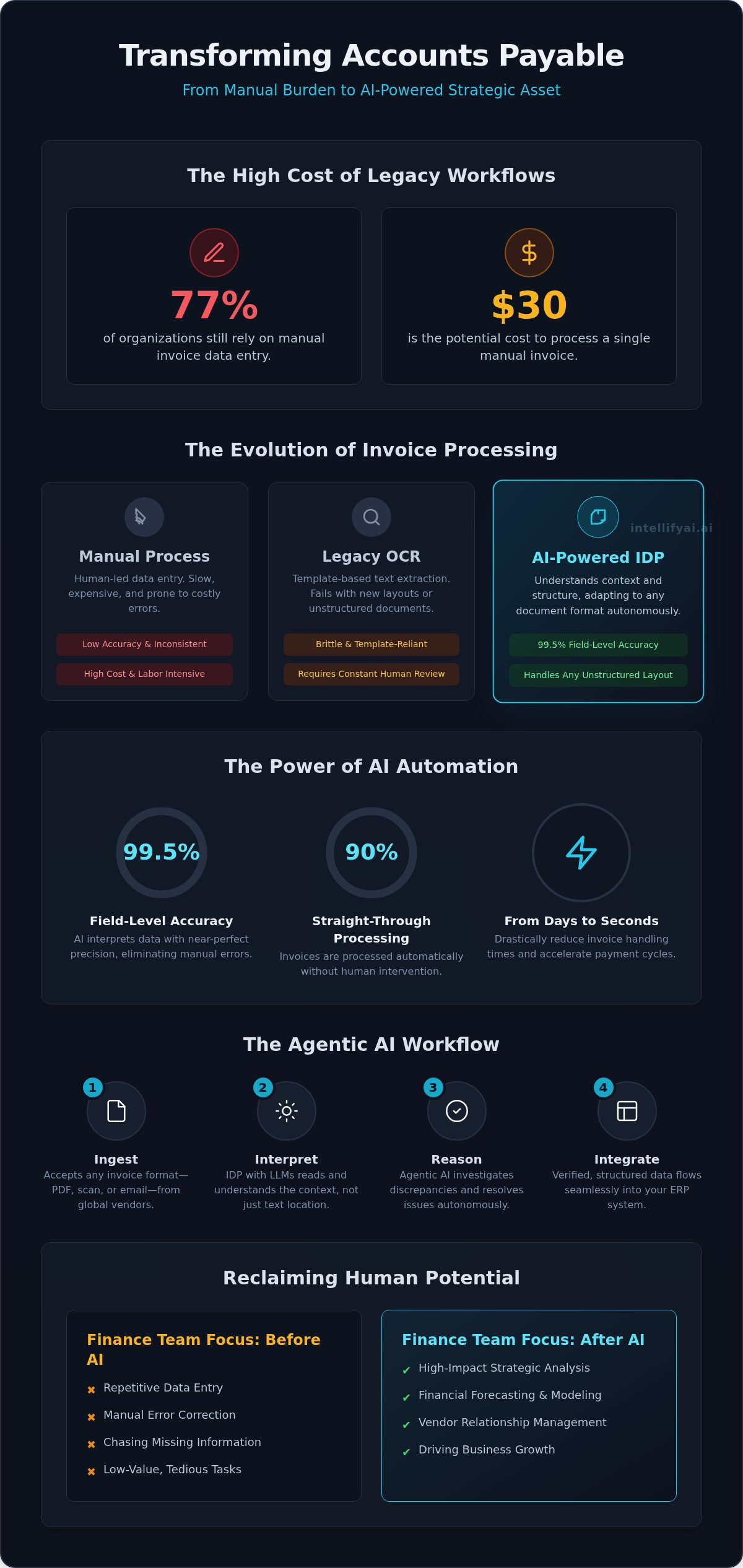
77% of organizations still manually enter data into their accounting systems, even as the cost per manual invoice climbs as high as $30. It’s a staggering inefficiency that anchors your finance team to repetitive, low-value tasks. You likely recognize that traditional OCR has reached its limit, frequently failing when a vendor changes a layout or submits an unstructured document. This reliance on legacy workflows creates a persistent bottleneck that prevents your enterprise from scaling effectively.
This guide demonstrates how to leverage AI for invoice processing automation to transform accounts payable into a high-velocity strategic asset. By integrating Agentic AI and Intelligent Document Processing (IDP), you can move beyond simple text extraction to achieve 99.5% field-level accuracy. We'll explore how these autonomous systems achieve 90% straight-through processing, reducing handling times from days to mere seconds. You will learn to architect a frictionless finance operation that empowers your staff to pivot from manual entry to high-impact strategic analysis.
Key Takeaways
• Move beyond the limitations of legacy OCR by adopting systems that interpret unstructured layouts and global document formats with high precision.
• Implement AI for invoice processing automation to achieve up to 99.5% accuracy through agentic reasoning and autonomous discrepancy resolution.
• Reclaim human potential by shifting your finance team's focus from repetitive data entry to high-value strategic analysis and financial forecasting.
• Follow a structured roadmap to audit your existing workflows and modernize your infrastructure for seamless, high-volume document intelligence.
• Leverage the i_Nova platform to transform complex, non-standard invoices into actionable data points that drive business growth.
The Evolution of Invoice Processing: Moving Beyond Manual Entry and OCR
AI invoice processing is the autonomous extraction and validation of financial data. It represents a fundamental shift from human-led data entry to machine-led intelligence. The Evolution of Invoice Processing shows how we've moved from paper-heavy workflows to digital interfaces, yet many organizations remain stuck in a middle ground. Traditional OCR systems often fail because they lack the ability to interpret unstructured layouts or diverse global formats. They look for text in specific zones. When a vendor changes a document's design, the automation collapses.
This failure creates the hidden cost of "semi-automated" systems. Your finance team ends up spending significant time reviewing and correcting machine output. This negates the efficiency gains you expected. True AI for invoice processing automation must handle the unexpected without human intervention.
To better understand how these systems function in a real-world environment, watch this helpful case study:
The Friction of Legacy Accounts Payable
Manual errors are more than just minor inconveniences. They damage vendor relationships and cause critical delays in cash flow. Research shows that 77% of organizations still manually enter invoices into their accounting systems, which drives processing costs as high as $30 per document. Template-based automation is simply insufficient for modern enterprises that deal with thousands of unique invoice styles. If your system requires a pre-defined map for every vendor, it isn't truly automated. Achieving a competitive edge requires a commitment to enterprise modernization, replacing brittle legacy tools with flexible, agentic solutions.
Transitioning to Intelligent Document Processing
The new standard is Intelligent Document Processing (IDP). Unlike OCR, which only sees characters, IDP uses Large Language Models (LLMs) to understand context. It can parse complex financial tables and identify line items even when they're buried in non-standard layouts. This technology doesn't just read the document; it interprets the meaning behind the data. IDP acts as the bridge between raw, unstructured data and the actionable intelligence needed for strategic financial decisions. By implementing robust AI for invoice processing automation, you ensure that your data is accurate and integrated for immediate use in your ERP.
How Agentic AI and i_Nova Redefine Document Intelligence
Static data extraction is no longer enough for the modern enterprise. While foundational tools like Microsoft's prebuilt AI model provide a baseline for identifying standard fields, they often stop at the point of extraction. True AI for invoice processing automation requires a system that can reason about the data it identifies. This is where Agentic AI transforms the accounts payable landscape. It doesn't just flag a discrepancy; it investigates it. By moving from passive recognition to active reasoning, your financial workflows become self-correcting ecosystems.
The i_Nova platform serves as the central engine for this intelligence. It's designed to handle the inherent complexity of unstructured documents that typically break traditional OCR. Whether your organization deals with diverse global formats or non-standard vendor layouts, i_Nova extracts actionable data with high-velocity precision. It acts as a bridge, turning raw document noise into structured, verified intelligence that flows directly into your ERP. For managed service providers looking to integrate these advanced intelligence platforms into their service catalog, they can visit MSPPro to discover scalable platform-as-a-service solutions.
The i_Nova Advantage for Unstructured Data
Enterprises operating across global markets face a constant stream of multi-language and multi-format invoices. i_Nova thrives in this environment by utilizing custom MLOps pipelines to learn from every document it processes. The platform doesn't rely on brittle templates. Instead, it continuously refines its extraction accuracy based on historical data and contextual understanding. This isn't a static software implementation; it's a dynamic asset that scales with your document volume. You can examine the technical specifications for these capabilities by visiting the i_Nova products page.
Agentic Workflows: From Extraction to Execution
An AI agent in the context of accounts payable acts as an autonomous digital worker. These agents do more than parse text; they execute complex workflows. Imagine a system that autonomously matches line items to specific purchase orders. If a price mismatch occurs, the agent doesn't simply pause the process for human review. It can trigger a voice agent to contact the vendor, clarify the discrepancy, and resolve the error in real time. This level of autonomy reduces the "human-in-the-loop" to only the most complex, high-value cases. By shifting the burden of exception management to intelligent agents, you liberate your finance team for high-level strategic analysis. Explore how our Agentic AI engineering services can modernize your back-office operations.
Strategic Benefits: Accuracy, Scalability, and Human Potential
The transition to AI for invoice processing automation marks the end of accounts payable as a mere cost center. Historically, enterprises measured success by minimizing the $10 to $30 cost associated with manual handling. Today, the metric has evolved into value-per-insight. When data is extracted and validated autonomously, it provides real-time visibility into liabilities and spending patterns. This shift allows leadership to make data-driven decisions that were previously obscured by the lag of manual entry.
Scalability becomes a non-issue during high-pressure cycles like end-of-year or end-of-quarter closing. While manual teams often struggle with the surge in document volume, implementing AI for invoice processing automation allows systems to expand their capacity instantly without increasing overhead. This elasticity ensures that your financial reporting remains accurate and on time, regardless of seasonal peaks. Automated validation also guarantees 100% compliance with internal audits. The system checks every line item against your business rules, eliminating the risk of duplicate payments or fraudulent submissions. In cases where these automated audits reveal systemic financial misconduct, legal experts such as Piacentile & Associates LLP provide the necessary counsel for federal whistleblower actions.
Achieving Straight-Through Processing (STP)
Straight-Through Processing (STP) is the primary KPI for any modern finance department. It refers to the percentage of invoices that move from receipt to payment without any human intervention. In 2026, advanced systems reach STP rates of 90% or higher, a significant leap from the 32.6% industry average seen in previous years. This level of efficiency doesn't just save time; it transforms your balance sheet. High STP rates accelerate the entire payment lifecycle, allowing your enterprise to capture early payment discounts and optimize liquidity management.
Liberating Human Creativity
We don't view automation as a replacement for human workers; it's a liberating force for unlocking human potential. Removing the burden of repetitive tasks significantly improves employee morale. Your team is no longer tethered to a keyboard, correcting OCR errors or typing vendor names. This evolution gives rise to the "Finance Strategist," a professional who focuses on high-level analysis, vendor negotiation, and process optimization. To prepare your organization for this transition, consider engaging with our AI strategy consulting services. We help you restructure your teams to maximize the impact of your new automated capabilities.
Implementing AI for Invoice Processing: A 2026 Roadmap
Deploying a high-performance system requires a structured, logical approach. Moving from manual friction to autonomous execution isn't an overnight change; it's a strategic migration. Follow this five-step roadmap to integrate AI for invoice processing automation into your enterprise operations:
Step 1: Audit Workflows.
Map your existing document journey. Identify high-friction points where manual data entry persists or where legacy OCR systems frequently trigger exceptions.
Step 2: Modernize Infrastructure.
Verify that your environment is cloud-native. High-volume Intelligent Document Processing (IDP) demands the elasticity and velocity that only cloud environments provide.
Step 3: Pilot with i_Nova.
Deploy the i_Nova platform on your most complex document sets. Use this phase to prove extraction accuracy on unstructured layouts that traditional tools can't handle.
Step 4: Agentic Integration.
Connect Agentic AI to your ERP. This allows the system to autonomously validate data, match purchase orders, and sync records without human intervention.
Step 5: MLOps Monitoring.
Establish a continuous feedback loop. Use MLOps pipelines to monitor model performance and ensure extraction remains precise as vendor layouts evolve.
Data Engineering and Cloud Readiness
Clean data is the lifeblood of any autonomous system. You must establish structured data pipelines to ensure your AI models receive high-quality inputs for training and refinement. This is where cloud-native modernization becomes a non-negotiable prerequisite. Without a scalable, cloud-based foundation, Agentic AI cannot access the real-time data it needs to reason and execute tasks. If your current stack is fragmented, our Agentic AI engineering services can help you build the custom integrations necessary for a unified workflow.
Governance, Risk, and Compliance (GRC)
Security remains the primary concern for finance leaders when automating sensitive data. Enterprise-grade AI for invoice processing automation must prioritize financial data privacy through robust encryption and access controls. Your automated workflows should adhere to SOC2 and GDPR standards to ensure global compliance, especially as the EU AI Act enforcement begins in August 2026. Transparency is equally vital. By utilizing version control within your MLOps pipelines, you create a permanent, auditable trail for every decision the AI makes. This ensures that your system remains compliant with both internal policies and external regulations. To begin your modernization journey, contact our strategic architects today.
Transforming Accounts Payable with IntellifyAi
IntellifyAi operates as a Strategic Architect for enterprises ready to transcend traditional back-office limitations. We don't just provide software; we engineer autonomous ecosystems. By combining the i_Nova platform's document intelligence with bespoke Agentic AI Engineering Services, we ensure your automation strategy is tailored to your specific operational DNA. This dual approach allows for rapid deployment through our SaaS core while maintaining the flexibility of custom MLOps pipelines. It's the difference between buying a tool and building a competitive advantage.
Our global footprint across the UK, USA, India, and UAE provides us with a unique perspective on diverse regulatory environments and market-specific challenges. This local expertise is vital when navigating the complexities of international finance and cross-border vendor management. We invite forward-thinking leaders to engage in a proof-of-value (PoV) session. Seeing i_Nova process your most difficult, unstructured invoices in real time clarifies the distance between current legacy tools and true intelligence. It's time to move beyond character recognition and embrace AI for invoice processing automation that reasons and resolves.
End-to-End Strategic Partnership
Modernizing accounts payable is a foundational pillar of enterprise growth. Our consulting services focus on building a bespoke roadmap that aligns with your long-term financial goals. We don't view AI for invoice processing automation as a temporary fix. It's a permanent investment in relevance. Our team works alongside your finance department to identify high-impact opportunities for team restructuring. This collaborative approach ensures that your staff is prepared to transition into strategic roles as the machines handle the data entry. To begin this transformation, contact IntellifyAi for a dedicated strategic session.
The Future of Autonomous Finance
Looking toward 2030, the concept of a "cost center" will become obsolete for high-performing finance teams. Invoice processing will be entirely frictionless; a background process that requires zero human intervention for nearly every transaction. IntellifyAi remains committed to this innovative future. We continuously refine our models to ensure your operations stay ahead of the curve. Modernize your back office with the power of i_Nova. Embrace a future where technology unlocks human potential and drives measurable financial returns. The path to a frictionless enterprise starts with a single, intelligent decision.
Architecting the Frictionless Finance Department
The shift from brittle OCR to agentic intelligence is no longer a luxury; it's a strategic necessity for the modern enterprise. By adopting AI for invoice processing automation, you replace manual friction with autonomous execution, achieving 99.5% accuracy and liberating your team for high-value analysis. This transition turns accounts payable from a cost-heavy bottleneck into a high-velocity engine for growth. You've seen how the roadmap from cloud-native infrastructure to agentic workflows creates a self-correcting ecosystem that scales without increasing overhead.
Success in this transformation depends on selecting the right architecture. The i_Nova IDP platform provides the intelligence needed to handle your most complex unstructured documents. Our expert Agentic AI engineering ensures that your workflows are autonomous, secure, and fully integrated with your existing ERP systems. With deep experience in global enterprise modernization across the UK, USA, and UAE, we provide the dependable foundation your digital transformation requires.
Partner with IntellifyAi to architect your autonomous finance future.
Your path to a modernized, high-performance back office is clear. We're ready to help you build it.
Frequently Asked Questions
How does AI for invoice processing differ from traditional OCR?
AI for invoice processing automation differs from traditional OCR by moving beyond simple character recognition to contextual understanding. While OCR relies on rigid templates and fails when layouts shift, AI interprets document intent. It extracts data from unstructured formats by reasoning about field relationships. This transition allows your system to handle diverse global invoices without constant manual intervention or the need for perpetual template redesigns.
Is Agentic AI secure enough for sensitive financial documents?
Enterprise-grade Agentic AI is engineered with rigorous security protocols to protect sensitive financial data. Our implementations prioritize SOC2 and GDPR compliance, ensuring that every data interaction remains encrypted and auditable. Unlike consumer tools, these systems reside within secure, cloud-native environments. They provide a permanent audit trail through MLOps version control, giving your finance department total transparency and control over automated decision-making processes.
Can i_Nova integrate with existing ERP systems like SAP or Oracle?
i_Nova is designed to integrate seamlessly with major ERP systems, including SAP, Oracle, and Microsoft Dynamics. The platform uses robust APIs and custom data engineering to ensure a frictionless sync between document extraction and your core financial records. This connectivity allows for real-time liability tracking and automated ledger updates. We specialize in custom integrations that bridge the gap between unstructured document intelligence and your existing enterprise architecture.
What is the typical ROI timeframe for an invoice automation project?
Most enterprises achieve a full return on investment within six to twelve months of deployment. By reducing processing costs from upwards of $30 to under $5 per invoice, the direct savings accumulate rapidly. Additional value comes from capturing early payment discounts and eliminating duplicate payments. The shift toward high straight-through processing rates allows you to reallocate human capital toward strategic growth initiatives almost immediately.
How does the system handle invoices with handwritten notes or poor scans?
Advanced Intelligent Document Processing (IDP) utilizes sophisticated computer vision and Large Language Models to interpret handwritten notes and low-quality scans. The system doesn't just read pixels; it understands context. If a scan is truly illegible, the Agentic AI can autonomously trigger a request for a clearer copy or flag the document for a brief human review. This ensures that even non-standard documents don't stall your high-velocity financial workflows.
Does AI invoice processing require a complete overhaul of my current IT stack?
Implementing AI for invoice processing automation doesn't require a total infrastructure overhaul. It's designed as a modernization layer that sits atop your existing systems. We focus on cloud-native integration, which allows you to upgrade your capabilities without disrupting current operations. This modular approach ensures that you can introduce agentic intelligence at your own pace while maintaining the stability and security of your core financial database.
How much human intervention is still required with an Agentic AI system?
Human intervention is limited to exception management and high-level strategic oversight. In a fully optimized Agentic AI system, up to 90% of invoices achieve straight-through processing without any human touch. Your staff only steps in when a document presents a complex discrepancy that requires professional judgment. This shift allows your finance team to pivot from data entry clerks to strategic analysts who manage by exception rather than by routine.
Can i_Nova handle multiple languages and international tax regulations?
i_Nova is engineered to handle multi-language invoices and complex international tax regulations across global markets. The platform's underlying LLMs are trained on diverse document sets from the UK, USA, and UAE. It automatically identifies regional tax requirements and ensures compliance with local financial standards. This global capability makes it an ideal solution for multinational enterprises looking to unify their accounts payable processes under a single, intelligent umbrella.









.svg)