
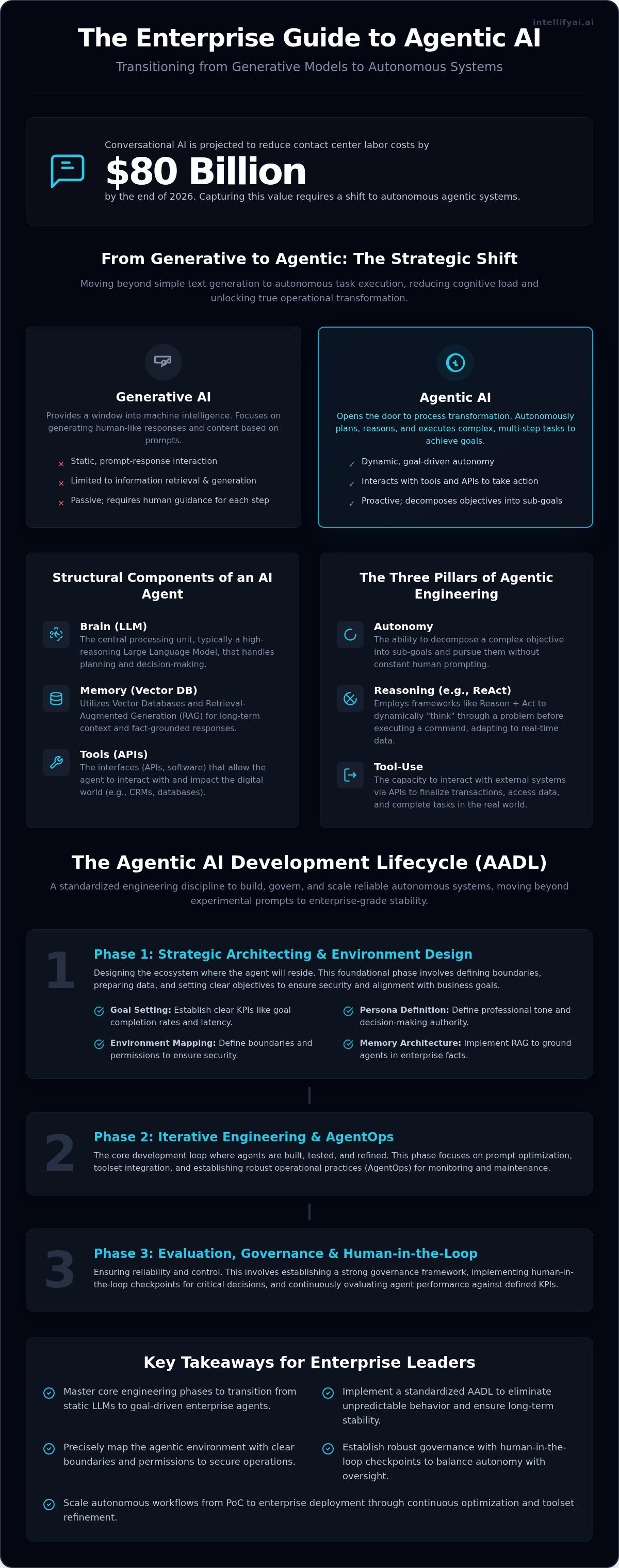
By the end of 2026, conversational AI is projected to reduce contact center labor costs by $80 billion. Capturing this value requires more than just deploying a basic chatbot. To achieve true scale, serious enterprises must transition toward autonomous systems that can plan, reason, and execute complex workflows. This shift necessitates a rigorous agentic ai development lifecycle that moves beyond experimental prompts into structured, governed engineering. It's the difference between a temporary pilot and a lasting investment in operational relevance.
You've likely experienced the frustration of unpredictable agent behavior or the challenge of proving ROI. It's a common hurdle for organizations looking to modernize while managing complex regulatory compliance and security concerns. Master the end-to-end engineering phases required to build reliable enterprise agents with this strategic blueprint. We'll examine how to integrate your existing data silos. We'll also implement a framework that balances high-level autonomy with essential human oversight. Use this repeatable methodology to transform advanced technology from a daunting complexity into a liberating force for your business growth.
Key Takeaways
• Transition from static LLM implementations to goal-driven enterprise agents by mastering the core engineering phases required for true autonomy.
• Implement a standardized agentic ai development lifecycle to eliminate unpredictable behavior and ensure long-term system stability across the enterprise.
• Map the agentic environment with precision, defining clear boundaries and permissions to secure autonomous operations within your existing data architecture.
• Establish a robust governance framework that integrates strategic human-in-the-loop checkpoints to balance system agency with essential human oversight.
• Scale autonomous workflows from initial proof-of-concept to enterprise-wide deployment through continuous prompt optimization and iterative toolset refinement.
Defining the Agentic AI Development Lifecycle (AADL)
The year 2026 marks a definitive pivot for enterprise AI. We've moved past the novelty of simple text generation. Today, the strategic focus is on Agentic Architecting. This shift requires a robust agentic ai development lifecycle to manage the inherent complexity of systems that don't just talk, but act. While traditional Software Development Lifecycles (SDLC) focus on deterministic logic, and MLOps manages model performance, the AADL governs the behavioral reasoning of an AI agent. It's a shift from writing code to designing intent.
Every agentic system is built on three structural components. First is the Brain, typically a high-reasoning Large Language Model that serves as the central processing unit. Second is Memory, utilizing Vector Databases to provide long-term context and retrieval-augmented generation. Third is Tools, which are the APIs and software interfaces that allow the agent to impact the digital world. For organizations ready to move beyond basic automation, our Agentic AI Engineering Services provide the technical foundation for this transition.
From Generative to Agentic: The Strategic Shift
Generative AI provided a window into machine intelligence. Agentic AI opens the door to total process transformation. By moving beyond simple responses to autonomous task execution, businesses can drastically reduce the cognitive load on human workers in back-office operations. This allows your team to focus on high-value creative work rather than repetitive digital chores. For instance, Aglaé By ClicFone acts as a 24/7 intelligent medical assistant, allowing healthcare professionals to offload administrative tasks. The agentic ai development lifecycle is a multi-stage engineering discipline for autonomous systems that integrates reasoning loops with tool-use to achieve complex business objectives. It ensures that every autonomous action remains aligned with corporate strategy and financial returns.
The Three Pillars of Agentic Engineering
Successful agentic systems rest on three technical pillars. Autonomy allows the system to decompose a complex objective into sub-goals without constant human prompting. Reasoning employs frameworks like ReAct (Reason + Act) to think through a problem before executing a command. This isn't a linear script. It's a dynamic response to real-time data. Finally, Tool-Use gives the agent the capacity to interact with CRM systems, databases, and external APIs to finalize transactions. These pillars transform a static model into a goal-driven partner. They create a frictionless future where technology serves as a bridge between abstract strategy and practical results. For organizations ready to build this bridge at scale, you can explore Enterprise AI Implementation and Managed Services to transition from initial pilots to secure, scalable production outcomes.
Phase 1: Strategic Architecting & Environment Design
The first phase of the agentic ai development lifecycle involves more than just selecting a model. It requires a deliberate design of the ecosystem where the agent will reside. You must identify high-impact applications like voice agents for customer service or automated back-office document processing. Mapping the agentic environment is critical. This process defines the boundaries and permissions of the autonomous system. It ensures the agent can access necessary tools without compromising enterprise security.
Data engineering serves as the bedrock of this phase. Effective agents require high-fidelity information to reason accurately. Use platforms like i_Nova to transform unstructured enterprise data into agent-ready intelligence. Once the data is prepared, you must define the agent's persona. This includes its professional tone, the scope of its decision-making authority, and clear escalation protocols. For organizations seeking to define these parameters with precision, our AI Strategy & Consulting team provides the necessary architectural expertise.
Goal Setting and Constraint Mapping
Success must be measurable. Establish clear KPIs such as goal completion rates and response latency. These metrics allow you to prove ROI early in the deployment. Implement rigid guardrails to prevent hallucinations or unauthorized actions. These safety measures ensure the agent remains within its operational boundaries. Designing a robust feedback loop between the agent and your enterprise systems is also essential. It allows the system to learn from its environment while remaining under your control.
Architecting the Memory Layer
Context is the currency of autonomy. Implement Retrieval-Augmented Generation (RAG) to ground agent responses in real-time enterprise facts. This prevents the agent from relying solely on its training data. Balance short-term conversational context with long-term memory structures. This enables persistent, multi-session interactions that feel seamless to the user. Throughout this process, prioritize data privacy and GDPR compliance. Protecting sensitive information is not just a legal requirement. It's a foundational element of trust in autonomous systems.
Phase 2: Iterative Engineering & AgentOps
Once the environment is designed, the agentic ai development lifecycle shifts into high-velocity engineering. The first decision involves selecting the base model, or the "brain," of the system. Enterprises must choose between the raw reasoning power of proprietary models like GPT-5 or the transparency and control of open-source options like Llama 4. This choice dictates the agent’s baseline intelligence and its ability to handle complex instructions. Following model selection, engineers develop the System Prompt. This prompt archetyping serves as the constitutional framework for the agent’s reasoning loops, ensuring every action aligns with corporate intent.
True agency requires the ability to interact with the world. Logic must be flawless. This means connecting the agent to your ERP, CRM, and internal communication channels. For multi-faceted business processes, we design multi-agent orchestration systems. Here, specialized agents collaborate on complex tasks, passing context between one another to reach a final goal. To maintain visibility, we implement AgentOps. This provides real-time monitoring of agent decisions and tool-use efficiency, allowing teams to identify and resolve logic bottlenecks before they impact the bottom line.
Implementing Reasoning Frameworks
Complex decision-making requires structured logic. We implement Chain-of-Thought (CoT) to help agents break down problems step-by-step. For even more nuanced scenarios, Tree-of-Thoughts (ToT) allows the system to explore multiple reasoning paths simultaneously. We also integrate reflexion strategies. These allow agents to evaluate their own output and correct mistakes autonomously. Throughout this process, we focus on optimizing latency. Reducing the time between reasoning steps is essential for maintaining a high-velocity user experience in multi-step workflows.
Tool-Use and API Orchestration
Agents must learn to select the most efficient tool for any given sub-task. This involves teaching the system to recognize when a specific API or database query is the optimal path forward. Engineering teams must also build robust error-handling protocols to manage API failures and edge cases. Without these, an autonomous system can stall or produce erratic results. By leveraging Agentic AI Engineering Services, businesses can build custom connectors that bridge the gap between legacy software and modern autonomous brains. This ensures a frictionless integration that turns static data into a dynamic corporate asset.
Phase 3: Evaluation, Governance & Human-in-the-Loop
Evaluation is the crucible of the agentic ai development lifecycle. In this phase, we move beyond simple text-matching scores to measure how effectively an agent interacts with its digital environment. Developing custom rubrics is essential. These must track reasoning accuracy, safety protocols, and goal-completion rates across diverse enterprise scenarios. We also implement red teaming to stress-test the system against jailbreaking attempts and "agentic drift," where the agent's reasoning slowly deviates from its original intent. Aligning these technical tests with a broader Enterprise AI Strategy ensures that autonomous systems remain corporate assets rather than liabilities.
Human-in-the-Loop (HITL) design is a priority for any strategic architect. It's not a sign of technical failure. It's a mechanism for organizational trust. By designing strategic checkpoints, you ensure human approval is required for high-stakes decisions, such as significant financial transactions or sensitive data modifications. This collaborative relationship between technology and human workers unlocks human potential without sacrificing operational security. If you are ready to implement these rigorous standards, our AI Strategy & Consulting team can help you build a governance framework that scales with your growth.
Measuring Autonomy and Reliability
Quantifying progress requires a precise "Agency Score." This metric tracks the number of steps an agent completes successfully without human intervention. We use automated testing pipelines with synthetic data to simulate edge cases and high-stress environments. This allows for rapid iteration without risking production data or system stability. Reliability in agentic systems is achieved through rigorous evaluation, not just better models. It's the result of a disciplined engineering process that treats autonomous behavior as a measurable and optimizable variable.
Security and Ethical Governance
Governance must be baked into the system architecture from day one. We prevent unauthorized tool-use and data exfiltration by enforcing strict permission layers at the API level. Every "thought" and "action" the agent takes must be recorded in an immutable audit trail. This total transparency is vital for regulatory compliance and internal accountability. Managing the ethical implications of autonomous decision-making requires a proactive approach. We ensure that every autonomous action is grounded in human-defined values, maintaining the stability of your operations as you scale into the future of work.
Deployment & Continuous Evolution with IntellifyAi
The deployment of a single agent marks a significant milestone. However, the true value lies in scaling these systems across the entire organization. Moving from a Proof of Concept (PoC) to enterprise-wide autonomous workflows is the final, most impactful stage of the agentic ai development lifecycle. This phase demands a commitment to continuous learning. By analyzing production performance, engineering teams can iteratively update agent prompts and toolsets to ensure they remain aligned with shifting business objectives. This is not a "set and forget" implementation. It's a living system that requires the specialized oversight provided by Managed AI Services to maintain peak agentic health and reasoning accuracy.
Future-proofing your investment means preparing for the next generation of multi-modal and embodied agents. As technology advances, your autonomous systems will soon process visual data and interact with physical environments in real-time. Establishing a robust lifecycle framework today ensures your enterprise remains relevant as these capabilities mature. This long-term viability positions your AI initiatives as central business pillars rather than temporary fixes. It allows your organization to lead the market by adopting a methodology that treats technology as a lasting investment in relevance.
Scaling Agentic Infrastructure
Scaling requires a cloud-native approach to handle the unpredictable compute demands of high-volume agentic interactions. Efficiency is paramount. You must implement FinOps strategies to manage the costs associated with multi-step reasoning loops and extensive tool-use. Integrating these agents into your existing Enterprise Modernization roadmap ensures that your autonomous intelligence layers sit naturally atop your legacy systems. This creates a frictionless flow of information that drives measurable financial returns while removing the burden of repetitive tasks from your workforce.
The IntellifyAi Advantage
We provide the bridge between abstract technical potential and concrete business results. By leveraging our i_Nova platform, we deliver intelligent, document-driven agentic workflows that extract value from your most complex unstructured data. Our philosophy treats technology as a partner to human potential. We don't just build software; we architect the future of your workforce. Contact our AI strategy consultants today to begin your journey through the agentic ai development lifecycle and unlock the liberating force of autonomous intelligence.
Architecting the Future of Enterprise Autonomy
The transition from static LLM implementations to autonomous, goal-driven agents represents a fundamental shift in corporate strategy. By adopting a structured agentic ai development lifecycle, your organization moves beyond the uncertainty of experimental pilots toward a repeatable blueprint for engineering excellence. This framework ensures that autonomy is balanced with rigorous human oversight and governance. It turns advanced technology into a liberating force that allows your team to focus on high-value creative work while agents manage the complexity of repetitive processes.
IntellifyAi stands ready as your strategic partner in this transformation. We offer specialized Agentic AI Engineering Services and Strategic AI Consulting for global enterprises looking to modernize with confidence. Our i_Nova Intelligent Document Processing platform serves as a primary example of how unstructured data can be converted into actionable agentic intelligence. Partner with IntellifyAi for Enterprise Agentic Engineering to secure your position at the cutting edge of the industry. The era of autonomous enterprise is here, and the opportunity to lead is yours.
Frequently Asked Questions
What is the difference between the standard SDLC and the Agentic AI Development Lifecycle?
The primary difference lies in the nature of the logic. Standard SDLC governs deterministic, rule-based code, while the agentic ai development lifecycle manages probabilistic reasoning and autonomous behavior. It's a shift from writing static instructions to designing goal-oriented intent. This framework ensures that agents can adapt to real-time variables without breaking the core system architecture, providing a more resilient foundation for enterprise intelligence.
How do you ensure security in an agentic system with autonomous tool-use?
Security is established through granular permission layers and rigid API-level guardrails. We implement a "least privilege" protocol, restricting the agent's access to only the tools and data necessary for its objective. Immutable audit trails record every reasoning step and digital action. This creates total transparency, allowing enterprises to scale autonomy while preventing unauthorized data exfiltration or system misuse within the corporate environment.
What are the most critical KPIs for measuring Agentic AI success in 2026?
Goal Completion Rate and the "Agency Score" are the most critical metrics for 2026. These KPIs measure the percentage of complex tasks an agent finishes successfully without human intervention. We also monitor reasoning latency and tool-selection accuracy to ensure high-velocity execution. These data points provide a clear view of the system’s operational efficiency and its direct impact on your overall financial returns.
Can Agentic AI be integrated with legacy enterprise software?
Integration is achieved through custom connectors and robust API orchestration. Agentic systems are specifically designed to act as a bridge between high-level reasoning models and legacy ERP or CRM software. This allows you to modernize your operations without a total infrastructure overhaul. It transforms your existing data into a dynamic resource for autonomous agents to execute high-value workflows across your current digital landscape.
How much human oversight is required in an agentic workflow?
Strategic human oversight is a foundational element of a responsible lifecycle. We design "Human-in-the-Loop" checkpoints specifically for high-stakes decisions, such as sensitive data modifications or large financial approvals. This ensures that the agent remains a liberating force for your workforce rather than a replacement. It balances the efficiency of autonomous execution with the essential security and ethical grounding of human judgment.
What is AgentOps and why is it necessary for the lifecycle?
AgentOps is the specialized engineering discipline focused on the real-time monitoring and maintenance of autonomous agents. It's essential for the agentic ai development lifecycle because it tracks the efficiency of reasoning loops and tool interactions. This visibility allows teams to identify logic bottlenecks and prevent "agentic drift." It ensures your autonomous systems remain dependable and performant as they scale across the broader enterprise infrastructure.
How does the i_Nova platform fit into the agentic development lifecycle?
The i_Nova platform functions as the critical data engineering layer for unstructured information. It extracts intelligence from complex documents and converts it into a format that agents can use for reasoning. In the lifecycle, i_Nova ensures that the agent’s memory is grounded in high-fidelity enterprise facts. This significantly reduces hallucinations and improves the accuracy of autonomous decision-making in document-heavy workflows and back-office processes.
What are the common pitfalls in the agentic AI development process?
Common pitfalls include rushing to deployment without rigid guardrails or a standardized evaluation rubric. Without these, agents can exhibit unpredictable behavior that compromises security. Another mistake is failing to define the agentic environment, which leads to agents attempting tasks beyond their authorized scope. Avoiding these errors requires a disciplined architectural approach that prioritizes long-term stability and security over temporary, experimental software fixes.









.svg)