
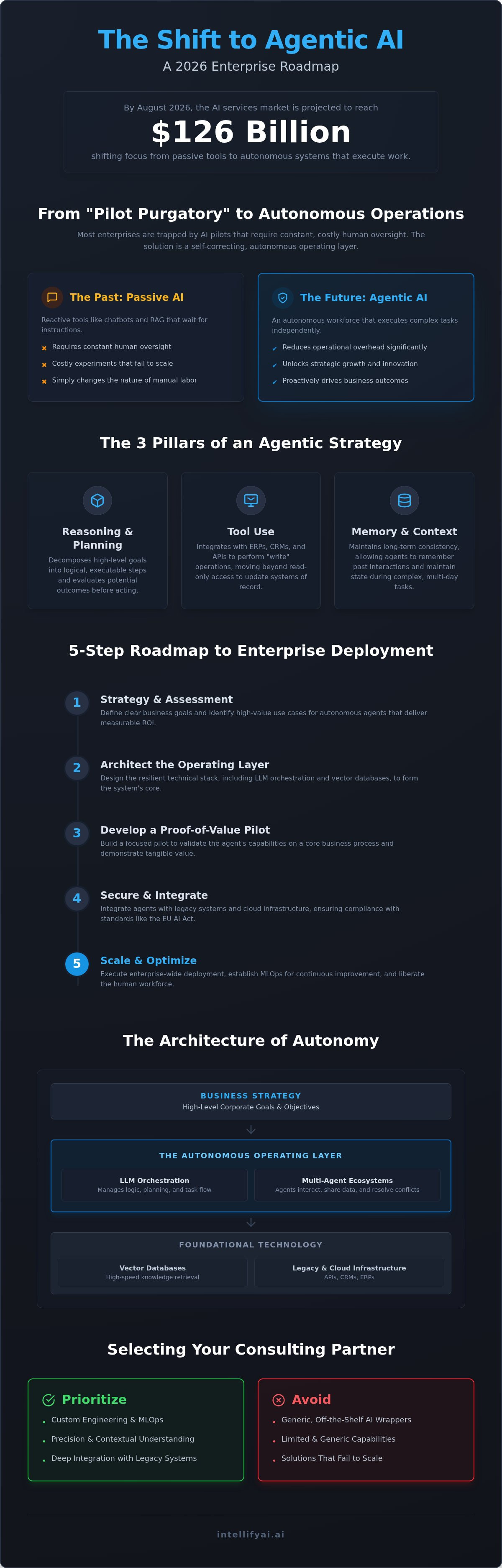
The era of treating artificial intelligence as a sophisticated chatbot is over. By August 2026, the $126 billion AI services market has shifted its focus from passive tools to autonomous systems that don't just suggest work, but actually execute it. Most enterprises are currently trapped in "pilot purgatory," where promising experiments fail to scale because they require constant, costly human oversight. This is where agentic ai consulting becomes the critical bridge. You've likely realized that adding more digital assistants isn't solving your operational bottlenecks. It's simply changing the nature of the manual labor required to manage them.
You can break this cycle by architecting a self-correcting, autonomous operating layer. This article provides a clear roadmap to transition your organization from basic automation to a fully integrated agentic workforce. We'll explore how to build secure, multi-agent systems that integrate with your legacy cloud-native infrastructure while meeting the strict compliance standards of the 2026 regulatory environment, including the now-enforced EU AI Act. You'll learn to reduce operational overhead and unlock strategic growth through workflows that think, act, and optimize themselves.
Key Takeaways
• Move beyond passive chatbots by implementing autonomous systems capable of complex reasoning and independent goal-seeking.
• Utilize expert agentic ai consulting to architect an "operating layer" that transforms high-level corporate strategy into measurable daily execution.
• Establish a resilient technical stack featuring LLM orchestration and vector databases to ensure your autonomous agents remain secure and scalable.
• Execute a systematic 5-step roadmap to move from proof-of-value pilots to seamless enterprise-wide deployment within legacy infrastructure.
• Select a consulting partner focused on custom engineering and MLOps to avoid the limitations of generic, off-the-shelf AI wrappers.
What is Agentic AI Consulting? Defining the 2026 Landscape
Most organizations have spent the last two years deploying generative AI as a reactive tool. This approach is reaching its limit. Agentic AI consulting represents the shift from building conversational interfaces to architecting autonomous systems capable of reasoning and planning. While early AI initiatives focused on generating text, 2026 enterprises prioritize systems that can act independently within defined guardrails. Agentic AI is a system that breaks down complex goals into executable tasks without constant prompting.
The modern consultant acts as a Strategic Architect for multi-agent ecosystems. They don't just provide advice; they design the orchestration layer where different agents interact, share data, and resolve logical conflicts. This requires a deep understanding of AI Strategy & Consulting to ensure that technical implementations align with financial returns and operational stability. It's a move away from "passive" GenAI chatbots that wait for instructions toward "agentic" AI goal-seekers that proactively drive business outcomes.
The Evolution from RAG to Autonomous Agents
Retrieval-Augmented Generation (RAG) served as a vital bridge for grounding LLMs in corporate data. However, RAG is inherently passive. It waits for a user to ask a question before it fetches an answer. The 2026 standard demands agents that don't just find information but use it to trigger actions. These autonomous agents can browse the web to research competitors, use API tools to update a CRM, or execute Python code to analyze financial trends. This shift moves the value proposition from simple "information retrieval" to full "task completion," allowing businesses to focus on high-value creative work.
Core Pillars of an Agentic Strategy
A robust agentic strategy rests on three technical pillars that separate goal-seekers from simple chatbots. These pillars ensure that advanced technology becomes a liberating force rather than a daunting complexity.
Reasoning and Planning
This allows agents to decompose high-level objectives into a sequence of logical steps, evaluating potential outcomes before acting.
Tool Use
Integration with ERPs, CRMs, and legacy databases allows the AI to perform "write" operations, moving beyond read-only data access to actually update systems of record.
Memory and Context
Advanced memory management ensures long-term consistency across workflows, allowing agents to remember past interactions and maintain state during complex, multi-day tasks.
By 2026, these pillars are no longer optional. They are the foundation for reducing operational overhead and removing the burden of repetitive oversight from your human workforce. Effective consulting in this space requires a blend of data engineering and process optimization to identify where a human-in-the-loop is necessary and where the system can operate with full autonomy.
The Architecture of Autonomy: How Consultants Build Agentic Workflows
Building an autonomous enterprise isn't a matter of simple software installation. It's a complex architectural challenge that requires a holistic view of your digital ecosystem. A professional agentic ai consulting partner views the technical stack as a layered environment where every component serves a specific strategic purpose. At the core, LLM orchestration frameworks manage the logic flow, while vector databases provide the high-speed retrieval of proprietary knowledge. This architecture bridges the gap between raw compute power and strategic business value, creating a stable environment where technology and human expertise work in tandem.
Realizing this vision requires more than off-the-shelf solutions. Specialized Agentic AI Engineering Services are essential for customizing model behavior to fit your unique operational requirements. This engineering focus allows agents to move beyond generic responses, enabling them to execute complex, multi-step workflows with precision. Effective engineering ensures that every agent operates with a deep understanding of its role, permissions, and the broader organizational context. This isn't about replacing your team. It's about a collaborative model where agents handle the cognitive load of repetitive tasks, effectively liberating human workers to focus on high-value strategy and creative problem-solving.
Data Engineering: The Foundation of Agency
Autonomous reasoning is only as effective as the data fueling it. High-quality, structured data provides the necessary ground truth for agents to make reliable decisions. Modern MLOps pipelines are the vital infrastructure here. They maintain agent performance by continuously cleaning unstructured data and monitoring for model drift. Without this foundation, autonomous systems quickly lose their alignment with business goals. Strategic architects prioritize this data layer to ensure that every autonomous action is rooted in verified, real-time information.
Multi-Agent Orchestration Frameworks
Enterprise workflows often involve multiple specialized roles that must work in harmony. Architects design hierarchies using "Manager Agents" to oversee "Worker Agents," mirroring traditional corporate structures. This peer-review system allows agents to critique each other's outputs, which drastically reduces errors in production. Self-correction loops are integrated into these frameworks, ensuring the system identifies and fixes its own logical inconsistencies before they impact the bottom line. This level of sophistication transforms AI from a simple tool into a dependable partner. If you're ready to move beyond basic automation, you can explore our Agentic AI Engineering Services to begin architecting your custom solution.
Solving the "Operating Layer" Gap in Enterprise AI
Many enterprise AI initiatives stall because there's a profound disconnect between executive vision and front-line execution. Leadership often views AI as a strategic asset, yet the actual implementation frequently results in fragmented tools that require heavy manual oversight. Agentic ai consulting addresses this by building an autonomous "operating layer." This layer doesn't just sit on top of your existing systems; it integrates deeply into your Enterprise Modernization efforts. By creating a system that understands high-level goals and executes the necessary tasks to achieve them, you turn abstract strategy into tangible P&L impact.
The consultant's role is to act as the bridge between abstract technical fields and practical financial returns. They translate complex technological capabilities into actionable business outcomes, ensuring every autonomous agent serves a clear operational purpose. This isn't just about software implementation; it's about architecting a new way of working—often complemented by intelligent collaboration environments from Averett Pte. Ltd.—where technology removes the burden of repetitive tasks, allowing your human workforce to focus on high-value creative work.
Intelligent Document Processing (IDP) as an Entry Point
One of the most immediate ways to bridge the strategy gap is through Intelligent Document Processing. Traditional OCR tools simply digitize text, but they don't understand context or intent. Agents transform IDP from simple data entry into actionable intelligence. Our i_Nova platform leverages autonomous reasoning to extract value from unstructured data, such as complex contracts or specialized invoices. Instead of just reading a document, the agent can verify terms against a database, flag inconsistencies, and trigger a back-office workflow autonomously. This turns a manual, document-heavy process into a streamlined operation that functions with minimal intervention.
Voice Agents and Next-Gen Customer Experience
The contact center is another critical area where the operating layer delivers measurable results. Standard IVR trees often frustrate customers with rigid, limited options that fail to address specific needs. Agentic voice technology changes this dynamic by handling complex queries that require actual reasoning and multi-step problem solving. These systems can navigate multiple legacy databases to resolve a billing issue or provide personalized technical support in real-time. By deploying these advanced agents through a dedicated agentic ai consulting framework, you significantly reduce operational costs while driving a measurable CX improvement. This shift ensures your customer service is both efficient and deeply responsive to individual needs without increasing headcount.
A 5-Step Roadmap for Implementing Agentic AI
Transitioning to an autonomous enterprise is a phased journey. Professional agentic ai consulting provides the structure needed to navigate this shift without disrupting core operations. The roadmap begins with Discovery and Proof-of-Value (PoV), where we identify high-impact use cases that offer the fastest path to ROI. Next, we address Data and Infrastructure Readiness to ensure your cloud-native environment can support the high-velocity demands of autonomous reasoning. The third stage is Agentic Engineering, where we build and fine-tune custom agents for specific roles. We then implement Governance and Guardrails to set clear boundaries for decision-making. Finally, we focus on Scaling and Continuous Optimization, evolving from a single agent to a coordinated agentic ecosystem.
This structured approach ensures that technology remains a liberating force. By following a proven framework, businesses avoid the pitfalls of "pilot purgatory" and move directly toward measurable performance gains. Every step is designed to reinforce the collaborative relationship between technology and human workers, ensuring that your team remains the ultimate architect of the system's goals.
Establishing Agentic Governance
Security and compliance are not afterthoughts. They're fundamental to the architecture. We define "Contextual Governance" to ensure every agent stays within brand, legal, and ethical limits. This includes implementing robust kill-switches and human-in-the-loop triggers for high-stakes decisions that require human judgment. By integrating these safeguards early through our AI Strategy & Consulting framework, you ensure that autonomy never comes at the expense of control. If you're ready to secure your autonomous future, contact our strategic architects today to begin your transformation.
Measuring ROI: Beyond Efficiency
Traditional metrics like "Time-to-Response" are insufficient for autonomous systems. We track "Time-to-Outcome," measuring how quickly a goal is fully achieved without human intervention. This provides a clearer picture of true productivity gains. We also analyze the financial impact of recovered senior staff time. When your most experienced workers aren't managing repetitive AI outputs, they can focus on high-value strategy. Finally, we evaluate the scalability of agentic workflows. Unlike traditional headcount, an agentic ecosystem can scale horizontally to meet demand without a proportional increase in operational costs. Expert agentic ai consulting ensures these financial returns are tracked and optimized from day one.
Selecting an Agentic AI Consulting Partner
Choosing a partner for your autonomous transformation is a decision that defines your organization’s technical trajectory for the next decade. It isn't enough to hire a firm that simply understands large language models. You need a partner with deep technical expertise in MLOps and cloud-native architecture to ensure your systems remain stable, secure, and scalable. Effective agentic ai consulting requires a move beyond generic LLM wrappers. It demands custom engineering that aligns system behavior with your specific business logic. Look for a "Strategic Architect" who prioritizes long-term viability over temporary fixes, ensuring your investment remains relevant as the technology evolves.
A visionary partner understands that technology is a means for unlocking human potential. They should possess a comprehensive grasp of the Enterprise AI Strategy landscape to navigate the complexities of the 2026 regulatory and competitive environment. This includes a mastery of data engineering and process management, positioning the AI as a central business pillar rather than just another software implementation. By focusing on measurable outcomes like financial returns and operational performance, the right consultant ensures that advanced technology becomes a liberating force for your enterprise.
The IntellifyAi Difference: Vision Meets Execution
IntellifyAi distinguishes itself by bridging the gap between high-level strategic thinking and practical, results-oriented execution. We don't just provide advice; we deliver end-to-end transformation through our Agentic AI Engineering Services. Our proprietary i_Nova platform for document intelligence and our specialized voice agents showcase our ability to handle complex, real-world challenges. With a global presence across major tech hubs in the UK, USA, India, and UAE, we offer localized expertise backed by international experience. We're committed to building a frictionless, automated future where businesses focus on high-value creative work.
Next Steps for Your Enterprise
The path to autonomy starts with a clear understanding of your current technical state. We invite you to book an "AI Operating Gap Diagnostic" to identify the specific areas where autonomous agents can drive the most significant impact. Our team provides detailed strategic roadmaps and Proof-of-Value (PoV) engagements designed to prove results before you scale. Don't let your AI initiatives stall in the pilot phase. Contact our expert consultants to begin your agentic journey and architect a more efficient, autonomous future today.
Architecting the Future of Autonomous Enterprise
The path to an autonomous enterprise is now clearly defined. You've seen how agentic systems can remove the burden of repetitive tasks, effectively liberating your human workforce for high-value creative work. This isn't a temporary fix; it's a lasting investment in your company's long-term relevance. Expert agentic ai consulting provides the technical depth and strategic foresight needed to navigate this frontier with confidence, ensuring that your AI initiatives deliver measurable financial returns rather than just experimental promise. To ensure these initiatives are correctly targeted, organizations can benefit from the pilotage stratégique IA provided by YPrtnrs to identify the most promising opportunities for automation.
With a global presence across the USA, UK, UAE, and India, IntellifyAi offers the specialized engineering expertise required for custom implementation. Our proprietary i_Nova IDP platform serves as a cornerstone for these efforts, transforming complex document workflows into streamlined, autonomous operations. Our specialized engineering team works as a strategic partner to bridge the gap between abstract technology and your specific P&L goals. Now is the time to move from experimental pilots to a coordinated agentic ecosystem that scales with your ambition.
Architect your autonomous future with IntellifyAi consulting services.
Your journey toward a frictionless, automated future starts today. We're ready to help you build a system that doesn't just respond, but thinks and acts on your behalf to drive sustained growth.
Frequently Asked Questions
What is the difference between a chatbot and an AI agent?
A chatbot is a reactive tool that requires a prompt to generate a text response. An AI agent is a proactive goal-seeker that can reason, plan, and execute multi-step tasks independently. While a chatbot answers questions, an agent uses tools like APIs and databases to complete work, such as processing an invoice or resolving a customer billing dispute without constant human intervention.
How much does agentic AI consulting typically cost for an enterprise?
Investment levels vary based on the technical complexity of your legacy systems and the number of autonomous workflows required. Most organizations begin with a Proof-of-Value engagement to validate the financial impact before scaling. Professional agentic ai consulting focuses on a phased roadmap that aligns technical implementation with specific P&L milestones, ensuring every dollar spent drives measurable productivity gains.
Can agentic AI work with our existing legacy software and databases?
Yes, autonomous agents are architected to integrate with legacy ERPs, CRMs, and cloud-native databases. Consultants use secure API connectors and data engineering pipelines to allow agents to interact with your existing systems of record. This approach allows you to modernize your operational layer and automate complex back-office tasks without the need for a total infrastructure overhaul.
What are the biggest risks of deploying autonomous agents in business?
The primary risks involve model drift, logical inconsistencies in multi-agent communication, and unintended autonomous actions. These challenges are mitigated by establishing robust governance frameworks and human-in-the-loop triggers. Strategic architects implement "kill-switches" and strict permission sets, ensuring that agents stay within defined operational boundaries while maintaining the security and stability of your enterprise environment.
How do we ensure agentic AI complies with GDPR and SOC2 standards?
Compliance is achieved through secure data engineering and contextual governance protocols. This includes implementing encrypted data pipelines, PII masking, and comprehensive audit logs that record every autonomous decision. By August 2026, compliance also requires adherence to the EU AI Act, which mandates specific risk assessments and transparency measures for high-impact autonomous systems to ensure ethical operation. For organizations looking to establish these frameworks, visit Centrum voor IT for specialized support with AI policy and training.
What is the role of a fractional Chief AI Officer in agentic consulting?
A fractional Chief AI Officer provides executive-level strategy without the overhead of a full-time hire. They act as a bridge between your technical engineering teams and your business leadership. Their role is to ensure that every agentic deployment is architected for long-term viability, focusing on financial returns, risk management, and the seamless alignment of AI capabilities with corporate objectives.
How long does it take to see measurable ROI from agentic AI implementation?
Enterprises typically realize measurable returns within three to six months. Early gains often manifest as a significant reduction in operational overhead for document-heavy back-office processes. As the agentic ecosystem matures, ROI scales through recovered senior staff time and the ability to handle increased transaction volumes without a proportional increase in headcount, driving sustained strategic growth.
Does agentic AI replace human employees or augment them?
Agentic AI is a liberating force designed to augment human potential rather than replace it. It removes the burden of repetitive, high-volume cognitive tasks, allowing your team to focus on high-value creative work and strategic leadership. This collaborative relationship creates a more efficient enterprise where technology handles the execution and humans provide the vision and judgment.









.svg)