
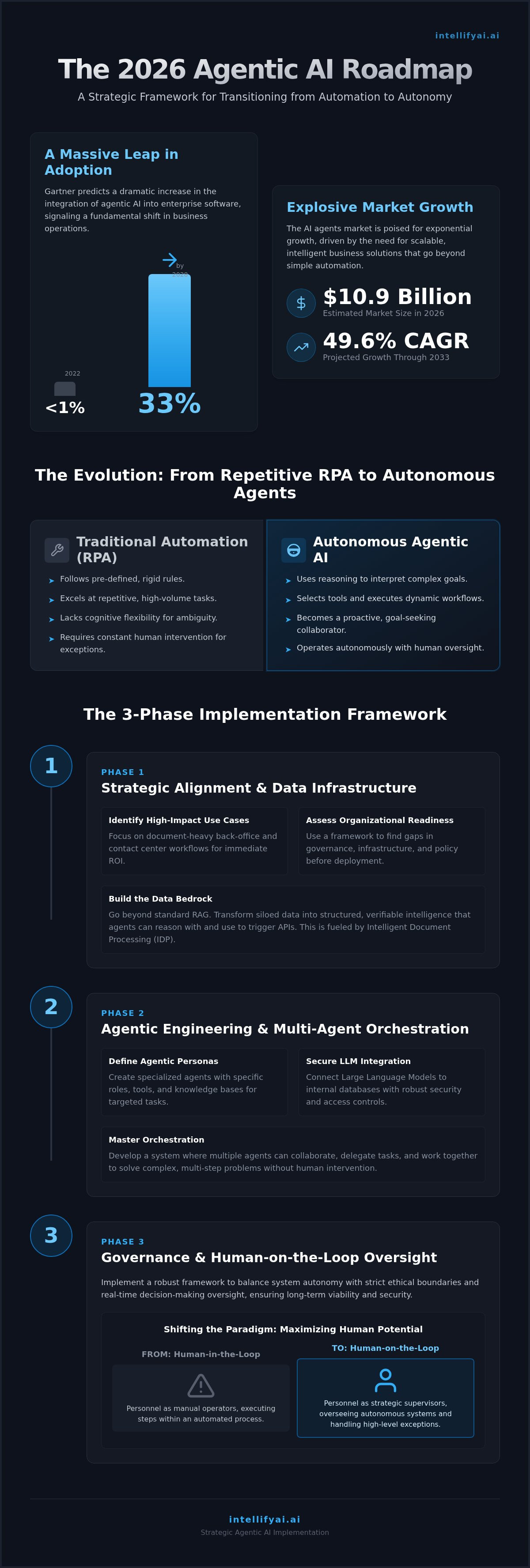
Gartner predicts that by 2028, 33% of enterprise software applications will include agentic AI, a massive leap from less than 1% just two years ago. This shift represents a fundamental change in how businesses operate. You likely recognize that the era of passive chatbots is ending, yet the path to true autonomy often feels blocked by concerns over AI hallucinations and the struggle to integrate agents with complex legacy data. It's a common challenge for serious enterprises looking to modernize without sacrificing operational control.
By following a structured agentic ai roadmap, you can master the transition from fragmented tools to a cohesive, autonomous workflow. This guide provides a strategic 2026 implementation framework designed for the professional architect. You'll gain a clear step-by-step deployment plan, an understanding of multi-agent orchestration, and a robust framework for balancing human oversight with system autonomy. We'll examine how to move from human-in-the-loop to human-on-the-loop operations while ensuring long-term viability, security, and measurable financial returns.
Key Takeaways
• Differentiate between traditional robotic process automation and autonomous agentic workflows capable of complex reasoning and goal-oriented execution.
• Identify high-impact deployment areas in back-office and contact center environments to ensure your agentic ai roadmap delivers immediate financial returns.
• Master the engineering requirements for multi-agent orchestration, from defining specific agentic personas to integrating large language models with secure internal databases.
• Transition to a "human-on-the-loop" model where personnel serve as strategic supervisors rather than manual operators, maximizing human potential across the enterprise.
• Implement a robust governance framework that balances system autonomy with strict ethical boundaries and real-time decision-making oversight.
What is an Agentic AI Roadmap and Why Does it Matter in 2026?
The year 2026 marks a definitive boundary in the history of digital transformation. We've moved beyond the novelty of generative chat into the era of the autonomous partner. To navigate this shift, a structured agentic ai roadmap is no longer optional; it's the fundamental requirement for any enterprise seeking to maintain market relevance. While traditional automation excels at repetitive, rule-based tasks, it lacks the cognitive flexibility to handle ambiguity. In contrast, What is Agentic AI refers to systems that possess the reasoning capabilities to interpret complex goals, select necessary tools, and execute workflows without constant manual intervention.
This distinction is critical for the bottom line. The global AI agents market is estimated to be USD 10.9 billion in 2026, with a projected CAGR of 49.6% through 2033. Gartner predicts that by 2028, 33% of enterprise software applications will include agentic AI. This rapid adoption is driven by the need to bridge the gap between isolated AI pilots and scalable business value. A roadmap provides that bridge. It transforms fragmented technical experiments into a unified strategy for enterprise autonomy.
The Evolution from Chatbots to Autonomous Agents
The transition from passive response systems to proactive goal-seekers defines the current technological frontier. Early AI implementations were reactive. They waited for a prompt and provided a single output. Modern cognitive architectures allow agents to break down high-level objectives into sequential steps. They become true collaborators. For leaders, understanding what is agentic ai is the first step in moving from simple automation to a sophisticated digital workforce that understands context and intent.
The Business Case for Agency: ROI and Efficiency
Enterprise leaders view agentic AI as a liberating force. By delegating cognitive labor to autonomous systems, businesses allow their human workforce to focus on high-value creative work and strategic decision-making. This shift is a core component of enterprise modernization, where the removal of repetitive tasks leads to significant gains in operational velocity. In 2026, agentic autonomy transforms operational overhead into a competitive engine by decoupling organizational growth from headcount.
Phase 1: Strategic Alignment and Data Infrastructure
Data engineering serves as the bedrock of this initial phase. Traditional vector databases and standard RAG (Retrieval-Augmented Generation) setups are often insufficient for agents that must execute complex actions. You need structured intelligence. This process involves transforming raw, siloed data into a format that agents can reason with, verify, and use to trigger external APIs. Aligning these technical efforts with a broader generative ai strategy ensures that your existing LLM investments are built to scale into more sophisticated agentic capabilities without requiring a total rebuild.
Intelligent Document Processing (IDP) as the Agentic Fuel
Agents are only as effective as the information they consume. Unstructured documents such as contracts, invoices, and complex emails often hide the very data points agents need to perform their tasks. Platforms like i_Nova provide the necessary extraction layer, converting static text into actionable intelligence for your digital workforce. Without robust IDP, agents operate on incomplete or inaccurate data. This leads to the very hallucinations that stall enterprise adoption. Reliability isn't just a goal; it's the prerequisite for any autonomous system to function within a professional environment.
Cloud-Native Modernization: The Scalability Requirement
Legacy on-premises systems frequently act as bottlenecks for autonomous agents. These agents require real-time access to diverse data sources and high-compute environments to perform multi-step reasoning. Transitioning to cloud-native architectures provides the elasticity and connectivity these systems demand to operate at scale. Engaging in ai strategy consulting during this phase ensures your infrastructure doesn't just store data, but actively facilitates orchestration. If you're looking to bridge the gap between legacy constraints and future autonomy, exploring strategic consulting services can help clarify your technical path forward.
Phase 2: Agentic AI Engineering and Multi-Agent Orchestration
Moving from strategy to execution requires a shift in technical focus. Your agentic ai roadmap must now prioritize the engineering of resilient, goal-oriented systems over simple prompt engineering. This phase involves building the cognitive infrastructure that allows agents to move beyond text generation and into active task execution. Unlike basic automation, agentic engineering focuses on creating systems that can self-correct and navigate non-linear workflows. You're not just building a script; you're architecting a digital workforce capable of independent reasoning.
Step 1: Designing the Agentic Persona.
Define specific roles, strict operational constraints, and the exact toolset the agent can access.
Step 2: Implementing LLM Orchestration.
Build the secure connective tissue between the model and your internal databases or third-party APIs.
Step 3: Developing Multi-Agent Systems (MAS).
Enable agents to collaborate through peer-review loops, where one agent executes and another validates the output.
Step 4: Integration with Communication Channels.
Deploy intelligence directly into voice agents and contact center interfaces for real-time interaction.
Step 5: Rigorous Testing.
Simulate edge cases and autonomous failure modes to ensure the system remains stable under pressure.
The Role of Agentic AI Engineering Services
Off-the-shelf retail software rarely meets the security and performance standards of a serious enterprise. Custom Agentic AI Engineering Services provide the control necessary to manage sensitive data and complex logic. These services allow you to build bespoke MLOps pipelines that monitor agent performance in real-time. This ensures your digital workforce remains accurate and compliant as your operations scale. By focusing on custom engineering, you avoid the limitations of generic tools and build a system tailored to your specific business architecture.
Voice Agents and Contact Center Transformation
The most visible impact of this engineering phase occurs in the customer experience. Modern voice agents are no longer limited to the rigid menus of traditional IVR systems. They can now understand intent and solve complex queries autonomously. By integrating agentic intelligence into the call centre, businesses provide frictionless service while liberating human agents for more nuanced interactions. This transformation turns a contact center into a high-velocity engine for customer satisfaction. It's about removing friction for the customer while maximizing the potential of your human staff.
Phase 3: Governance, MLOps, and Human-on-the-Loop
The final phase of a robust agentic ai roadmap focuses on control and long-term sustainability. As systems gain autonomy, the traditional "human-in-the-loop" model becomes a bottleneck. We transition to a "human-on-the-loop" architecture. In this model, your personnel act as strategic supervisors. They set the parameters, monitor the execution, and intervene only when the system identifies a high-risk anomaly. This shift requires a sophisticated approach to AI governance that manages ethics, bias, and autonomous decision-making boundaries. It's about moving from governing static outputs to governing dynamic behaviors, ensuring your workforce is prepared for this evolution through the expertise of Rozsak Management Consulting, Inc..
Operationalizing this level of autonomy requires enterprise-grade MLOps Pipelines. These pipelines aren't just for deployment. They provide the continuous optimization and performance monitoring necessary to prevent model drift. Security and compliance must be baked into the architecture from the start. Agents must adhere to SOC2 and GDPR standards. We apply the "principle of least privilege" to every agent. This ensures each digital worker has access only to the specific tools and data required for its assigned task, minimizing the attack surface and ensuring regulatory alignment.
Building Trust through Explainability and Audits
Trust is the currency of autonomous systems. To achieve it, you must build comprehensive audit trails for every action an agent takes. These logs provide a clear history of reasoning and tool usage. If an agent makes a decision, the system must explain why. Managed services play a vital role here. They maintain model performance and handle the complexities of FinOps, ensuring your AI investments remain cost-effective. MLOps ensures the long-term viability of agentic systems by creating a feedback loop that identifies failure modes before they impact the business.
Scaling the Roadmap: From Pilot to Enterprise-Wide Autonomy
Scaling requires a repeatable framework. Once a pilot succeeds in a document-heavy workflow or a contact center, you must standardize the onboarding process for new use cases. This involves a significant cultural shift. You aren't replacing workers. You're preparing the workforce for a collaborative relationship with AI. Measure your success through concrete metrics: growth, operational performance, and financial returns. If you're ready to move beyond experimental pilots, consult with our AI strategy team to define your path to enterprise-wide autonomy.
Executing Your Roadmap with IntellifyAi
Executing a vision for enterprise autonomy requires more than just software. It demands a partner who understands the intricate balance between high-level strategy and technical precision. IntellifyAi acts as your Strategic Architect. We bridge the gap between abstract technological potential and the practical requirements of a growing enterprise. Our end-to-end services cover every stage of your digital transformation, from the initial development of your agentic ai roadmap to the deployment of custom Agentic AI engineering solutions. We don't just provide tools; we architect the future of your workforce.
Reliability is the cornerstone of our methodology. We leverage our flagship i_Nova platform to ensure your agents operate on a foundation of intelligent, accurately extracted data. This eliminates the risk of hallucinations and ensures that your autonomous workflows remain dependable in high-stakes environments. We prioritize data integrity because we know that an agent is only as effective as the intelligence it consumes. By grounding our engineering in verified data engineering practices, we provide the stability serious enterprises require for long-term growth.
We don't believe in experimental ambiguity. Instead, we focus on delivering measurable impact through a Proof-of-Value (PoV) engagement. This low-friction entry point allows you to witness the tangible benefits of agentic workflows in a controlled, high-impact scenario. You can validate the performance and financial returns of the system before committing to enterprise-wide scaling. This results-oriented approach ensures that every step of your agentic ai roadmap is backed by evidence and aligned with your bottom line.
Consulting and Strategy for 2026
Every organization faces unique challenges and legacy constraints. Our tailored Strategic Consulting Services align agentic capabilities with your specific business goals. We ensure your transition to autonomy is both secure and profitable. This involves a deep dive into your current data infrastructure and a clear identification of the most valuable use cases for your specific industry. For ongoing insights into the evolving technological landscape and practical implementation tips, we invite you to explore the latest IntellifyAi Blogs.
Contact IntellifyAi Today
The shift toward autonomous enterprise partners is accelerating. Leaders who act now will define the competitive landscape of 2026 and beyond. IntellifyAi provides the deep technical expertise and strategic vision necessary to modernize your operations without disrupting your core stability. We maintain a global presence across the UK, USA, India, and UAE to support your international growth and modernization needs. Reach out to our team via our Contact Page to begin your transformation and unlock the full potential of your human capital.
Architecting the Future of Enterprise Autonomy
The transition to agentic AI is the defining shift of the 2026 business landscape. You've seen how a successful agentic ai roadmap begins with strategic data engineering and scales through sophisticated multi-agent orchestration. By moving toward a human-on-the-loop model, your organization can unlock human potential while maintaining strict behavior governance and security. This transformation isn't about replacing your workforce; it's about empowering your team to focus on high-value creative work by removing the burden of repetitive tasks.
IntellifyAi provides the deep technical expertise needed to bridge the gap between abstract innovation and operational stability. With a global presence across four major tech hubs, we offer end-to-end MLOps and engineering expertise tailored for the serious enterprise. Our proven i_Nova platform ensures your autonomous workflows are grounded in intelligent data extraction and reliable performance. Partner with IntellifyAi to engineer your autonomous future.
The path to enterprise autonomy is a journey toward liberation from complexity. Start building your legacy of innovation today.
Frequently Asked Questions
What is the primary difference between an AI agent and a standard chatbot?
An AI agent is designed for goal-oriented execution; a standard chatbot is designed for response generation. While chatbots predict the next best word in a conversation, agents use reasoning to break down complex objectives into sequential tasks. Agents possess the autonomy to use external tools, access databases, and trigger APIs to complete a workflow without constant human prompting.
How long does it typically take to implement an agentic AI roadmap?
Defining a timeline for your agentic ai roadmap depends on the complexity of your legacy systems and specific use cases. Most organizations achieve a functional Proof-of-Value within 4 to 8 weeks. A full enterprise-wide deployment typically spans 6 to 9 months as you integrate multi-agent orchestration and establish robust governance protocols.
Can agentic AI work with unstructured data like PDFs and emails?
Yes, processing unstructured data is a core strength of autonomous agents. By using intelligent document processing platforms like i_Nova, agents extract actionable intelligence from static PDFs, complex contracts, and emails. This allows the agent to transform raw information into structured data points that trigger specific business actions or updates in your CRM.
What are the biggest security risks when deploying autonomous agents?
The primary risks involve unauthorized tool access and data leakage through prompt injection. Protecting your enterprise requires a "least privilege" security model where each agent only accesses the specific data and APIs needed for its role. You must also implement strict behavior governance to ensure agents don't exceed their operational boundaries or access sensitive silos.
How do we ensure that AI agents do not "hallucinate" in a business environment?
Eliminating hallucinations requires grounding the agent in your own structured intelligence through Retrieval-Augmented Generation (RAG). Your agentic ai roadmap should include multi-agent validation loops where a supervisor agent audits the reasoning of the executor agent. This architecture ensures every action is verified against internal truths before the system proceeds with execution.
Do I need a custom LLM to build an agentic AI system?
No, you don't need to train a custom large language model from scratch. Most enterprises leverage existing frontier models through secure APIs and focus their engineering efforts on the agentic logic, tool integration, and data engineering. The value lies in the orchestration layer and how the model connects to your specific business environment.
What is the role of a human-on-the-loop in an autonomous system?
A human-on-the-loop acts as a strategic supervisor rather than a manual operator. They monitor the agent's performance, handle high-risk exceptions that fall outside the agent's confidence threshold, and refine operational parameters. This model allows the system to handle the volume of repetitive work while ensuring human expertise guides the most critical decisions.
How do I calculate the ROI of an agentic AI engineering project?
Calculate your return by measuring the reduction in manual processing hours and the increase in transaction velocity. Compare the cost of engineering and infrastructure against the financial gains from improved accuracy and the ability to scale operations without increasing headcount. Most enterprises see the highest returns in document-heavy back-office tasks and high-volume contact center interactions.









.svg)