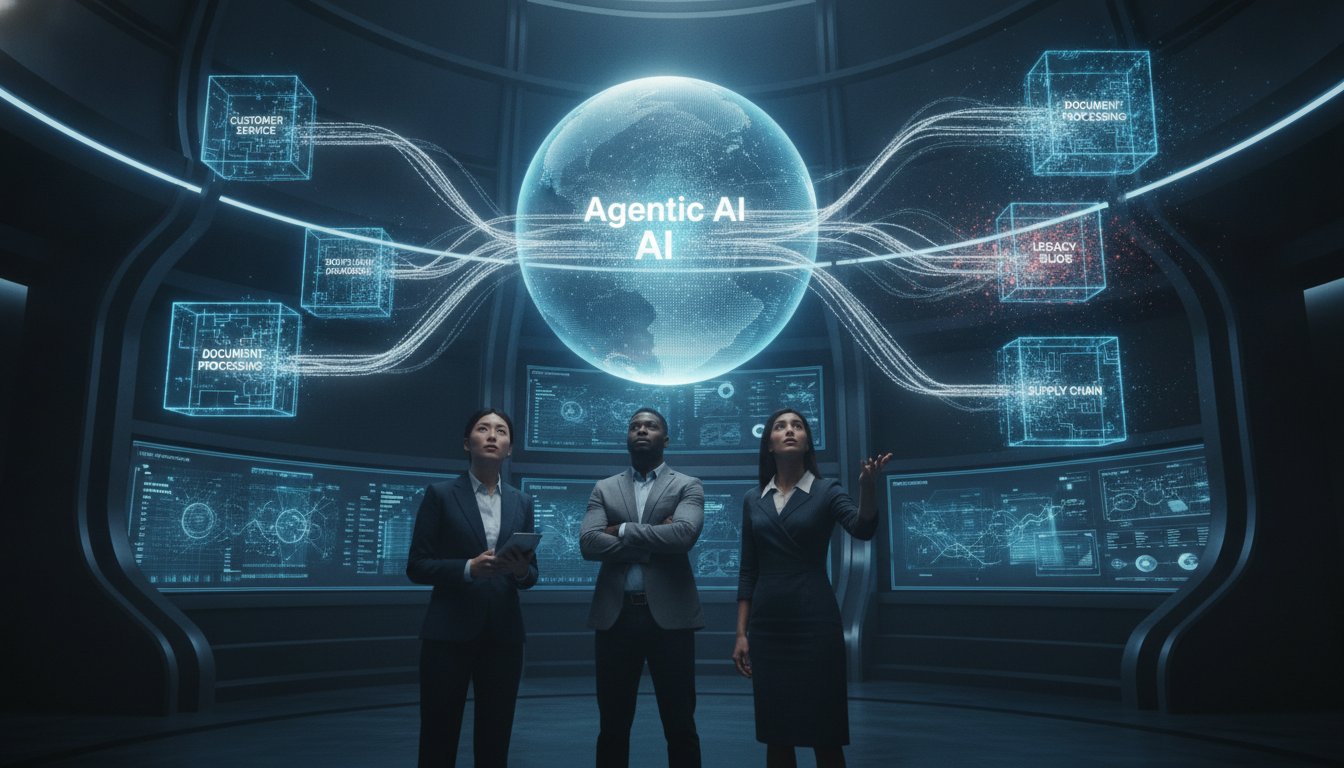
The global agentic AI market has reached a pivotal $9.87 billion valuation in 2026, signaling a permanent shift from AI as a consultant to AI as a digital worker. Most enterprise leaders agree that while generative tools are impressive, they haven't yet solved the deep-seated friction in legacy call centres or the mounting costs of manual document processing. You're likely dealing with siloed data that prevents your technology from taking meaningful action. It's a common hurdle in the transition from simple automation to true system autonomy.
This article provides a strategic deep dive into the most effective agentic ai use cases currently driving enterprise modernization. You'll learn how autonomous agents are moving beyond simple tasks to orchestrate complex, multi-step operations across your entire back office. We'll outline how to achieve reduced operational overhead and build scalable autonomous workflows that deliver a measurable ROI. It's time to stop managing fragmented systems and start architecting a frictionless future.
Key Takeaways
• Transition from rigid automation to dynamic reasoning by deploying systems capable of autonomous planning and complex tool use.
• Ground your autonomous workflows in proprietary enterprise data using RAG to ensure accuracy and eliminate hallucinations in decision-making.
• Explore high-impact agentic ai use cases like voice agents for contact centres and intelligent document processing for back-office transformation.
• Overcome data silos by leveraging cloud-native modernization as the essential connective tissue for scalable agentic intelligence.
• Follow a disciplined strategic roadmap that moves from Proof-of-Value to full architectural readiness to secure a clear ROI on your AI investments.
The Evolution of Autonomy: Defining Agentic AI Use Cases
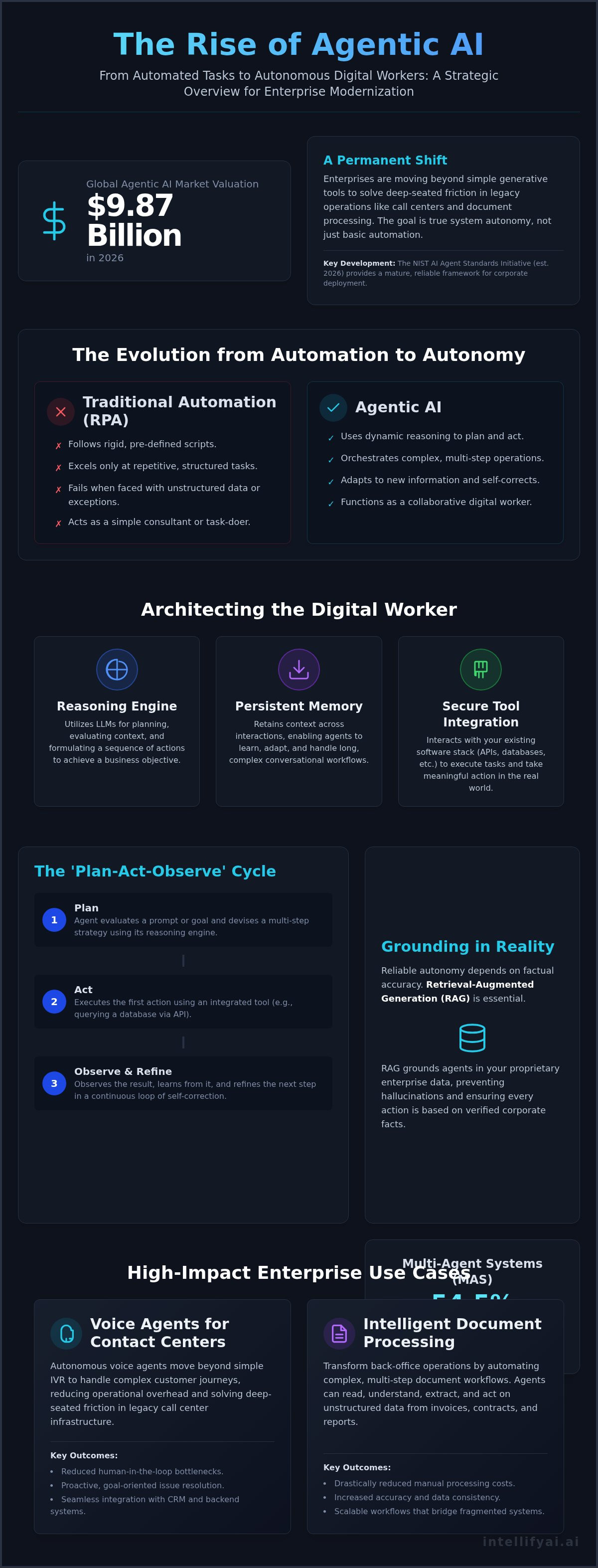
The enterprise landscape has moved beyond static automation. In 2026, the focus has shifted toward systems that don't just follow a script but understand a business objective. An Intelligent agent represents this fundamental transition, moving from the rigid logic of Robotic Process Automation (RPA) toward dynamic, goal-oriented decision-making. While RPA excels at repetitive keystrokes, it fails when faced with unstructured data or shifting variables. Agentic AI, by contrast, uses Large Language Model (LLM) reasoning loops to evaluate context, plan a sequence of actions, and execute them using integrated tools. With the NIST AI Agent Standards Initiative established in early 2026, the framework for deploying these systems has finally matured into a reliable corporate asset.
To better understand how these systems function in a real-world environment, watch this helpful video:
This technological leap redefines the relationship between software and staff. We are witnessing the rise of the collaborative digital worker. These agents possess three core components: a reasoning engine for planning, persistent memory systems to retain context across interactions, and secure tool integration to interact with your existing software stack. By synthesizing these elements, agentic ai use cases are transforming how businesses handle complexity without increasing headcount or operational friction.
From Chatbots to Autonomous Orchestrators
Simple conversational AI proved its value in basic customer queries, but it lacks the depth required for complex enterprise operations. Modern agents function as orchestrators. They don't just answer a question; they initiate a multi-step workflow. Through iterative reasoning loops, an agent can identify a missing piece of information, query a database, and self-correct if the initial output doesn't meet the defined business objective. This shift moves your operations from reactive support to proactive process management, allowing technology to act as a bridge between fragmented legacy systems.
The ROI of Agentic Autonomy in 2026
Measuring the success of these implementations requires a move toward outcome-based metrics. Efficiency is a baseline. The real value lies in the reduction of the human-in-the-loop bottleneck for high-volume tasks. By automating complex workflows in the back office, enterprises can redirect their human talent toward high-value creative work. These systems are a lasting investment in relevance. They don't just execute; they learn and adapt to business changes, ensuring long-term viability in a competitive market. For organizations ready to transition, our Agentic AI Engineering Services provide the technical foundation needed to build these autonomous workflows.
Architecting Autonomy: How Modern Agents Execute Complex Tasks
Building an autonomous system requires more than just a large language model. It demands a structured architectural framework that enables consistent execution. At the heart of most agentic ai use cases is the 'Plan-Act-Observe' cycle. This loop allows the agent to evaluate a prompt, execute an action using available tools, and observe the result to refine its next move. It is a continuous process of self-correction that mirrors human problem-solving. Reliability in these workflows depends heavily on Retrieval-Augmented Generation (RAG). By grounding agents in your specific enterprise data, RAG prevents the hallucinations that often plague general-purpose models, ensuring every action is based on verified corporate facts.
The complexity of modern business often requires multi-agent systems (MAS). In 2026, multi-agent architectures are projected to hold a 54.5% market share, according to Coherent Market Insights. These systems allow specialized agents to collaborate on cross-departmental problems. For example, a logistics agent can work alongside a financial agent to reconcile shipping delays with quarterly budget forecasts. Managing this complexity requires robust MLOps to maintain performance and enforce runtime governance. If you are looking to define your path, an AI Strategy & Consulting session can help identify the right architecture for your specific needs.
Reasoning and Planning Frameworks
Modern agents utilize advanced reasoning models like Chain-of-Thought (CoT) and Tree-of-Thoughts (ToT). CoT allows the agent to follow a linear logical path, while ToT enables it to explore multiple branching solutions simultaneously to find the most efficient route. Agentic planning is the autonomous decomposition of complex objectives. This capability allows the system to take a high-level goal, such as "optimize Q3 supply chain costs," and break it down into actionable sub-tasks like auditing vendor contracts and identifying shipping redundancies.
Tool Use and API Integration
To be effective, agents must interact with your existing technology stack, including CRM, ERP, and legacy database systems. This interaction happens through secure API integrations. The security layer is the most critical component of this architecture. It governs how agents access and modify sensitive data, ensuring they operate within predefined boundaries. IntellifyAi engineering services specialize in building these secure tool-access layers. We ensure your agents have the permissions they need to be productive without compromising your enterprise security protocols. This creates a frictionless environment where autonomous agents can execute tasks across your entire digital infrastructure.
High-Impact Agentic AI Use Cases for Enterprise Growth
Identifying high-value agentic ai use cases requires looking past basic administrative tasks. While simple automation handles scheduling, agentic orchestration manages end-to-end business outcomes. In 2026, the focus has shifted toward autonomous systems that bridge departmental gaps and solve complex logistical challenges. Enterprises are moving from doing things faster to doing things smarter by deploying agents that can reason through unstructured environments. This shift is essential for maintaining a competitive edge as the global market for autonomous process automation continues to expand.
Next-Gen Customer Experience: Voice Agents
The modern contact centre is no longer a site of friction. By deploying human-like voice agents, businesses can move beyond the limitations of legacy Interactive Voice Response (IVR) systems. These autonomous workers don't just route calls; they resolve them. They can process complex refunds, update account records in real-time, and handle multifaceted inquiries with the nuance of a human agent. This capability reduces call abandonment rates and allows human staff to focus on high-stakes customer relationships that require empathy and advanced negotiation.
Intelligent Document Processing (IDP) with i_Nova
Back-office transformation relies on the ability to extract actionable intelligence from unstructured data at scale. Our i_Nova platform serves as the foundation for this transition, particularly in document-heavy industries like insurance and finance. In automated claims processing, agents ingest diverse document types, verify policy details, and flag discrepancies for review. This isn't simple data extraction; it's a strategic bridge between raw documents and business insights. By removing the manual processing bottleneck, i_Nova allows for near-instantaneous auditing and financial reconciliation.
Financial Operations and Compliance
Reliability in financial workflows is paramount. Multi-agent systems now conduct autonomous reconciliation and real-time fraud detection by monitoring transaction patterns across global accounts. These agents provide a level of oversight that was previously impossible, generating detailed audit trails for every action taken. This ensures regulatory compliance, which is critical as the new prohibitions added by the Digital Omnibus package require compliance by December 2, 2026. For a deeper look at the governance frameworks supporting these systems, read our guide on What Is Agentic AI? to understand how to secure your autonomous enterprise.
Beyond these sectors, agentic intelligence is revolutionizing supply chain orchestration. Agents manage autonomous inventory levels by predicting demand shifts and automatically renegotiating vendor timelines. Similarly, in HR, personalized onboarding agents map new hire skills to long-term talent gaps, ensuring your workforce evolves alongside your technology. These implementations aren't just temporary fixes; they're central pillars of a modern, growth-oriented enterprise.
Breaking Silos: Integrating Agentic Workflows with Legacy Infrastructure
Digital fragmentation is the silent killer of enterprise AI initiatives. Most organizations possess the necessary data, but it remains locked in isolated silos that prevent autonomous systems from seeing the full picture. Agentic AI serves as the connective tissue in these environments. By integrating with legacy systems through modern API layers, agents can retrieve information from an on-premise ERP and use it to update a cloud-based CRM. This interoperability is what makes the most ambitious agentic ai use cases possible. Rather than a total system overhaul, the goal is to create a unified digital fabric where agents operate across boundaries.
Cloud-Native Modernization as a Foundation
Moving toward autonomy requires a shift from monolithic architectures to modular microservices. Agents perform best when they can consume discrete services via APIs rather than navigating a tangled web of legacy code. This modernization also introduces the need for FinOps. Because agents utilize high-frequency reasoning loops, businesses must optimize their cloud spend to ensure these workflows remain cost-effective. For a detailed roadmap on this transition, explore our strategy for Enterprise Modernization 2026.
Data Engineering for Agentic Reliability
Agents require a single source of truth to make accurate decisions. This is where data engineering becomes indispensable. Building robust pipelines ensures that the data being fed into the 'Plan-Act-Observe' cycle is clean, structured, and relevant. In dynamic business environments, real-time data streaming allows agents to react to market shifts or inventory changes as they happen. Data engineering is the fuel that powers the engine of agentic autonomy. Without it, even the most sophisticated reasoning model will fail due to poor inputs.
Strategic Implementation Without Disruption
Successful deployment doesn't require a 'rip-and-replace' strategy. Such approaches often lead to operational paralysis and high levels of organizational anxiety. Instead, we advocate for an incremental deployment model. Identify a single high-impact workflow, modernize the underlying data layer, and deploy a targeted agentic solution. This proves value quickly while building the foundation for broader scaling. If you're ready to begin this transition, our Agentic AI Engineering Services can help you architect a scalable, secure integration path.
Deploying Agentic Intelligence: A Strategic Roadmap for 2026
Implementing autonomous systems isn't a single event. It's a disciplined progression. To successfully operationalize agentic ai use cases, your organization must move through a structured deployment lifecycle. This ensures every implementation remains grounded in business reality and delivers a clear financial return. By following a layered approach, you can manage the complexity of digital transformation while maintaining the stability of your core operations. This roadmap serves as the blueprint for moving from abstract potential to measurable autonomous performance.
Phase 1: Opportunity Identification and Proof-of-Value (PoV).
Start by targeting high-friction workflows where manual bottlenecks are most severe. A PoV validates the reasoning capabilities of the agent within a controlled environment, proving the concept before committing to a full-scale rollout.
Phase 2: Architectural Design and Data Readiness.
Your data engineering must provide a single source of truth. This phase involves mapping the RAG infrastructure and ensuring your cloud-native environment is ready for secure agentic integration.
Phase 3: Custom Agent Engineering and Tool Integration.
This is the build phase. It involves developing specific reasoning loops and secure API connections required for the agent to interact with your existing ERP and CRM systems.
Phase 4: Scaling and Continuous Optimization via MLOps.
Once a single agent is stable, scale to multi-agent systems. MLOps ensures that as your business changes, your agents adapt through runtime governance and consistent performance monitoring.
Finding the Right Strategic Partner
Off-the-shelf solutions often fail to account for unique enterprise logic. Custom engineering is the only way to ensure your agents understand the nuances of your specific industry and internal processes. When evaluating partners, prioritize those with deep technical expertise in both AI strategy and cloud-native modernization. A partner should act as a bridge between abstract technology and your practical business needs. You can explore our AI Strategy & Consulting services to begin developing your customized roadmap today. We focus on building systems that aren't just innovative, but dependable and secure.
Collaborative Intelligence: The Future of Work
The final stage of digital transformation is cultural. Frame your agents as human-augmentation tools rather than replacements for your staff. This technology is a liberating force. It removes the burden of repetitive tasks and allows your workforce to focus on high-value creative work. Preparing your staff for a shift toward agent management and oversight is critical for long-term success. The competitive advantage in 2026 belongs to those who adopt autonomous workflows early. It isn't just about efficiency; it's about building a business that is inherently more resilient, scalable, and ready for a frictionless future.
Architecting Your Autonomous Enterprise
The transition from rigid automation to autonomous orchestrators is a present-day strategic requirement. By grounding agents in proprietary data and architecting scalable multi-agent systems, enterprises can finally unlock the full potential of their digital infrastructure. We've examined high-impact agentic ai use cases that prove how technology can bridge legacy gaps to create a frictionless operational environment. This evolution isn't about replacing human talent; it's about providing the tools necessary to unlock it.
Building this future requires more than off-the-shelf software. It demands a partner who understands the intersection of custom Agentic AI Engineering and enterprise-grade IDP with i_Nova. From global strategic consulting to full-scale implementation, we help you transform abstract complexity into a lasting competitive advantage. Partner with IntellifyAi to engineer your autonomous future.
Frequently Asked Questions
What is the primary difference between a chatbot and an AI agent?
Chatbots are conversational interfaces designed to provide information based on specific prompts. AI agents are autonomous executors that use reasoning loops to plan and perform multi-step tasks across various tools. A chatbot might explain a refund policy, but an agent logs into the ERP, verifies the transaction, and processes the payment without manual intervention.
How do agentic AI use cases improve ROI compared to traditional automation?
Agentic AI improves ROI by managing unstructured data and dynamic decision-making that traditional RPA cannot handle. While RPA reduces time on repetitive keystrokes, agentic ai use cases focus on outcome-based returns, such as lowering total operational overhead in complex back-office workflows. This allows enterprises to scale autonomous operations without a linear increase in human oversight costs.
Can AI agents work with legacy ERP and CRM systems?
AI agents can integrate with legacy systems through secure API layers and custom middleware. They act as the connective tissue between modern cloud-native applications and on-premise databases. By utilizing specialized engineering, agents can ingest data from an older ERP to inform actions in a modern CRM, effectively extending the utility and lifespan of your existing infrastructure.
What are the most common risks associated with autonomous AI agents?
The primary risks include reasoning hallucinations and a lack of runtime governance. Without proper grounding in enterprise data via RAG, agents may take incorrect actions based on false context. Security is also a concern, as agents require permissions to modify sensitive data. Implementing robust MLOps and clear guardrails is essential to ensure the system operates within defined operational boundaries.
How long does it typically take to deploy an enterprise-grade AI agent?
Deployment follows a phased approach that usually spans three to six months. A Proof-of-Value (PoV) can often be established within four to six weeks to validate the core reasoning loop. Full-scale integration with complex toolsets and legacy infrastructure requires more time for data engineering and security auditing to ensure long-term stability and measurable performance.
What industries are seeing the fastest adoption of agentic AI use cases?
Financial services, insurance, and logistics are seeing the most rapid adoption of agentic ai use cases in 2026. These sectors manage high volumes of unstructured data and complex regulatory requirements, making them ideal for autonomous document processing. Contact centres are also transforming quickly through the deployment of autonomous voice agents to handle multifaceted customer inquiries.
Does my business need a full cloud migration before using agentic AI?
A full cloud migration is not strictly required, but a cloud-native foundation improves scalability. Agents can operate in hybrid environments, pulling data from on-premise servers while utilizing cloud-based reasoning engines. However, modernizing monolithic architectures into microservices makes it significantly easier for agents to consume data and interact with various business tools efficiently and securely.
How do I ensure an AI agent remains compliant with industry regulations?
Ensuring compliance requires building real-time audit trails and strict runtime governance into the agentic architecture. Agents must be programmed to follow specific regulatory frameworks, such as the EU AI Act obligations. By maintaining a transparent log of every decision and action, enterprises can provide necessary documentation for audits while ensuring the AI remains within legal guardrails.









.svg)