
If your current document processing system still requires a human to fix every non-standard invoice or complex contract, you aren't actually automating; you're simply digitizing a bottleneck. Most enterprises have spent years building rigid templates that break the moment a vendor changes a layout or a regulatory body updates a form. It's a cycle of high operational costs and constant manual intervention that keeps your most talented people tethered to repetitive data entry. You deserve a system that thinks rather than one that just follows a fragile script.
This guide explores how agentic intelligent document processing shifts the paradigm from passive data extraction to autonomous reasoning. You'll discover how the i_Nova platform enables systems to transcend traditional automation, providing the reasoning and execution capabilities needed for complex document-driven business logic. We'll examine the shift from simple data capture to actionable intelligence, providing a strategic roadmap for enterprises ready to deploy autonomous workflows that finally eliminate the human-in-the-loop burden and unlock true operational scale.
Key Takeaways
• Learn how agentic intelligent document processing transcends passive extraction to provide autonomous reasoning and execution for complex business logic.
• Identify the structural limitations of legacy template-based systems and why context-aware models are essential for managing modern document variability.
• Shift from manual exception handling to autonomous loops where AI agents identify and resolve extraction errors without human intervention.
• Establish a resilient foundation for digital transformation by following a structured roadmap focused on cloud-native modernization and data engineering.
• Bridge the gap between abstract AI strategy and practical execution by utilizing the i_Nova platform as your primary vehicle for document-driven automation.
What is Agentic Intelligent Document Processing?
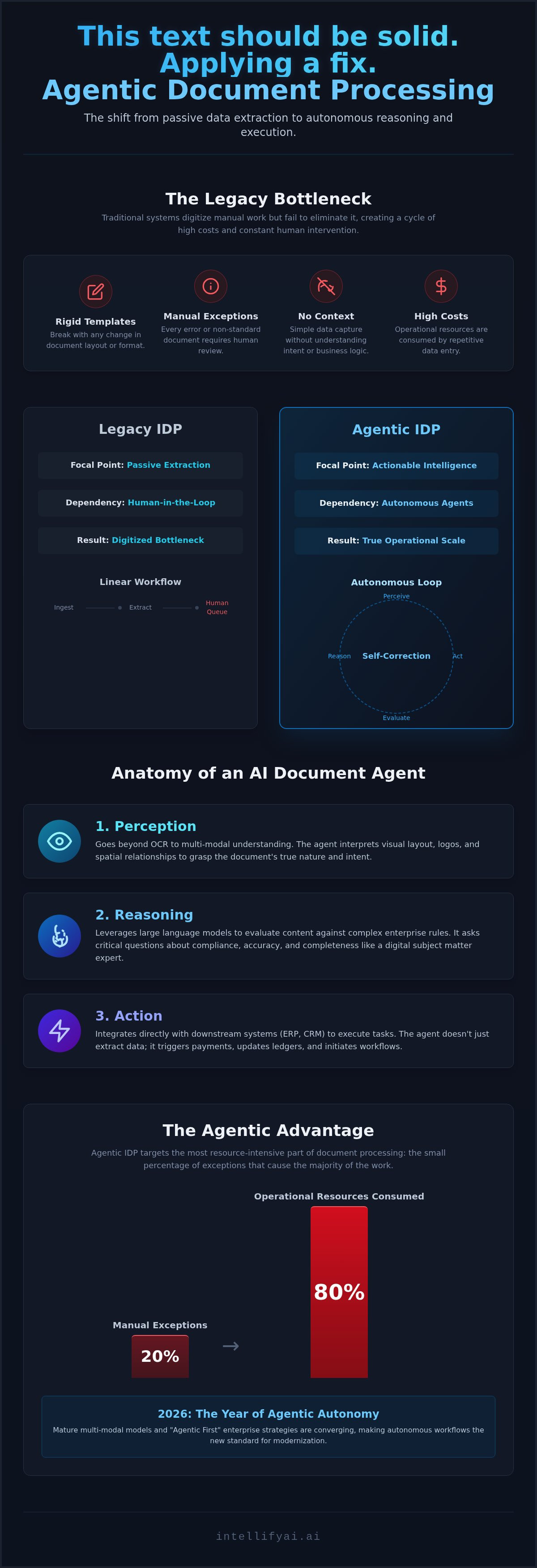
Traditional automation has reached a functional plateau. While legacy systems excel at extracting structured data from consistent forms, they fail the moment a document deviates from a pre-defined template. Agentic intelligent document processing represents a fundamental shift from these rigid, linear pipelines to autonomous, iterative loops. It isn't just about reading text; it's about interpreting intent and executing logic. By merging autonomous agents with advanced document intelligence, enterprises can finally move beyond simple data capture toward a system that perceives, reasons, and acts independently.
At the core of this evolution is the Reasoning Engine. Unlike standard OCR that identifies characters, a Reasoning Engine evaluates unstructured context against complex business rules. It functions as a digital subject matter expert that understands why a document exists and what needs to happen next. This transition replaces human-led validation with agent-led exception handling. When the system encounters a discrepancy, it doesn't simply flag an error for a person to fix. It investigates the cause, queries relevant databases, and resolves the issue using its own internal logic.
To better understand the shift toward visual and contextual understanding, watch this helpful video:
The Anatomy of an AI Document Agent
An effective AI document agent operates through three primary layers of intelligence. These layers allow it to handle the variability of modern business communication without constant retraining or manual oversight.
Perception
This goes beyond character recognition to multi-modal understanding. The agent interprets the visual layout, logos, and spatial relationships to grasp the document's true nature.
Reasoning
By leveraging large language models, the agent evaluates content against specific enterprise constraints. It asks critical questions about compliance, accuracy, and completeness.
Action
The agent doesn't leave data in a silo. It integrates directly with downstream ERP or CRM systems to execute tasks, such as updating a ledger or triggering a payment.
Why 2026 is the Year of Agentic Autonomy
The convergence of several technological and economic factors has made 2026 the definitive year for agentic adoption. Multi-modal models have matured to a point where they can process visual and textual data simultaneously with near-human precision. This technical readiness coincides with an enterprise shift toward "Agentic First" modernization strategies. Companies are no longer looking for incremental improvements; they want to eliminate the final 20% of manual document exceptions that often consume 80% of their operational resources. By choosing agentic AI engineering services, businesses can transform these high-cost bottlenecks into streamlined, autonomous workflows that scale without increasing headcount.
How Agentic IDP Transforms Enterprise Workflows
Traditional document workflows are linear. They move from ingestion to extraction and, inevitably, to a human queue for correction. Agentic intelligent document processing breaks this cycle by introducing autonomous loops. Instead of a one-way street, the workflow becomes a dynamic environment where agents evaluate their own output. This shift transforms the document from a static image into a catalyst for immediate business action.
Self-correction is the hallmark of this transformation. When an agent encounters ambiguous data, it doesn't pause for human intervention. It cross-references internal databases or applies historical context to resolve the uncertainty. This capability reduces the human-in-the-loop requirement for complex exceptions, which currently accounts for a significant portion of operational overhead in document-heavy industries. By automating these micro-decisions, enterprises can finally achieve the end-to-end automation that legacy IDP promised but failed to deliver.
From Extraction to Execution
The true value of an agent lies in its ability to execute downstream tasks. Consider a standard accounts payable workflow. In a traditional setup, the system extracts the invoice amount and waits. An agentic system goes further. It verifies the invoice against the original purchase order, checks the warehouse receipt for proof of delivery, and initiates the payment through the ERP system. It isn't just extracting data; it's managing the entire transaction.
In legal and compliance sectors, this autonomy is even more critical. Agents can perform cross-document synthesis, linking data across thousands of files to identify risks or flag non-compliance. They summarize complex litigation documents and highlight contradictory clauses across multiple contracts. This allows your legal team to focus on strategy rather than discovery. For organizations looking to build these specialized capabilities, our Agentic AI engineering services provide the technical foundation for custom agent development.
The Role of i_Nova in Actionable Intelligence
The i_Nova platform serves as the bridge between raw, unstructured data and strategic business action. While standard tools focus on storage, i_Nova prioritizes interpretation. It leverages sophisticated agentic frameworks to handle high-volume document sets that lack a uniform structure. This is where "intelligent" document processing becomes actionable.
By using the i_Nova platform, enterprises can process complex documents with a level of nuance previously reserved for human experts. It doesn't just record information; it understands the business implications of that information. This liberated human capital can then be redirected toward high-value creative work, ensuring your staff spends their time on growth rather than data reconciliation.
Legacy IDP vs. Agentic IDP: A Strategic Comparison
The gap between legacy automation and agentic intelligent document processing isn't merely a matter of speed; it's a difference in cognitive capability. Traditional IDP systems were designed for a static world where document layouts remained constant. They functioned as sophisticated scanners that mapped pixels to data fields. In contrast, agentic systems operate as digital colleagues capable of interpreting nuance and managing ambiguity. While legacy tools focus on the "what" of a document, agentic AI understands the "why," allowing it to navigate the complexities of modern enterprise data where 90% of information is unstructured.
The Ceiling of Traditional Automation
Legacy IDP relies heavily on brittle, template-based models. These systems frequently fail when a document layout shifts by even a few pixels or when a vendor updates a standard invoice format. This technical fragility creates a massive hidden cost: the manual verification queue. In many enterprises, up to 20% of documents still require human intervention because the automation isn't flexible enough to handle minor variations. This creates a permanent operational bottleneck that prevents true scaling. For a deeper look at how this shift impacts broader business operations, see our guide on what is agentic AI.
The human-in-the-loop requirement in legacy systems is a structural necessity, not a choice. Because traditional tools lack reasoning, they can't verify if a date makes sense in context or if a line item matches a specific contract clause. They simply flag the uncertainty and wait for a person to resolve it. This keeps your most expensive talent tethered to low-value data reconciliation tasks rather than strategic growth initiatives.
The Agentic Advantage
Agentic systems replace rigid templates with context-aware reasoning. These models don't just extract data; they evaluate it against established business rules. If an agent encounters a new document format, it uses its internal logic to locate the necessary information based on intent rather than coordinates. This dynamic adaptability means the system learns and adjusts in real-time, eliminating the need for constant re-training or template updates. It treats every document as a unique data set to be understood rather than a pattern to be matched.
Beyond extraction, agents serve as the connective tissue between your data and your systems. Through direct API execution, an agent can take the information it has processed and immediately trigger a workflow in your ERP or CRM. It acts as an autonomous bridge, ensuring that document intelligence leads directly to business results. While agentic extraction can take longer per page than traditional methods, the reduction in human overhead and the increase in accuracy provide a superior return on investment for complex, high-stakes document environments.
Implementing Agentic IDP: The Enterprise Roadmap
Implementing agentic intelligent document processing isn't a plug-and-play exercise. It's a strategic transformation that requires a rigorous, multi-phase roadmap to ensure long-term viability and measurable ROI. Enterprises must move beyond tactical fixes and adopt a holistic engineering approach that prioritizes system autonomy over simple digitization. This journey requires a deliberate balance between high-level vision and technical execution.
Phase 1: Strategic Discovery.
Identify document-heavy workflows where manual exceptions drive up operational costs and map these specifically to business outcomes.
Phase 2: Modernization.
Establish cloud-native infrastructure to provide the elastic compute power and low-latency environments required for autonomous reasoning.
Phase 3: Proof-of-Value.
Demonstrate agentic autonomy within a specific, high-value use case to validate the reasoning engine's ability to handle complex exceptions.
Phase 4: Scaling.
Deploy MLOps to manage a fleet of agents, ensuring they remain accurate as document formats and regulatory requirements evolve.
For organizations seeking expert guidance during these initial stages, our AI strategy and consulting services provide the necessary architectural oversight to ensure a frictionless transition from legacy systems to autonomous workflows.
The Critical Role of Data Engineering
Autonomous agents are only as effective as the data pipelines feeding them. Without robust data engineering, agents lack the high-fidelity context needed to make informed decisions. Structuring unstructured data for agentic consumption involves more than just cleaning text; it requires building pipelines that preserve the visual and semantic relationships within a document. This foundation allows agents to interpret intent rather than just identifying characters.
Effective data engineering ensures that agents have access to real-time, verified information. This allows them to perform complex tasks, such as cross-referencing an invoice against a legacy database, without human intervention. By investing in foundational data architecture, enterprises create a resilient environment where agentic systems can thrive and scale without increasing technical debt.
Governance and MLOps in Agentic Workflows
As agents take on more decision-making authority, governance becomes a central pillar of the enterprise strategy. Explainable AI is a core requirement for document-driven decisions, especially in regulated industries like finance or healthcare. Stakeholders must be able to audit the reasoning behind every autonomous action to ensure compliance, security, and ethical alignment. This transparency transforms advanced technology from a daunting complexity into a dependable business asset.
Scale requires the implementation of sophisticated MLOps. Version control, continuous performance monitoring, and automated retraining loops are essential to prevent model drift in dynamic document environments. These pipelines ensure that your autonomous agents remain a lasting investment in relevance. For a detailed technical breakdown of these systems, refer to our MLOps pipelines guide.
Ready to modernize your back office? Explore our Agentic AI Engineering Services to begin your transformation into an autonomous enterprise.
Future-Proofing with IntellifyAi: Your Agentic Partner
IntellifyAi serves as the definitive bridge between abstract technological potential and the rigorous demands of enterprise reality. We don't just provide tools; we build the cognitive infrastructure required for a truly autonomous back office. By combining the i_Nova platform with our deep expertise in Agentic AI Engineering Services, we provide a holistic solution that transcends simple software implementation. This is the Strategic Architect approach: we design for long-term viability, ensuring your systems remain resilient as the technological landscape evolves.
Our methodology treats agentic intelligent document processing as a central pillar of your business architecture. We focus on the collaborative relationship between advanced technology and your human workforce. By removing the burden of repetitive data reconciliation, we allow your staff to focus on high-value creative work. This shift doesn't just improve efficiency; it unlocks human potential and drives strategic growth.
Custom Engineering for Complex Environments
Off-the-shelf retail software often fails in the face of complex, messy enterprise data. These rigid applications lack the flexibility to integrate with bespoke legacy ecosystems or handle the nuance of specialized industry documents. IntellifyAi succeeds where generic solutions fall short by engineering agents specifically for your unique operational environment. Modernization isn't about replacing tools; it's about engineering autonomy into the heart of the enterprise.
We specialize in Cloud-Native and Enterprise Modernization, ensuring your agentic workflows are scalable and secure. Our team integrates autonomous agents directly into your existing ERP and CRM systems, creating a frictionless flow of information. This bespoke approach ensures that your automation isn't a siloed experiment, but a functional part of your core business logic that delivers immediate results.
Strategic AI Consulting for 2026 and Beyond
Navigating the Agentic Frontier requires more than just technical code; it requires a sophisticated roadmap anchored in financial returns. Our AI Strategy and Consulting team helps leaders identify high-impact opportunities for document autonomy. We focus on ROI, performance, and long-term stability. This ensures that your investment in AI isn't just a temporary fix but a lasting competitive advantage.
With a global presence in the UK, USA, UAE, and India, IntellifyAi provides the technical depth and strategic oversight needed for global scale. We help you move beyond the limitations of legacy IDP toward a future where documents think, reason, and act. The era of manual processing is coming to an end. Partner with IntellifyAi for your AI transformation and begin engineering the future of your enterprise today.
The Strategic Path to Document Autonomy
The transition from legacy automation to agentic intelligent document processing marks a definitive shift in how modern enterprises manage information. We've explored how autonomous agents replace rigid, template-based systems with context-aware reasoning engines that perceive and act independently. This evolution doesn't just digitize your data; it engineers autonomy into the heart of your business logic. By resolving the final 20% of manual document exceptions, you liberate your most valuable talent for high-impact strategic work.
IntellifyAi provides the architectural oversight and technical depth needed to navigate this frontier. With our flagship i_Nova platform and global delivery across the UK, USA, UAE, and India, we offer the custom MLOps and cloud-native expertise required for sustainable scale. Don't let the friction of manual processing limit your growth potential. It's time to build a back office that thinks. Scale your enterprise workflows with IntellifyAi's Agentic Engineering and embrace a future where technology serves as a true catalyst for human potential. We look forward to helping you secure your competitive advantage in this new era of autonomy.
Frequently Asked Questions
What makes document processing 'agentic' compared to traditional IDP?
The primary differentiator is the shift from passive extraction to autonomous reasoning. While traditional systems rely on rigid templates that break with layout changes, agentic intelligent document processing uses a reasoning engine to interpret intent. It doesn't just read the document; it understands the business context and executes the next logical step in the workflow. This transforms the system from a simple data capture tool into a digital colleague capable of independent execution.
Can agentic IDP systems handle handwritten or poorly scanned documents?
Yes, these systems excel where traditional OCR fails. By leveraging multi-modal large language models, agents process visual layout and textual content simultaneously. This allows them to decipher spatial relationships in handwritten notes or interpret context from low-resolution scans. Instead of failing on a blurry line, the agent uses the surrounding information to make an informed, logical deduction about the missing data, significantly reducing manual verification requirements.
How do AI agents ensure security and compliance with sensitive enterprise data?
Security is maintained through rigorous MLOps and explainable AI frameworks. Unlike black-box models, agentic systems provide a clear audit trail for every autonomous decision. This transparency ensures that document-driven actions comply with global regulatory standards like GDPR or HIPAA. By deploying these agents within secure, cloud-native environments, enterprises maintain full control over sensitive data while benefiting from the speed of autonomous processing and continuous performance monitoring.
What is the role of a human in an agentic intelligent document processing workflow?
Humans move into roles focused on strategic architecture and oversight. In an agentic intelligent document processing environment, the AI handles the repetitive, low-value exception loops that typically drain staff time. Human workers are liberated to focus on high-value creative work and complex decision-making. This collaborative relationship ensures that technology handles the volume while humans provide the ethical and strategic direction needed for long-term business growth.
Does implementing agentic IDP require a complete overhaul of our existing systems?
Implementation doesn't require a rip-and-replace approach. Agentic AI is engineered to function as a connective layer that integrates with your existing ERP, CRM, and legacy databases via direct APIs. This allows you to modernize your back office without the risk of operational downtime. It's about enhancing your current infrastructure with autonomous capabilities rather than starting from scratch, making it a sustainable investment in enterprise relevance.
How do I measure the ROI of switching to an agentic IDP platform?
ROI is measured through the reduction of operational overhead and the elimination of manual bottlenecks. Enterprises should track the decrease in human-in-the-loop costs for complex exceptions and the acceleration of end-to-end processing times. For example, some regional financial firms have seen invoice processing costs drop by up to 81%. By shifting from data extraction to actionable intelligence, the system delivers measurable financial returns through increased accuracy and scale.
What are the common challenges when deploying autonomous AI agents for documents?
The most common hurdles involve higher latency and the need for robust data engineering. Agentic extraction takes more time per page than traditional parsing because the system is actively reasoning through the content. Additionally, agents are only as effective as the data pipelines feeding them. Success requires a deliberate strategy to structure your data for agentic consumption, ensuring the system has the high-fidelity context needed to make accurate autonomous decisions.









.svg)