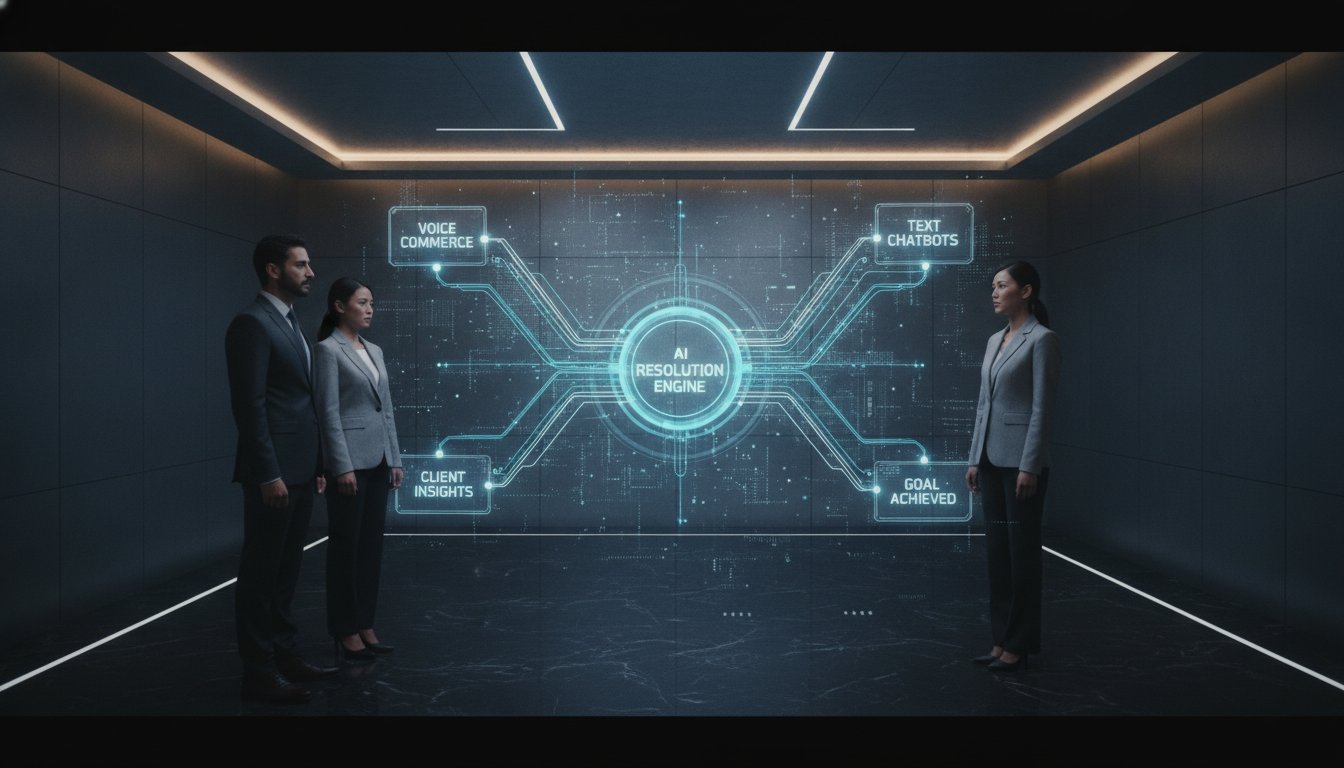
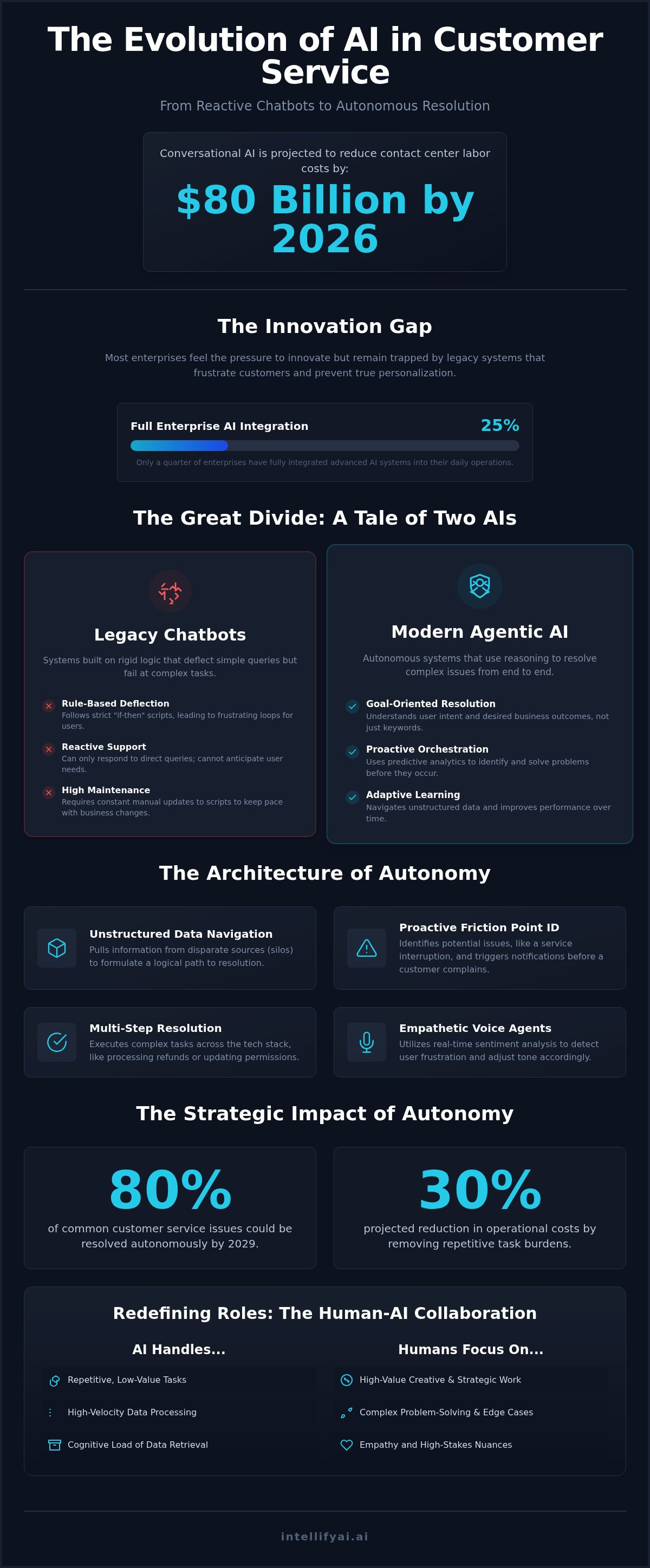
Conversational AI is projected to reduce contact center labor costs by $80 billion in 2026, yet only 25% of enterprises have fully integrated these systems into their daily operations. Most leaders feel the pressure to innovate but remain trapped by legacy chatbots that frustrate customers and data silos that prevent true personalization. You understand that a simple software patch won't solve what's fundamentally an architectural challenge. Successfully deploying AI for customer service automation requires a shift toward autonomous, agentic workflows that resolve issues rather than just deflecting them.
We'll show you how to transition from reactive support to a sophisticated framework that drives superior customer experiences and measurable ROI. This article outlines the path to 24/7 proactive resolution by integrating voice agents and text-based intelligence. You'll discover how to unlock actionable insights from unstructured support data using advanced engineering services and platforms like i_Nova. We're moving beyond the era of basic automation into a future where technology empowers your team to focus on high-value work while autonomous systems handle the repetitive burden.
Key Takeaways
• Transition from rule-based deflection to goal-oriented AI for customer service automation that resolves complex inquiries autonomously.
• Discover how agentic AI architectures use reasoning to navigate unstructured data, providing a more fluid and intelligent customer experience.
• Analyze the strategic ROI of removing repetitive task burdens, allowing your workforce to focus on high-value creative and strategic initiatives.
• Establish a robust data engineering foundation to ensure your AI deployment is scalable, secure, and integrated with legacy systems.
• Implement a collaborative framework where technology empowers human talent, creating a sustainable and future-proof customer service ecosystem.
Beyond Chatbots: The Evolution of AI for Customer Service Automation
In 2026, the definition of AI for customer service automation has moved far beyond simple query deflection. It is no longer a peripheral tool; it is a core architectural pillar for the modern enterprise. Legacy chatbots rely on rigid "if-then" logic that often traps users in circular, frustrating loops. These systems are limited by the scripts their creators write. Modern AI agents, however, operate with goal-oriented reasoning. They understand intent, context, and the desired business outcome. This shift represents the Evolution of AI for Customer Service Automation from a simple interface layer to a sophisticated operational engine.
Strategic leaders view this technology as a liberating force rather than a replacement for human staff. By removing the burden of repetitive, low-value tasks, you allow your human talent to focus on high-value creative work and complex problem-solving. This isn't just about technical efficiency. It's about enterprise modernization. Transitioning to an autonomous framework requires a "Strategic Architect" mindset. You aren't just buying software; you're building a system that treats automation as a central business pillar focused on long-term viability and measurable ROI.
From Reactive Support to Proactive Orchestration
Why Legacy Automation Fails the Modern Contact Centre
Rigid, scripted paths are the primary cause of modern customer frustration. When a user's needs fall outside a pre-written dialogue, legacy systems break. Maintaining these outdated structures is expensive and requires constant manual updates to keep pace with business changes. In contrast, autonomous agents navigate unstructured environments with ease. They handle routine transactions while maintaining a seamless handoff to human experts for complex edge cases. This "human-in-the-loop" model ensures that empathy is present where it matters most, while AI for customer service automation handles the heavy lifting of data processing and high-velocity task management.
The Architecture of Autonomy: How Agentic AI Transforms CX
Agentic AI represents a fundamental shift in how enterprises approach AI for customer service automation. Unlike standard conversational interfaces that simply recognize keywords, agentic systems possess the ability to reason through complex tasks. They operate within unstructured environments, pulling data from disparate sources to formulate a logical path toward resolution. This level of autonomy is critical for modern enterprises that require more than just a digital receptionist. It demands a move away from generic retail software toward Agentic AI Engineering Services that align with specific business logic and security protocols.
This architectural shift is grounded in the concept of AI-Human Collaboration in Customer Service. By 2029, agentic AI could autonomously resolve 80% of common customer service issues. This doesn't just reduce operational costs by a projected 30%. It creates a symbiotic environment where the AI handles the cognitive load of data retrieval while humans manage high-stakes emotional nuances. Success in this field requires a custom approach that integrates deeply with your existing infrastructure rather than sitting on top of it as a superficial layer.
The Role of Autonomous Voice Agents in 2026
Voice agents have evolved into high-fidelity, low-latency partners that mirror human empathy. These systems utilize real-time sentiment analysis to detect frustration or urgency, adjusting their tone and escalation path accordingly. For the modern contact centre, this means scaling operations without the need for a larger physical footprint. These agents handle thousands of simultaneous calls with consistent quality, ensuring that every customer interaction remains professional, productive, and resolved on the first attempt.
Orchestrating Intelligent Workflows with i_Nova
True autonomy requires the ability to digest messy data. Through Intelligent Document Processing, the i_Nova platform allows agents to handle support attachments and extract actionable intelligence from unstructured emails. Instead of a human agent manually verifying a PDF invoice or a warranty claim, the system automates this back-office verification within the support thread. This integration ensures that the resolution isn't just fast; it's accurate and fully documented within your existing systems. If your organization is ready to move beyond basic chatbots, consider exploring our AI Strategy & Consulting to define your unique roadmap for autonomy.
Measuring the Strategic Impact: ROI and CX Modernization
The strategic impact of AI for customer service automation isn't found in superficial dashboards. It's found in the fundamental restructuring of your enterprise cost-to-serve. While traditional metrics focus on deflection speed, sophisticated leaders prioritize the liberation of human capital. By removing the burden of repetitive tasks, you allow your workforce to focus on high-stakes problem solving and relationship management. This shift directly influences Customer Lifetime Value (CLV); a frictionless experience prevents churn and turns a standard support interaction into a loyalty-building event. Implementing our CX Improvement Framework ensures that these improvements are systemic rather than sporadic.
A visionary approach to automation views technology as a lasting investment in relevance. It isn't a temporary fix for high ticket volumes; it's a commitment to long-term viability. When you move beyond the surface level, you see that AI for customer service automation acts as a bridge between abstract technical capability and practical business needs. It ensures the stability and security of your operations while driving performance. This methodology frames advanced tools as a means for unlocking human potential, adding a layer of ethical consideration to your digital transformation journey.
Key Performance Indicators for Automated CX
In 2026, First Contact Resolution is no longer the ultimate gold standard. We now prioritize "Zero-Touch" resolution rates, which measure the percentage of inquiries resolved entirely by autonomous agents without any human intervention. Modern systems also track customer sentiment shifts through automated interactions, identifying how effectively an agentic workflow de-escalates a frustrated user in real-time. Automated Customer Experience (ACX) is the primary 2026 benchmark for assessing the health and efficiency of your support ecosystem.
Financial Returns: FinOps and Cloud Cost Optimization
Financial performance in the AI era is inextricably tied to technical efficiency. Enterprise Modernization is the key to reducing the technical debt that often plagues legacy systems. High-velocity automation requires a disciplined approach to FinOps, where you manage LLM token costs through efficient engineering to prevent budget bloat. Research indicates that companies see a return of $3.50 for every $1 invested in AI customer service. This ROI is best realized through Agentic AI Engineering Services rather than uncoordinated trial-and-error.
Building the Roadmap: Deploying Scalable AI Support Workflows
Transitioning to an autonomous support ecosystem is a deliberate architectural project. It requires more than just an API key; it demands a rigorous deployment roadmap that prioritizes stability, security, and brand safety. Successful enterprises avoid the "big bang" approach, opting instead for a Proof-of-Value (PoV) engagement. This phase validates specific use cases in a controlled environment before committing to a global rollout. By focusing on high-impact, low-complexity tasks first, you build the internal confidence necessary to scale. This structured methodology ensures that AI for customer service automation becomes a reliable business pillar rather than an experimental novelty.
You must treat the deployment of agentic workflows as a long-term investment in your company's relevance. The goal is to move beyond simple deflection and toward full resolution. This requires a partner who understands the bridge between abstract technical fields and the practical needs of a growing enterprise. We emphasize a collaborative relationship where technology removes the burden of repetitive tasks, allowing your human workers to unlock their full potential in high-value roles. This vision of a frictionless, automated future is only possible with a solid technical foundation.
Data Engineering and Cloud-Native Foundations
Your AI agents are only as intelligent as the data they can access. Most legacy enterprises are hindered by unstructured data silos that prevent true personalization. You must prioritize cleaning and structuring these legacy assets to ensure AI readiness. Leveraging Agentic AI Engineering Services allows you to build custom data pipelines that feed high-fidelity information into your agents. Utilizing platforms like i_Nova for Intelligent Document Processing ensures that your agents can digest complex support attachments instantly. A cloud-native architecture is also essential. It provides the low-latency response times required for voice agents to maintain natural, human-like conversational rhythms without technical friction.
AI Governance: SOC2 and GDPR Compliance
Security and brand safety are the most significant objections to enterprise AI adoption. Deploying autonomous systems requires robust guardrails to prevent hallucinations and ensure data privacy. You must implement reasoning checks that keep agents within their defined operational boundaries. Our AI Strategy & Consulting services help you navigate these complexities by establishing a framework for SOC2 and GDPR compliance. This includes securing voice and text logs and ensuring that every interaction is documented and auditable. By addressing risk mitigation at the start, you ensure the long-term viability of your modernization efforts.
If you are ready to secure your technical foundation and begin your deployment journey, contact our engineering team to discuss your strategic roadmap.
The IntellifyAi Methodology: Partnering for CX Transformation
IntellifyAi acts as the Strategic Architect for your digital transformation. We recognize that AI for customer service automation is not a plug-and-play utility but a fundamental business pillar that requires deep technical expertise and a focus on the bottom line. Our methodology moves beyond abstract technical implementation to deliver practical, results-oriented execution. We frame advanced technology as a liberating force. By automating repetitive tasks and document-heavy support threads through our i_Nova platform, we allow your organization to focus on high-value creative work. This collaborative relationship between human talent and autonomous systems is the cornerstone of our philosophy.
Long-term viability is our priority. We don't offer temporary fixes; we build lasting investments in enterprise relevance. Our Agentic AI Engineering Services ensure that your automation framework is dependable and secure. We position ourselves as a bridge between cutting-edge technological fields and the practical, day-to-day needs of a growing company. This approach ensures that your transition to an autonomous future is frictionless and measurable. We treat our core methodology as a holistic philosophy, ensuring that every deployment enhances the stability of your operations while driving superior performance.
Custom Engineering vs. Off-the-Shelf Retail Software
Generic retail software often fails to capture the unique nuances of a sophisticated brand voice. These off-the-shelf tools are built for the average user, not the complex needs of a serious enterprise. By choosing custom-engineered AI for customer service automation, you gain several strategic advantages:
Model Ownership
You retain control over your proprietary data pipelines and custom-trained models.
Architectural Alignment
Your AI agents are built to integrate seamlessly with your specific legacy systems and cloud-native infrastructure.
Scalable Growth
Workflows are designed to evolve alongside your business, preventing the technical debt associated with rigid, third-party software.
Starting Your Transformation: Strategic Realization
The journey toward an autonomous future begins with a clear, logical roadmap. We help you move from your current state of reactive support to a future of proactive orchestration. This process starts with a Proof-of-Value engagement that validates our methodology within your unique environment. We are a partner for serious enterprises looking to modernize without sacrificing security or stability. Our focus remains intensely on your financial returns and the long-term health of your customer ecosystem. Contact our strategists to begin your PoV and realize the full potential of agentic intelligence.
Architecting the Future of Enterprise Support
The transition to AI for customer service automation is no longer a choice between software vendors; it's a strategic commitment to architectural excellence. By moving from reactive deflection to autonomous resolution, you unlock the full potential of your workforce and drive measurable financial returns. This shift requires a foundation of clean data and agentic reasoning that bridges the gap between technical complexity and business growth. You aren't just implementing a tool. You're building a central business pillar.
IntellifyAi brings a global presence across the UK, USA, UAE, and India to support your modernization journey. Our expertise in Agentic AI and Intelligent Document Processing through the i_Nova platform ensures that your support ecosystem is both scalable and secure. We offer a composed, results-oriented approach to enterprise consulting that prioritizes long-term viability over temporary fixes. You have the opportunity to redefine your customer experience as a driver of performance and stability.
Partner with IntellifyAi to architect your autonomous CX future.
Your enterprise is ready for a frictionless, automated future. Let's begin the transformation.
Frequently Asked Questions
How does AI for customer service automation differ from a standard chatbot?
Standard chatbots rely on rigid, scripted logic that often leads to circular loops and user frustration. In contrast, AI for customer service automation utilizes agentic reasoning to understand intent and execute complex, multi-step resolutions. These agents don't just deflect tickets; they navigate unstructured data to solve problems autonomously. This shift represents a move from simple interface layers to sophisticated operational engines that handle end-to-end customer journeys without human intervention.
Can AI voice agents truly replace human empathy in sensitive calls?
AI voice agents are designed to complement human empathy rather than replace it entirely. They utilize real-time sentiment analysis to detect urgency or frustration, adjusting their tone to mirror professional composure. For high-stakes emotional situations, the system facilitates a seamless handoff to human experts. This collaborative model allows your team to focus on complex, sensitive cases while the AI manages high-velocity routine interactions with consistent quality and accuracy.
What are the main security risks when automating customer support with AI?
The primary security risks include data privacy breaches, unauthorized access to sensitive logs, and the potential for AI hallucinations. Enterprises must implement robust guardrails to ensure that agents operate within strict operational boundaries. We prioritize SOC2 and GDPR compliance to protect customer information throughout the automation lifecycle. A custom-engineered approach is essential to secure data pipelines and prevent the vulnerabilities often found in generic, off-the-shelf retail software.
How long does it typically take to deploy an Agentic AI support workflow?
A typical deployment begins with a Proof-of-Value engagement, which usually takes four to six weeks to validate specific use cases. Following a successful PoV, a full enterprise-scale rollout of agentic workflows generally spans three to six months depending on system complexity. This phased roadmap ensures that the technical foundation is stable and secure before global implementation. It allows for rigorous testing of reasoning paths and integration points to ensure long-term viability.
Will AI for customer service automation integrate with my existing CRM?
What is the expected ROI for an enterprise-level AI automation project in 2026?
Enterprises in 2026 typically see a return of $3.50 for every $1 invested in AI customer service. Strategic automation can lead to a 30% reduction in operational costs by autonomously resolving up to 80% of common support issues. These financial returns are driven by reduced cost-per-ticket and the liberation of human talent for higher-value creative work. Investing in custom engineering rather than uncoordinated trial-and-error maximizes these long-term gains and ensures architectural stability.
How do you prevent AI agents from providing incorrect or hallucinated information?
We prevent hallucinations by grounding AI agents in your proprietary data through Retrieval-Augmented Generation and strict reasoning guardrails. Agents are programmed to only provide information sourced from verified internal documents and databases. Our i_Nova platform further assists by extracting precise intelligence from unstructured attachments and emails. Constant monitoring and "human-in-the-loop" verification during the initial deployment phase ensure that the system maintains high accuracy and adheres to your specific brand voice.









.svg)