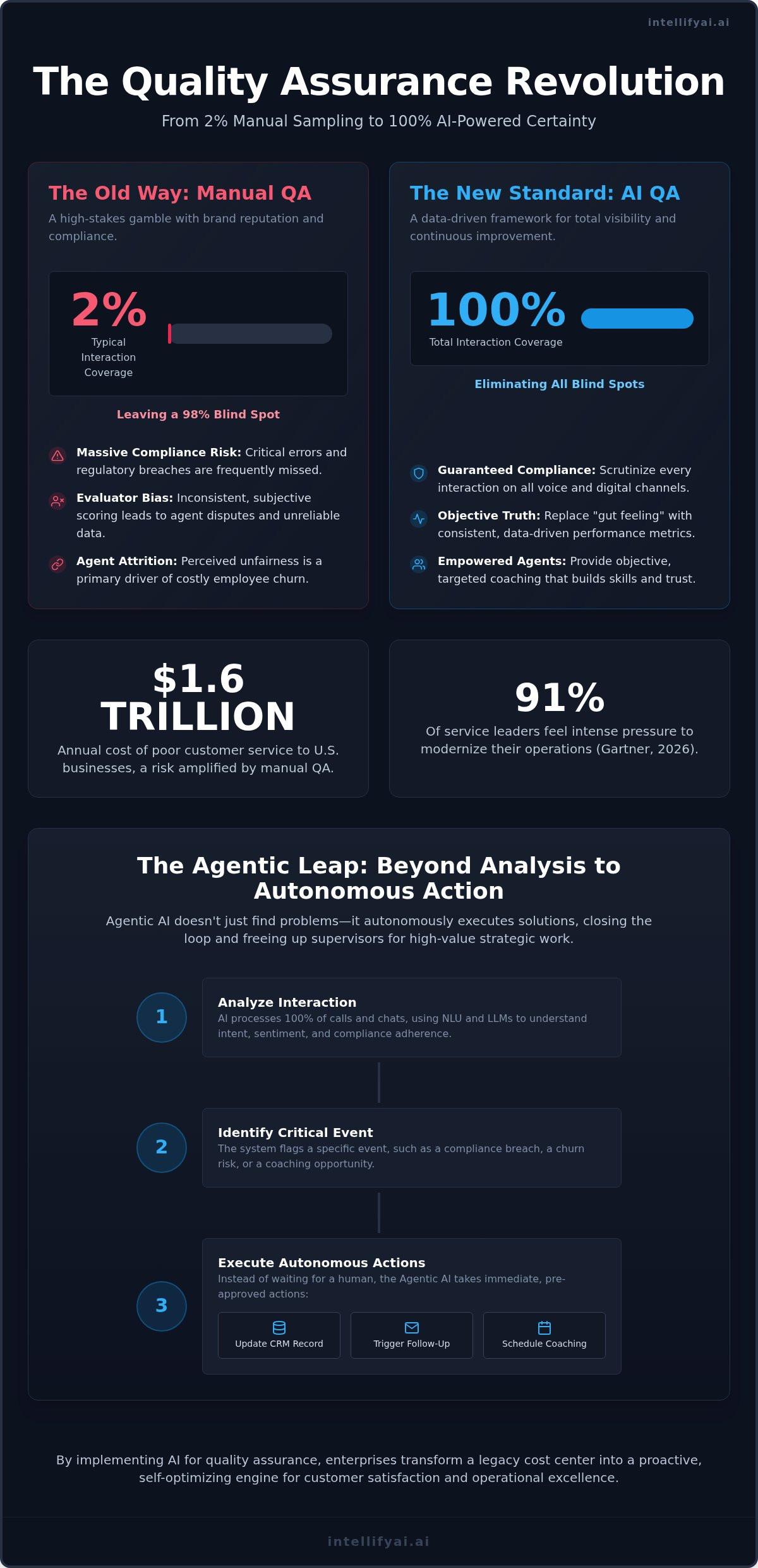
If your quality assurance team only reviews 2% of customer interactions, you aren't managing risk; you're essentially gambling with your brand's reputation. With poor customer service costing U.S. businesses an estimated $1.6 trillion annually, the traditional manual approach is no longer a viable strategy for serious enterprises. Implementing AI for call center quality assurance is no longer a futuristic luxury. It's the critical feedback loop required to power a self-optimizing, agentic enterprise that captures every insight across voice and digital channels.
You've likely experienced the friction of inconsistent scoring and the lack of real-time insights that lead to customer churn. It's a common pain point that leaves 91% of service leaders feeling intense pressure to modernize according to 2026 Gartner data. This guide provides a strategic roadmap to transition from manual sampling to 100% automated intelligence. You'll discover how to leverage Agentic AI to ensure total compliance, provide objective coaching for every agent, and drive measurable improvements in CSAT and NPS. We'll break down the shift from basic monitoring to a frictionless, data-driven CX framework that unlocks your team's full potential.
Key Takeaways
• Eliminate compliance blind spots by transitioning to 100% interaction coverage across all voice and digital channels, ensuring no critical customer data is overlooked.
• Discover how Agentic AI moves beyond static scoring to autonomously execute tasks, such as updating CRM records and triggering immediate follow-up workflows.
• Implement AI for call center quality assurance as a strategic tool to provide objective, data-driven coaching that empowers agents rather than just monitoring them.
• Master a phased implementation roadmap that prioritizes robust data engineering to unify fragmented legacy systems into a high-performance, cloud-native environment.
• Leverage a comprehensive CX Improvement Framework to transform raw interaction insights into measurable gains for CSAT, NPS, and overall operational efficiency.
The Shift to 100% Coverage: Why Manual Call Center QA is Obsolete
Manual sampling is a legacy relic that no longer serves the modern enterprise. In a typical high-volume environment, human evaluators review only 1% to 2% of calls. This "2% Problem" creates massive blind spots in regulatory compliance and customer experience. AI for call center quality assurance solves this by analyzing 100% of interactions. It's a system designed to scrutinize every word, silence, and sentiment across voice and digital channels, ensuring nothing slips through the cracks.
Beyond coverage, manual QA suffers from evaluator bias. Different supervisors often score the same call differently, leading to agent disputes and inconsistent data. AI provides a single source of truth. It removes the subjective "gut feeling" and replaces it with objective, data-driven performance metrics. This shift allows leadership to move from reactive monitoring, where you fix problems weeks after they occur, to proactive, real-time intelligence.
To better understand this concept, watch this helpful video:
From Keyword Spotting to Intent Recognition
Legacy speech analytics relied on simple keyword spotting. If a customer said "cancel," the system flagged it. Modern AI for call center quality assurance uses Natural Language Understanding (NLU) and Large Language Models (LLMs) to grasp intent and nuance. It recognizes when a customer is frustrated even if they don't use specific trigger words. This context-aware approach is essential for complex enterprise conversations where emotion and subtle cues dictate the outcome. LLMs now achieve high accuracy in sentiment analysis, allowing for a deeper understanding of the customer emotional journey.
The Cost of Inaction in a High-Volume Environment
Ignoring the shift to total coverage carries a heavy price. Missed compliance infractions can lead to significant fines, especially under updated 2026 regulations like the CCPA. Additionally, inconsistent QA is a primary driver of agent attrition. When agents feel unfairly judged by biased sampling, they leave. The cost of recruiting and retraining is far higher than the investment in sophisticated Agentic AI engineering services. Modern QA is the foundation for any enterprise modernization strategy, turning a cost center into a source of actionable data.
The Agentic Advantage: How Autonomous AI Redefines Quality Management
Agentic AI represents the next frontier in enterprise evolution. While traditional systems simply observe, agentic systems reason, plan, and execute. In the context of AI for call center quality assurance, this means moving beyond static scorecards. An autonomous system doesn't just flag a compliance error; it closes the loop. It can automatically update CRM records, trigger follow-up emails to customers, or schedule a coaching session for the agent based on the specific breach detected. This level of autonomy removes the administrative burden from supervisors, allowing them to focus on high-value human development.
There's a fundamental difference between "AI-powered" tools and "AI-driven" autonomous workflows. AI-powered tools require human intervention to act on insights. AI-driven workflows operate independently, managing the lifecycle of an interaction from the moment the call ends. This autonomy creates a powerful synergy with voice agents. By using AI for call center quality assurance as a foundation, enterprises can ensure their automated agents are always learning from the best human interactions. This creates a self-optimizing ecosystem where human excellence and machine efficiency reinforce one another.
Autonomous Scoring vs. Human Calibration
Trust in automation requires transparency. Agentic AI uses multi-step reasoning to justify every score it assigns, providing a clear audit trail for supervisors and agents alike. This "explainability" is crucial for enterprise-grade adoption, as it eliminates the "black box" perception of AI. Supervisors can drill down into why the AI flagged a specific sentiment or why it rated a resolution as incomplete. Agentic QA is a system that learns from human feedback to refine its own rubrics, ensuring the technology evolves alongside your business goals. This collaborative approach builds trust and ensures the AI remains aligned with corporate culture.
Integrating Intelligent Document Processing for Unstructured Data Intelligence
Quality management must extend beyond the phone line. By leveraging intelligent document processing, enterprises can apply the same level of scrutiny to emails, chat logs, and support tickets. This creates a unified intelligence layer across all customer touchpoints. Success depends on robust data engineering to clean and prep transcripts, ensuring the AI analyzes high-quality, actionable data rather than noise. This process transforms fragmented data into a strategic asset. If you're ready to move beyond basic monitoring, exploring a custom AI strategy can help define your path toward an autonomous future.
Overcoming the Transparency Gap: Balancing Automation and Human Oversight
Frontline workers often view the introduction of AI for call center quality assurance with skepticism. They fear a digital "big brother" that penalizes them for every minor deviation. This perspective ignores the strategic reality of modern enterprise modernization. We position AI as a liberating force that removes the burden of repetitive administrative tasks. By automating the mundane, agents focus on high-value creative work and complex problem-solving. This shift doesn't just improve the bottom line; it restores dignity to the agent role.
Technology doesn't replace human judgment. It enhances it. A "Human-in-the-Loop" (HITL) model ensures that subject matter experts remain essential for calibrating empathy and handling complex edge cases. AI acts as a sophisticated "Agent Assist" tool rather than a cold evaluator. It provides real-time coaching during live interactions, offering the support agents need precisely when they need it. This collaborative relationship between technology and human workers is the foundation of a resilient, modern contact center.
Building Trust with Data-Driven Coaching
Trust is built on objectivity. Traditional QA is often viewed as punitive because it relies on small, subjective samples that fail to represent an agent's true performance. Modern AI insights allow for personalized, fair development plans based on total interaction data. This shift to "supportive QA" reduces agent stress significantly. For example, automating After-Call Work (ACW) through AI-generated summaries can lead to a 25% to 30% increase in agent efficiency. Agents spend less time on manual data entry and more time engaging with customers in a meaningful way.
Ensuring Ethical AI and Governance
Scaling automation requires a robust foundation of AI enterprise governance. This framework is essential to prevent bias in QA models and ensure fairness across diverse agent populations. It also ensures strict adherence to evolving data privacy laws. As of January 1, 2026, updated CCPA regulations demand increased scrutiny of automated decision-making technology. Maintaining GDPR and SOC2 compliance during the processing of AI for call center quality assurance data isn't just a legal requirement. It's a core pillar of a dependable enterprise strategy. Transparency ensures that both customers and employees feel secure in a frictionless, automated future.
A Strategic Roadmap for Implementing AI QA at Scale
Scaling AI for call center quality assurance requires a methodical, five-phase approach to ensure long-term viability and security. Moving from a manual environment to an autonomous one is a structural transformation that demands precise execution. A phased roadmap allows leadership to manage change effectively while securing measurable returns at every milestone.
Phase 1: Audit and Strategy.
Begin by identifying high-impact use cases and current QA bottlenecks. This phase defines the strategic "why" and sets the benchmarks for success.
Phase 2: Data Engineering.
Connect fragmented data sources into a unified, cloud-native environment. This step is critical; without clean data, your AI will analyze noise rather than actionable insights.
Phase 3: Proof of Value (PoV).
Test the AI model against a subset of historical call data. This validates the accuracy of your sentiment analysis and compliance scoring before a full rollout.
Phase 4: Full-Scale Integration.
Roll out automated scoring across the entire contact centre. This is where you achieve the 100% interaction coverage discussed in previous sections.
Phase 5: Continuous Optimization.
Use MLOps to refine models based on changing customer behavior. The system must evolve to remain relevant as market conditions shift.
Selecting the Right AI QA Framework
Enterprises must choose between off-the-shelf SaaS and custom Agentic engineering. While SaaS offers speed, custom solutions provide the deep integration needed for complex enterprise workflows. Scalability and cloud-native architecture are non-negotiable during your AI strategy consulting phase. The Strategic Architect approach to vendor selection prioritizes long-term stability over temporary fixes, ensuring your platform is a lasting investment rather than a temporary patch. If you're ready to define your path, explore our consulting services to build a custom roadmap.
Measuring ROI Beyond CSAT
Traditional metrics like CSAT are important, but AI provides deeper financial insights. Quantify the reduction in Average Handle Time (AHT) achieved through real-time agent assist and automated post-call work. Calculate the value of improved compliance and reduced fine risks, especially given the $1.6 trillion annual cost businesses pay for lost customers. Finally, track the impact on First Call Resolution (FCR). As agents receive more objective, data-driven coaching, their ability to resolve complex issues on the first attempt improves significantly. This creates a frictionless experience that directly impacts your bottom line.
Partnering for CX Transformation: The IntellifyAi Approach
Enterprise leaders don't just need software; they need a strategic partner who understands the high stakes of digital transformation. IntellifyAi provides sophisticated Agentic AI engineering services designed to move your organization beyond basic automation. Our approach treats AI for call center quality assurance as a central pillar of business growth rather than just a technical implementation. We focus on creating a fully autonomous, intelligent workflow that removes the friction from customer interactions and internal processes alike.
Strategic Consulting for Long-Term Viability
We bridge the gap between abstract technological fields and practical business outcomes. Our strategy ensures that every implementation is anchored in financial returns and operational efficiency. Roadmap development is a critical component of our process. It ensures your investment is future-proof and adaptable to changing market conditions. We view our relationship with clients as a collaborative partnership. This is a shared journey toward excellence, not a simple vendor-client transaction. Our goal is to build a foundation that supports your growth for years to come.
Ready to Modernize Your Contact Centre?
The competitive advantage of achieving 100% coverage is undeniable. By transitioning to AI for call center quality assurance, you eliminate the risks associated with manual sampling and biased scoring. You gain the ability to analyze every interaction for compliance and sentiment, turning raw data into a strategic asset. This is the path to a frictionless, automated future where your business can focus on high-value creative work. The burden of repetitive tasks should no longer hold your team back from driving true CX excellence.
Don't let legacy systems limit your enterprise potential. The shift to an agentic enterprise is already happening. Secure your position at the cutting edge of the industry with a partner who remains focused on the stability and security of your operations. Contact our AI strategy consultants to start your transformation today.
Architecting the Future of Contact Centre Intelligence
The shift from manual sampling to total interaction coverage isn't just an operational upgrade; it's a strategic necessity for the modern enterprise. Implementing AI for call center quality assurance allows your organization to move from reactive monitoring to a self-optimizing ecosystem. We've explored how Agentic AI redefines quality management by reasoning through complex interactions and autonomously closing the loop on critical tasks. This transition empowers your team to focus on high-value creative work while ensuring 100% compliance and objective agent development.
As specialists in Agentic AI Engineering with a global presence across the UK, USA, and UAE, IntellifyAi is built to navigate this complexity with you. Our CX Improvement Framework is engineered specifically to drive measurable enterprise ROI and long-term viability. Don't let legacy bottlenecks hinder your modernization. Book a Strategic AI Consultation to begin architecting your frictionless, automated future. The path to CX excellence is clear; it's time to execute.
Frequently Asked Questions
How accurate is AI for call center quality assurance compared to human evaluators?
AI for call center quality assurance provides higher consistency than human evaluators by applying identical rubrics to every interaction without fatigue. Human scoring often varies significantly due to subjective bias or shifting interpretations of a script. Modern Large Language Models (LLMs) now achieve high accuracy benchmarks in sentiment analysis, ensuring that your performance data remains objective and reliable across thousands of daily calls.
Can AI QA understand different accents and dialects in a global call center?
Advanced Natural Language Understanding (NLU) models are specifically engineered to recognize diverse global accents and dialects. These systems use deep learning to understand intent and context rather than just matching phonemes. This capability is essential for global enterprises maintaining high standards across multiple regions. It ensures that no customer interaction is misinterpreted due to linguistic variation or regional nuance.
What is the difference between automated QA and conversation intelligence?
Automated QA focuses on scoring interactions against specific compliance and performance rubrics to ensure agent adherence. Conversation intelligence provides broader market trends and customer sentiment insights. Agentic AI bridges this gap by not only identifying issues but also executing tasks to resolve them. This creates a self-optimizing workflow where insights lead directly to autonomous actions within your CRM or back-office systems.
How does AI QA help with regulatory compliance in financial services?
Total interaction coverage eliminates the compliance gaps inherent in random manual sampling. In financial services, missing a single mandatory regulatory disclosure can lead to significant fines. AI monitors 100% of calls for script adherence and PII handling. This ensures strict compliance with updated 2026 regulations like the CCPA and provides a verifiable audit trail for every customer engagement.
Will AI replace my quality assurance managers?
Technology acts as a liberating force that allows managers to focus on high-value human development rather than repetitive scoring tasks. AI handles the administrative burden of data collection and initial grading. This shift enables QA leaders to become strategic coaches who use objective data to unlock agent potential. It transforms the role from a monitor to a mentor, improving overall team morale.
What data security measures are required for AI call processing?
Enterprise-grade AI for call center quality assurance requires robust data engineering to ensure PII redaction and end-to-end encryption. Systems must comply with SOC2, GDPR, and the latest 2026 CCPA mandates regarding automated decision-making. Strategic architects prioritize security by implementing cloud-native environments that isolate sensitive data while still providing the actionable intelligence needed for continuous performance improvement.
How long does it take to implement an AI QA system in an enterprise?
A full-scale enterprise rollout typically follows a phased roadmap over three to six months. This timeframe includes the initial strategy audit, data engineering for system integration, and a proof-of-value phase. Starting with high-impact use cases allows for immediate ROI while the system scales to handle 100% of interactions. This methodical approach ensures the stability and security of your operations during the transition.
Can AI QA work with both voice and digital channels like chat and email?








.svg)