
Gartner projects that conversational AI will reduce contact center labor costs by $80 billion in 2026 alone. Despite this massive potential, many enterprises remain tethered to rigid IVR menus that drive high abandonment rates and ballooning operational costs. You've likely experienced the friction of deploying basic bots that hallucinate during complex edge cases, failing to provide the stability your brand requires.
Modernizing your customer experience isn't about adding another layer of automation; it's about deploying a strategic architect for your CX. This guide explores how an agentic ai voice agent for call center transformation replaces legacy systems with reasoning-capable entities that execute end-to-end business workflows. You'll learn how to achieve 90% resolution without human handoff and reduce cost-per-call by 70%.
We will detail the transition toward autonomous back-office execution and provide a roadmap for maintaining compliance with the latest FCC and EU AI Act regulations. This is the blueprint for a frictionless, automated future that unlocks human potential for high-value creative work.
Key Takeaways
• Learn how to replace rigid legacy IVR menus with autonomous digital employees that utilize proactive reasoning to resolve complex customer inquiries.
• Discover the technical architecture required to deploy an ai voice agent for call center operations, including function calling for real-time CRM and ERP integration.
• Identify the critical performance metrics for 2026, focusing on sub-800ms latency benchmarks and high-precision reasoning accuracy.
• Master a phased implementation framework that prioritizes high-impact workflow mapping and the engineering of a sophisticated enterprise knowledge layer.
• Transition your CX strategy from off-the-shelf software implementations to custom-engineered agentic solutions that ensure long-term operational viability.
Transitioning from Legacy IVR to Agentic AI Voice Agents
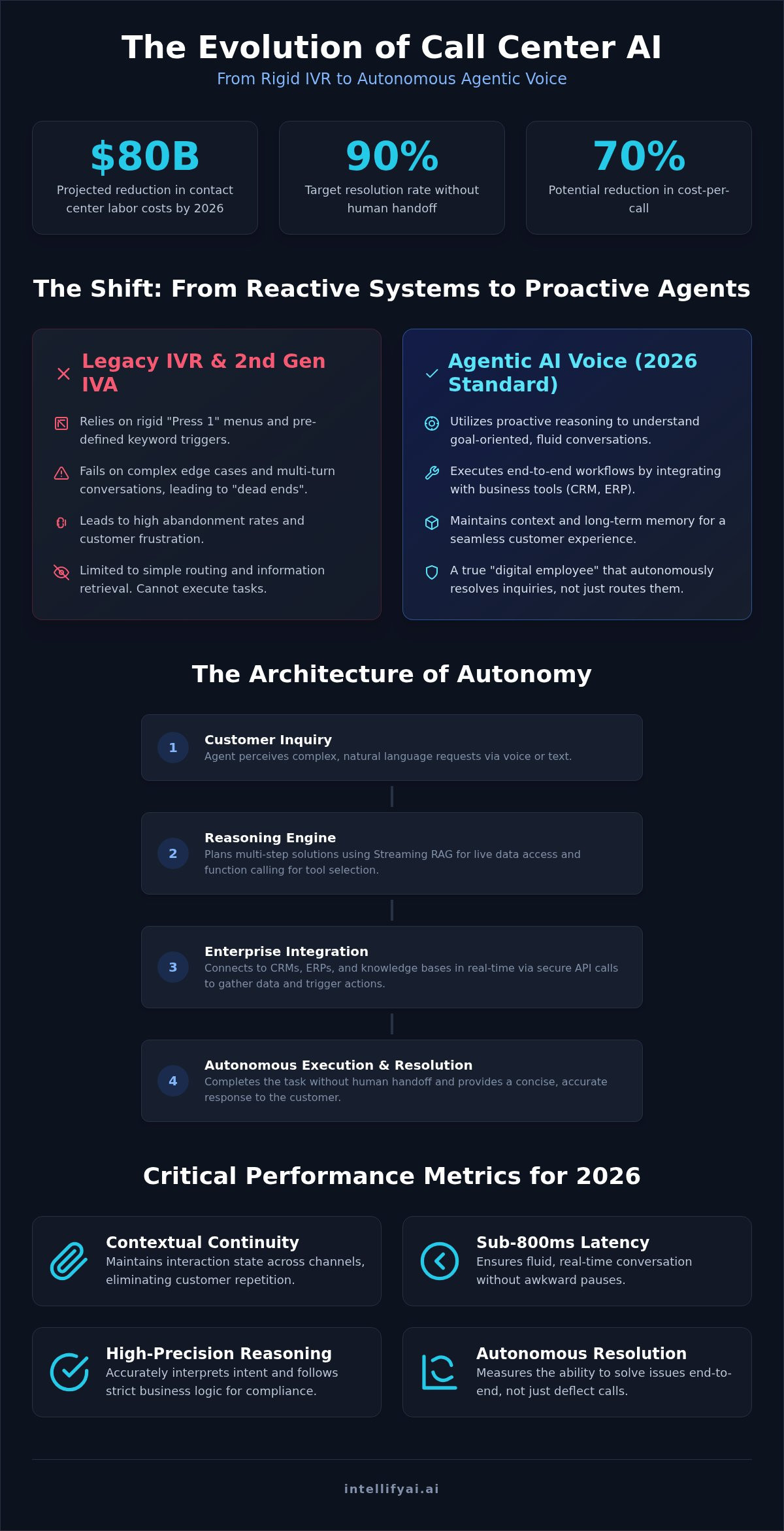
The era of the numeric keypad is over. Serious enterprises are rapidly moving away from static "press 1" menus toward fluid, goal-oriented digital employees. This shift represents a fundamental change in customer service architecture. An ai voice agent for call center operations no longer simply routes calls; it resolves them. By 2026, these agents utilize generative ai to perform autonomous decision-making, allowing them to handle the nuance of human conversation while maintaining strict business logic.
This transition isn't just about better technology. It's about the bottom line. Reducing cost-per-interaction while simultaneously boosting CX satisfaction scores is now a strategic imperative. Gartner projects that conversational AI will reduce contact center labor costs by $80 billion in 2026. This isn't achieved through better routing, but through autonomous resolution. Agentic systems move from reactive intent matching to proactive reasoning. Instead of waiting for a specific keyword, the agent analyzes the entire context of the conversation to determine the most efficient path to success. You can further optimize these processes by utilizing an AI-powered cloud contact center like Nexdial to automate your business communication. This results in a frictionless future where technology liberates human workers from repetitive tasks, allowing your team to focus on high-value creative work.
Limitations of 2nd Gen IVA Systems
Second-generation Intelligent Virtual Assistants (IVAs) were a step forward, but they remain limited by their reliance on rigid intent mapping. These systems fail when faced with multi-turn prompts or complex edge cases because they can only react to pre-defined triggers. When a customer deviates from the script, they hit a "dead end," leading to high abandonment rates and frustrated, high-value clients. For a serious enterprise, the maintenance costs of manual intent mapping are simply unscalable. You cannot code for every possible human variable. Attempting to do so creates a fragile system that breaks the moment a user asks a question in an unexpected way.
Defining the Agentic Voice Agent in 2026
An agentic voice agent is an autonomous system that reasons through enterprise data and utilizes business tools to solve customer goals without human intervention. Unlike their predecessors, these intelligent agents possess four critical characteristics: autonomy, tool-use, context-awareness, and long-term memory. They understand who the customer is, what they've done in the past, and which specific API calls are needed to resolve a request in real-time. By bridging the gap between front-office CX and back-office execution, an ai voice agent for call center environments becomes a true digital employee rather than a simple interface. They don't just provide information; they execute work across your CRM and ERP systems to deliver measurable results.
The Architecture of Autonomy: How AI Voice Agents Reason
The technical foundation of an ai voice agent for call center modernization has shifted. While early iterations focused on natural sounding speech, the 2026 standard prioritizes a reasoning engine. This layer acts as the agent's brain, allowing it to plan multi-step solutions in real-time rather than following a pre-written script. As the U.S. GAO explains AI agents, these systems are defined by their ability to perceive their environment and take actions to achieve specific goals. For an enterprise, this means the agent doesn't just listen. It analyzes the customer's problem, determines the necessary steps for resolution, and executes them autonomously.
Maintaining this level of intelligence requires Streaming Retrieval-Augmented Generation (RAG). This technology allows the agent to access live knowledge bases without the latency penalties that plagued earlier models. By retrieving data in parallel with speech processing, the agent provides accurate, context-aware answers in sub-800ms timeframes. Contextual continuity ensures that if a customer calls back or moves from a chat to a voice channel, the agent maintains the state of the interaction. This eliminates the need for the customer to repeat information, which remains a primary driver of high abandonment rates in legacy systems.
Integrating Unstructured Intelligence with i_Nova
Effective reasoning requires high-quality data. Our intelligent document processing capabilities via the i_Nova platform feed structured insights from unstructured sources directly to the voice agent. This unlocks knowledge trapped in policy manuals, complex contracts, and messy customer histories. Instead of a generic "I don't know," the agent can state, "I've reviewed your specific contract terms, and here is the solution." This level of precision transforms the agent from a basic interface into a deeply knowledgeable consultant. It's about moving beyond simple intent matching to true cognitive understanding.
Dynamic Tool Use and API Orchestration
Reasoning is useless without the power to act. Through dynamic tool use, or function calling, an ai voice agent for call center environments can autonomously trigger refunds, book appointments, or update records mid-conversation. This is achieved through secure, permissioned API orchestration with your existing CRM and ERP systems. The conversation moves from talking about a problem to executing the solution instantly. If you are looking to bridge the gap between abstract technology and bottom-line results, our Agentic AI Engineering Services can help architect these complex integrations.
Performance Metrics: Beyond Latency to Business Logic
For years, the industry fixated on latency as the sole indicator of quality. While achieving sub-800ms response times is essential for natural turn-taking in 2026, it's now considered a baseline commodity rather than a competitive advantage. Sophisticated enterprises have shifted their focus toward reasoning accuracy and first-call resolution (FCR). It's no longer enough for an ai voice agent for call center operations to sound human; it must think like an expert. The 2025 State of Voice AI Report highlights that business satisfaction is now tied directly to the agent's ability to navigate complex logic without human intervention.
Measuring an agentic system requires a new set of KPIs. FCR remains the ultimate metric for autonomy, but we must also track the "Tool-Use Success Rate." This measures how often the agent correctly identifies and executes the right API call to solve a customer's specific problem. Additionally, sentiment alignment ensures the agent's tone matches the customer's emotional state. A strategic architect doesn't just deliver data; they manage the customer's experience with empathy and precision. When these metrics align, the result is a 70% reduction in cost-per-call and a significant lift in retention scores.
The 2026 Performance Benchmark Table
To evaluate your current system against industry leaders, use these benchmarks as your guide. Logic is the primary differentiator in a market saturated with realistic but shallow voice bots.
| Metric | 2026 Enterprise Target | Business Impact |
|---|---|---|
| Standard Latency | < 800ms | Natural conversation flow; reduced user frustration. |
| Reasoning Accuracy | > 95% | Elimination of hallucinations in complex edge cases. |
| Autonomous FCR | > 90% | Massive reduction in human agent overhead. |
| Hallucination Rate | < 1% | Maintains brand trust and regulatory compliance. |
MLOps: The Engine of Continuous Improvement
Deploying an ai voice agent for call center workflows is not a one-time event. It's a commitment to long-term viability. This is why mlops pipelines are critical for modern enterprises. These pipelines manage automated feedback loops, allowing the system to learn from every human-in-the-loop escalation. By implementing version control for agent prompts and core reasoning logic, you ensure that your digital workforce evolves alongside your business. This systematic approach to improvement transforms advanced technology into a dependable, liberating force for your entire organization.
Strategic Implementation: Integrating Voice into Enterprise Workflows
Implementing an ai voice agent for call center operations requires a structured, multi-phase approach. It isn't a simple vendor selection process. It's a strategic architectural decision that demands a clear roadmap for success. Serious enterprises don't just deploy software. They re-engineer their entire workflow to leverage the power of autonomous reasoning. This systematic transition ensures that your digital workforce is an asset rather than a liability.
Phase one focuses on opportunity mapping. Identify workflows where high call volume intersects with high complexity. These are the areas where agentic AI provides the highest return on investment. Phase two involves deep data engineering. You must prepare your knowledge layer to support the RAG and tool-use capabilities discussed in previous sections. This ensures the agent has the correct context to act. Without this foundation, even the most advanced reasoning engine will fail to deliver results.
Phase three is the Pilot and Proof of Value (PoV). Prove the system's reasoning capabilities within a secure sandbox before a full rollout. This allows you to fine-tune the agent's logic and tool-use precision. Finally, phase four covers scaling and governance. This stage involves managing multi-agent orchestration and ensuring the system remains compliant with evolving global regulations. This phased approach mitigates risk while maximizing operational impact. It positions your company as a leader in the digital transformation landscape.
The Role of AI Strategy Consulting
Enterprise leaders often fall into the point-solution trap. They deploy a single bot for a single task, which creates a fragmented customer experience. Professional ai strategy consulting ensures your voice agents align with broader digital transformation goals. This strategic alignment builds a roadmap that accounts for future autonomous capabilities. It moves your organization toward a future where technology is a liberating force rather than a daunting complexity. To start building your roadmap, explore our AI Strategy & Consulting services.
Governance, Risk, and Compliance (GRC)
Governance, risk, and compliance are non-negotiable in 2026. You must ensure PCI-DSS and GDPR compliance in every automated voice interaction. Managing agentic risk is particularly critical. This involves creating oversight mechanisms for unauthorized or unexpected agent decisions. Every AI-driven call must have a transparent audit trail. This level of accountability ensures the stability and security of your operations. It protects both your brand reputation and your customers' sensitive data. This isn't just about following rules; it's about building long-term trust with your clientele.
Partnering for Transformation: The IntellifyAi Advantage
Selecting a partner for an ai voice agent for call center transformation is a high-stakes decision that defines your operational trajectory for the next decade. Off-the-shelf retail software often fails to meet the rigorous demands of the modern enterprise because it lacks the flexibility to handle unique business logic and complex integration requirements. IntellifyAi positions itself as a Strategic Architect, moving beyond simple software delivery to provide custom-engineered solutions. We bridge the gap between abstract technical fields and the practical needs of a growing company, ensuring your transition to agentic intelligence is both innovative and dependable.
The synergy between our i_Nova platform and our voice agents creates a truly intelligent enterprise loop. While competitors focus on surface-level voice realism, we focus on the data engineering required to make those voices smart. By extracting intelligence from unstructured documents and histories, we provide your agents with a superior knowledge layer. Our global presence in the UK, USA, UAE, and India allows us to offer deep technical expertise with a nuanced understanding of local market requirements. This global reach ensures that your deployment is supported by a partner who remains ahead of the curve while focusing on the stability and security of your operations.
Engineering Excellence in Agentic AI
Our engineering services are dedicated to building custom reasoning layers that reflect the specific complexities of your industry. We don't believe in one-size-fits-all automation. Instead, we focus on enterprise modernization to ensure your agents are cloud-native, scalable, and high-performing. This technical foundation supports a collaborative future where advanced technology acts as a liberating force, removing the burden of repetitive tasks and allowing your human workers to focus on high-value creative work. By treating our methodology as a holistic business pillar, we ensure your investment provides long-term viability rather than a temporary fix.
Next Steps: Your Roadmap to Autonomy
The journey toward a fully autonomous contact center begins with a structured Proof of Value (PoV) engagement. Our consulting team works directly with your leadership to identify high-impact workflows and prove reasoning capabilities within your specific infrastructure. To deepen your understanding of these autonomous systems, we invite you to explore our latest insights on what is agentic ai. This guide provides the strategic context necessary for serious enterprises looking to modernize. When you are ready to execute your transformation, contact an IntellifyAi expert to design your agentic voice strategy and secure your position at the cutting edge of the industry.
Securing Your Competitive Edge through Agentic Intelligence
The transition from legacy IVR to agentic autonomy is no longer a distant vision; it's a strategic necessity for the 2026 enterprise. By moving beyond simple latency metrics to focus on reasoning accuracy and first-call resolution, you transform your customer experience into a high-performance engine of growth. Deploying a sophisticated ai voice agent for call center operations ensures that your business logic is executed with precision, liberating your human workforce for high-value strategic work and creative problem-solving.
As a Strategic Architect in this space, IntellifyAi provides the specialized Agentic AI Engineering and proprietary i_Nova IDP Platform required to navigate this complex shift. We help you move beyond fragile off-the-shelf software toward resilient, custom-engineered solutions that prioritize long-term viability, security, and measurable financial returns. The future of customer interaction belongs to those who embrace autonomy as a central business pillar rather than a temporary software patch. This is your opportunity to modernize your operations and build lasting relevance in a rapidly evolving market.
Design your autonomous call center strategy with IntellifyAi and lead your industry into a frictionless, automated future. Your transformation starts today.
Frequently Asked Questions
What is the difference between a standard chatbot and an agentic voice agent?
How do AI voice agents handle complex customer emotions or frustration?
These systems use real-time sentiment analysis to detect vocal cues, pitch changes, and emotional intensity. When an agent identifies high levels of frustration, it can immediately adjust its tone or trigger a prioritized escalation to a human specialist. This ensures that complex emotional cases receive the appropriate level of empathy while maintaining operational efficiency across the contact center.
Is the latency low enough for the conversation to feel natural in 2026?
Sub-800ms latency is the industry-leading benchmark for natural turn-taking in 2026. Modern architectures achieve this by using streaming RAG and parallel processing layers. This technical precision eliminates the awkward pauses found in earlier systems, creating a frictionless conversation that mirrors human interaction and prevents the "walkie-talkie" effect common in legacy tools.
Can an AI voice agent actually process payments and update CRM records?
Yes, agentic systems use secure function calling to interact directly with your back-office systems. They can autonomously trigger refunds, update CRM records, or process payments through PCI-compliant gateways. This capability moves the interaction from a simple information exchange to complete task execution, significantly improving first-call resolution rates.
How do we ensure our data remains secure when using LLM-based voice agents?
Security is maintained through a combination of private LLM instances and robust PII masking protocols. Every ai voice agent for call center deployment we architect follows strict enterprise standards, including SOC2 and GDPR compliance. Data is encrypted at rest and in transit, ensuring your proprietary enterprise information never trains public models or leaves your secure environment.
What happens if the AI voice agent cannot solve a customer problem?
The agent initiates a seamless human handoff if it reaches the edge of its reasoning capabilities or encounters an unsupported edge case. The human specialist receives a complete transcript and a concise summary of the agent's actions so far. This collaborative approach ensures the customer never has to repeat information, protecting your brand reputation and CX satisfaction scores.
How long does it typically take to deploy an enterprise-grade voice agent?
A typical enterprise deployment follows a structured, phased timeline. A Proof of Value (PoV) can be established in four to six weeks, while full-scale integration into complex multi-turn workflows usually takes three to six months. This roadmap allows for the rigorous engineering of the knowledge layer and reasoning logic before a complete global rollout.
Do we need to replace our existing call center infrastructure to use AI agents?
You don't need to replace your current telephony stack to leverage agentic AI. Most modern agents integrate via cloud-native APIs or standard SIP trunking with your existing contact center infrastructure. This allows you to modernize your CX layer and improve performance without the disruption or cost of a full hardware overhaul.









.svg)