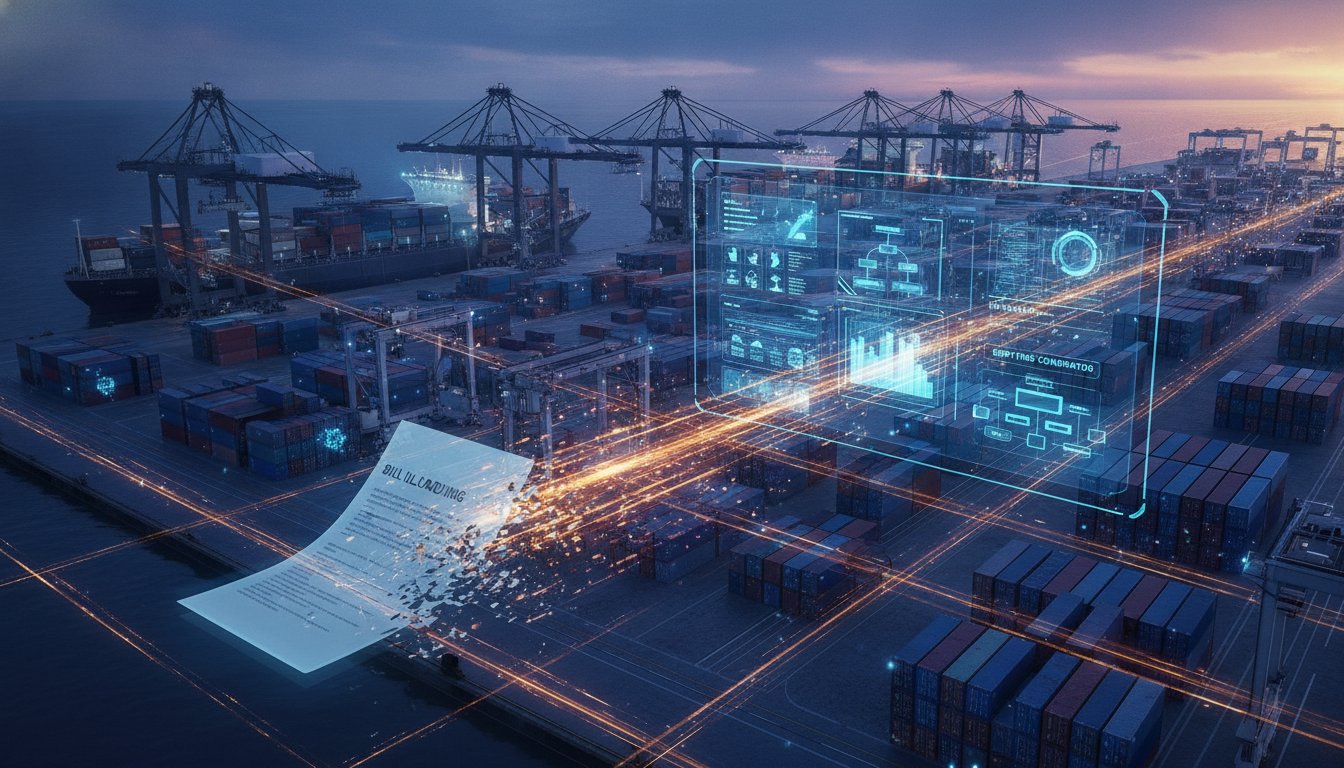
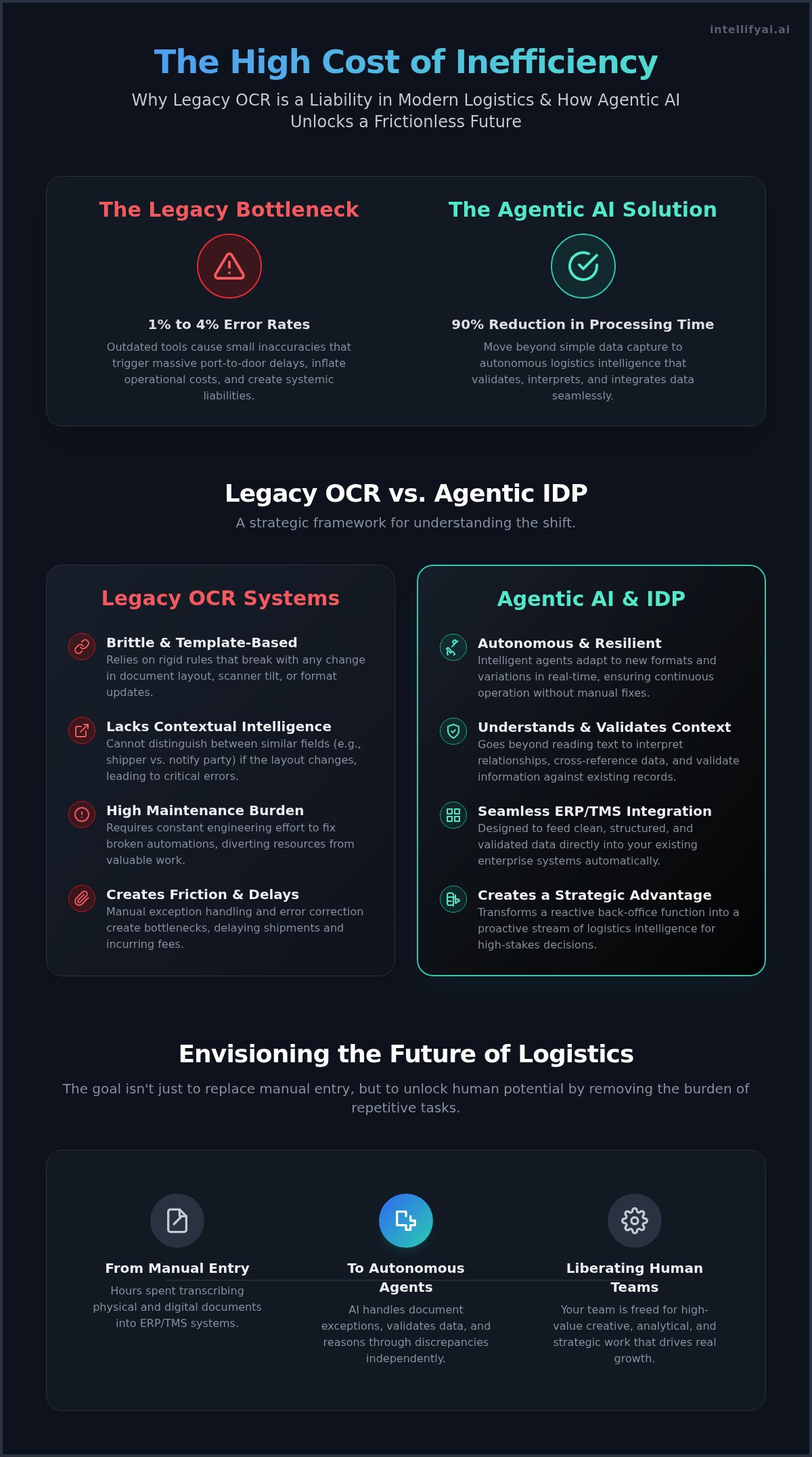
Legacy OCR systems aren't failing because they can't read text; they're failing because they lack the context to understand logistics. Many enterprises still struggle with 1 to 4 percent error rates when automating bill of lading data extraction using outdated tools. These small inaccuracies often trigger massive delays that disrupt port-to-door timelines and inflate operational overhead. If you've accepted these inefficiencies as an unavoidable cost of doing business, you're overlooking a significant strategic advantage.
You can achieve a 90 percent reduction in processing time by moving toward Agentic AI and next-generation IDP. This guide explores how the i_Nova platform transitions your back office from manual entry to autonomous logistics intelligence. You'll discover how to build a system that doesn't just capture data, but also handles exceptions autonomously and integrates into your ERP or TMS. We're moving beyond simple automation toward a future where technology unlocks human potential by removing the burden of repetitive tasks. It's time to replace legacy friction with a frictionless, automated future for your enterprise operations.
Key Takeaways
• Identify why manual document handling has become a significant liability and how to mitigate the systemic errors that delay port-to-door timelines.
• Discover the strategic advantage of automating bill of lading data extraction using Agentic AI that validates and interprets context rather than just scanning text.
• Transition from legacy OCR to the i_Nova IDP platform to achieve seamless integration with your existing ERP and TMS environments.
• Implement a phased modernization roadmap that includes strategic audits and cloud-native data engineering to ensure long-term system scalability.
• Envision a future where autonomous logistics agents handle document exceptions, liberating your team for high-value creative and strategic work.
The High Cost of Manual Bill of Lading Processing in 2026
The Bill of Lading (BoL) remains the critical legal backbone of global commerce. It serves as a document of title, a receipt for goods, and a contract of carriage. In the high-velocity supply chain environment of 2026, relying on manual data entry for these documents is no longer just an inefficiency. It's a systemic liability. When your team spends hours transcribing physical or digital sheets into your ERP, they aren't just wasting time. They're creating a bottleneck that ripples through your entire logistics network.
To better understand this concept, watch this helpful video:
The Friction Point: Unstructured Data in Global Trade
Global trade involves a chaotic variety of BoL layouts. Every carrier, port, and region uses different formats, making standardization nearly impossible. Extracting specific line items, hazardous material codes, and complex multi-party addresses requires more than just reading words. It requires understanding the relationship between data points. For instance, a notify party address in a non-standard position can confuse traditional systems, leading to missed delivery notifications. Inaccurate digitization of these elements doesn't just slow down operations; it risks significant compliance penalties if hazardous materials aren't tracked correctly across international borders.
Why Legacy OCR Is No Longer Sufficient
Traditional OCR tools have reached a technical ceiling. These template-based systems are notoriously brittle. They rely on rigid rules that break the moment a carrier updates their document layout or a scanner produces a slightly tilted image. This creates a high maintenance burden, as engineers must constantly fix the automation. Legacy systems lack the contextual intelligence to distinguish between a shipper's address and a notify party when the layout changes. We need a more resilient approach. Transitioning to automating bill of lading data extraction via intelligent platforms like i_Nova allows businesses to move from simple character recognition to true document interpretation. This shift ensures long-term viability and allows your workforce to focus on high-value strategic execution rather than fixing broken data streams.
Agentic AI: The New Frontier of Bill of Lading Automation
Agentic AI represents a fundamental shift from passive data capture to active operational reasoning. While traditional tools struggle with the variability of trade documents, our approach focuses on automating bill of lading data extraction through intelligent agents that validate and execute workflows independently. These agents don't just identify characters; they understand the document's role within the broader legal framework for electronic bills of lading. This transition from "reading" to "understanding" allows enterprises to treat document processing as a strategic data intelligence problem rather than a manual administrative burden.
By deploying autonomous agents, businesses move beyond the limitations of template-based systems. These agents reason through discrepancies, cross-reference container numbers with port schedules, and validate freight charges against pre-negotiated contracts. This level of autonomy is central to IntellifyAi’s products, which are designed to integrate seamlessly into complex enterprise environments. The result is a system that doesn't just extract data but prepares it for immediate, high-stakes decision-making.
i_Nova: Extracting Intelligence from Chaos
The i_Nova platform serves as a sophisticated engine for transforming unstructured chaos into actionable intelligence. It handles diverse formats including low-resolution scans, smartphone photos, and multi-page PDFs with high precision. While many competitors struggle with the granular detail of line-item extraction, i_Nova excels at identifying hazardous material codes, weight distributions, and multi-party notify addresses. This precision ensures that the data entering your ERP is not just digitized, but verified and ready for use. For organizations looking to modernize their back office, exploring our Agentic AI engineering services is the first step toward a frictionless future.
The Role of MLOps in Logistics Automation
Sustaining high accuracy in a global logistics environment requires more than a one-time software implementation. It demands a robust framework for continuous optimization. This is where MLOps pipelines become indispensable. These pipelines monitor model performance in real-time, identifying when a new carrier format or regional document variation causes a dip in confidence scores.
Agentic systems utilize human-in-the-loop (HITL) feedback to learn and adapt over time. When an exception occurs, a human expert provides the correction, and the system incorporates that logic into its future reasoning. This collaborative relationship between technology and human workers ensures long-term viability and prevents the "automation decay" common in legacy systems. By prioritizing automating bill of lading data extraction through an MLOps-driven approach, enterprises secure a lasting investment in operational relevance.
Legacy OCR vs. Agentic IDP: A Strategic Framework
Understanding the difference between character recognition and cognitive interpretation is essential for global logistics leaders. While legacy OCR focuses on "reading" pixels to identify letters, Agentic Intelligent Document Processing (IDP) prioritizes "interpreting" the intent and legal significance of the data. This distinction becomes critical when automating bill of lading data extraction across thousands of unique carrier formats. Legacy tools are fundamentally limited by their lack of context; they see text but don't understand the underlying business logic.
Scalability in global operations requires a system that handles document variability without constant human oversight. Traditional OCR often fails when it encounters a non-standard layout, requiring manual intervention that slows down the entire supply chain. In contrast, Agentic IDP uses autonomous reasoning to adapt to new formats. By investing in Agentic AI engineering services, enterprises build a resilient infrastructure that grows with their volume. This strategic shift ensures that your back office remains a driver of efficiency rather than a bottleneck during peak shipping seasons.
Accuracy and Contextual Awareness
True intelligence in logistics requires understanding complex relationships. Agentic systems recognize the nuanced roles of the Shipper, Consignee, and Carrier, even when they're positioned unconventionally on a page. This contextual awareness allows the AI to perform cross-document validation, such as flagging inconsistencies between a Bill of Lading and a Purchase Order (PO). If the weight or quantity on the BoL doesn't match the PO, the system identifies the discrepancy immediately. This proactive approach significantly reduces human intervention for non-standard documents, allowing your team to focus on resolving high-level strategic issues rather than hunting for data entry errors.
Integration and Downstream Execution
The final differentiator is what happens after the data is extracted. Legacy tools typically stop at generating a CSV file, which then requires another manual step to upload into a Transport Management System (TMS). Agentic IDP bridges this gap by triggering downstream actions autonomously. These agents can update TMS records, initiate customs filings, or send real-time alerts to port operators the moment a document is processed. This seamless flow is the hallmark of enterprise modernization from cloud-native to agentic intelligence. By automating bill of lading data extraction within a fully integrated ecosystem, you're not just digitizing paper; you're building a responsive, autonomous logistics intelligence engine that delivers measurable financial returns.
Implementing an Autonomous BoL Extraction Workflow
Moving from legacy OCR to a fully autonomous workflow requires a disciplined implementation framework. You aren't just installing software; you're re-engineering your logistics intelligence. This process begins with a Strategic Audit to map your existing document flow and identify where friction occurs. By pinpointing exactly where manual entry slows your port-to-door timeline, you create a baseline for measurable improvement. Successfully automating bill of lading data extraction requires this foundational understanding of your current operational bottlenecks.
The implementation follows a logical, high-velocity progression:
Data Engineering
We prepare your cloud-native infrastructure for AI ingestion. This ensures high-quality data pipelines can handle unstructured formats at scale.
Agent Configuration
This stage involves training i_Nova on your specific business rules, carrier nuances, and hazardous material codes.
Integration
We connect the IDP platform directly to your ERP, TMS, and WMS. Data flows from the document into your core systems without human intervention.
Scaling
Once the BoL workflow is optimized, you can move toward a holistic automated back office that handles commercial invoices and packing lists with equal precision.
The Importance of AI Strategy and Consulting
Success in 2026 isn't accidental. It requires a strategic AI roadmap to align your technological investments with long-term business goals. Utilizing AI strategy consulting helps you identify high-value use cases that offer the fastest ROI. This approach ensures your cloud-native modernization supports the high-velocity requirements of agentic workflows. Without a clear strategy, businesses risk implementing "brittle" solutions that fail to adapt to the evolving global trade environment.
Securing the Workflow: Governance and Compliance
Securing these workflows is paramount for any global enterprise. Trade documents contain sensitive commercial data that must be protected under frameworks like SOC2 and GDPR. We ensure data integrity through rigorous version control in AI models and secure, cloud-native data handling protocols. Automating bill of lading data extraction within our framework means your data remains audit-ready and compliant across all jurisdictions.
Our methodology focuses on an ethical implementation that empowers your workforce. We frame advanced tools as a means for unlocking human potential rather than a replacement for labor. By removing the burden of repetitive tasks, technology allows your team to focus on high-stakes creative problem-solving and strategic relationship management. This collaborative relationship between technology and human workers is a central pillar of long-term operational viability. Ready to modernize your operations? Explore our Agentic AI engineering services to start your transformation today.
The Future of Logistics: Beyond the Bill of Lading
Logistics leaders must recognize that the bill of lading is one piece of a much larger data puzzle. The true competitive advantage in the coming years lies in the ability to synchronize disparate data streams into a single, cohesive operational narrative. By automating bill of lading data extraction, you build the foundation for a system that eventually manages every document in the supply chain without friction. This is where IntellifyAi steps in as your Strategic Architect. We engineer the bridge between advanced technical fields and the practical, results-oriented needs of your enterprise, ensuring your modernization efforts deliver measurable financial returns.
Holistic Intelligent Document Management
The principles of the i_Nova platform apply far beyond a single document type. The same agentic framework that interprets a BoL can process commercial invoices, packing lists, and customs declarations with identical precision. This creates what we call the "Network Effect" of logistics intelligence. When all trade documents exist within a single agentic ecosystem, the system performs cross-document validation automatically. It can verify that the weights on a packing list match the BoL and the pricing on the commercial invoice. This holistic approach transforms document management into a high-performance lever for growth. To see how this philosophy scales across various enterprise use cases, explore the insights on the IntellifyAi blog.
Partnering with IntellifyAi for Global Scale
Achieving a fully autonomous back office requires a partner with deep technical expertise and global delivery capabilities. IntellifyAi operates across the UK, USA, India, and UAE, providing the engineering depth needed for enterprise-grade modernization. We're committed to the long-term viability of your operations, framing advanced technology as a liberating force that allows your team to focus on high-value strategic work. Our methodology ensures that every implementation is a lasting investment in relevance rather than a temporary fix.
Don't let legacy processes anchor your growth in an increasingly high-velocity market. We invite you to move toward a frictionless future where technology and human workers collaborate to unlock new levels of potential. Reach out via our Contact page to initiate a proof-of-value engagement and redefine your logistics intelligence for the agentic frontier.
Securing Your Competitive Advantage in the Agentic Frontier
The transition from manual document entry to autonomous logistics intelligence is no longer optional for global enterprises. By successfully automating bill of lading data extraction through Agentic AI, you eliminate the systemic errors and delays that disrupt modern supply chains. This strategic shift allows your organization to move past the technical ceiling of legacy OCR and embrace a future defined by contextual document understanding. It's about transforming a reactive back office into a proactive driver of growth.
Our approach combines the i_Nova flagship IDP platform with global strategic AI consulting to ensure your digital transformation is both scalable and secure. We provide the Agentic AI engineering excellence required to bridge the gap between complex technological fields and your practical business needs. This collaborative relationship between technology and human workers ensures long-term viability for your operations. Transform your logistics workflows with IntellifyAi’s i_Nova platform today. We look forward to architecting a frictionless future for your enterprise.
Frequently Asked Questions
How accurate is AI in extracting data from handwritten Bills of Lading?
Modern Agentic AI achieves high precision with handwritten text by using neural networks trained on vast datasets of logistics documents. It doesn't just scan; it interprets the context of the field to validate ambiguous characters. If the system's confidence score falls below a set threshold, it routes the document to a human expert for verification. This ensures that even messy, non-standard handwriting doesn't stall your digital supply chain.
Can i_Nova integrate with my existing SAP or Oracle TMS?
Yes, i_Nova is built for seamless enterprise-grade integration. It utilizes robust APIs and cloud-native connectors to push validated data directly into platforms like SAP, Oracle TMS, or Microsoft Dynamics. This eliminates the need for manual CSV uploads and ensures your core systems reflect real-time logistics intelligence. Our engineering team handles the custom implementation to ensure the data mapping aligns with your specific business rules.
What is the difference between OCR and Intelligent Document Processing (IDP)?
OCR is a legacy technology that recognizes individual characters, while IDP interprets the document's meaning. IDP uses machine learning to understand the relationship between data points, which is critical for automating bill of lading data extraction. While OCR breaks when a layout changes, IDP remains resilient by reasoning through the document's structure. This shift allows for true automation rather than simple digitization.
How long does it take to deploy an autonomous BoL extraction system?
A standard deployment typically follows a timeline of four to twelve weeks. This includes the initial strategic audit, data engineering, and agent configuration phases. We prioritize a phased rollout that delivers immediate value by automating your highest-volume carrier formats first. This methodical approach ensures system stability while your team adapts to a more autonomous back-office workflow.
Does automating BoL extraction help with customs compliance?
Automating your document extraction significantly enhances customs compliance by eliminating human transcription errors. The system automatically validates hazardous material codes, weights, and notify party details against global regulatory databases. By providing an audit-ready digital trail, it helps you avoid the costly delays and fines associated with inaccurate filings. This proactive validation is a key driver of long-term operational viability.
What happens if the AI agent encounters a document it doesn’t recognize?
If the AI agent identifies a layout or data point it cannot resolve with high confidence, it triggers a human-in-the-loop exception. A human expert reviews the document and provides the correct interpretation. This feedback is then ingested by the MLOps pipeline, allowing the system to learn and handle similar documents autonomously in the future. This collaborative model ensures data integrity while continuously improving system performance.
Is my logistics data secure during the AI processing phase?
Security is a foundational pillar of our implementation strategy. All data is processed within SOC2 and GDPR compliant environments, utilizing end-to-end encryption for both data at rest and in transit. We ensure that your sensitive trade information is protected by enterprise-grade governance and version control. This focus on stability and security provides the reassurance needed for serious enterprises to modernize their operations.
How does Agentic AI handle multi-page or complex shipping documents?
Agentic AI handles multi-page documents by maintaining a holistic understanding of the shipment's data structure. It tracks line items across several pages and links them back to the primary header information without losing context. Successfully automating bill of lading data extraction for complex shipments requires this level of reasoning. It ensures that every container number and weight distribution is captured, regardless of the document's length or complexity.








.svg)