
What if your contact center could resolve complex customer issues end-to-end without a single manual handoff? Most enterprise leaders are tired of basic chatbots that merely deflect calls while legacy systems remain siloed and agent turnover hits 31%. You recognize that inconsistent customer experiences are a symptom of fragmented technology. To bridge this gap, your organization needs a shift toward true autonomy. Implementing sophisticated contact center ai solutions is no longer about simple automation. It's about building a strategic framework for total enterprise transformation that empowers your workforce rather than replacing it.
We'll show you how to move beyond basic tools to a fully autonomous, agentic contact center that drives measurable ROI. By 2026, conversational AI is projected to save businesses $80 billion in labor costs, but capturing that value requires a composed, architectural approach. This guide outlines how to reduce Average Handle Time and increase First Call Resolution through autonomous task execution. We'll explore the integration of unstructured data via platforms like i_Nova, the impact of the EU AI Act, and how to position your infrastructure for long-term viability in a rapidly evolving regulatory environment.
Key Takeaways
• Learn why modern contact center ai solutions must transition from "deflection-first" bots to "resolution-first" autonomous systems that manage end-to-end workflows.
• Discover how agentic voice agents move beyond simple scripted responses to execute complex tasks like billing updates, scheduling, and technical troubleshooting.
• Understand the critical role of data engineering and cloud-native infrastructure in creating a reliable foundation for high-fidelity, scalable AI performance.
• Identify the specific strategic roadmap for a frictionless implementation, beginning with a comprehensive CX audit to pinpoint high-impact use cases.
• Explore how a shift toward autonomous task execution directly improves the bottom line by reducing Average Handle Time and lowering the cost-per-interaction.
The Evolution of Contact Center AI Solutions in 2026
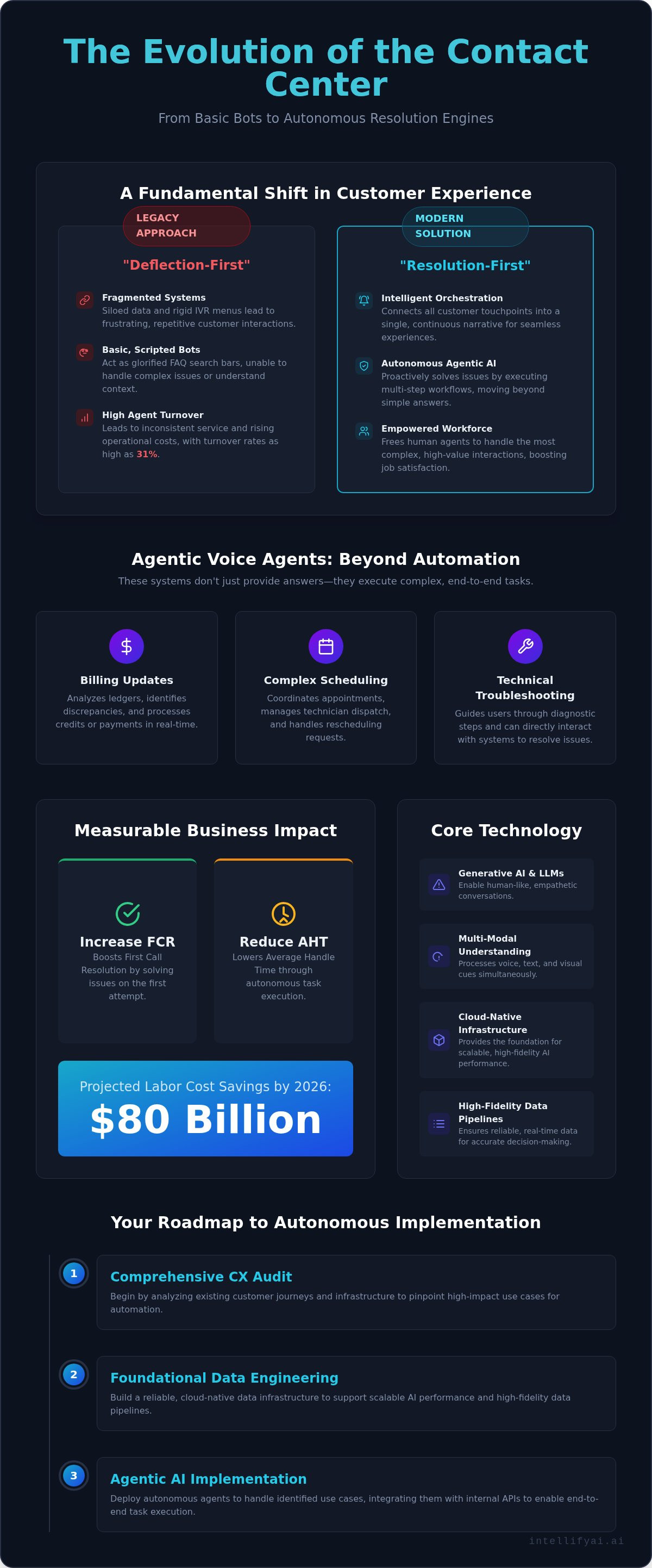
By 2026, the evolution of contact centers has reached a critical inflection point. Modern contact center ai solutions are no longer just software add-ons; they're sophisticated ecosystems of autonomous agents and high-fidelity data pipelines. This shift represents a fundamental move away from "Deflection-First" strategies. In the past, businesses used automation to keep customers away from human agents to save costs. Today, the focus is "Resolution-First." The goal is to solve the problem immediately, regardless of whether the interaction is handled by a human or an autonomous system.
Legacy IVR systems have become the primary bottleneck for enterprise growth. Their rigid, menu-driven structures frustrate users and fail to capture the nuance of modern customer needs. Generative AI has solved this by enabling human-like, empathetic interactions. These systems don't just process keywords; they understand intent, tone, and sentiment in real time. This allows enterprises to provide a level of care that was previously impossible at scale.
To better understand the trajectory of this technology, watch this helpful video:
From Basic Chatbots to Intelligent Orchestration
First-generation chatbots often failed to meet enterprise CX standards because they lacked context and depth. They were essentially glorified FAQ search bars. We've now entered the era of intelligent orchestration. Multi-modal AI now understands voice, text, and even visual cues simultaneously. Orchestration layers act as a central nervous system, connecting disparate customer touchpoints into a single, continuous narrative. This ensures that a customer never has to repeat their story, even when moving between different channels or agents.
Why Enterprise Leaders are Prioritising AI Modernization
A global talent shortage in high-tier technical support has made traditional hiring models unsustainable. Enterprise leaders recognize they cannot scale operations through a linear increase in headcount. Contact center ai solutions allow companies to expand their service capacity without the associated costs of massive recruitment and training. By 2026, the market expectation is 24/7, instantaneous resolution. Modernization through Agentic AI Engineering Services is the only way to meet these demands while protecting the bottom line. This isn't just a tech upgrade; it's a strategic necessity for long-term relevance.
Moving Beyond Automation: The Power of Agentic Voice Agents
Automation in the past was reactive. It followed a rigid script. Agentic AI is proactive. It follows an objective. While how IBM defines contact center AI often focuses on natural language processing and agent assistance, the 2026 standard has shifted toward full autonomy. Agentic voice agents represent the next tier of contact center ai solutions. These systems don't just provide answers. They execute multi-step workflows by interacting directly with your internal APIs. This capability transforms the contact center from a cost center into a high-efficiency resolution engine.
Imagine a customer calling to resolve a complex billing discrepancy. A standard bot might identify the issue and transfer the call to a human. An agentic voice agent analyzes the ledger, identifies the error, and processes the credit instantly. This real-time problem solving is possible because Large Language Models (LLMs) are now deeply integrated with transactional systems. Voice remains the preferred channel for these high-stakes interactions. It offers a level of reassurance and immediate feedback that text-based channels often lack. When customers face high-stress problems, they want to hear a confident, capable voice that can take action.
Autonomous Task Execution in CX
True transformation requires "System 2" thinking. This involves slower, more logical reasoning that allows an AI to plan a sequence of actions rather than just predicting the next word. For example, in a product return scenario, an agentic system doesn't just issue a label. It checks inventory levels, validates warranty status, and suggests a replacement based on current stock. We specialize in building these custom workflows through our Agentic AI engineering services. This ensures your contact center ai solutions aren't just a voice on the phone, but a functional extension of your operations.
The i_Nova Advantage: Processing Unstructured Customer Data
Most enterprises sit on a mountain of "dark data." This includes fragmented emails, chat logs, and previous call recordings that typically go unused. Our i_Nova platform uses Intelligent Document Processing (IDP) to extract intelligence from these unstructured sources. It feeds this actionable data back into the voice agent's context window. This allows for hyper-personalized interactions. If a customer previously emailed about a specific technical glitch, the voice agent already knows the history. It doesn't ask. It acts. Turning these insights into performance is the hallmark of a mature digital strategy. If you're ready to move beyond basic deflection, you can explore our AI strategy and consulting to see how these tools fit your specific architecture.
Core Components of a Modern AI-Driven Contact Center
High-performance contact center ai solutions are not built on algorithms alone. They're built on infrastructure. Many enterprises fail because they prioritize the user-facing interface while neglecting the underlying data foundation. A Strategic Architect understands that the model is only as effective as the data it consumes. This requires a shift from viewing AI as a "black box" to treating it as a managed industrial process. Your infrastructure must be resilient, transparent, and capable of evolving alongside your business needs.
Scalability is non-negotiable for global organizations. Cloud-native infrastructure ensures 99.99% uptime, allowing your system to handle sudden spikes in call volume without latency or degradation in service quality. Integrated with this technical layer is real-time sentiment analysis. This "emotional layer" tracks customer frustration levels during every interaction. If the sentiment drops below a specific threshold, the system triggers an immediate human intervention. This balance ensures that technology removes the burden of repetitive tasks while humans remain available for high-stakes emotional support.
The Role of Data Engineering and AI Services
Clean data is the prerequisite for trust. In many cases, the quality of your data is more important than the specific LLM being used. Without high-fidelity data, even the most advanced models produce hallucinations that damage customer relationships. We focus on building vector databases that enable Retrieval-Augmented Generation (RAG). This allows your AI to pull contextually relevant information from your proprietary knowledge base in milliseconds. It transforms a generic model into a specialized expert on your products. Explore our Data Engineering & AI Services to understand how we structure this foundation for enterprise-grade reliability.
MLOps: Maintaining Performance in a Dynamic Market
The "engine room" of any enterprise AI is the MLOps pipeline. In a dynamic market, customer behavior and product details change daily. Model drift occurs when an AI's performance begins to decay because the real-world data it encounters no longer matches its training. Continuous training loops are the solution. These pipelines automatically incorporate new product information and fresh interaction data to maintain peak performance. This ensures your investment remains relevant long after the initial implementation. For a deeper dive into these systems, visit our blogs for our latest insights on MLOps pipelines and the future of enterprise automation.
Implementing AI Without Friction: A Strategic Roadmap
Strategic transformation is not a single event. It is a sequence of deliberate phases designed to mitigate risk while maximizing impact. Deploying contact center ai solutions at an enterprise scale requires more than just software procurement. It demands a roadmap that aligns technical capabilities with specific business outcomes. This structured approach ensures that modernization efforts don't disrupt existing operations but rather enhance them systematically. By following a tiered deployment strategy, leaders can maintain stability while capturing the efficiency of autonomous systems.
A successful transition follows these five critical steps:
Strategic AI Consulting and CX Audit
Evaluate legacy bottlenecks, data availability, and current agent workflows to identify gaps.
Identifying Use Cases
Prioritize high-impact, low-complexity tasks, such as automated scheduling or billing inquiries, for the initial phase.
Engineering Workflows
Develop custom agentic paths and API connections that allow the AI to take action within your backend systems.
Shadow Mode Testing
Run the AI in the background to validate its accuracy and decision-making against live agent performance without risk.
Global Scaling
Roll out the solution across the enterprise, using FinOps principles to optimize resource consumption and ROI.
The Proof of Value (PoV) Phase
A full-scale replacement of existing systems is rarely the correct starting point. Instead, we advocate for a Proof of Value (PoV) phase. This 90-day window focuses on specific KPIs, such as a reduction in Average Handle Time (AHT) or an increase in First Call Resolution (FCR). By proving the technology in a controlled environment, you build the internal consensus necessary for broader adoption. It allows you to refine the model's logic before it touches every customer interaction. If you're ready to identify your first use case, you can start with our AI Strategy & Consulting services.
Governance and Compliance in AI Operations
Compliance is the bedrock of enterprise trust. Every automated voice interaction must adhere to strict regulatory standards, including GDPR and SOC2. By August 2, 2026, the EU AI Act requires clear disclosure for AI systems handling customer calls, making transparency a core architectural requirement. We implement "Human-in-the-Loop" (HITL) protocols for high-risk decisions, ensuring that a human expert can always intervene when necessary. This balance protects your brand's reputation while maintaining the efficiency of your contact center ai solutions. To understand the broader implications of these systems for your business, read our latest insights on what is Agentic AI.
Ready to build a resilient, future-proof service operation? Contact our strategic architects today to begin your CX audit.
Choosing Your Contact Center AI Partner: Why IntellifyAi?
Selecting a partner for enterprise-grade contact center ai solutions requires a shift in perspective. You don't need another software vendor; you need a Strategic Architect. At IntellifyAi, we don't just provide tools. We build the bridge between abstract technological potential and practical, bottom-line results. Our approach is rooted in the CX Improvement Framework, a holistic methodology that treats digital transformation as a central business pillar rather than a temporary software implementation. This framework is not just a checklist; it's a philosophy of continuous optimization that aligns every autonomous workflow with your overarching corporate strategy.
We prioritize long-term viability and cloud-native modernization as the foundations of your success. Our global presence across the UK, USA, UAE, and India allows us to combine international engineering standards with local market expertise. This ensures that your infrastructure remains resilient and compliant with evolving global regulations. We focus on creating a frictionless future where technology and humans work in a collaborative, ethical partnership. By choosing a partner focused on the stability and security of your operations, you ensure that your investment remains relevant as the market evolves.
Engineering Excellence for Complex Enterprises
Off-the-shelf retail software often falls short of the complex, custom requirements of a serious enterprise. We specialize in custom Agentic AI Engineering Services that integrate directly with your unique data architecture and proprietary systems. This bespoke approach ensures that your autonomous agents can execute high-value tasks without constant manual oversight. We systematically break down your technical challenges into digestible segments, moving from specific business hurdles to measurable financial impact. Our mission is to remove the burden of repetitive tasks to unlock human potential. By automating the routine, we allow your workforce to focus on the creative, high-value work that truly drives growth.
Next Steps: Modernize Your Contact Center Today
Modernizing your operations is a strategic investment in your company's long-term relevance. We invite you to begin a roadmap development session to identify the specific use cases that will yield the highest ROI for your organization. With hubs in major global tech centers, our team is positioned to support your transformation regardless of your geographical footprint. It's time to move beyond basic automation toward a fully autonomous resolution engine. Secure your competitive edge with contact center ai solutions that are engineered for precision and scaled for global performance.
Contact our team today to schedule your initial strategic consultation and begin your journey toward enterprise-grade autonomy.
Architecting the Next Era of Customer Experience
The transition from reactive automation to proactive, autonomous resolution is the defining shift of 2026. Enterprises that embrace this change don't just reduce costs; they unlock the full potential of their human workforce by eliminating the burden of repetitive tasks. Implementing advanced contact center ai solutions requires a commitment to engineering excellence and a clear strategic roadmap. By integrating high-fidelity data through our proprietary i_Nova IDP platform and following our Enterprise CX Improvement Framework, you can transform your service operations into a high-performance resolution engine.
Success in this landscape depends on specialized Agentic AI Engineering that bridges the gap between abstract technology and measurable financial returns. It's time to move beyond deflection and start delivering instantaneous, end-to-end resolutions. We're ready to help you navigate this complexity with a composed, authoritative approach that prioritizes long-term viability and operational security. Your journey toward a frictionless, automated future begins with a single strategic realization.
Take the first step toward enterprise modernization. Book a Strategic AI Consultation with IntellifyAi today and discover how to scale your operations with confidence.
Frequently Asked Questions
What are contact center AI solutions?
Contact center ai solutions are integrated ecosystems of autonomous agents, data engineering pipelines, and orchestration layers. They move beyond basic automation to handle end-to-end customer resolutions. These systems use natural language processing to understand intent and sentiment. By connecting directly to internal APIs, they execute complex tasks that previously required human intervention.
How much can I save by implementing AI in my contact center?
Implementing these tools offers substantial financial returns. Industry benchmarks indicate a live human phone interaction costs between $13.50 and $17.00 per contact. In contrast, an AI voice agent can handle the same interaction for approximately $0.30 to $0.50. Conversational AI is projected to save businesses $80 billion in labor costs by 2026. This allows enterprises to scale without a linear increase in headcount.
Can AI voice agents handle complex customer complaints?
Modern agentic systems are designed for complex logic and multi-step problem solving. They use advanced reasoning to plan actions rather than just reciting scripts. These agents can access customer history, validate warranties, and process credits through backend integrations. If a complaint reaches an emotional threshold, sentiment analysis triggers a seamless handoff to a human specialist.
How long does it take to deploy an enterprise-grade AI solution?
A strategic deployment typically follows a phased roadmap. We recommend starting with a Proof of Value (PoV) phase that lasts approximately 90 days to validate specific use cases. This allows for model tuning and API integration in a controlled environment. Full-scale global deployment occurs after this validation. This structured timeline ensures stability and security throughout the digital transformation process.
Is contact center AI secure and compliant with data regulations?
Security is a foundational requirement for enterprise contact center ai solutions. Systems must comply with GDPR and SOC2 standards to protect sensitive customer data. By August 2, 2026, the EU AI Act mandates transparency and human oversight for high-risk AI systems. Our frameworks prioritize data encryption and human-in-the-loop protocols to ensure every interaction remains secure and legally compliant.
What is the difference between a chatbot and an agentic AI agent?
Chatbots are reactive and follow rigid, script-based paths. They're often limited to answering basic FAQs. Agentic AI agents are proactive and objective-oriented. They don't just talk; they take action. These agents use reasoning to navigate complex workflows and interact with internal systems to resolve issues end-to-end without needing a human to step in.
Do I need to replace my existing CRM to use AI solutions?
You don't need to replace your existing CRM to modernize your operations. Modern AI solutions are designed to integrate with your current infrastructure via robust APIs. We focus on cloud-native modernization that bridges the gap between legacy systems and advanced AI models. This approach allows you to leverage your existing data while adding a new layer of autonomous capability.
How does AI sentiment analysis improve customer service?
Sentiment analysis tracks the customer's emotional state in real time by analyzing tone and vocabulary. It identifies rising frustration or urgency before a situation escalates. This intelligence allows the system to adjust its own responses or alert a human supervisor for immediate intervention. It ensures that technology serves as a liberating force that enhances, rather than replaces, human empathy.









.svg)