Conversational AI is projected to slash contact center labor costs by $80 billion in 2026. You're likely dealing with the friction of high agent turnover and legacy infrastructure that simply can't keep pace with modern customer demands. It's a persistent challenge to maintain consistency across channels when your teams are buried under a mountain of repetitive, low-value queries. Adopting generative ai for contact centers has evolved beyond simple chat interfaces into a core strategic pillar for enterprise growth.
We see advanced technology as a catalyst for human potential rather than a replacement for it. This guide provides the blueprint to transition from outdated IVR systems to autonomous, agentic AI workflows that deliver measurable results. You'll learn how to drive down Average Handle Time and boost First Contact Resolution through precise engineering and cloud-native modernization. We'll examine the shift toward intelligent agents that execute complex processes, ensuring your enterprise remains resilient, compliant, and focused on high-value outcomes.
Key Takeaways
• Understand the transition from rigid, menu-based IVR systems to LLM-powered natural language understanding for more fluid customer interactions.
• Discover the evolution from passive chatbots to active Agentic AI capable of reasoning through and solving multi-step business processes autonomously.
• Analyze how deploying generative ai for contact centers through autonomous voice agents can significantly reduce call volumes while increasing human agent satisfaction.
• Master a five-step modernization roadmap for integrating advanced AI into legacy infrastructure using cloud-native engineering for maximum scalability.
• Learn why partnering with a Strategic Architect for custom AI engineering ensures long-term operational viability and a superior return on investment.
Beyond the Script: The Shift to Generative AI in Contact Centers
The era of "Press 1 for support" is officially a relic of the past. In 2026, the adoption of generative ai for contact centers represents a fundamental shift from rigid, menu-based IVR systems to fluid, natural language understanding. While legacy infrastructure relies on pre-defined paths that often lead to customer frustration, Generative AI technology allows systems to interpret unstructured speech and text with human-like precision. This isn't just about automation. It's about removing the friction that has historically plagued the customer journey.
By leveraging advanced LLMs, enterprises can now treat every interaction as a unique conversation rather than a ticket to be processed. This technology acts as a liberating force within the organization. It strips away the burden of repetitive, low-value queries, such as password resets or order tracking, which typically consume the majority of an agent's bandwidth. When these tasks move to an autonomous layer, your human agents gain the freedom to handle high-stakes, complex resolutions that require deep emotional intelligence and creative problem-solving.
To better understand how this technology assists agents in real-time, watch this helpful video:
The Evolution from Chatbots to Conversational Intelligence
We've moved decisively beyond simple rule-based bots. Early iterations relied on keyword matching, which failed the moment a customer deviated from a script. Modern transformer-based models prioritize contextual understanding. They recognize that "my card isn't working" and "I need to report a lost card" require different emotional tones and security protocols. This evolution introduces a layer of digital empathy. It allows the AI to mirror the customer's urgency and provide a composed, authoritative response that builds trust while resolving the issue.
Why 2026 is the Tipping Point for AI Adoption
Several factors have converged to make this the definitive year for enterprise transformation. With AI projected to handle 95% of all customer interactions by the end of 2026, the technology has moved from an experimental luxury to an operational necessity. Enterprise-grade LLMs now offer the security and low latency required for real-time voice agents. Simultaneously, global regulations have provided a clear framework for transparent, ethical deployment. Customers now expect instant, personalized 24/7 support across every channel. Failing to meet this standard isn't just an operational lapse; it's a strategic risk. To navigate these complexities, organizations are turning to Enterprise AI Strategy Consulting to ensure their modernization efforts translate into measurable financial returns.
The Architecture of Autonomy: How Agentic AI Powers Modern CX
Passive Generative AI provides answers. Agentic AI provides solutions. While early implementations of generative ai for contact centers focused on simple text generation, the modern enterprise requires an autonomous architecture capable of execution. This shift is fundamentally shaping the contact center by moving beyond conversation into end-to-end resolution. Agentic AI uses a sophisticated reasoning engine to break down multi-step customer problems. It plans a sequence of actions, executes them through integrated business systems, and observes the results to ensure the customer's goal is met. This isn't just a better interface; it's a digital workforce.
This autonomy is fueled by high-quality data. Our i_Nova platform bridges the critical gap between unstructured customer data and autonomous action. By extracting intelligence from complex sources like insurance claims, technical manuals, or historical transcripts, i_Nova provides the "brain" for the agentic layer. It translates messy, real-world information into structured logic that the AI can act upon with precision. This ensures that the system doesn't just talk about a problem but possesses the specific context required to fix it.
The Role of LLMs and RAG in Real-Time Support
Reliability is the non-negotiable cornerstone of enterprise AI. To eliminate the risk of "hallucinations" in high-stakes environments, we utilize Retrieval-Augmented Generation (RAG). This architecture grounds the Large Language Model (LLM) in your specific corporate knowledge base. Instead of relying on general training data, the system retrieves verified facts from your internal documents before generating a response. This ensures every interaction is accurate, compliant, and up-to-date. For a deeper technical breakdown of these autonomous workflows, explore our executive guide on What Is Agentic AI?.
Intelligent Document Processing (IDP) in the Contact Center
The back office is frequently the bottleneck of the customer experience. i_Nova transforms this through Intelligent Document Processing. By processing emails, forms, and attachments in real-time, the platform provides agents and autonomous systems with instant context. It doesn't just extract data; it creates actionable intelligence. This automation reduces manual entry errors and accelerates processing times for complex requests like mortgage applications or medical billing. It's a scalable solution that ensures data accuracy while freeing human talent for strategic oversight.
This architecture represents a collaborative framework. Human supervisors remain in the loop, managing edge cases and refining the AI's reasoning paths. This partnership ensures long-term viability and operational security for the serious enterprise. If you're ready to build this foundation, our Agentic AI Engineering Services can help you modernize your existing stack.
Strategic Comparison: Generative Chatbots vs. Autonomous Voice Agents
Traditional generative chatbots are often reactive, functioning as sophisticated interfaces for text-based FAQ retrieval. While they improve accessibility, they rarely resolve complex issues without human intervention. In contrast, autonomous voice agents represent the next frontier of generative ai for contact centers. These systems don't just generate text; they execute multi-step workflows in real-time through natural speech. This shift from passive assistance to active resolution is what distinguishes a modern enterprise from one tethered to legacy limitations.
The impact on call volume is immediate. By resolving routine inquiries like payment processing or appointment scheduling at the first point of contact, voice agents significantly reduce the pressure on human teams. This leads to a marked increase in agent satisfaction. Your human workforce is no longer burdened by the monotony of repetitive scripts. Instead, they focus on high-stakes escalations where emotional intelligence and nuanced judgment are essential. This "human-in-the-loop" model ensures that while the AI handles the bulk of the volume, a specialist is always available for complex edge cases.
Voice Agents: The New Standard for Call Centres
Modern voice agents utilize advanced natural language synthesis to deliver low-latency, human-like interactions. They handle authentication protocols and standard service requests with a level of precision that traditional IVRs cannot match. By integrating directly with your backend systems, these agents provide a seamless experience that feels intuitive to the customer. For organizations looking to implement these capabilities, our Agentic AI Voice Agents offer a specialized framework for next-generation customer engagement.
Quantifying ROI: Performance and Financial Returns
Investing in autonomous AI is a strategy for long-term enterprise relevance rather than a temporary fix. The financial benefits are documented through several key performance indicators:
Reduced Average Handle Time (AHT)
Autonomous agents process data and execute tasks faster than manual entry allows.
Increased First Contact Resolution (FCR)
Intelligent reasoning paths ensure more queries are resolved without transfers.
Operational Cost Savings
Conversational AI is projected to reduce contact center labor costs by $80 billion in 2026.
Scalability
Managed AI services allow you to handle spikes in volume without the overhead of seasonal hiring.
By the end of 2026, ROI in agentic AI will be defined by the successful transition of routine interactions into autonomous resolution paths, effectively decoupling operational growth from linear headcount increases.
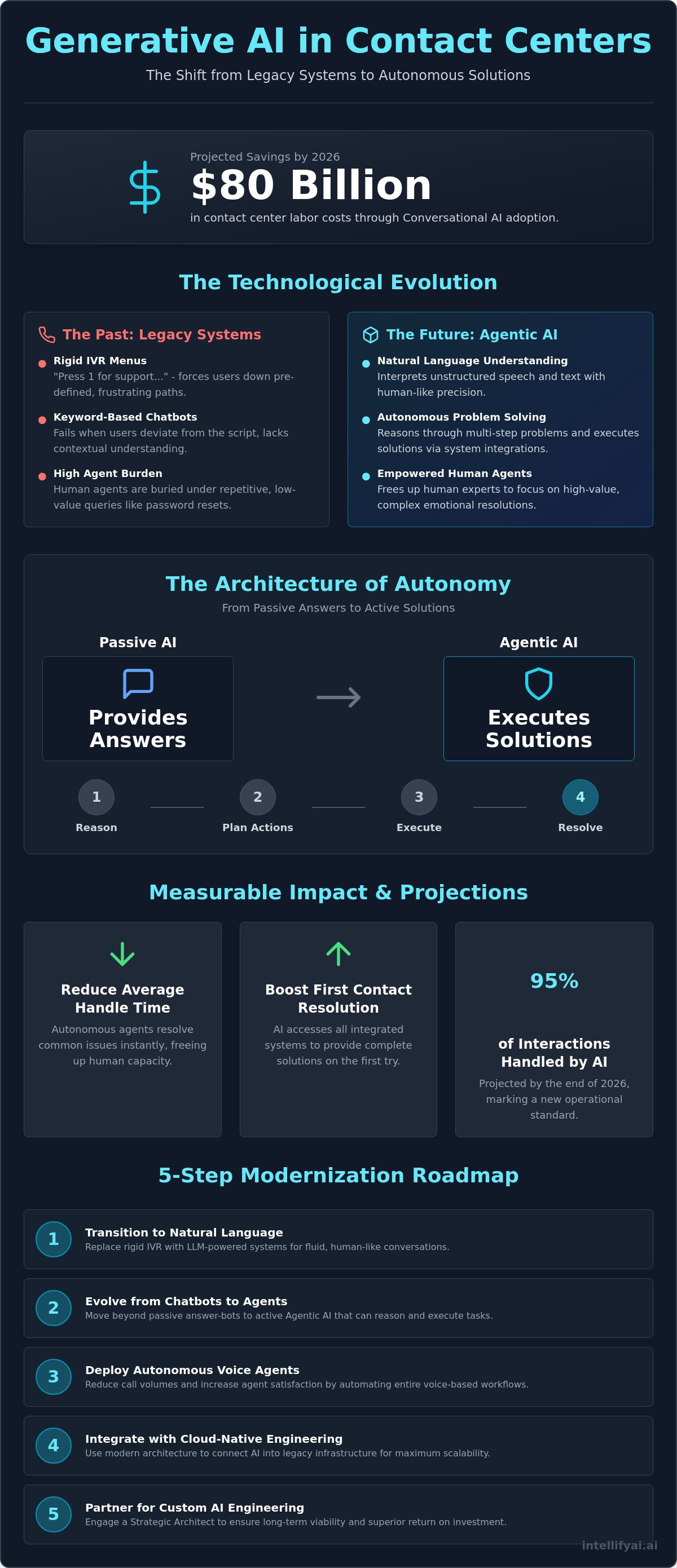
Roadmap to Implementation: Modernizing Legacy Infrastructure
Integrating generative ai for contact centers requires more than a simple API connection. It demands a structural overhaul of your technical architecture. Legacy systems, often siloed and rigid, cannot support the high-velocity data requirements of autonomous agents. To ensure a successful transformation, we follow a systematic five-step roadmap:
Strategic Audit
Map existing workflows to identify high-volume, low-complexity tasks where automation delivers the highest immediate return.
Cloud-Native Migration
Transition core infrastructure to cloud environments to achieve the elasticity needed for real-time model inference.
Data Pipeline Engineering
Clean and structure internal data to ground the AI in your specific business logic and historical context.
System Integration
Embed AI agents into your CRM and back-office platforms to enable end-to-end execution of customer requests.
MLOps Deployment
Establish continuous monitoring and feedback loops to maintain model performance, accuracy, and safety over time.
This process ensures that your modernization efforts are both stable and scalable. It moves the conversation from abstract potential to practical, measurable execution.
Cloud-Native Modernization and Data Engineering
Legacy on-premise systems struggle with the latency demands of modern LLMs. Without the scalability of the cloud, real-time voice and text interactions experience delays that degrade the customer experience. A robust data pipeline is equally critical. It allows for the fine-tuning of models using your unique historical data, ensuring the AI understands the specific nuances of your industry. For a deeper look at this technical shift, read about Enterprise Modernization 2026.
Governance, Risk, and Compliance (GRC) for AI
Security remains the primary barrier to adoption for many serious enterprises. Our Agentic AI Engineering Services address this by building strict guardrails into the core architecture. This includes implementing contextual governance to manage hallucinations and ensuring compliance with evolving global regulations. For instance, the EU AI Act transparency obligations take effect on August 2, 2026, requiring clear disclosure when customers interact with an AI system. We prioritize data privacy and ethical validation to protect your brand and your operations.
By treating implementation as a holistic philosophy rather than a one-time software install, you build a lasting investment in operational relevance. If you're ready to architect your transformation, our team provides the expert AI Strategy & Consulting required to guide your roadmap.
Partnering for Performance: Custom AI Engineering with IntellifyAi
Building a future-proof operation requires a partner who understands that technology is only as effective as the strategy behind it. We position ourselves as the Strategic Architect for your digital transformation, providing custom engineering that aligns with your specific bottom-line objectives. Our end-to-end model ensures that your journey with generative ai for contact centers moves from a high-level vision to a tangible, high-performance reality. We don't just implement tools. We engineer systems that unlock human potential by removing the burden of repetitive tasks.
At the core of our methodology is the CX Improvement Framework. This proprietary approach systematically identifies friction points within your customer journey and resolves them through autonomous workflows. By bridging the gap between unstructured data and action, we allow your business to focus on high-value creative work. This isn't a temporary software fix; it's a lasting investment in your enterprise's relevance and operational efficiency.
Strategic Consulting and Roadmap Development
Risk mitigation is a priority for any global enterprise looking to modernize. We utilize a Proof of Value (PoV) approach to demonstrate measurable impact before full-scale deployment begins. Our consulting services ensure that every technological choice serves a clear business goal, whether you are in finance, healthcare, or retail. We develop custom roadmaps that account for your unique infrastructure, ensuring that your transition to agentic intelligence is seamless and secure. This strategic foundation prevents the fragmented implementation often seen in less organized digital transformations.
Managed Services and Continuous Optimization
Deployment is only the beginning of the transformation journey. Maintaining peak performance requires dedicated MLOps pipelines to monitor model accuracy and prevent performance drift over time. We also integrate FinOps principles to optimize cloud costs, ensuring your large-scale generative ai for contact centers remains financially sustainable as it scales. Our managed services provide the stability and security required for serious enterprises to innovate with confidence. This commitment to long-term viability transforms your AI layer into a central business pillar. We invite you to contact IntellifyAi for a tailored assessment of your current operations and a clear path toward autonomous excellence.
Leading the Next Wave of Enterprise Modernization
Digital transformation in 2026 requires a move beyond passive interfaces toward agentic systems that execute end-to-end workflows. Adopting generative ai for contact centers allows your business to decouple growth from linear hiring while boosting First Contact Resolution. This evolution transforms your support hub into a strategic asset that prioritizes human talent for high-value work. It's a fundamental shift from simply answering queries to resolving them autonomously.
Our global presence across the UK, USA, India, and the UAE ensures your modernization is backed by deep technical expertise and regional compliance knowledge. By leveraging our proprietary i_Nova platform and the CX Improvement Framework, we turn legacy infrastructure into an intelligent hub of autonomous action. Transform your contact center with custom Agentic AI engineering from IntellifyAi.
The path to a frictionless, automated future is clear. You have the roadmap to build an operation that remains relevant and resilient for years to come.
Frequently Asked Questions
How does generative AI differ from traditional chatbots in a contact center?
Generative AI utilizes Large Language Models to understand intent and context, whereas traditional chatbots rely on rigid, keyword-based scripts. This shift allows for fluid, human-like conversations that adapt to a customer's specific phrasing. It eliminates the frustration of menu-based systems by interpreting unstructured speech and text with high precision, providing a much more natural interaction.
What are the primary benefits of using agentic AI for customer service?
Agentic AI moves beyond providing simple answers to executing multi-step business processes autonomously. These systems can reason through complex problems, query internal databases, and update CRM records without human intervention. The primary benefit is the ability to resolve issues end-to-end, which significantly increases First Contact Resolution and overall operational efficiency.
Is generative AI secure enough for sensitive customer data in 2026?
Modern implementations of generative ai for contact centers are secured through Retrieval-Augmented Generation and strict governance frameworks. By 2026, compliance with the EU AI Act ensures transparency and ethical data handling across global operations. These systems use internal knowledge bases to ground every response, effectively eliminating hallucinations and protecting sensitive customer information through robust guardrails.
How much can a contact center save by implementing autonomous voice agents?
Conversational AI is projected to reduce contact center labor costs by $80 billion in 2026. By automating routine, low-value queries through autonomous voice agents, enterprises can handle significantly higher volumes without increasing their total headcount. This decoupling of operational growth from linear labor costs provides a scalable model for long-term financial stability and relevance.
Does generative AI replace human agents in the call center?
Advanced technology acts as a liberating force designed to unlock human potential rather than replace human labor. By removing the burden of repetitive tasks, your agents are free to focus on high-stakes escalations that require deep emotional intelligence. This collaborative relationship improves agent satisfaction and ensures that complex edge cases receive the specialized attention they deserve.
What is the role of Intelligent Document Processing (IDP) in CX?
Intelligent Document Processing, powered by platforms like i_Nova, converts unstructured data from emails, forms, and attachments into actionable intelligence. In the contact center, this provides agents and autonomous systems with instant context for every interaction. It accelerates back-office automation and ensures that data extraction is accurate and directly relevant to the customer's immediate needs.
How long does it take to modernize a legacy contact center for AI integration?
The timeline for modernizing a legacy contact center depends on the complexity of your existing stack, but a strategic roadmap typically yields proof of value within months. Transitioning to cloud-native infrastructure is the first critical step in the process. A phased approach allows enterprises to integrate generative ai for contact centers systematically while maintaining the stability of current operations.
What is an AI Strategic Architect, and why do I need one?
An AI Strategic Architect serves as the essential bridge between abstract technical capabilities and practical business outcomes. You need one to ensure that your AI implementation isn't just a temporary software install, but a central business pillar. Partners like IntellifyAi provide the engineering expertise and strategic consulting required to build secure, scalable, and high-performance autonomous hubs.









.svg)