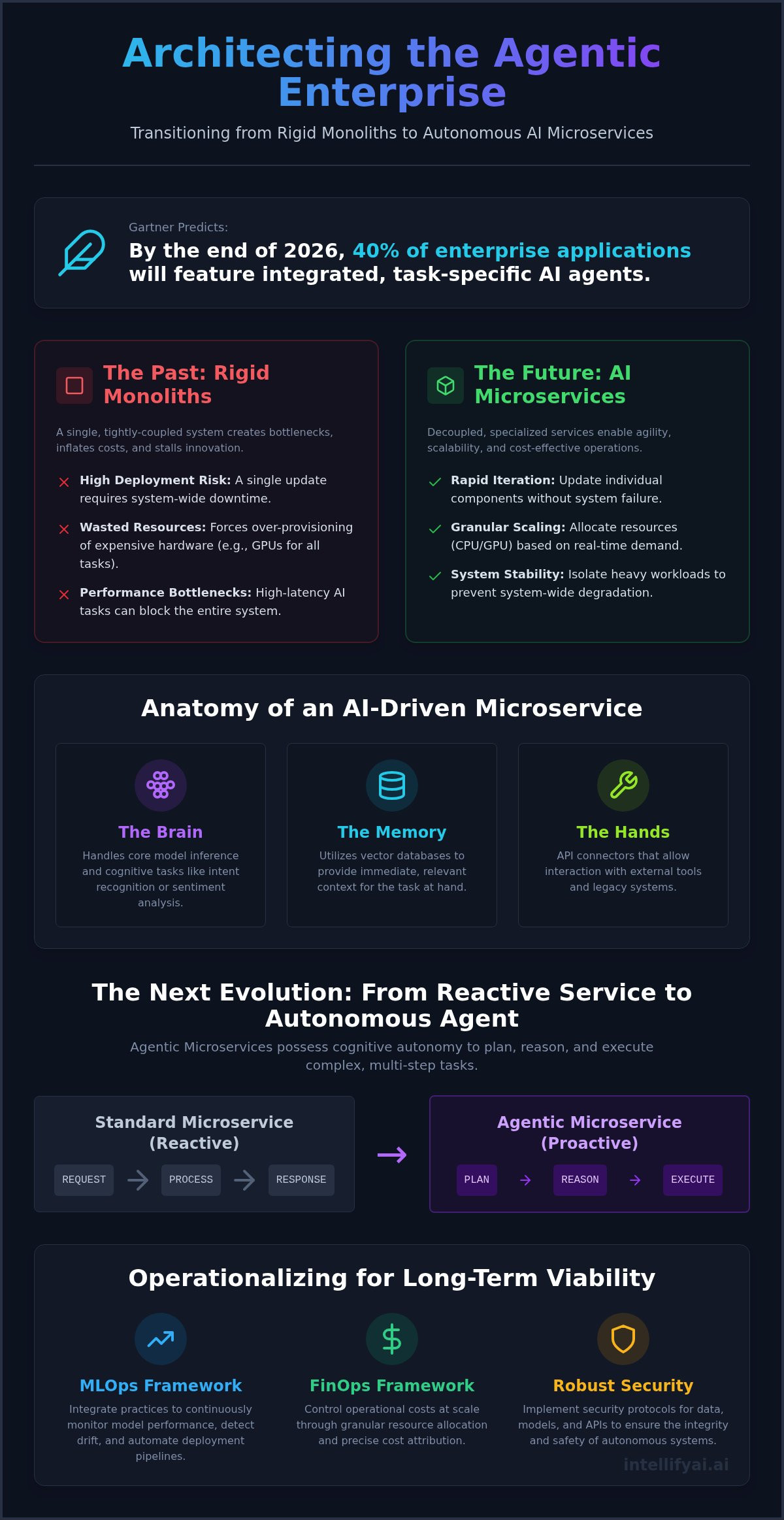
By the end of 2026, Gartner predicts that 40% of enterprise applications will feature integrated, task-specific AI agents. Most organizations, however, still attempt to run these sophisticated workflows on rigid monolithic systems. If your current conversational ai architecture requires system-wide downtime for a simple model update or suffers from high latency during complex requests, you're operating on a foundation built for the past. It's time to move beyond the limitations of request-response patterns that stall innovation.
Scaling compute-heavy AI tasks shouldn't compromise your entire ecosystem's stability. You need a framework that treats cognitive autonomy as a scalable microservice rather than a bolted-on feature. This article provides a strategic roadmap for architecting the agentic enterprise through modular, cloud-native modernization. You'll learn how to transition to an event-driven framework that supports rapid iteration, reduces operational costs through granular resource allocation, and allows for the seamless integration of autonomous agents into your core business processes.
Key Takeaways
• Shift from monolithic models to specialized microservices to enable rapid updates and granular resource allocation.
• Understand the transition from reactive software to agentic microservices that possess cognitive autonomy for complex task execution.
• Replace traditional request-response patterns with event-driven conversational ai architecture to handle high-latency AI workflows efficiently.
• Secure long-term viability by integrating MLOps and FinOps frameworks that monitor performance and control operational costs at scale.
• Apply these architectural principles to document intelligence through modular platforms like i_Nova to unlock human potential in the back office.
What are Microservices for AI Applications?
AI microservices are specialized, independent units of intelligence designed to execute specific cognitive tasks. Unlike traditional software services, these units encapsulate the logic, data dependencies, and model weights required for a single function, such as intent recognition or sentiment analysis. Adopting a microservice architecture allows enterprises to decouple their AI capabilities from a single, rigid stack. This shift from monolithic AI to modular AI is a fundamental requirement for a modern conversational ai architecture that must remain agile in a rapidly changing market.
Strategic architects view these microservices as the essential infrastructure for organizational agility. By breaking down a massive model into distributed specialized models, businesses can update individual components without risking a total system failure. This modularity ensures that inference engines, data pre-processors, and feedback loops function as autonomous services. These services can be scaled independently based on real-time demand, ensuring that your conversational ai architecture remains responsive and cost-effective.
To better understand how these modular components fit together in a production environment, watch this helpful video:
The Anatomy of an AI-Driven Microservice
A high-performing AI microservice consists of three primary layers: the Brain, the Memory, and the Hands. The Brain handles the core model inference, while the Memory utilizes vector databases to provide immediate context for the task at hand. The Hands represent the API connectors that allow the service to interact with external tools or legacy systems. To maintain consistency across diverse cloud environments, teams rely on containerization tools like Docker and Kubernetes. An Inference Service is a stateless microservice optimized for high-throughput model execution.
Why Monoliths Fail the AI Scalability Test
Monolithic architectures present an all-or-nothing deployment risk that modern enterprises can't afford. If one part of a giant AI model fails or requires an update, the entire system often goes offline. This lack of isolation creates significant bottlenecks, especially when dealing with the heterogeneous hardware requirements of AI. Large language models often require expensive GPUs, while data pre-processing tasks are better suited for standard CPUs. A monolith forces you to over-provision hardware across the entire stack, leading to wasted resources and inflated costs.
Monoliths also struggle with inference latency. In a non-modular setup, a single long-running inference task can block the entire request-response cycle, causing system-wide performance degradation. Transitioning to Agentic AI Engineering Services allows organizations to resolve these bottlenecks. By isolating heavy workloads into their own microservices, you ensure that high-latency tasks don't interfere with the user experience or overall system stability.
Agentic AI: Microservices with Cognitive Autonomy
The evolution of AI within the enterprise requires a shift from passive services to active agents. Standard microservices wait for a specific request and return a pre-defined response. In contrast, Agentic Microservices possess the cognitive autonomy to plan, reason, and execute multi-step tasks. This transformation is central to a high-velocity conversational ai architecture. These autonomous units don't just process data; they interact with external tools and legacy systems to fulfill complex business objectives. They represent the next logical step in Cloud Native Artificial Intelligence, turning static code into a proactive workforce.
Implementing these capabilities requires a sophisticated approach to system design. Many organizations struggle with the transition because they treat AI as a standalone feature rather than an architectural pillar. Real success comes from integrating Agentic AI Engineering Services to build a framework where agents can operate independently yet cohesively. This involves a strategic choice between orchestration and choreography. Orchestration uses a central controller to manage agent interactions, while choreography relies on event-driven triggers to allow agents to collaborate without a single point of failure. Both methods have their place in a modern enterprise, but the choice depends on your specific operational requirements.
The Multi-Agent System (MAS) Architecture
A Multi-Agent System (MAS) is a cluster of microservices collaborating to solve complex enterprise problems. In this architecture, a Manager Agent microservice acts as the strategic lead, breaking down high-level requests into smaller, manageable sub-tasks. It then delegates these tasks to specialized Worker Agents. This hierarchy ensures that the system remains scalable and organized. To understand the broader business implications of this shift, explore our guide on What Is Agentic AI? and how it redefines autonomous workflows.
State Management in Autonomous Microservices
Maintaining context across distributed services is a significant technical hurdle. Autonomous microservices must distinguish between short-term memory and long-term memory to remain effective. Short-term memory, or session state, tracks the immediate conversation flow. Long-term memory utilizes vector embeddings to recall historical data and strategic preferences. Technologies like Redis are essential for low-latency state sharing, ensuring that an agent in one part of the network knows exactly what happened in another. If you're ready to modernize your operations, consider exploring our AI Strategy & Consulting to align your technical stack with your long-term growth goals.
Scaling AI with Event-Driven Architecture (EDA)
Traditional request-response models like REST or gRPC often fail when integrated into a sophisticated conversational ai architecture. Large language model inference tasks are computationally intensive and can take several seconds or even minutes to complete. Forcing a client to wait for a synchronous response leads to timeout errors and a brittle user experience. Event-Driven Architecture (EDA) solves this by using message brokers to decouple the request from the execution. This creates a resilient system where agents operate with asynchronous intelligence, processing tasks in the background while the front-end remains responsive.
Decoupling is a strategic necessity for long-term viability. It allows you to update or swap a specific AI model without disrupting the entire event chain. For example, you might replace a general-purpose model with a specialized AI-augmented teaching model to improve accuracy in a specific domain. This flexibility is a core pillar of Enterprise Modernization 2026. By moving away from rigid connections, you ensure your infrastructure can evolve alongside rapid technological breakthroughs without requiring a total system overhaul.
Request-Response vs. Event-Driven AI
The choice between these paradigms depends on your operational goals. While request-response is suitable for simple lookups, it struggles under the weight of multi-step AI reasoning. For high-volume tasks, fire-and-forget patterns are superior because they allow the system to ingest data at scale and process it as resources become available. This approach is essential for maintaining a high-performance conversational ai architecture in a demanding enterprise environment.
| Feature | Request-Response | Event-Driven AI |
|---|---|---|
| Latency | Low (if fast) | Variable (Asynchronous) |
| Scalability | Limited by connections | High (Queue-based) |
| Fault Tolerance | Low (Cascading failures) | High (Isolates failures) |
| Complexity | Simple | Moderate to High |
Implementing Message Brokers for AI Workflows
Kafka serves as a powerful backbone for streaming real-time AI insights. It allows multiple agents to subscribe to specific event topics, creating a collaborative environment where one agent's output becomes another's trigger. To ensure enterprise-grade stability, you must implement Dead Letter Queues. These queues capture failed AI inferences, allowing for manual review or automatic retries without crashing the primary workflow. Event-driven triggers reduce idle GPU costs by activating services only on demand. This granular resource allocation ensures that your Agentic AI Engineering Services remain both powerful and cost-effective.
Operationalizing AI Microservices: Security, MLOps, and FinOps
Building a modular conversational ai architecture is only the first phase of digital transformation. The true challenge lies in operationalizing these services to ensure they're secure, scalable, and profitable. Strategic architects must treat AI microservices as financial assets that require precise management. This involves moving beyond basic cloud monitoring to a robust FinOps framework. By tracking the exact cloud cost of every inference task, enterprises can verify ROI and optimize resource allocation in real time. This level of visibility turns advanced technology into a predictable business driver.
Security in a distributed AI environment requires a zero-trust approach. Traditional perimeter defenses are insufficient when multiple agents exchange sensitive data across a service mesh. Implement strict identity verification between each microservice to prevent data leakage and mitigate risks like prompt injection. This granular security layer ensures that your automated workflows remain compliant with evolving global standards. Protecting your organization's proprietary intelligence is not a one-time setup; it's a continuous operational priority that safeguards your long-term viability.
The MLOps Pipeline for Distributed AI
Managing multiple AI models requires a sophisticated MLOps Pipelines Guide to automate deployment and monitoring. Each microservice container must include version control for both the underlying code and the specific model weights. This allows for seamless rollbacks if performance degrades. Continuous monitoring is essential to detect model drift at the service level, ensuring that your agents maintain their accuracy as real-world data evolves. High-velocity automation ensures that your human workers can focus on high-value creative work rather than repetitive system maintenance.
Governance and Compliance in Modular AI
Maintaining a clear audit trail is vital when data moves between specialized AI services. Your system must record every decision point and data transformation to meet GDPR and SOC2 requirements. This level of transparency is not just about compliance; it's about building trust with users and stakeholders. Establishing these governance frameworks often requires specialized AI Strategy & Consulting to align technical implementation with corporate risk management policies. A well-governed architecture turns compliance from a burden into a competitive advantage.
Ready to move from abstract models to a secure, enterprise-grade operation? Schedule a session with our team for expert Agentic AI Engineering Services to harden your infrastructure today.
Building the Future: Intelligent Document Processing as a Microservice
Intelligent Document Processing (IDP) represents the ultimate test case for a modular conversational ai architecture. While many enterprises struggle with the high volume of unstructured data that flows through their back offices, a microservice-based approach allows for the systematic extraction of value from these assets. Research from June 2026 indicates that the average ROI from IDP implementation exceeds 260% over three years. This level of performance is only achievable when you move away from monolithic processing and toward a distributed, cloud-native framework that can scale with your business needs.
Our proprietary platform, i_Nova, is built specifically on these architectural principles. It doesn't treat document intelligence as a single, opaque process. Instead, it utilizes a sophisticated mesh of independent services to handle diverse formats, including complex PDFs, audio recordings, and video files. This modularity ensures that each task, from initial data extraction to semantic analysis, is handled by a service optimized for that specific cognitive load. By integrating these capabilities into your conversational ai architecture, you turn raw data into actionable intelligence with unprecedented speed.
i_Nova: Modular Intelligence in Action
i_Nova leverages a microservices mesh to extract, validate, and integrate document data directly into your existing enterprise workflows. By utilizing plug-and-play AI models, your organization can deploy industry-specific logic for legal, financial, or medical documents without re-engineering the entire stack. This flexibility eliminates the traditional bottlenecks that plague manual back-office operations. Removing these friction points results in a measurable improvement in customer experience as processing times drop from days to seconds, allowing your team to focus on high-value strategic work.
Strategic Next Steps for Enterprise Leaders
Modernizing your enterprise doesn't require a high-risk, total system overhaul. We advocate for a Proof of Value (PoV) approach that targets your most significant monolithic bottlenecks first. Start by auditing your current workflows to identify where high latency or manual intervention is stalling growth. This focused strategy allows you to demonstrate measurable impact and secure internal buy-in before scaling the solution across the organization. This methodical progression ensures stability while driving rapid digital transformation.
The transition to an agentic enterprise is a journey toward long-term relevance and operational excellence. By adopting a modular framework today, you ensure your infrastructure remains ready for the technological breakthroughs of tomorrow. Contact IntellifyAi for a Strategic AI Modernization Roadmap to begin your transition from legacy systems to autonomous, scalable intelligence.
The Blueprint for a Scalable Agentic Future
Transitioning to a modular conversational ai architecture is no longer a technical luxury; it's a strategic imperative for the modern enterprise. By decoupling cognitive tasks into specialized microservices, you eliminate the bottlenecks of monolithic systems and unlock the potential of autonomous agents. This approach ensures your infrastructure remains resilient, cost-effective, and ready for the rapid pace of AI innovation in 2026. Success requires a deliberate balance between visionary strategy and technical precision.
IntellifyAi stands as your global partner in this transformation. With a presence in the UK, USA, UAE, and India, we are specialists in Cloud-Native & Enterprise Modernization. As the architects behind the i_Nova IDP platform, we bring deep technical expertise to every implementation. We help you turn complex technological challenges into liberating business forces that allow your team to focus on high-value creative work by removing the burden of repetitive tasks.
Take the first step toward a frictionless, automated future. Modernize your enterprise with our Agentic AI Engineering Services and build a foundation for lasting relevance. The future of your enterprise is modular, autonomous, and ready for growth.
Frequently Asked Questions
Are microservices necessary for all AI applications?
No, simple standalone models or initial prototypes don't always require a modular approach. However, for a sophisticated conversational ai architecture that must support enterprise-scale growth, microservices are essential. They prevent a single point of failure from collapsing your entire operation. Serious enterprises prioritize this modularity to ensure long-term viability and to avoid the technical debt associated with rigid, monolithic systems.
How do microservices improve the scalability of Large Language Models (LLMs)?
Microservices allow you to isolate LLM inference from other application functions. You can deploy compute-heavy models on specialized GPU instances while keeping routine data processing on standard CPUs. This granular resource allocation ensures that intensive tasks don't bottleneck the rest of your system. It enables you to scale specific models horizontally based on real-time demand rather than over-provisioning your entire infrastructure.
What is the impact of microservices on AI inference latency?
While microservices introduce minor network overhead, they often reduce total system latency through parallel processing. By breaking a complex request into sub-tasks executed by independent agents, you avoid the sequential delays inherent in monolithic setups. Modern inter-service communication protocols like gRPC keep this overhead minimal. The result is a more responsive system that handles high-volume requests without degrading performance for the end user.
Can I use different programming languages for different AI microservices?
Yes, a polyglot approach allows you to use the best tool for every specific task. You might choose Python for a machine learning inference service while using Go or Node.js for high-throughput API gateways. This flexibility allows your engineering teams to leverage the unique strengths of different ecosystems. It ensures your conversational ai architecture isn't limited by the constraints of a single programming language or framework.
How does Event-Driven Architecture help in reducing AI cloud costs?
Event-Driven Architecture reduces costs by activating expensive resources only when a specific trigger occurs. Instead of maintaining active GPU instances that sit idle between requests, services can scale out in response to message queue events. This on-demand processing model aligns your infrastructure spend directly with actual usage. It's a fundamental strategy for improving ROI and maintaining a lean, efficient cloud operation.
What are the security risks of using microservices for AI?
The primary risks include an expanded attack surface and the complexity of securing data as it moves between services. A modular system requires zero-trust verification at every service boundary rather than just a single perimeter defense. Implementing mutual TLS and robust identity management is critical to prevent unauthorized access. These measures ensure that your proprietary intelligence and customer data remain protected across the entire service mesh.
How do I manage model versioning across multiple microservices?
Manage versioning through container registries and automated MLOps pipelines that tag both code and model weights. This allows you to run A/B tests or canary deployments by routing traffic to specific versions of a microservice. Maintaining a central registry ensures that you can roll back to a stable state without disrupting other parts of the ecosystem. It provides the control necessary for rapid, low-risk iteration.
What is the difference between orchestration and choreography in AI agents?
Orchestration relies on a central controller to direct the flow of tasks, while choreography allows agents to respond independently to shared events. Orchestration provides more explicit control for complex business logic and strict workflows. Choreography offers higher resilience and scalability by removing the central manager as a potential bottleneck. The choice depends on whether your priority is centralized governance or decentralized system flexibility.









.svg)