
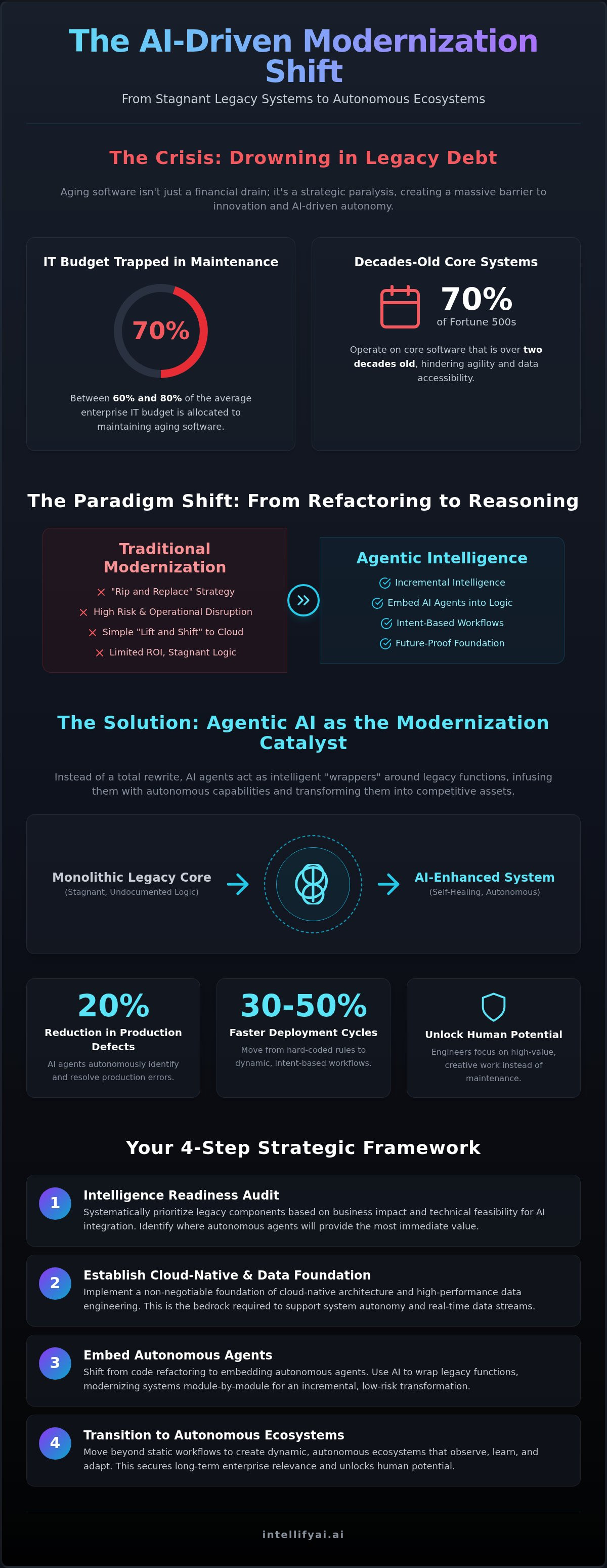
The average enterprise currently allocates between 60% and 80% of its IT budget to the mere maintenance of aging software. For many Fortune 500 companies, these core systems are over two decades old, creating a massive barrier to innovation. You likely feel the weight of this technical debt every time a new initiative stalls because your monolithic codebase won't cooperate. Modernizing legacy systems with ai is no longer a luxury; it's a requirement for survival in a market that demands autonomous speed and cloud-native agility.
We understand that the traditional "rip-and-replace" model is often too high-risk for critical operations. This article provides a sophisticated alternative. You'll discover how to transform stagnant architecture into an autonomous, AI-driven ecosystem using Agentic Intelligence and cloud-native engineering. We'll outline a clear 2026 roadmap to reduce operational overhead and bridge the gap between your existing constraints and an automated future. This framework demonstrates how leveraging tools like the i_Nova platform can unlock trapped data and empower your human talent for higher-value work.
Key Takeaways
• Identify the critical shift from infrastructure debt to intelligence debt to ensure your modernization projects deliver measurable competitive ROI.
• Discover the strategic process for modernizing legacy systems with ai by embedding autonomous agents directly into existing monolithic logic.
• Implement an "Intelligence Readiness" audit to systematically prioritize legacy components based on business impact and technical feasibility.
• Establish a non-negotiable foundation of cloud-native architecture and high-performance data engineering to support system autonomy.
• Transition from stagnant workflows to autonomous ecosystems that unlock human potential and secure long-term enterprise relevance.
The 2026 Legacy Debt Crisis: Why Traditional Modernization Is Failing
Traditional DevOps has hit a ceiling. While infrastructure automation once provided a competitive edge, it is now the baseline for entry. The real crisis in 2026 isn't just about old servers; it's about systems that are functionally blind to the era of Agentic AI. Enterprises currently allocate between 60% and 80% of their IT budgets to maintaining older systems. This isn't just a financial drain; it's a strategic paralysis. When understanding legacy systems, we must look beyond their age and focus on their inability to process real-time, unstructured data at scale. 70% of Fortune 500 companies still operate with core software over two decades old, creating a massive barrier to the autonomy required for modern competition.
Simple "lift and shift" cloud migrations no longer provide a competitive ROI. Moving a monolithic application to the cloud without re-engineering is like putting a faster engine in a horse-drawn carriage. You might gain a slight performance boost, but you're still limited by the original design. Modernizing legacy systems with ai is the only way to break this cycle. Without this integration, companies find themselves at a "modernization plateau" where they've automated their deployment but haven't empowered their logic.
The Rise of Intelligence Debt
Intelligence debt is the new technical debt. It's the inability of a system to support or interact with autonomous agents. Static codebases hinder real-time decision-making because they lack the flexibility to ingest and act on dynamic data streams. The cost of this debt is staggering. While direct maintenance for 10-15 legacy applications can cost up to $800,000 annually, the true price is the opportunity cost of lost innovation. If your system can't feed an AI model, you're losing the 30-50% faster deployment cycles that AI-first companies now enjoy.
Why 'Rip and Replace' is a 20th-Century Strategy
Total system overhauls are notoriously high-risk and often end in failure. They disrupt operations and drain resources without guaranteeing success. In 2026, the Strategic Architect favors "Incremental Intelligence." This approach modernizes systems module by module, embedding AI where it provides the most immediate value. It's a pragmatic transition from cloud-native to agentic workflows. To see how this philosophy is reshaping the industry, explore our guide on Enterprise Modernization 2026. By focusing on modernizing legacy systems with ai through gradual, high-impact changes, you maintain stability while building a future-proof foundation.
From Code Refactoring to Agentic Intelligence: The New Paradigm
Modernization has evolved beyond simple code translation. In 2026, the focus has shifted from rewriting every line of COBOL to infusing existing logic with autonomous intelligence. While traditional legacy application modernization strategies often centered on manual refactoring, modernizing legacy systems with ai introduces a layer of Agentic Intelligence that interacts with old code in real-time. This isn't just about speed; it's about creating systems that understand intent. Large language models (LLMs) now act as a Rosetta Stone for monolithic codebases. They automatically document undocumented logic and interpret complex dependencies that have existed for decades. This shift allows for self-healing architectures. In these environments, AI agents identify and resolve production errors autonomously. This reduces production defects by an average of 20% while allowing your engineers to focus on high-value creative work. By modernizing legacy systems with ai, you turn a technical burden into a competitive engine. This transition eliminates the ambiguity of legacy systems, replacing guesswork with data-driven certainty.
Agentic AI as the Modernization Catalyst
Traditional automation follows a rigid "if-then" logic. Agentic AI is different. It uses reasoning to achieve a specific business outcome. By using AI agents as "wrappers" around legacy functions, you can modernize without a total rewrite. This moves your enterprise from hard-coded rules to intent-based workflows. These agents don't just execute tasks; they observe, learn, and adapt to changing operational requirements. Instead of getting bogged down in the syntax of the past, your team can focus on the strategy of the future. If you're new to this concept, our guide on What Is Agentic AI? provides a comprehensive breakdown for executives. This approach ensures your modernization is a lasting investment rather than a temporary fix.
Extracting Value from Legacy Data with IDP
Data silos are often trapped in unstructured legacy formats like physical documents or outdated PDFs. Intelligent Document Processing (IDP) acts as a critical modernization tool here. Our proprietary i_Nova platform uses advanced IDP to extract actionable intelligence from these stagnant formats. It turns a back-office burden into a strategic asset. This transformation directly impacts customer experience and operational efficiency by making previously inaccessible data available for real-time AI modeling. By converting unstructured data into high-performance data streams, you feed the very AI models that drive your autonomy. To explore how these tools can fit into your specific architecture, you can learn more about our Agentic AI Engineering Services. This is the bridge between your current constraints and a frictionless future.
Strategic Framework: Assessing Legacy Systems for AI Integration
Success in 2026 requires a shift from reactive patching to proactive architectural design. You can't simply layer AI onto a broken foundation and expect a transformation. Instead, modernizing legacy systems with ai starts with a rigorous Strategic Framework. This process identifies which parts of your monolithic architecture are ready for autonomy and which require foundational stabilization. By prioritizing targets based on business impact versus technical complexity, you ensure that every investment yields a measurable return. We focus on creating a Proof of Value (PoV) rather than a mere proof of concept. This ensures that the transition from monolithic architecture to micro-agent services is grounded in financial reality and operational necessity.
The journey toward an autonomous enterprise is not a single leap but a series of calculated moves. We categorize legacy components into four quadrants based on their business impact and technical debt levels. High-impact, low-complexity modules are modernized first to deliver immediate ROI. This pragmatic approach allows you to begin modernizing legacy systems with ai without the catastrophic risks associated with full-scale replacements. It turns the daunting complexity of digital transformation into a manageable, results-oriented roadmap that reassures stakeholders and secures long-term viability.
The AI Readiness Audit
We begin by analyzing data silos to determine if unstructured data is accessible for machine learning. We also evaluate existing API connectivity to see if 'agentic wrappers' can be deployed without disrupting core functions. This assessment identifies the technical friction points that could hinder system autonomy. An AI Readiness Audit is the essential prerequisite for any 2026 modernization project.
Building the AI Modernization Roadmap
Your roadmap must balance immediate operational relief with long-term strategic evolution. Short-term wins, such as implementing Intelligent Document Processing, provide the momentum needed for larger architectural shifts. This gradual approach aligns perfectly with our Enterprise AI Strategy Consulting methodology. To define your specific path toward an autonomous future, explore our IntellifyAi Consulting Services for a partnership built on stability and innovation.
The Technical Pillars: Cloud-Native Architecture and Data Engineering
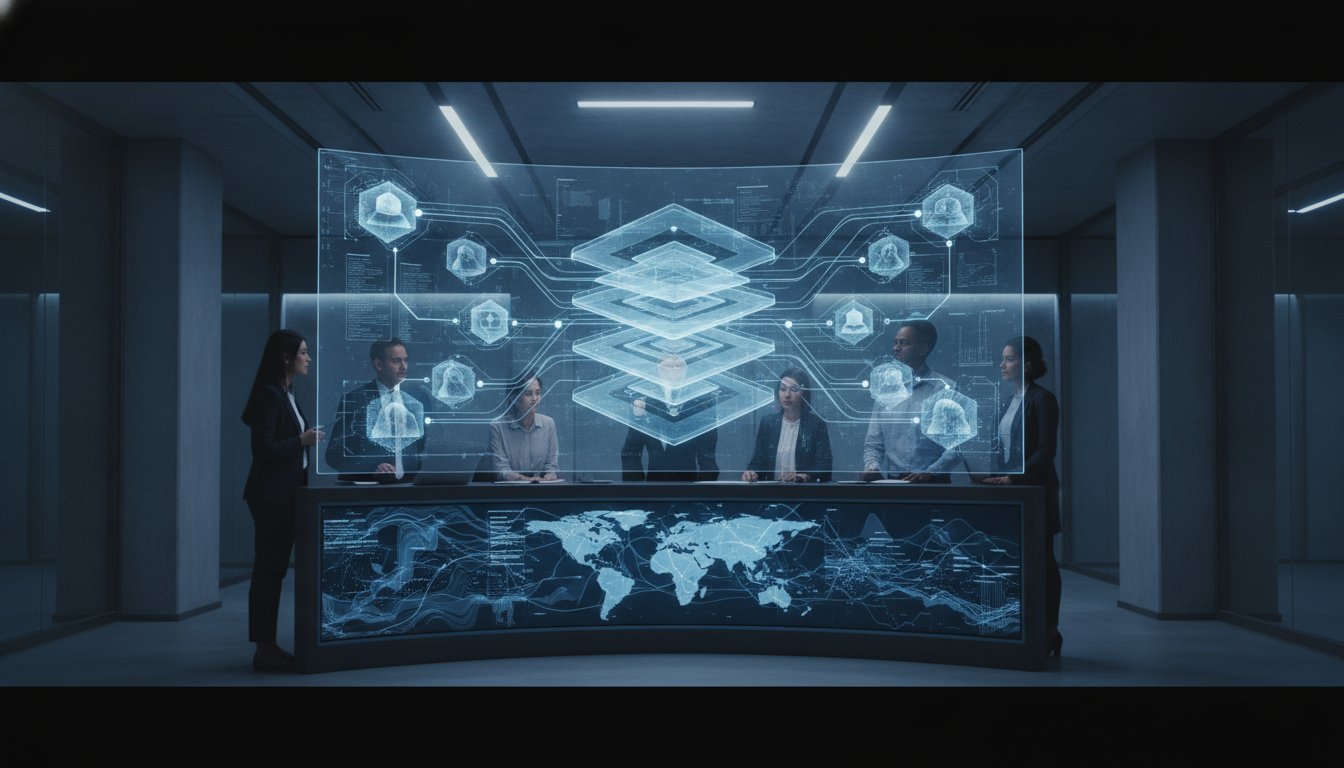
Integrating MLOps is essential for the continuous optimization of these modernized systems. An autonomous environment isn't a "set and forget" solution. It requires a disciplined approach to model versioning, testing, and deployment to ensure that your AI agents remain accurate and effective as business conditions change. Security and governance must be baked into the architecture from day one. In an autonomous environment, maintaining compliance requires automated guardrails that monitor agent behavior in real-time. This ensures that your enterprise remains secure while reaping the rewards of high-velocity automation.
Cloud-Native Foundations for AI
Serverless and containerized environments are essential for scaling agents across a global enterprise. These technologies provide the on-demand compute power that Agentic AI requires to process complex workflows. In 2026, the server intelligence agent has emerged as a critical component of modern IT infrastructure. This specialized agent autonomously manages resource allocation, identifies bottlenecks, and optimizes server performance without human intervention. Cloud-native design provides the elastic scalability that allows Agentic AI to process complex enterprise workflows without latency.
Data Engineering: The Fuel for Modernized Intelligence
High-performance data engineering is the fuel for your modernized intelligence. Legacy databases are often too rigid and slow to support real-time AI reasoning. You must transition from these stagnant silos to real-time data pipelines that provide a constant stream of high-quality information to your models. Data quality and version control are paramount here; an AI agent is only as reliable as the data it consumes. If you're ready to build the technical foundation for your autonomous future, explore our Agentic AI Engineering Services to see how we bridge the gap between legacy constraints and cloud-native performance. This is the first step toward a truly intelligent enterprise.
Partnering for Transformation: Scalable AI Modernization with IntellifyAi
Turning monolithic constraints into autonomous engines requires more than just software; it requires a Strategic Architect. At IntellifyAi, we specialize in modernizing legacy systems with ai by bridging the gap between abstract technical potential and practical business outcomes. Our approach isn't about replacing your existing infrastructure overnight. It's about systematically infusing intelligence into your core workflows to eliminate the 60% to 80% budget drain associated with legacy maintenance. By transitioning from technical debt to a proactive competitive advantage, you allow your organization to focus on high-value strategy rather than repetitive troubleshooting.
The i_Nova platform serves as a critical accelerator in this transformation. While traditional modernization projects often stall due to unstructured data silos, i_Nova uses Intelligent Document Processing to extract actionable insights from stagnant legacy formats. This capability ensures that your modernization effort is fueled by accurate, real-time data from day one. We don't just migrate your data; we unlock its value. This results in a frictionless ecosystem where information flows seamlessly from back-office records to front-end AI agents, directly improving your customer experience and operational agility.
The IntellifyAi Methodology
Our methodology is built on the belief that technology should unlock human potential. We combine strategic AI consulting with bespoke Agentic AI engineering to create systems that are simultaneously innovative and dependable. This holistic philosophy treats modernization as a central business pillar rather than a one-off IT project. With a global presence and deep cross-sector expertise, we provide the stability and security serious enterprises require during high-velocity digital shifts. We partner with you to ensure your investment in modernizing legacy systems with ai delivers long-term viability and measurable financial returns.
Start Your Modernization Journey
The path to an autonomous enterprise is a strategic choice. We invite you to explore our AI Blogs for deeper insights into the technologies and frameworks shaping the 2026 landscape. If you're ready to move beyond the constraints of your current architecture, Contact IntellifyAi for a strategic consultation. Let's build a roadmap that transforms your legacy systems into a liberating force for your business.
Securing Your Enterprise Autonomy in 2026
Success requires a partner who acts as a Strategic Architect. Our proprietary i_Nova IDP platform and global Agentic AI engineering expertise provide the technical backbone for this transformation. We apply an architect-first methodology to bridge the gap between your current constraints and a frictionless future. Take the first step toward reclaiming your IT budget and accelerating your innovation cycle. Book a Strategic AI Modernization Consultation with IntellifyAi today. Your autonomous future is a liberating force that starts with a single strategic realization.
Frequently Asked Questions
What does modernizing legacy systems with AI actually mean in 2026?
Modernizing legacy systems with ai in 2026 means infusing autonomous agents directly into monolithic logic to create self-healing, intent-based workflows. It's a fundamental shift from simple infrastructure updates to resolving intelligence debt. This approach allows your systems to reason and adapt rather than just following rigid, hard-coded rules established decades ago.
Can I modernize my legacy system with AI without moving to the cloud?
Technically, hybrid models allow for some AI integration on-premises, but cloud-native architecture is the non-negotiable host for full system autonomy. The elasticity of serverless and containerized environments is what allows AI agents to scale and process complex enterprise workflows without latency. Without the cloud, you'll likely hit a performance ceiling that limits the ROI of your AI initiatives.
How long does a typical AI modernization project take for an enterprise?
Most enterprises see measurable results within three to six months through a targeted Proof of Value (PoV). A full modular transformation typically spans twelve to eighteen months. This incremental approach ensures stability and allows you to modernize module by module, reducing the operational risks associated with a "big bang" replacement.
What is the ROI of using Agentic AI for legacy system modernization?
The ROI manifests as a 30% to 50% increase in deployment speed and a 20% decrease in production defects. By modernizing legacy systems with ai, you also reclaim a significant portion of the 60% to 80% of IT budgets typically lost to maintenance. These savings allow you to redirect capital toward high-value innovation and growth strategies.
Is my legacy data too disorganized for Intelligent Document Processing (IDP)?
Disorganized data is exactly what our i_Nova platform is designed to handle. Intelligent Document Processing excels at extracting actionable intelligence from unstructured legacy formats like physical records or outdated PDFs. It turns stagnant data silos into high-performance pipelines that feed your autonomous agents the information they need to make real-time decisions.
What are the biggest risks when modernizing legacy systems with AI?
The primary risks involve inadequate data governance and the failure to implement automated security guardrails. In an autonomous environment, maintaining compliance requires a disciplined approach to MLOps and real-time monitoring of agent behavior. Without these technical pillars, enterprises risk creating new forms of technical debt that hinder long-term viability.
How do I choose between refactoring code or using AI agents as wrappers?
Choose AI agents as wrappers for high-impact functions that require immediate agility and intent-based reasoning. Deep code refactoring is better suited for core systems where long-term stability and cloud-native performance are critical. A Strategic Architect evaluates your architecture to prioritize these targets based on business impact versus technical complexity.
Does AI modernization require hiring an entirely new engineering team?
No, it's about empowering your existing talent. AI modernization removes the burden of repetitive maintenance tasks, which allows your current engineers to focus on strategy and creative work. We view technology as a collaborative partner that unlocks human potential rather than a replacement for your skilled workforce.








.svg)