
In 2026, the most expensive mistake an enterprise can make isn't choosing the wrong model, but choosing the wrong architecture to feed it. Many organizations treat generative AI as a monolithic solution, only to be met with high hallucination rates and the crushing costs of frequent model updates. You've likely felt the tension between maintaining strict data privacy and achieving the high level of accuracy your business requires. The debate over RAG vs fine tuning is no longer just a technical preference; it's a fundamental strategic decision that determines the long-term viability of your AI investment.
We'll help you master the structural differences between these two approaches to build a high-performance, verifiable, and scalable AI architecture. By aligning your technical choices with specific business outcomes, you can transform AI from a daunting complexity into a liberating force for your workforce. This article provides a clear decision matrix for choosing between RAG and fine tuning, explains how to integrate these architectures with autonomous agents, and delivers a practical roadmap for enterprise implementation. You'll move beyond the hype to build a system that prioritizes stability, security, and measurable financial returns.
Key Takeaways
• Identify the structural differences in RAG vs fine tuning to determine which architecture provides the real-time data freshness and verifiability your enterprise requires.
• Eliminate high hallucination rates by establishing a dynamic knowledge retrieval system that serves as a grounded source of truth for all AI-generated outputs.
• Optimize your ROI by applying a strategic decision matrix that balances the long-term economics of query costs against the initial investment of model training.
• Explore how hybrid architectures and agentic AI integration allow your business to move beyond simple chat interfaces toward fully autonomous enterprise workflows.
• Follow a structured implementation roadmap that includes architectural audits and data readiness assessments to ensure your AI strategy remains scalable and secure.
Navigating the LLM Optimization Landscape: RAG vs. Fine-Tuning
By 2026, the era of generic AI experimentation has ended. Enterprises have transitioned from asking what Large Language Models (LLMs) can do to asking how they can be reliably controlled. Modern models are more capable than ever, but they remain disconnected from your live business data by default. To bridge this gap, leaders must choose between two primary paths: Retrieval-Augmented Generation (RAG) and model fine-tuning. This choice isn't merely a technical preference; it's a strategic decision regarding how your organization manages its intellectual capital and operational risk.
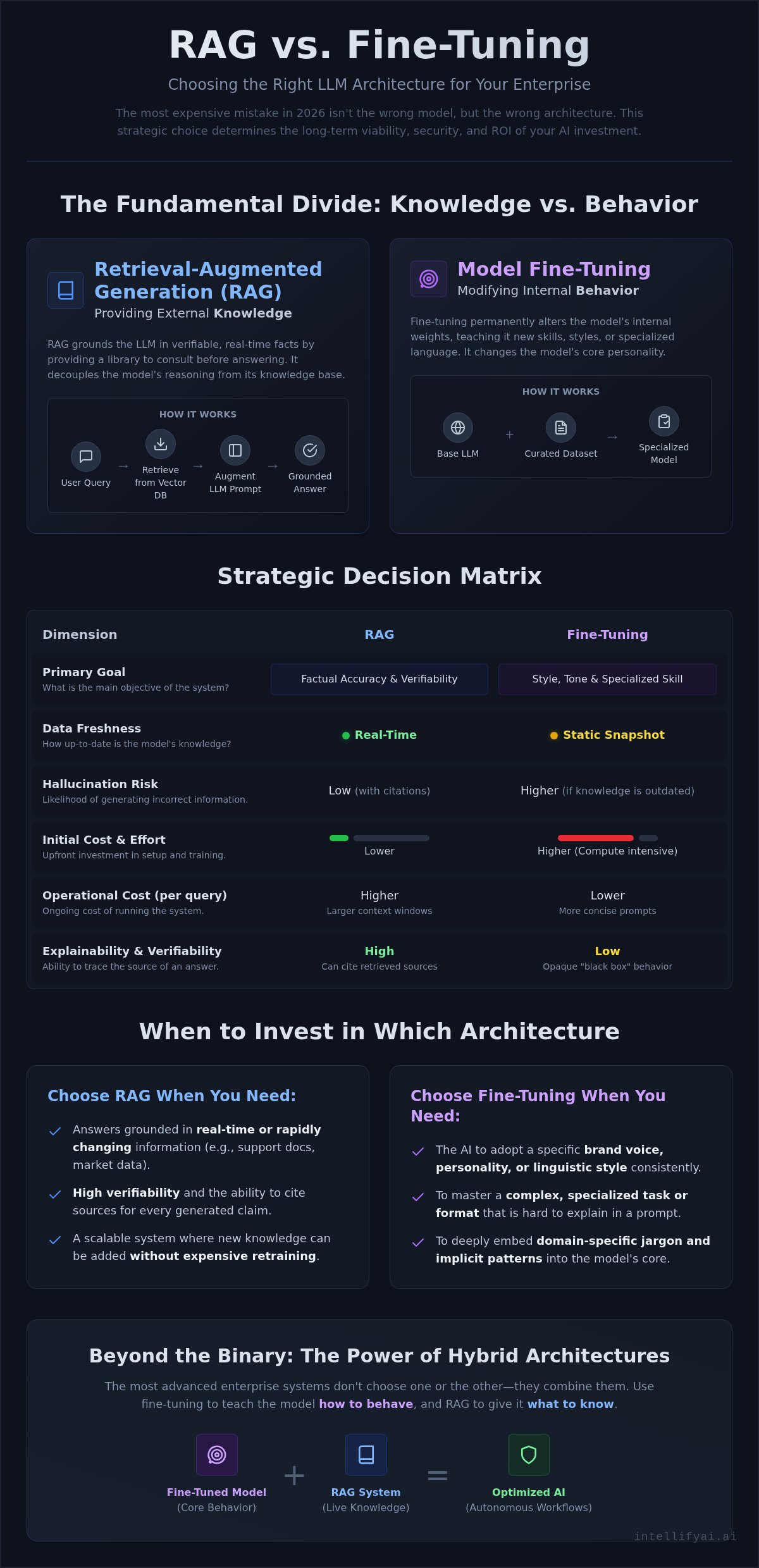
The most effective way to view this architectural divide is through the lens of "Knowledge vs. Behavior." RAG provides the model with a library to consult, while fine-tuning alters the model's fundamental personality and skill set. Understanding the nuances of RAG vs fine tuning is the first step toward building a system that doesn't just generate text, but drives measurable business value through precision and reliability. Choosing the wrong path early can lead to significant architectural debt that hinders future scalability.
What is Retrieval-Augmented Generation (RAG)?
Retrieval-Augmented Generation is a dynamic knowledge retrieval system that keeps your AI grounded in reality. The process begins when a query is converted into a numerical vector. The system then searches a specialized vector database to find the most relevant information chunks based on mathematical similarity. These pieces of data are injected into the model's context window, providing the LLM with the exact information it needs to answer accurately. In 2026, expanded context windows have made this process incredibly robust, allowing for the inclusion of complex technical manuals or entire customer histories in a single prompt. RAG is an architectural framework that provides Large Language Models with a real-time bridge to external, authoritative knowledge sources without altering the underlying model weights.
What is Model Fine-Tuning?
For organizations looking to avoid costly mistakes, starting with a clear vision is essential. Engaging in professional AI strategy consulting can help clarify which path aligns with your long-term operational goals before you commit significant engineering resources. This ensures your AI implementation remains an asset rather than a liability.
Critical Performance Dimensions: Identifying the Structural Gaps
Choosing between RAG vs fine tuning requires a clinical analysis of your data's lifecycle. Performance in an enterprise context isn't just about speed; it's about the reliability of the output and the sustainability of the underlying infrastructure. Organizations often struggle when they apply a static solution to a dynamic problem. By evaluating specific structural dimensions, you can avoid the architectural traps that lead to model obsolescence and inflated operational budgets.
Knowledge Freshness and Real-Time Data Access
Static training snapshots are the primary weakness of fine-tuned models. In fast-moving industries like finance or logistics, information has a high decay rate. A model fine-tuned on last month's compliance regulations is already a liability. RAG serves as the gold standard for these environments because it decouples the reasoning engine from the knowledge base. By integrating RAG for intelligent document processing, your AI can ingest unstructured data from live feeds, ensuring that every response reflects the most current reality. This architecture transforms your AI from a frozen archive into a living participant in your business workflows.
Verifiability, Citations, and Hallucination Control
Hallucinations remain a persistent threat to enterprise AI adoption. Fine-tuning often exacerbates this issue by creating a "black box" where the model generates plausible but incorrect information with high confidence. It lacks a mechanism to say "I don't know" based on a specific reference. RAG mitigates this by providing a clear audit trail. Because the model must pull from a specific context window, it can provide direct citations for every claim it makes. As highlighted by Red Hat on RAG vs. fine-tuning, this verifiability is essential for legal and financial sectors where compliance hinges on a verifiable source of truth. If your use case requires strict accountability, the retrieval mechanism is non-negotiable.
The complexity of implementation also varies significantly between these two paths. Fine-tuning demands rigorous MLOps pipelines, high-quality curated datasets, and significant compute credits for periodic retraining. RAG, conversely, shifts the burden toward DataOps and vector database management. While RAG requires sophisticated orchestration to maintain retrieval quality, it avoids the recurring heavy-lift costs associated with model training cycles. For those ready to architect these systems, our Agentic AI engineering services provide the technical foundation for scalable, high-performance deployment. Balancing these maintenance costs is vital for ensuring long-term project viability.
The Strategic Decision Matrix: When to Invest in Which
Determining the right architectural path for your enterprise requires a structured evaluation of your operational needs. While technical teams often focus on model accuracy, strategic leaders must evaluate the long-term economic and architectural impact of RAG vs fine tuning. This decision matrix moves beyond code to address the core business logic that drives ROI. By asking the right questions now, you prevent the accumulation of architectural debt that can paralyze a growing AI ecosystem.
Use this 5-point checklist to guide your architectural realization:
Data Volatility
Does your critical information change daily or remain static for months?
Auditability
Is a verifiable source of truth required for legal or regulatory compliance?
Stylistic Control
Does the output need to strictly adhere to a specific brand voice or technical format?
Budget Structure
Do you prefer upfront capital investment for training or recurring operational costs for retrieval?
Model Agency
Will the model act as a passive responder or an active participant in autonomous enterprise workflows?
The economic trade-off is often the deciding factor in these implementations. Fine-tuning involves a high initial cost of training due to data curation and GPU hours, but it results in a more efficient model that requires fewer tokens per query. RAG, by contrast, has a lower entry barrier but incurs a higher cost per query because every interaction pulls extensive context into the prompt. IBM's perspective on RAG and fine-tuning reinforces that the choice depends on how you value the balance between model specialization and information fluidity. In 2026, as token costs continue to evolve, optimizing this balance is essential for maintaining a competitive bottom line.
Use Cases Favoring RAG (Dynamic Knowledge)
RAG is the superior choice for internal knowledge bases and HR portals where policies, benefits, or employee handbooks change frequently. It allows your system to access real-time inventory and pricing for customer support bots without the need for constant retraining cycles. This approach effectively removes the burden of repetitive data entry, allowing your workforce to focus on high-value strategy rather than manual updates. For organizations managing massive volumes of unstructured data, RAG serves as the foundation for modern Agentic AI engineering services that require grounded, real-time intelligence.
Use Cases Favoring Fine-Tuning (Specialized Output)
Fine-tuning excels when the model must internalize complex, domain-specific vocabularies, such as medical coding or legal shorthand. It's also essential for maintaining a distinct, consistent brand voice across all voice agents. By modifying the model's internal weights, you ensure it performs reliably on niche technical formats or low-resource languages where generic models often falter. This specialization is a lasting investment in your company's unique identity and operational relevance, providing a level of behavioral consistency that retrieval alone cannot achieve.
Moving Beyond the Binary: Hybrid Architectures and Agentic AI
By 2026, the most sophisticated enterprises have abandoned the simplistic RAG vs fine tuning debate in favor of a unified architecture. Treating these two methodologies as mutually exclusive is a strategic oversight that limits the potential of your AI ecosystem. High-performance systems now utilize a "RAG-tuned" approach, where a model is fine-tuned to master a specific behavioral style or industry jargon while relying on RAG for its factual grounding. This hybrid strategy ensures your AI is both a specialized expert and a well-informed researcher, capable of delivering results that are both nuanced and accurate.
This shift represents a move from passive chatbots toward active, action-oriented agents. In this new paradigm, the model's internal weights provide the "reasoning logic," while the retrieval layer serves as its "long-term memory." This structure allows for a more fluid interaction between the model's internalized skills and its external knowledge base. It creates a system that doesn't just predict the next word, but understands how to navigate complex enterprise environments to solve specific business challenges.
The Power of the Hybrid Approach
Consider a legal firm utilizing a hybrid architecture. The firm fine-tunes a model on decades of proprietary contract language to ensure it masters the specific "how" of legal drafting. Simultaneously, it employs RAG to fetch the latest case law and regulatory updates, providing the "what" for every specific query. This combination reduces the total cost of ownership (TCO) because the model doesn't require constant, expensive retraining to stay current. Intelligent routing layers can then determine whether a query requires internal behavioral expertise or external factual retrieval, optimizing performance and compute spend in real time.
RAG as the Engine for Agentic AI Workflows
The 2026 frontier is defined by what is agentic ai: autonomous systems that don't just answer questions, but execute multi-step workflows. For an agent to be effective, it must have access to a verifiable source of truth to inform its decisions. RAG provides this foundation, acting as the bedrock for agentic ai engineering services that drive true digital transformation. These agents use retrieval mechanisms to check inventory, verify compliance, and cross-reference data before taking action.
When technology is architected this way, it ceases to be a daunting complexity and becomes a liberating force for your workforce. By removing the burden of repetitive data retrieval and verification, you allow your team to focus on high-value creative work and strategic realization. If you are ready to move beyond basic implementations and build a truly autonomous enterprise, explore our Agentic AI engineering services to begin your transformation. This collaborative relationship between human strategy and machine execution is the key to long-term viability in an AI-driven economy.
Executing Your AI Roadmap: From Strategy to Production
Transitioning from a theoretical understanding of RAG vs fine tuning to a production-ready system requires more than technical skill; it demands a clinical assessment of your organization's data readiness. By 2026, the most resilient companies have learned that architectural debt is the silent killer of AI ROI. You must begin with a comprehensive enterprise AI audit to identify where your data is siloed and how it can be structured for maximum model performance. Engaging in professional ai strategy consulting at this stage prevents costly pivot points later in the development cycle, ensuring your architecture is built for long-term viability rather than temporary hype.
Assessing Your Enterprise Data Readiness
The "Garbage In, Garbage Out" rule is especially punishing in the context of RAG. To build a high-performance system, you must prioritize cleaning and indexing your unstructured data. This process involves more than just storage; it requires a sophisticated data engineering foundation that can handle real-time updates. Integrating cloud-native modernization with your AI strategy ensures that your infrastructure can handle the high-velocity retrieval cycles RAG requires. By creating a scalable data pipeline today, you are preparing your business for the autonomous workflows of tomorrow.
Partnering for Scalable AI Engineering
Off-the-shelf retail software often lacks the flexibility needed for serious enterprise modernization. Custom engineering allows you to tailor every aspect of the RAG vs fine tuning balance to your specific business logic. Partnering with a Strategic Architect provides the deep technical expertise required to build systems that are simultaneously innovative and stable. This collaborative relationship ensures that your technology remains a liberating force for your human workers, removing the burden of repetitive tasks and allowing them to focus on high-value creative work.
Building a frictionless, automated future for your enterprise is a journey that starts with a single, strategic step. If you are ready to move beyond abstract concepts and begin a proof-of-value engagement, visit the IntellifyAi contact page to speak with our engineering team. We are here to help you architect a scalable, high-performance AI ecosystem that delivers measurable financial returns and secures your position at the cutting edge of your industry.
Architecting the Future of Enterprise Intelligence
The strategic selection between RAG vs fine tuning determines whether your AI remains a static tool or evolves into a dynamic competitive advantage. You now understand that while RAG provides a grounded, verifiable source of truth, fine-tuning offers the behavioral specialization required for high-stakes enterprise tasks. By moving toward hybrid architectures, your organization can leverage the reasoning power of specialized models alongside the real-time accuracy of live data retrieval. This approach doesn't just solve immediate technical challenges; it builds a scalable foundation for long-term operational relevance.
IntellifyAi acts as your Strategic Architect in this transition. As specialists in Agentic AI and intelligent automation, we utilize our proprietary i_Nova platform to transform complex document processing into frictionless workflows. With a global delivery model and deep technical expertise, we ensure your AI implementation is secure, scalable, and focused on the bottom line. It's time to unlock your team's human potential by removing the burden of repetitive data management. Schedule a Strategic AI Consultation with IntellifyAi today to begin your transformation. The path to a truly autonomous enterprise is clear, and the results will redefine your business performance.
Frequently Asked Questions
Is RAG better than fine-tuning for reducing hallucinations?
RAG is significantly more effective at reducing hallucinations because it forces the model to cite external, verifiable evidence. Fine-tuning modifies internal weights, which can lead the model to generate plausible but false information with high confidence. By providing a specific context window, RAG ensures the model stays grounded in your authoritative data sources rather than relying on potentially outdated or incorrect training patterns.
Can RAG and fine-tuning be used together in a single system?
Yes, integrating both approaches creates a superior hybrid architecture. You can fine-tune a model to master your brand's specific tone or complex industry jargon while using RAG to provide the most current factual information. This dual strategy allows the model to "know" how to behave while having a library to consult for the "what," optimizing the overall performance of RAG vs fine tuning implementations.
Which approach is more cost-effective for a mid-sized enterprise in 2026?
RAG is typically the more cost-effective choice for mid-sized enterprises due to its lower initial investment. Fine-tuning requires significant upfront capital for data curation and GPU compute hours. While RAG has higher recurring query costs, it avoids the expensive retraining cycles necessary to keep a fine-tuned model relevant. This makes RAG a more flexible and sustainable investment for companies with evolving data needs.
Does fine-tuning a model ensure data privacy and security?
Fine-tuning does not guarantee data privacy and can actually introduce security risks. Data used during training becomes baked into the model's weights, making it potentially recoverable through sophisticated prompt injection attacks. RAG offers better security controls because you can manage data access at the database level. This ensures that the model only retrieves information the specific user is authorized to see, maintaining strict enterprise standards.
How often do I need to update a RAG system compared to a fine-tuned model?
RAG systems update instantly as you add or modify documents in your vector database. This real-time agility is essential for fast-moving industries. In contrast, a fine-tuned model requires a full retraining cycle to ingest new information, which can take days or weeks. This makes RAG the preferred architecture for any use case where the "decay rate" of information is high and accuracy depends on the latest data.
What is the role of vector databases in a RAG architecture?
Vector databases act as the primary retrieval engine in a RAG architecture. They store your unstructured data as numerical embeddings, which represent semantic meaning rather than just keywords. When a user asks a question, the system searches the database for the most mathematically similar content. This relevant context is then fed to the LLM, allowing it to generate an informed response based on your proprietary knowledge base.
Is fine-tuning necessary for domain-specific tasks like medical diagnosis?
Fine-tuning is often essential for high-specialization fields like medical diagnosis to ensure the model masters specific reasoning patterns and terminology. Generic models frequently struggle with the nuance of clinical shorthand or complex legal structures. However, even a fine-tuned diagnostic model should be paired with RAG to access the latest medical journals and patient records, ensuring that its specialized behavior is always informed by current facts.
How do AI agents utilize RAG to perform autonomous tasks?
AI agents use RAG as a dynamic long-term memory to inform their autonomous decision-making. Instead of just answering questions, these agents retrieve relevant documents to understand the parameters of a task before executing it. This retrieval process allows an agent to check inventory levels, verify compliance rules, or reference past project history. By grounding actions in real-time data, RAG enables agents to perform multi-step enterprise workflows with high reliability.









.svg)