
Your AI models are only as intelligent as the context they consume. In 2026, the difference between a high-performing autonomous agent and a hallucinating liability is exactly one second of data freshness. For the serious enterprise, real-time data processing for AI has moved beyond the realm of simple dashboard requirements. It's now the fundamental nervous system required for true system autonomy.
You've likely felt the friction of high latency in decision-making or the complexity of integrating streaming data with legacy batch systems. It's a common bottleneck that prevents advanced technology from delivering its promised value. We understand that outdated context leads to unreliable results and missed opportunities. This article explores how to transform your data architecture from a passive archive into an active engine for zero-latency decision-making. We'll examine the evolution of Agentic AI, the shift toward AI-ready data products, and the specific strategies needed to future-proof your operations. Discover how to turn raw data streams into a liberating force that allows your business to focus on high-value creative work while autonomous systems handle the rest.
Key Takeaways
• Eliminate the "Stale Data Trap" by transitioning from traditional batch processing to a real-time intelligence model that prevents AI hallucinations and strategic drift.
• Discover the architectural requirements of Retrieval-Augmented Generation (RAG) and vector databases for high-scale, real-time data processing for AI.
• Transition from passive insights to a "Zero-Latency Enterprise" where autonomous agents execute complex business logic without human bottlenecks.
• Apply the five-step "Source-to-Agent" framework to modernize your data stack while prioritizing data quality over sheer volume for better system reliability.
• Leverage cloud-native engineering services to bridge the gap between abstract AI strategy and practical, autonomous business execution.
The Evolution of Data Processing: Why AI Demands Real-Time Intelligence in 2026
In 2026, the definition of "real-time" has matured significantly. It's no longer just about millisecond latency in a database. It's about the "actionable second" where an AI system consumes, understands, and responds to a live event. Enterprises have moved past the era of viewing data as a static resource. Today, real-time data processing for AI serves as the essential nervous system that keeps autonomous systems aligned with reality. When context is lost, the model fails.
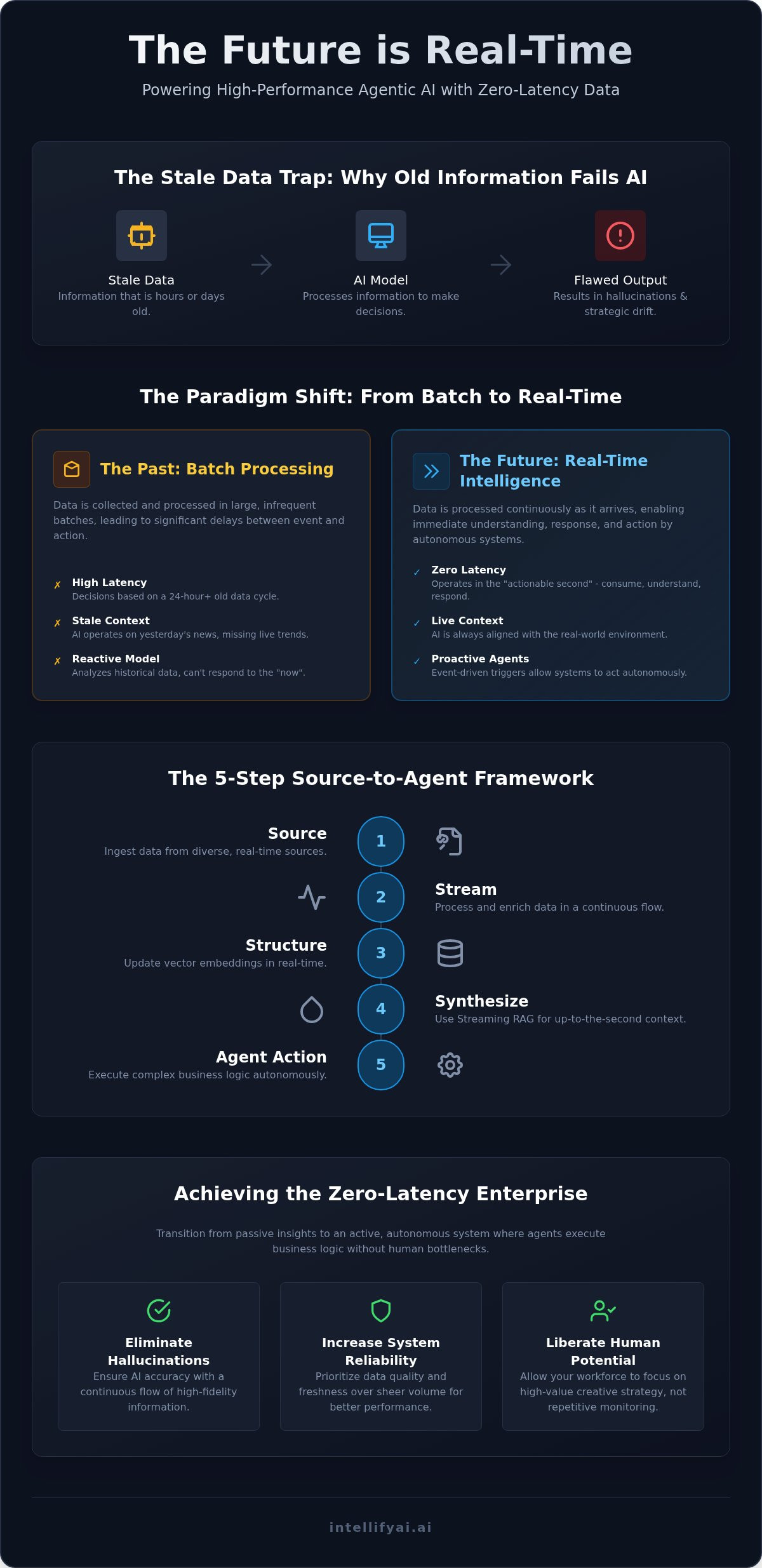
Traditional architectures often fall into the "Stale Data Trap." When a model relies on information that is even an hour old, it loses its strategic edge. This lag creates a disconnect between the AI's internal logic and the external market environment. This disconnect often leads to hallucinations or strategic drift. To remain competitive, organizations must adopt Stream processing as a foundational capability. It's the only way to ensure that autonomous agents operate with perfect clarity.
To better understand this concept, watch this helpful video:
Batch vs. Real-Time: The Cost of Latency
A 24-hour data cycle is a liability in a high-velocity market. While "Historical AI" focuses on learning from the past to predict the future, "Live AI" responds to the present as it unfolds. This shift requires a new set of metrics. Data Freshness is now a primary KPI for AI performance. If your data isn't fresh, your AI is effectively making decisions based on yesterday's news. The hidden costs of latency include failed automations and degraded customer trust. Real-time data processing for AI eliminates these bottlenecks by providing a continuous flow of high-fidelity information.
The Rise of the Agentic Era
Understanding what is agentic ai is crucial for any leader looking to modernize. These systems don't just wait for a human to type a prompt. They require continuous data streams to maintain their autonomy and execute complex business logic. We've transitioned from static, reactive models to dynamic, event-driven agent triggers. Real-time data serves as the primary sensory input for autonomous agents, enabling them to navigate the business landscape with precision. This evolution allows your workforce to step away from repetitive monitoring and focus on high-value creative strategy.
The Architecture of Immediacy: How Real-Time Streams Power Agentic AI
To build an autonomous enterprise, you must master the architecture of immediacy. It's no longer sufficient to have a high-speed data pipe if the destination is a static, disconnected warehouse. Real-time data processing for AI requires a fundamental shift in how we structure information for consumption by Large Language Models (LLMs). This architecture relies on the seamless integration of streaming pipelines and semantic retrieval systems. It's about moving data from its source to a decision-ready state in seconds.
Streaming RAG: Beyond Static Knowledge Bases
Retrieval-Augmented Generation (RAG) has matured into a dynamic context engine. In 2026, relying on a static knowledge base is an operational risk. Modern architectures utilize streaming pipelines to update vector embeddings the instant a new data point arrives. This low-latency indexing is non-negotiable for maintaining AI accuracy. The i_Nova platform serves as a benchmark for this capability. It processes unstructured data into live intelligence, allowing agents to access current document context without delay. Enterprises seeking to bridge this gap can leverage specialized Agentic AI engineering services to build these high-velocity pipelines.
The Role of Vector Databases in 2026
Traditional relational databases prioritize structured consistency over semantic meaning. While they remain essential for transactional records, they fail to support the fluid needs of AI agents. Vector databases have become the standard for real-time semantic search at scale. They allow agents to find relevant context based on intent rather than just keywords. Real-time vector updates are the primary defense against "contextual decay." In long-running AI sessions, agents can lose track of the current state if their underlying data source isn't refreshing. Optimizing these systems for high-concurrency and low-latency retrieval ensures that your agents never forget the latest operational changes.
Source-intelligent streaming represents the next frontier. By processing data at the origin, enterprises reduce the noise that enters the central model. This event-driven approach ensures that Agentic AI workflows are triggered by specific, high-value signals rather than scheduled polls. It creates a frictionless flow from data generation to autonomous action. When your architecture is event-driven, your agents become proactive partners rather than reactive tools. Mastering real-time data processing for AI is the only way to ensure these agents remain synchronized with a rapidly changing business environment.
Beyond Analytics: Real-Time Data as the Catalyst for Autonomous Decision-Making
The true value of intelligence lies in execution. While the previous decade focused on descriptive analytics, the current era demands a shift from "Insight" to "Action." We're moving beyond dashboards that simply report what happened. Instead, we're building systems where agents use live data to execute complex business logic without waiting for human intervention. This is the foundation of the Zero-Latency Enterprise. It's a model where standard operating procedures are automated through continuous streams of information. Effective real-time data processing for AI transforms these streams into immediate operational commands, removing the human bottlenecks that once slowed down organizational response times.
Consider the impact on risk management. In cybersecurity and fraud prevention, a delay of even a few seconds can result in catastrophic losses. Modern agents monitor network telemetry and transaction patterns in the millisecond. They don't just alert a security team; they isolate compromised nodes and block suspicious transfers instantly. Similarly, in global supply chain orchestration, agents use live telemetry to re-route shipments and re-allocate resources based on port congestion or weather disruptions. This level of system autonomy ensures that your operations remain resilient and cost-effective, even in volatile environments.
Autonomous Customer Experience (CX)
Customer expectations have reached a point where scripted responses are no longer acceptable. Modern voice agents leverage real-time sentiment analysis and purchase history to pivot conversations dynamically. They don't follow a rigid tree. Instead, they understand the caller's frustration or intent and adjust their strategy on the fly. These agents can check live inventory, verify shipping status, and process refunds autonomously. Sub-second data processing is the key to building this level of trust. When a customer feels that an agent is truly informed and capable of solving their problem, loyalty increases significantly.
Predictive Maintenance and Industrial IoT
In industrial settings, the synergy between digital twins and real-time AI agents is transforming maintenance cycles. Sensors on the factory floor stream performance data directly into agentic workflows. When a component shows signs of wear, the agent doesn't just flag it for a technician. It triggers the procurement of the replacement part and schedules the maintenance window during the least disruptive period. This autonomous self-healing reduces operational downtime and extends the lifespan of expensive assets. By integrating real-time data processing for AI into your industrial IoT strategy, you turn potential failures into managed, automated events.
Strategic Implementation: Building an AI-Ready Real-Time Data Pipeline
The "Big Data" hangover has left many enterprises with vast, stagnant lakes of unusable information. In 2026, volume is vanity; freshness is sanity. To move from passive storage to active intelligence, you must adopt a "Source-to-Agent" framework. This five-step approach modernizes your data stack by focusing on event sourcing, stream orchestration, contextual enrichment, vectorization, and finally, agentic action. Real-time data processing for AI is not a bolt-on feature. It is a structural redesign that prioritizes high-quality, high-velocity signals over the sheer accumulation of historical records.
Managing the performance of these systems requires more than just traditional IT monitoring. You must integrate robust MLOps pipelines to oversee real-time model performance and data drift. Without this automated oversight, autonomous agents can quickly become misaligned with shifting operational realities. Governance and ethics must be baked into the pipeline at the architectural level. This ensures that your agents remain within safe operational guardrails while they execute high-stakes decisions in the millisecond. If you are ready to modernize your infrastructure, our Agentic AI Engineering Services can help you bridge the gap between legacy systems and autonomous intelligence.
Modernising Legacy Infrastructure
Cloud-native transformation is a prerequisite for high-throughput streams. Legacy data warehouses were designed for retrospective reporting, not for powering autonomous agents. You must bridge the gap between these systems and modern data lakes to create a unified environment. Evaluating your "AI-readiness" requires a clear-eyed assessment of your current infrastructure. Use this checklist to determine if your foundation is ready for Agentic AI:
• Does your system support sub-second ingestion latency?
• Are schemas unified across both streaming and batch layers?
• Is there a native, low-latency integration with vector databases?
• Can your infrastructure scale horizontally during sudden event bursts?
• Are automated data quality checks integrated directly into the stream?
Data Engineering for Agentic Autonomy
Feature stores play a critical role in providing consistent, low-latency data to real-time models. They act as a centralized repository where agents can pull pre-computed features without recalculating them for every prompt. This is vital when handling high-cardinality data, where the sheer number of unique elements can sacrifice processing speed if not managed correctly. Furthermore, ensuring data lineage and auditability in autonomous streaming environments is essential for compliance and troubleshooting. You must be able to trace every decision an agent makes back to the specific data point that triggered it. This transparency is the only way to maintain trust in a fully automated enterprise.
Implementing real-time data processing for AI requires a shift in mindset from data management to data orchestration. It's about creating a frictionless path from the moment a data point is generated to the moment an agent takes a corrective or strategic action. By focusing on quality and speed, you turn your data pipeline into a competitive advantage rather than a storage cost.
Modernising for the Future: Engineering Your Real-Time AI Advantage
Enterprise modernization is a continuous journey. It begins with cloud-native infrastructure and culminates in agentic intelligence. This transition represents the shift from systems that store data to systems that act upon it. Achieving this requires a sophisticated approach to real-time data processing for AI. It's about ensuring your organization is not just fast, but intelligently responsive. We view this evolution as a liberation from the burden of repetitive tasks, allowing your business to focus on high-value creative strategy.
Our engineering services provide the technical backbone for this transformation. We act as Strategic Architects, focusing on the long-term viability of your AI investments. A core component of this is the i_Nova platform. It specializes in converting unstructured documents into real-time actionable intelligence. This allows your agents to digest complex information and execute business logic with unprecedented speed and accuracy. By partnering with a dedicated engineering team, you bridge the gap between abstract strategy and practical, results-oriented execution.
The IntellifyAi Methodology
Our approach is rooted in practical execution. We move from a Proof-of-Value (PoV) to global scale through a disciplined, phased implementation. This ensures that every technical milestone is grounded in a measurable business outcome. Our consulting services are specifically designed to align these technical capabilities with financial returns. We prioritize human-AI collaboration. Our goal is to empower your workforce by automating repetitive tasks, allowing your team to focus on high-value creative work. This philosophy treats technology as a partner in unlocking human potential.
Next Steps for Enterprise Leaders
The path to autonomy begins with a clear assessment of your current state. Conduct a "Data Velocity Audit" to identify which workflows will benefit most from immediate automation. This requires a cross-functional team of data engineers and AI strategists working in tandem. Building this internal capability is essential for long-term success. You must ensure that your real-time data processing for AI is scalable and secure. If you're ready to define your future, contact IntellifyAi today. We'll help you architect a comprehensive real-time AI roadmap that secures your competitive advantage in 2026 and beyond.
Architecting Your Autonomous Future
The shift toward agentic intelligence is a structural requirement for the 2026 enterprise. We've explored how transitioning from batch cycles to a "Zero-Latency" model turns your data into a liberating force. By mastering real-time data processing for AI, you move beyond the limitations of historical analytics and empower autonomous systems to act with precision. This evolution removes the burden of repetitive monitoring. It allows your human workforce to focus on high-value creative strategy.
As specialists in Agentic AI Engineering, IntellifyAi bridges the gap between raw data streams and autonomous execution. With a global presence across the UK, USA, India, and the UAE, we provide the technical expertise needed to modernize complex environments. Our flagship i_Nova platform demonstrates this impact by turning unstructured document flows into immediate, actionable intelligence. The era of passive models is ending. It's time to build the nervous system your enterprise deserves.
Modernise your enterprise with real-time Agentic AI. Contact our strategists today. We're ready to help you navigate this transformation with confidence and clarity.
Frequently Asked Questions
What is the difference between real-time and near-real-time data processing for AI?
Real-time data processing for AI refers to sub-second latency where data is processed in milliseconds. This is essential for interactive applications like autonomous voice agents or high-frequency trading. Near-real-time processing typically involves a delay of up to 30 seconds. While near-real-time is sufficient for updating a logistics dashboard, true real-time is required when an agent must pivot its strategy during a live customer interaction.
How does real-time data processing reduce AI hallucinations?
Hallucinations often occur when an AI model lacks current context and attempts to fill information gaps with plausible but incorrect data. By providing up-to-the-second information, real-time pipelines ensure the model's environment matches reality. This continuous stream of truth grounds the agent. It significantly reduces the likelihood of contextual errors or fabricated responses by ensuring the model always operates on the most recent facts available.
Can my existing data warehouse support real-time Agentic AI?
Standard data warehouses are optimized for retrospective analysis and batch ingestion; this makes them unsuitable for the immediacy of Agentic AI. To support autonomous systems, you must integrate a streaming layer or move toward a lakehouse architecture. This allows for the simultaneous ingestion and retrieval of data required to power decision-making engines. We often help clients build these bridges without requiring a total system replacement.
What are the most common challenges when implementing real-time data pipelines?
The most significant challenges include managing data quality at high velocity and bridging the gap between modern streams and legacy systems. Many organizations also struggle with the complexity of real-time data processing for AI when scaling across multiple geographical regions. Success requires a robust MLOps framework to monitor model performance and prevent data drift in these high-speed environments while maintaining strict governance standards.
How much latency is acceptable for an autonomous AI agent?
Acceptable latency is defined by the specific business outcome you aim to achieve. Interactive voice agents require latency below 200 milliseconds to maintain a natural conversation flow. For back-office automation or supply chain adjustments, latency of several seconds is often acceptable. The critical factor is ensuring the agent acts before the context of the situation changes or the opportunity for intervention passes.
Is real-time data processing secure for highly regulated industries like finance?
Real-time systems are highly secure when built with a security-by-design philosophy. In regulated industries like finance, real-time streams actually enhance compliance by enabling instantaneous fraud detection and automated audit trails. We implement strict end-to-end encryption and automated governance guardrails. These measures ensure agents operate within legal and ethical boundaries at all times while providing a transparent record of every autonomous decision.
Do I need to replace my entire data stack to enable real-time AI?
You don't need to replace your entire infrastructure to begin your modernization journey. Most successful enterprises use a phased approach, building streaming side-cars that ingest data from legacy systems and vectorize it for AI consumption. This allows you to modernize incrementally. You can prove value in specific high-impact use cases before scaling the architecture across the entire organization, ensuring a better return on investment.
How does IntellifyAi's i_Nova platform handle real-time document processing?
The i_Nova platform acts as an intelligent bridge between unstructured data and autonomous agents. It processes documents, such as invoices or legal contracts, the moment they enter your ecosystem. By extracting and vectorizing this information in real-time, i_Nova ensures your agents have immediate access to the latest document intelligence. This eliminates the need for manual data entry or waiting for nightly batch updates to refresh the model's knowledge base.









.svg)