
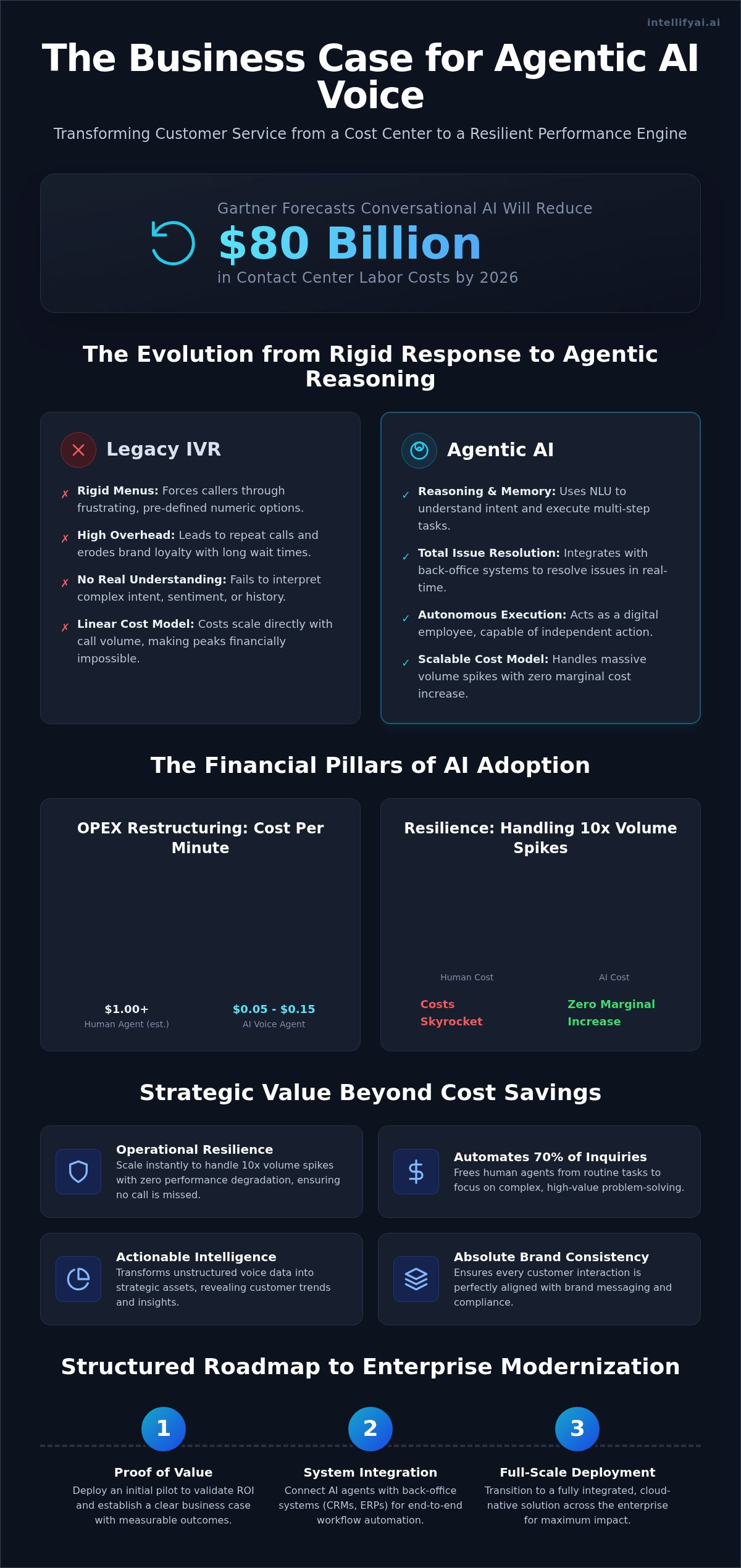
Gartner forecasts that conversational AI will reduce contact center labor costs by $80 billion in 2026. For the modern enterprise, this isn't just an efficiency metric; it's a mandate for survival. If you're currently struggling with the high operational costs of traditional call centers and the rigid limitations of legacy IVR, you know that the status quo is failing your customers. Building a definitive business case for AI voice agents requires moving beyond simple cost deflection. It's about establishing a framework for autonomous systems that handle end-to-end workflows while maintaining strict compliance with the EU AI Act and updated TCPA regulations.
You've likely seen the frustration of peak demand periods where scaling human labor becomes financially impossible. We'll show you how to solve this by mastering the financial and strategic framework needed to justify and scale autonomous AI voice agents within your organization. This article provides a clear ROI framework and explores how agentic AI engineering transforms customer service from a cost center into a resilient performance engine. We'll analyze the shift toward operational agency, where technical sophistication meets measurable growth, ensuring your enterprise remains ahead of the curve through 2026 and beyond.
Key Takeaways
• Shift from rigid legacy IVR to agentic AI systems that utilize reasoning and memory to execute complex business tasks autonomously.
• Develop a board-ready business case for AI voice agents by analyzing the significant cost delta between human agent rates and AI operational expenses.
• Achieve true operational resilience by scaling to handle 10x volume spikes with zero marginal cost increases or additional headcount.
• Transform voice interactions into strategic assets by extracting actionable intelligence and ensuring absolute brand consistency across every call.
• Master the structured roadmap for enterprise modernization, moving from an initial proof of value to a fully integrated, cloud-native deployment.
The Evolution of Voice: From Rigid IVR to Agentic AI Voice Agents
The transition from legacy Interactive Voice Response (IVR) systems to autonomous agents marks a fundamental shift in how enterprises manage customer interactions. Traditional IVR relies on rigid, pre-defined menus that force callers through a labyrinth of numeric options. Modern voice agents utilize Natural Language Understanding (NLU) to interpret intent and sentiment in real-time. This isn't just a technological upgrade; it's the core foundation of a modern business case for AI voice agents. By 2026, the global AI voice agents market is projected to reach $3.5 billion, signaling that voice maturity has finally caught up with enterprise demands.
To better understand this concept, watch this helpful video:
We've reached a stage where Collaborative Intelligence defines the workplace. Advanced systems handle high-volume, repetitive tasks with precision, while human agents focus on high-value creative work and complex problem-solving. This partnership removes the burden of mundane data entry and basic triage, allowing your workforce to leverage their emotional intelligence where it matters most. It's a strategic realignment that treats technology as a liberating force rather than a mere replacement for labor.
Why Traditional IVRs Fail the Modern Customer
Rigid menu structures carry significant hidden costs. When a system fails to route a customer correctly, it leads to repeat calls and increased operational overhead. High-velocity markets don't tolerate long wait times, and every minute spent on hold erodes brand loyalty. The IVR frustration gap is the primary driver for customer churn in the digital age.
The Agentic Difference: Reasoning vs. Response
Unlike simple chatbots, agentic AI voice agents possess reasoning, memory, and autonomous execution capabilities. They use sophisticated intelligence, such as the i_Nova platform, to process unstructured customer data and understand complex histories. These systems don't just provide canned responses; they execute multi-step tasks. By integrating directly with back-office systems, agents can verify identities, process payments, or update records in real-time. This shifts the focus from simple call deflection to total issue resolution. Building a business case for AI voice agents today means investing in a system that acts as a fully functional digital employee capable of independent action.
Quantifying the ROI: The Financial Pillars of the Business Case
Building a board-ready business case for AI voice agents requires a shift from qualitative benefits to quantitative certainty. While human agent hourly rates continue to climb due to labor shortages and cost-of-living adjustments, the operational cost of an AI voice agent in 2026 typically ranges from $0.05 to $0.15 per minute. This delta represents more than just incremental savings; it's a fundamental restructuring of your enterprise cost base. By deploying autonomous systems, you replace a linear cost model with a scalable, fixed-cost infrastructure.
Scalability remains the greatest vulnerability of the traditional contact center. When volume spikes 10x during a market event or product launch, a human-centric model breaks or incurs massive overtime and recruitment fees. An autonomous system handles these surges with zero marginal cost increase. You're no longer paying for potential capacity; you're paying for actual utilization. This resilience protects your revenue by ensuring no call goes unanswered and no lead is abandoned during peak demand, directly addressing the frustrations of legacy systems.
Operational Expenditure (OPEX) Optimization
True ROI analysis looks beyond cost-per-interaction to cost-per-resolution. By automating the routine 70% of inbound inquiries, you drastically reduce the repetitive tasks that drive high agent attrition and recruitment costs. Integrating FinOps principles into your cloud-native deployment ensures your voice models remain cost-optimized as they scale. This strategic offloading allows your human workforce to focus on complex, high-empathy cases that require sophisticated problem-solving. It's a liberating force for your staff and a performance multiplier for your bottom line.
Revenue Generation and Lead Qualification
AI agents aren't just defensive tools; they're offensive revenue drivers. Outbound agents qualify thousands of leads instantly, accelerating sales cycles by removing the manual triage bottleneck. Proactive retention calls, powered by predictive analytics, can identify at-risk customers before they churn. With 157.1 million Americans projected to use voice assistants in 2026, a 24/7 autonomous presence ensures your business captures global opportunities in every time zone without increasing headcount. Every interaction becomes an opportunity for lead capture or upselling that would otherwise be lost to wait times.
For enterprises requiring a tailored financial model to justify this transition, our Consulting Services provide bespoke ROI simulations based on your specific call volumes and operational complexity.
Beyond Cost: Strategic Value and Competitive Advantage
Focusing solely on cost reduction ignores the most potent aspect of the business case for AI voice agents: strategic intelligence. While traditional call centers treat voice interactions as ephemeral events, an agentic system transforms every conversation into a structured data asset. This shift allows leadership to move from reactive management to proactive strategy. By capturing and analyzing 100% of interactions, you gain a granular understanding of customer intent that was previously impossible to achieve at scale.
Operational speed becomes a primary competitive moat. When market conditions shift or regulatory requirements change, you don't need to retrain hundreds of human agents over several weeks. You simply update the central logic of your fleet. This near-instant deployment ensures that your entire organization pivots in unison, maintaining absolute brand consistency and compliance. For enterprises looking to define a unique persona, our Agentic AI Engineering Services allow for the development of custom brand voices that reflect your specific corporate identity.
Voice Analytics and the Feedback Loop
Modern voice agents act as the front line of your CX Improvement Framework, feeding real-time sentiment analysis directly into product development cycles. They identify emerging market trends and customer pain points the moment they arise. This eliminates the lag between customer feedback and operational change, allowing you to refine product strategy with surgical precision. It's a closed-loop system where every customer interaction actively improves the business's core offerings.
Operational Resilience and Disaster Recovery
True resilience is the ability to maintain business continuity during unforeseen crises. AI voice agents eliminate single points of failure in the contact center by providing a distributed, cloud-native infrastructure that never sleeps. Whether facing a regional outage or a global surge in demand, your service remains uninterrupted. This scalability isn't just about handling calls; it's about building a robust foundation that protects your reputation when your competitors are most vulnerable. It's a long-term investment in relevance that secures your operations against volatility.
Implementation Roadmap: Overcoming Technical and Governance Hurdles
Executing a successful business case for AI voice agents in 2026 requires more than just selecting a vendor. It demands a disciplined, three-phase roadmap designed for enterprise scale. Phase 1 begins with a Proof of Value (PoV) and strategic roadmap development, where we identify high-impact use cases that offer the fastest path to ROI. Phase 2 transitions into data engineering and cloud-native integration. During this stage, systems like our i_Nova platform process unstructured data to provide the reasoning capabilities required for autonomous task execution. Finally, Phase 3 implements MLOps to ensure continuous performance monitoring and long-term reliability.
Rigorous compliance is the foundation of this roadmap. As of August 2, 2026, the EU AI Act is generally applicable, requiring businesses to inform callers immediately that they're interacting with an AI. Furthermore, the TCPA mandates prior express consent for AI-generated voice calls, with violations carrying penalties of up to $1,500 per call. For enterprises, SOC2 and GDPR compliance aren't just checkboxes; they're essential safeguards for processing sensitive customer voiceprints and personal data.
Governance, Risk, and Compliance (GRC) for Voice
Mitigating the risks of bias and hallucination is critical for maintaining brand trust. Implementing AI enterprise governance frameworks allows you to set clear guardrails for autonomous behavior. Privacy must be integrated into the automated transcription and storage layers to meet global standards. For financial services, navigating the Sarbanes-Oxley (SOX) implications of automated transactions via voice requires absolute transparency and a comprehensive audit trail for every decision the agent makes.
The Role of MLOps in Long-Term Viability
A "set and forget" mentality is a recipe for operational failure. Customer intent and language patterns shift over time, a phenomenon known as "concept drift" that can degrade the accuracy of your models. To maintain enterprise-grade reliability, you must leverage MLOps pipelines for continuous model fine-tuning and monitoring. This ensures your agents remain accurate and effective as your business evolves, providing a lasting investment in relevance rather than a temporary fix.
Ready to modernize your operations with a secure, scalable solution? Explore our Agentic AI Engineering Services to begin your strategic transformation.
Conclusion: The IntellifyAi Perspective on Enterprise Transformation
The transition from a cost center to a value center is the definitive conclusion of any modern business case for AI voice agents. We've moved well beyond the era of mere cost deflection. Today's enterprise leaders recognize that autonomous systems aren't just tools for efficiency; they're the architects of a more responsive, data-driven, and resilient organization. By integrating agentic capabilities into your core operations, you don't just cut expenses. You build a scalable foundation for long-term growth and competitive relevance through 2026 and beyond.
IntellifyAi serves as the Strategic Architect for this transformation. We bridge the gap between abstract technical complexity and the practical, bottom-line requirements of a global enterprise. Our focus remains on deep technical expertise and results-oriented execution. We don't view advanced technology as a daunting hurdle, but as a liberating force. This perspective ensures your digital transformation remains grounded in stability, security, and measurable financial returns. We position your brand at the cutting edge while maintaining the operational stability your customers expect.
Starting Your Journey with a Strategic Partner
Off-the-shelf retail software often fails to meet the rigorous demands of enterprise-grade modernization. These generic solutions lack the custom engineering required to handle unstructured data or integrate seamlessly with complex, legacy back-office systems. A holistic Enterprise AI Strategy is essential for navigating the agentic frontier. It allows you to move beyond temporary fixes and invest in a lasting infrastructure that evolves with your business. This strategic approach ensures that every implementation is a central business pillar rather than just a software installation.
The ultimate goal of this modernization is the collaborative success of human and machine. When AI handles the repetitive and the mundane, your human workforce is free to focus on high-value creative work. This partnership unlocks human potential rather than replacing it. It creates a workplace where technical precision and human empathy work in tandem to deliver exceptional customer experiences. By removing the burden of repetitive tasks, you empower your team to solve the complex problems that drive true innovation and long-term viability.
Take the first step toward a frictionless, automated future for your enterprise. Contact our AI Strategy Consultants today to begin your strategic transformation.
Mastering the Agentic Frontier
The transition to autonomous voice agents is no longer a speculative venture; it's a strategic imperative for the 2026 enterprise. By shifting from legacy IVR to agentic systems, you transform a primary source of customer friction into a high-performance value center. You've seen how a robust business case for AI voice agents rests on measurable ROI, operational resilience, and the liberating power of collaborative intelligence. This modernization allows your human workforce to step away from repetitive tasks and focus on the complex, creative work that defines your competitive edge.
IntellifyAi stands as your dedicated Strategic Architect in this journey. With a global presence across the UK, USA, UAE, and India, we specialize in enterprise-grade digital transformation that prioritizes security and scale. Our i_Nova platform and expertise in Agentic AI ensure your deployment is built on a foundation of reasoning and autonomous execution rather than simple deflection. We provide the technical depth and strategic consulting required to navigate evolving global regulations while securing your long-term viability. Partner with IntellifyAi to engineer your autonomous voice future. The path to a frictionless, automated future is clear, and the results are within your reach.
Frequently Asked Questions
What is the typical ROI timeline for an enterprise AI voice agent deployment?
Enterprises typically realize a full return on investment within 6 to 12 months. Early gains often stem from immediate labor cost savings and the elimination of after-hours staffing requirements. Long-term ROI scales as the system resolves a higher percentage of complex queries without human intervention. This timeline assumes a phased implementation starting with a Proof of Value. A strong business case for AI voice agents accounts for both direct OPEX reduction and the value of recovered abandoned calls.
How do AI voice agents handle complex, multi-step customer requests?
Agentic AI uses reasoning and Natural Language Understanding to process multi-step workflows. Unlike simple decision trees, these systems access back-office databases to verify information and execute tasks in real-time. They maintain context across long conversations to ensure a logical flow toward resolution. This capability allows the agent to handle unstructured data through platforms like i_Nova, moving beyond basic FAQ responses to full operational agency and independent task completion.
Will AI voice agents replace human call centre staff entirely?
No, the goal is collaborative intelligence rather than total replacement. AI handles the high-volume, repetitive inquiries that often lead to agent burnout and high attrition rates. This shift liberates your human workforce to focus on high-value creative work and complex emotional escalations. By removing the burden of mundane tasks, you unlock the human potential within your contact center while maintaining a lean, efficient operational structure that scales effortlessly during demand spikes.
What are the main security risks associated with voice AI in 2026?
Primary risks include voiceprint data privacy and compliance with updated TCPA and EU AI Act mandates. As of August 2026, enterprises must prioritize SOC2 compliance and the secure storage of biometric data. Unauthorized collection of voiceprints from minors under the amended COPPA rule also carries significant legal weight. We mitigate these risks through rigorous data engineering and enterprise-grade governance frameworks that prioritize the security and stability of your client's operations.
How does an AI voice agent integrate with our existing CRM and legacy systems?
Integration occurs through secure API layers and cloud-native middleware. Modern voice agents connect directly to your CRM, ERP, and helpdesk systems to pull customer history and push real-time updates. This ensures that every interaction is logged and every task is executed within your existing technical ecosystem. Custom engineering services facilitate these connections, ensuring that the AI agent functions as a fully integrated member of your digital infrastructure without requiring a complete system overhaul.
Can AI voice agents handle multiple languages and regional accents effectively?
Advanced models now support over 100 languages and diverse regional accents with high accuracy. These systems use sophisticated acoustic modeling to filter background noise and interpret varied speech patterns. This capability is essential for global enterprises operating across multiple time zones and cultures. Your business case for AI voice agents should highlight this as a key driver for international growth and consistent global customer satisfaction scores across all geographic markets.
What is the difference between a voice bot and an Agentic AI voice agent?
The difference lies in reasoning and autonomy. A standard voice bot follows rigid, menu-driven scripts and often fails when a customer deviates from the expected path. An Agentic AI voice agent possesses memory and reasoning capabilities, allowing it to understand intent and execute complex multi-step processes independently. It doesn't just answer questions; it resolves issues by interacting with your back-office systems to complete entire business workflows without any human intervention.
How do we ensure our AI voice agent maintains our specific brand personality?
We define specific brand guardrails through custom engineering and tone-of-voice modeling. This ensures the agent uses your corporate vocabulary, follows your specific service protocols, and reflects your brand's unique persona in every interaction. Unlike off-the-shelf retail software, custom-engineered agents are trained on your historical data and brand guidelines. This creates a frictionless and consistent experience that reinforces brand loyalty while delivering the high-velocity efficiency of advanced enterprise automation.









.svg)