
What if your document silos weren't just passive storage, but the primary engine for your company's autonomous decision-making? Most executives understand that up to 93% of their corporate knowledge is currently trapped in fragmented PDFs and images. You've likely experienced the high cost of manual validation and the frustration of failing to scale AI because of poor data quality. Deploying the right unstructured data extraction tools is no longer a technical choice; it's a strategic mandate for the modern enterprise.
This guide demonstrates how next-generation extraction technologies are shifting from simple text scraping to deep, agentic understanding. You'll learn to transform stagnant archives into autonomous enterprise intelligence using advanced workflows that prioritize long-term viability and measurable ROI. We'll preview the 2026 regulatory environment, including the latest EDPB guidelines and EU AI Act requirements, to ensure your data strategy remains a secure, high-performing asset. The goal is simple: move from manual data entry to a frictionless pipeline of automated intelligence.
Key Takeaways
• Leverage multi-modal extraction to process complex text, tables, and images simultaneously, moving beyond simple OCR to true semantic understanding.
• Evaluate unstructured data extraction tools based on their capacity for real-time scalability and their ability to integrate seamlessly into a broader agentic AI ecosystem.
• Implement a strategic audit to identify high-value document silos, ensuring your data engineering efforts target the areas with the highest potential ROI.
• Transition from raw data capture to autonomous workflows by orchestrating specialized AI agents that execute business processes with minimal human oversight.
• Discover how enterprise-grade platforms like i_Nova provide the security and technical architecture required to turn fragmented information into a central pillar of corporate intelligence.
The Evolution of Unstructured Data Extraction in 2026
In the current fiscal landscape, data is no longer a static resource to be stored; it's a dynamic asset to be activated. Most organizations find themselves managing vast quantities of unstructured data, spanning everything from legal contracts and emails to complex voice recordings and technical schematics. Research indicates that between 80% and 93% of all enterprise information falls into this category. For decades, this "dark data" remained a liability, consuming storage costs without providing strategic value. In 2026, the paradigm has shifted. We've moved beyond simple data scraping into the era of intelligence extraction, where the goal isn't just to move text, but to capture institutional knowledge.
The High Cost of Information Silos
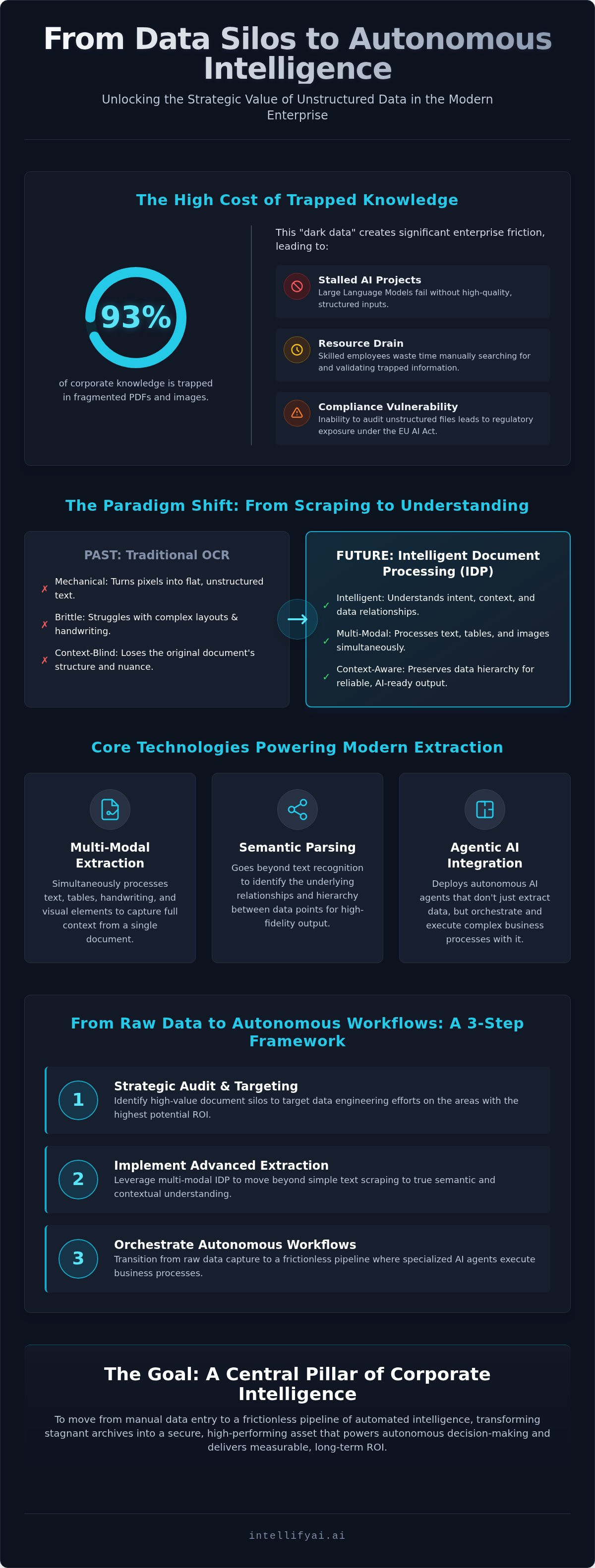
Fragmented data is the silent killer of enterprise velocity. When critical information remains trapped in disconnected PDFs and images, the productivity drain is immense. This friction creates a fundamental barrier to scaling modern AI initiatives. Consider the primary risks of operating with inaccessible data:
Stalled AI Projects
Large Language Models require high-quality, structured inputs to provide accurate outputs.
Resource Drain
Skilled employees often spend significant portions of their day manually validating or searching for trapped information.
Compliance Vulnerability
Inability to audit unstructured files leads to regulatory exposure under the latest EU AI Act requirements.
If the majority of your data is dark, your enterprise is operating on only a fraction of the available truth. This gap leads to decisions based on incomplete insights and missed market opportunities. Deploying sophisticated unstructured data extraction tools is the only way to close this gap and maintain a competitive edge.
The Intelligent Document Processing (IDP) Paradigm
Traditional Optical Character Recognition (OCR) was designed to turn pixels into characters. It was a mechanical solution for a digital problem. Modern extraction tools have evolved into Intelligent Document Processing (IDP) platforms. These systems don't just see text; they understand intent, context, and the complex relationships between data points. IDP serves as the essential bridge between raw, messy files and structured, AI-ready outputs.
This transition is a core component of enterprise modernization, allowing businesses to liberate their data from legacy silos. By automating the extraction of meaning, enterprises can finally focus their human talent on high-value creative work rather than repetitive administrative tasks. It's about building a foundation of reliability that supports the next generation of autonomous business agents.
Core Technologies Powering Modern Extraction Tools
Modern unstructured data extraction tools no longer rely on simple pattern matching. They've evolved into sophisticated ecosystems powered by Large Language Models (LLMs) that provide deep semantic understanding. This shift allows enterprises to move beyond the authoritative definition of unstructured data as a storage burden and toward seeing it as a source of competitive intelligence. Multi-modal extraction is the standard in 2026. It enables the simultaneous processing of text, embedded tables, and visual elements within a single document. By analyzing these layers together, the system understands how a caption relates to a chart or how a signature validates a clause.
From OCR to Semantic Parsing
Traditional OCR often struggles with non-linear layouts, complex tables, and diverse handwriting styles. It creates a flat text file that loses the original document's structure and nuance. Semantic parsing solves this by identifying the underlying relationships between data points. It preserves the hierarchy of information, ensuring that a header remains linked to its corresponding paragraph. Semantic parsing serves as the foundation of modern data engineering. By maintaining this context, businesses can ensure that their AI models receive high-fidelity inputs. This precision is critical for achieving measurable ROI and avoiding the data quality traps that stall many enterprise AI initiatives.
The Rise of Agentic Extraction
The most significant advancement in 2026 is the integration of agentic AI. Unlike static scripts, a server intelligence agent can autonomously navigate complex extraction tasks. These agents don't just extract data; they validate it against predefined business rules. If an agent identifies an inconsistency in a financial statement, it can cross-reference other documents or apply logical checks to verify the result. These agentic workflows represent the cutting edge of unstructured data extraction tools, providing a level of autonomy previously impossible.
This autonomous verification drastically reduces human-in-the-loop requirements. It allows your team to focus on high-value strategic realizations rather than manual data correction. These agentic workflows are typically built on cloud-native architectures. This setup ensures high-velocity processing that scales effortlessly with your document volume. It provides the stability and security necessary for serious enterprises. If you're looking to modernize your stack, exploring strategic AI consulting can help align these technologies with your long-term business goals.
Key Features to Evaluate in Enterprise Extraction Platforms
Selecting unstructured data extraction tools requires a shift from a simple technical checklist to a high-level strategic alignment. In 2026, multi-format support is a non-negotiable requirement. Your platform must ingest HTML, Word, and specialized industry formats with the same precision as standard PDFs. Scalability is equally critical. Processing millions of documents in real-time ensures your intelligence remains current, preventing the latency that often cripples high-velocity decision-making in sectors like supply chain or global finance. Security remains the bedrock of enterprise trust. Prioritize solutions that offer SOC2 Type II readiness, GDPR compliance, and flexible data residency options to meet stringent global regulatory standards.
Data Governance and Compliance Frameworks
Automated extraction must be auditable. Every data point needs a clear lineage, showing exactly which document and which model iteration generated the output. Managing Personally Identifiable Information (PII) requires automated masking to maintain privacy without sacrificing data utility. For regulated industries, implementing AI contextual governance ensures that your extraction processes align with evolving legal frameworks. This level of oversight turns a technical process into a defensible business asset that withstands the scrutiny of internal audits and external regulators. It ensures that your automation efforts don't create new liabilities.
Integration and Downstream Utility
Data is only as valuable as its accessibility. An API-first design is essential for frictionless enterprise modernization, allowing extraction tools to feed directly into existing ERP and CRM systems without manual intervention. Modern platforms also serve as the primary pipeline for vector databases, enabling Retrieval-Augmented Generation (RAG) that uses your own institutional knowledge to ground AI responses. Customizing outputs for specialized schemas in Finance, Legal, or Healthcare ensures that extracted data is immediately actionable. This integration capability transforms raw files into the structured fuel that powers your entire AI ecosystem. It allows your workforce to focus on high-value creative work by removing the burden of repetitive data management.
From Raw Data to Agentic Workflows: A Strategic Framework
Strategic implementation begins with a clear architectural vision. Too often, enterprises treat data ingestion as a localized technical problem rather than a core business pillar. To achieve true transformation, you must view the deployment of unstructured data extraction tools as the first step in a broader autonomous lifecycle. Start by auditing your information landscape to identify high-value silos. This audit reveals where inaccessible data creates the most friction, whether in legal archives or customer service logs. Once identified, select a platform that aligns with your long-term vision. This selection process should be informed by professional AI strategy consulting to ensure your tools integrate seamlessly with your existing cloud-native stack.
Building a reliable pipeline requires a logical progression. After selection, establish automated validation and enrichment layers. These layers ensure that extracted data is not only accurate but also contextually relevant for downstream applications. Finally, deploy agentic AI to execute specific business tasks based on this intelligence. Selecting the right unstructured data extraction tools ensures your architecture remains viable and ready for scale. It's about moving your organization from simply storing data to actively utilizing it to drive bottom-line results.
The Roadmap to Autonomous Operations
The ultimate goal of this framework is the transition from descriptive data to prescriptive action. When extraction is automated and intelligent, it becomes the fuel for advanced voice agents and contact centre automation. These tools can then handle complex queries by accessing real-time, structured insights that were previously trapped in voice recordings or emails. By removing the burden of repetitive back-office tasks, you allow your workforce to focus on high-value creative work. This is the essence of digital transformation: using technology to unlock human potential.
Measuring ROI on Intelligence Extraction
Success in this domain is measured through concrete business outcomes. Track accuracy rates and the specific reduction in manual processing time to quantify your initial gains. However, the true value lies in improved decision speed and enhanced customer experience (CX). A clean, structured enterprise knowledge base is a lasting investment in relevance. It provides the stability and security necessary for scaling future AI projects without the risk of data hallucinations. If you're ready to modernize your data infrastructure, reach out to our engineering team to discuss a custom implementation strategy.
Implementing i_Nova: The IntellifyAi Approach
Modernizing your document infrastructure requires more than a software subscription; it demands a foundational shift in how your organization processes institutional knowledge. i_Nova is our flagship Intelligent Document Processing (IDP) platform, designed specifically to meet the rigorous demands of the 2026 enterprise. While many unstructured data extraction tools offer basic API connectivity, i_Nova serves as the orchestration layer for a broader ecosystem of Agentic AI engineering. This platform doesn't just capture data points. It understands the underlying business logic, allowing your organization to transition from manual oversight to high-velocity, autonomous operations. By choosing a Strategic Architect partner over a simple software vendor, you ensure that your extraction pipeline is built for long-term viability and security.
Custom Engineering vs. Off-the-Shelf Tools
Enterprise complexity rarely fits into a generic, one-size-fits-all box. Off-the-shelf tools often fail when faced with specialized industry schemas or highly variable document layouts that require sophisticated MLOps. We prioritize custom implementation because we understand that your data environment is unique. Our role in cloud-native modernization involves building tailored AI models that evolve alongside your business requirements. This approach ensures that your unstructured data extraction tools remain accurate even as your document types change over time. We provide continuous performance monitoring and data engineering support, transforming your extraction process into a central business pillar rather than a temporary technical fix. This collaborative relationship between advanced technology and human workers is what allows your team to focus on high-value creative work.
Getting Started with a Proof-of-Value (PoV)
The path to automation shouldn't be a leap of faith. We recommend beginning with a Proof-of-Value (PoV) project to define clear success metrics for your first extraction initiative. During this phase, we identify a specific high-value data silo and demonstrate how to transition it from a manual bottleneck to an automated workflow. We track accuracy, reduction in manual validation time, and the speed of downstream integration to quantify the impact on your bottom line. This structured approach eliminates ambiguity and provides a clear roadmap for scaling intelligence across your entire enterprise. It's time to stop treating your documents as stagnant archives and start using them as strategic assets. Contact our strategists to discuss your unstructured data challenges and begin your modernization journey today.
Securing Your Position in the Autonomous Enterprise Era
The transition from manual data entry to autonomous intelligence is the defining shift for the 2026 enterprise. Modern unstructured data extraction tools have evolved beyond basic OCR to become the foundation for agentic workflows and real-time decision-making. By prioritizing semantic understanding and robust governance, you ensure your organization remains both compliant and competitive in a rapidly evolving regulatory landscape. This isn't just about operational efficiency. It's about liberating your human workforce to focus on high-value creative work while autonomous systems manage the repetitive complexity.
Success requires more than just software; it requires a strategic partnership. With a global presence in major tech hubs and deep specialization in agentic AI, IntellifyAi provides the end-to-end consulting and engineering support necessary for true enterprise transformation. We bridge the gap between complex technical fields and your practical business needs, ensuring long-term viability for your digital assets. It's time to stop managing documents and start leading with intelligence. The future of your enterprise is waiting to be unlocked.
Unlock your enterprise intelligence with i_Nova and turn your stagnant data silos into a powerful engine for growth.
Frequently Asked Questions
What is the difference between OCR and unstructured data extraction tools?
OCR converts images of text into machine-readable characters but lacks structural understanding. Modern unstructured data extraction tools use Large Language Models to identify the semantic relationship between those characters. While OCR creates a flat text file, extraction tools build a structured database that preserves hierarchies and context. This allows your enterprise to go beyond simple digitisation and move toward true institutional knowledge activation.
Can unstructured data extraction tools handle handwritten documents?
Yes, next-generation platforms process handwritten documents with high accuracy using multi-modal deep learning. These systems don't just recognize individual letters; they interpret the context of the entire sentence to resolve ambiguous scripts. This capability is essential for processing legacy archives, medical records, and legal notes. By automating the extraction of handwritten data, businesses can finally digitize records that were previously considered too complex for traditional automation.
How do these tools ensure data security and GDPR compliance?
Enterprise platforms prioritize security through SOC2 Type II readiness and strict adherence to GDPR and the EU AI Act. These tools employ automated PII masking to protect sensitive information during the extraction process. Data residency options allow you to maintain control over where your information is stored and processed. This rigorous approach ensures that your move toward automation doesn't create new compliance liabilities or security risks.
What industries benefit most from Intelligent Document Processing?
Banking, healthcare, and legal sectors see the most immediate impact from Intelligent Document Processing. Any industry managing high volumes of variable documents, such as insurance claims or shipping manifests, can significantly reduce manual overhead. These sectors use unstructured data extraction tools to accelerate decision-making and improve accuracy. The goal is to remove the burden of repetitive administrative tasks, allowing professionals to focus on high-value strategic work.
How does extracted data feed into Generative AI models?
Extracted data serves as the high-fidelity fuel for Retrieval-Augmented Generation (RAG) and other Generative AI workflows. By converting messy PDFs into structured JSON or CSV formats, these tools ensure that your AI models are grounded in factual, corporate-specific data. This reduces the risk of hallucinations and improves the reliability of AI-generated insights. Structured outputs are essential for feeding vector databases that power your internal knowledge assistants.
What is the implementation timeline for an enterprise-grade extraction platform?
A typical enterprise implementation follows a phased roadmap, beginning with a Proof-of-Value (PoV) that lasts two to four weeks. Full-scale integration into your existing CRM or ERP systems generally takes three to six months, depending on the complexity of your data silos. This timeline includes custom model training, security auditing, and workflow automation. Starting with a focused pilot ensures that the final deployment delivers measurable ROI and aligns with your broader strategy.
Do I need a data engineering team to use these tools?
You don't necessarily need an in-house data engineering team if you partner with a provider that offers end-to-end consulting. Managed platforms like i_Nova are designed to handle the underlying technical complexity, allowing your business units to focus on outcomes. However, a strategic partner acts as a Strategic Architect, ensuring your extraction pipeline is scalable and secure. This collaborative approach provides the technical expertise required without the need for massive internal hiring.
Can these tools process images and video as well as text?
Modern extraction tools are multi-modal, meaning they process images, diagrams, and video recordings alongside standard text. They can extract data from complex technical schematics or identify key moments in a recorded call centre interaction. This holistic approach allows your enterprise to capture intelligence from every available format. By integrating these diverse data streams, you create a comprehensive knowledge base that supports sophisticated, agentic business workflows.









.svg)