
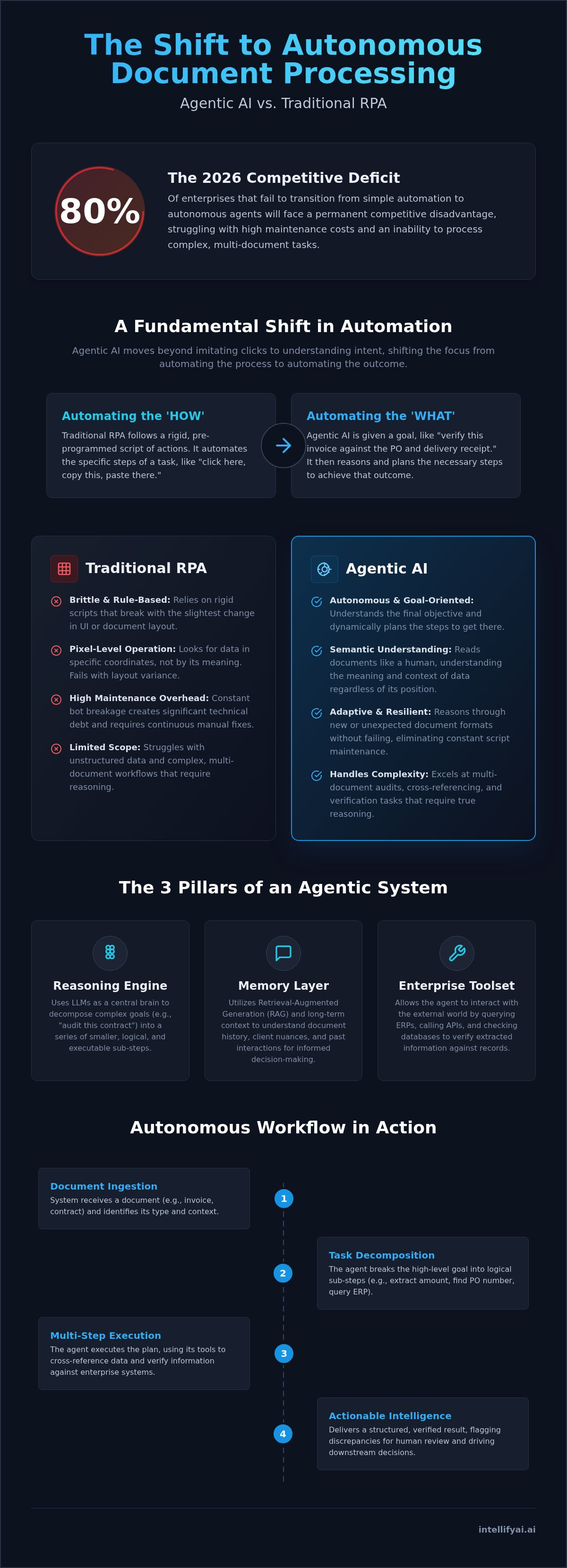
By 2026, 80% of enterprises that fail to move from simple chat interfaces to autonomous agents will face a permanent competitive deficit. This reality forces a critical evaluation of your current automation stack. You likely understand the frustration of maintaining RPA scripts that break whenever a document layout shifts by a few pixels. This constant bot breakage creates high maintenance costs and limits your ability to process complex, multi-document tasks that require actual reasoning.
Comparing agentic ai vs rpa for document processing reveals that the former is not just a tool upgrade, but a shift from automating the how to automating the what. You've likely reached the ceiling of what traditional bots can achieve. This article provides a roadmap to transition from brittle scripts to autonomous, reasoning-based workflows that adapt to change. We will explore the architectural requirements for 2026, the reduction in total cost of ownership, and how the i_Nova platform enables auditable, human-in-the-loop governance at scale. It's time to move beyond simple imitation and embrace true document intelligence.
Key Takeaways
• Move beyond passive data extraction by understanding the shift toward active reasoning, where autonomous systems use LLMs to plan and execute complex document tasks.
• Analyze the architecture of autonomous workflows, focusing on how task decomposition allows agents to break down multi-document audits into logical, manageable sub-steps.
• Evaluate the strategic trade-offs of agentic ai vs rpa for document processing, specifically how reasoning models eliminate the technical debt of maintaining thousands of brittle templates.
• Establish a secure deployment roadmap using AI strategy consulting to integrate human-in-the-loop governance and robust MLOps within your enterprise framework.
• Discover how the i_Nova platform serves as a technical foundation for unstructured intelligence, bridging the gap between abstract AI theory and measurable business results.
What is Agentic AI for Document Processing?
Agentic AI represents a fundamental shift in how enterprises handle unstructured data. Unlike traditional systems that simply pull text from predefined boxes, Agentic AI uses Large Language Models (LLMs) as a reasoning engine to plan and execute multi-step workflows. It doesn't just read; it understands intent. While legacy Intelligent Document Processing (IDP) relies on passive extraction, Agentic AI employs active reasoning to solve business problems autonomously.
When evaluating agentic ai vs rpa for document processing, the primary distinction lies in autonomy and goal-orientation. A goal-oriented agent understands that an invoice isn't just a set of strings, but a financial obligation that requires verification against a purchase order and a delivery receipt. The i_Nova platform serves as the foundation for this transformation, converting raw document data into actionable intelligence that drives downstream decision-making without constant human intervention.
Reasoning, Memory, and Toolsets: The Agentic Core
The core of an agentic system consists of three sophisticated pillars. First, the reasoning engine uses LLMs as a central brain to decompose complex document tasks into smaller, logical steps. Second, the memory layer utilizes Retrieval-Augmented Generation (RAG) and long-term context to understand document history and specific client nuances. Finally, the toolset allows agents to interact with the broader enterprise environment. They can query ERPs, call APIs, or check databases to verify that the information they've extracted is accurate and compliant with internal records.
The 2026 Shift: Why RPA is No Longer Enough
Historically, Robotic Process Automation (RPA) provided a reliable way to automate repetitive, rule-based tasks. However, these bots struggle with the hyper-variability of modern business documents. RPA operates at the pixel level, looking for data in specific coordinates. If a vendor changes an invoice layout by even a small margin, the bot breaks, leading to high maintenance costs and operational friction.
Agentic AI moves beyond these rigid constraints by focusing on semantic understanding rather than visual templates. It recognizes the meaning of the content regardless of where it appears on the page. In the context of agentic ai vs rpa for document processing, the choice becomes clear for enterprises facing high-volume, variable workflows. Agentic AI allows workers to focus on high-value creative strategy by removing repetitive document burdens.
The Architecture of Autonomous Document Workflows
Building a resilient document strategy requires moving beyond linear scripts. In an agentic workflow, the lifecycle begins with document ingestion, where the system identifies the file type and situational context. Instead of following a rigid path, the agent performs task decomposition. It breaks a complex request, such as a multi-document compliance audit, into logical sub-steps. The agent extracts terms from a contract, cross-references them with regulatory updates, and flags discrepancies. This fundamental shift in agentic ai vs rpa for document processing allows the system to handle unforeseen variables that would typically crash a standard bot.
This architecture is inherently dynamic. When an agent encounters a new document format, it doesn't fail; it reasons through the structure. It acts as a Transforming Enterprise Automation catalyst by linking disparate data points into a unified narrative. To implement these sophisticated loops, many organizations leverage specialized Agentic AI engineering services to ensure the underlying stack is cloud-native, secure, and scalable across global operations.
Layout-Aware Reasoning and Vision Models
Traditional OCR often fails when documents contain nested tables, complex forms, or hand-annotated notes. Vision-first models solve this by treating the document as a visual entity rather than a simple string of characters. They preserve structural context, understanding that a signature's proximity to a specific clause changes its legal weight. Whether processing messy PDFs or complex spreadsheets, these agents maintain the relationship between data points. This ensures that the semantic meaning of the layout remains intact during extraction.
Human-in-the-Loop: Designing the Oversight Layer
True autonomy doesn't mean removing human oversight. It means optimizing it. Effective architectures define clear confidence thresholds for every task. If an agent's reasoning falls below a set percentage, it triggers a request for human review. To maintain transparency, agents provide visual grounding, offering direct citations and proof for every data point extracted. This creates a collaborative environment where humans act as strategic validators rather than data entry clerks. If you're ready to refine your internal governance, exploring our latest insights on AI strategy can provide a clear path forward.
Agentic AI vs. RPA: A Strategic Comparison for 2026
Strategic decision-making in 2026 requires a clear framework for evaluating the leap from script-based automation to autonomous reasoning. When analyzing agentic ai vs rpa for document processing, the most significant factor is the elimination of technical debt. Traditional RPA requires the creation and maintenance of thousands of individual templates. Every time a vendor updates a portal or a layout, the bot fails. In contrast, a single reasoning model can generalize across infinite variations. For a deeper look at how these systems operate, read our guide on What Is Agentic AI? to understand the executive implications of autonomous workflows.
Deployment speed also shifts the ROI calculation. RPA projects often stall during the "template creation" phase, where every document type requires a custom script. Agentic AI uses prompt-based generalization. This allows for rapid deployment across diverse business units without the need for bespoke coding for every new form. This speed ensures that your enterprise stays ahead of the curve while maintaining the stability of your core operations.
Templates vs. Reasoning: The Efficiency Gap
RPA is inherently brittle. A shift of just two pixels in an invoice layout can render a standard bot useless, forcing IT teams into a reactive cycle of constant maintenance. This creates a hidden cost that often outweighs the initial automation benefits. Agentic AI introduces "Zero-Shot" capability, allowing the system to process document formats it has never encountered before. It doesn't look for coordinates; it looks for meaning. This reduces the manual hours spent on "bot-fixing" by allowing one model to handle what previously required hundreds of distinct scripts. IT resources are finally freed to focus on high-value architectural improvements rather than routine repairs.
Total Cost of Ownership (TCO) Analysis
The initial engineering investment for Agentic AI is often higher than a simple RPA pilot. However, the long-term maintenance savings are transformative. Scaling an RPA solution typically requires a linear increase in infrastructure and human oversight. Agentic systems, particularly those built on the i_Nova platform, allow enterprises to process millions of documents with minimal incremental costs. This scalability ensures that growth doesn't lead to a corresponding explosion in operational overhead.
This operational velocity directly impacts customer experience (CX) by reducing document turnaround times from days to seconds. Measurable gains in financial returns become evident as document-heavy processes, like mortgage approvals or insurance claims, accelerate. Enterprises that embrace this shift move from managing a library of scripts to governing a fleet of intelligent agents. This is a move toward a frictionless, automated future where technology acts as a force multiplier for human potential.
Implementing Agentic AI: Governance, GRC, and MLOps
Deploying autonomous systems requires more than technical skill. It demands a rigorous governance framework. When comparing agentic ai vs rpa for document processing, the complexity of governance increases as systems move from following rules to making decisions. An enterprise roadmap must prioritize security from the first ingestion point. Engaging in AI strategy consulting is essential to establish the necessary guardrails that prevent autonomous agents from operating outside of business intent.
Compliance is non-negotiable. Fully automated document pipelines must adhere to SOC2 and GDPR standards to protect sensitive data. This is especially critical as most obligations for high-risk AI systems under the EU AI Act come into force on August 2, 2026. Supporting these agents requires a foundation of Enterprise Modernization, ensuring your infrastructure is as agile as the intelligence it hosts. This modernization ensures that the shift in agentic ai vs rpa for document processing results in long-term stability rather than temporary gains.
Establishing the GRC Framework
Data privacy remains the cornerstone of modern GRC. Systems must handle Personally Identifiable Information (PII) according to global regulations like GDPR and CCPA. However, privacy is only the first step. Explainability is vital. "Black Box" AI is unacceptable for enterprise audits. Every decision an agent makes must be traceable. We provide comprehensive audit trails for every document processed, ensuring that stakeholders can verify the logic behind every autonomous action.
MLOps for Agentic Stability
Stability in production requires advanced MLOps. We monitor for "Agent Drift," which occurs when accuracy degrades as document types evolve or external data environments change. Maintaining performance over time requires strict version control for prompts, model configurations, and tool access. Additionally, FinOps plays a critical role in 2026. We optimize cloud costs for high-volume document reasoning tasks, ensuring that the strategic value of automation isn't eroded by inefficient infrastructure usage. If you're ready to secure your automation future, contact our engineering team to design your GRC-compliant roadmap.
Future-Proofing with IntellifyAi's i_Nova Platform
The transition from legacy automation to autonomous intelligence requires more than just new software. It demands a partner who understands the bridge between abstract AI theory and measurable enterprise results. IntellifyAi acts as your Strategic Architect. We provide the technical foundation and the consulting expertise needed to navigate the complexities of agentic ai vs rpa for document processing. While RPA remains a tool for simple, static tasks, our i_Nova platform enables a future where documents drive their own workflows through active reasoning.
I_Nova: Actionable Intelligence from Unstructured Data
The i_Nova platform is engineered to handle the hyper-variability of modern enterprise data. It manages multi-format complexity with ease, processing everything from dense legal contracts to intricate technical schematics and hand-annotated spreadsheets. Unlike traditional systems that struggle with non-standard layouts, i_Nova uses vision-first models to maintain structural context and semantic meaning. This ensures that the data extracted is not just accurate, but contextualized for your specific business logic.
Seamless integration is a core pillar of our architecture. We connect agentic outputs directly into your existing ERP and CRM ecosystems, ensuring that intelligence flows where it is needed most. Our cloud-native infrastructure provides the resilience required to process document volumes at a global scale. This allows your enterprise to scale operations without the linear increase in technical debt associated with maintaining thousands of brittle RPA scripts. By modernizing your stack, you turn unstructured data into a strategic asset.
The Strategic Architect Partnership
We don't just deliver tools; we build the 2026 roadmap for your digital transformation. Our AI strategy consulting services ensure that your move toward agentic systems is secure, compliant, and aligned with long-term financial goals. We utilize a Proof of Value (PoV) approach to minimize risk. This methodology allows us to prove the ROI of agentic workflows in a controlled environment before moving to full-scale deployment. This ensures that every investment you make is grounded in practical, verifiable performance gains.
The choice between agentic ai vs rpa for document processing is a choice between stagnation and growth. RPA served its purpose for the previous decade, but the next era belongs to systems that can reason, plan, and adapt. We provide the custom engineering services required to tailor these agents to your unique industry nuances, from healthcare compliance to financial auditing. It's time to liberate your workforce from repetitive burdens and unlock their potential for high-value creative work. Contact IntellifyAi to initiate your agentic document transformation.
Securing Your Position in the Autonomous Future
The transition from static automation to autonomous intelligence is no longer a theoretical choice; it's a strategic necessity. By 2026, the competitive gap between enterprises using brittle scripts and those leveraging reasoning-based agents will be insurmountable. Our analysis of agentic ai vs rpa for document processing confirms that true value lies in systems that understand business intent rather than just pixel coordinates. You've seen how the right architecture eliminates technical debt and allows your team to focus on high-value creative strategy.
IntellifyAi stands ready as your Strategic Architect. We provide the i_Nova platform for scalable document intelligence alongside deep expertise in MLOps and enterprise GRC. Our global engineering team ensures your transition is secure, compliant, and results-oriented. Don't let legacy limitations dictate your operational velocity or stifle your growth potential. It's time to build a frictionless future where technology serves as a genuine force multiplier for your workforce. Book a Strategic AI Consultation today to initiate your document transformation. Your enterprise deserves a foundation built for the next decade of innovation.
Frequently Asked Questions
What is the primary difference between Agentic AI and traditional RPA for documents?
The main distinction between Agentic AI and traditional RPA lies in decision-making autonomy. RPA mimics human keystrokes to follow rigid, rule-based paths; it breaks when layouts change. Agentic AI uses Large Language Models to reason through document intent and adapt to variations. When comparing agentic ai vs rpa for document processing, the shift is from automating how a task is done to automating what the business goal is.
Can Agentic AI handle handwritten or poorly scanned documents?
Yes, Agentic AI systems like the i_Nova platform excel at processing low-quality scans and handwritten text. Traditional OCR often fails on messy inputs because it lacks contextual awareness. Vision-first models analyze the entire document layout to interpret characters within their semantic environment. This allows for high-accuracy extraction from complex forms, hand-annotated spreadsheets, and historical records that would typically require manual data entry or result in significant errors.
How do you prevent hallucinations in autonomous document processing?
Hallucinations are mitigated through a combination of Retrieval-Augmented Generation (RAG) and strict confidence thresholds. We design workflows where agents provide visual grounding and direct citations for every extracted data point. If an agent's confidence score falls below a predefined level, the system automatically triggers a human-in-the-loop review. This ensures that autonomous document workflows remain accurate, auditable, and grounded in the source material without the risk of fabricated information.
Is Agentic AI compliant with GDPR and SOC2 standards?
Agentic AI is fully compliant with GDPR and SOC2 standards when implemented within a GRC-compliant framework. Our engineering services prioritize data privacy by ensuring that sensitive information is handled according to global regulations. We maintain rigorous audit trails for every decision made by the AI; this transparency is critical for enterprise audits. It also meets the high-risk system requirements set by the EU AI Act, ensuring long-term operational security.
What are the most common use cases for Agentic IDP in the finance sector?
In the finance sector, Agentic IDP streamlines complex workflows such as mortgage application processing, KYC verification, and cross-border compliance audits. These tasks involve multi-document reasoning that traditional bots cannot handle. By automating the extraction and verification of data across disparate financial statements and legal contracts, enterprises significantly reduce turnaround times. This shift in agentic ai vs rpa for document processing allows financial institutions to scale their operations without a linear increase in overhead costs.
How long does it take to deploy an agentic document workflow compared to RPA?
Deploying an agentic workflow is often faster than traditional RPA because it eliminates the need for bespoke templates. RPA requires developers to script every possible document variation, which can take weeks per format. Agentic systems use prompt-based generalization to understand new layouts instantly. While the initial architectural setup is more complex, the ability to process thousands of different document types without custom coding results in a shorter time-to-value for the enterprise.
Does Agentic AI replace human workers in the back office?
Agentic AI does not replace human workers; it acts as a cognitive force multiplier. By removing the burden of repetitive document processing, these tools allow your team to focus on high-value creative strategy and complex decision-making. We frame technology as a liberating force that unlocks human potential. The goal is a collaborative environment where agents handle monotonous data extraction while humans provide the strategic oversight and final validation required for complex tasks.
What infrastructure is required to run Agentic AI for document processing?
Running Agentic AI requires a modernized, cloud-native infrastructure capable of supporting high-volume reasoning tasks. This stack typically involves containerized environments and robust data engineering to create a unified source of truth. Our i_Nova platform is designed for this level of scalability, ensuring that your document intelligence workflows remain resilient across global operations. A foundation in enterprise modernization is essential to manage the computational demands of these autonomous agents.








.svg)