
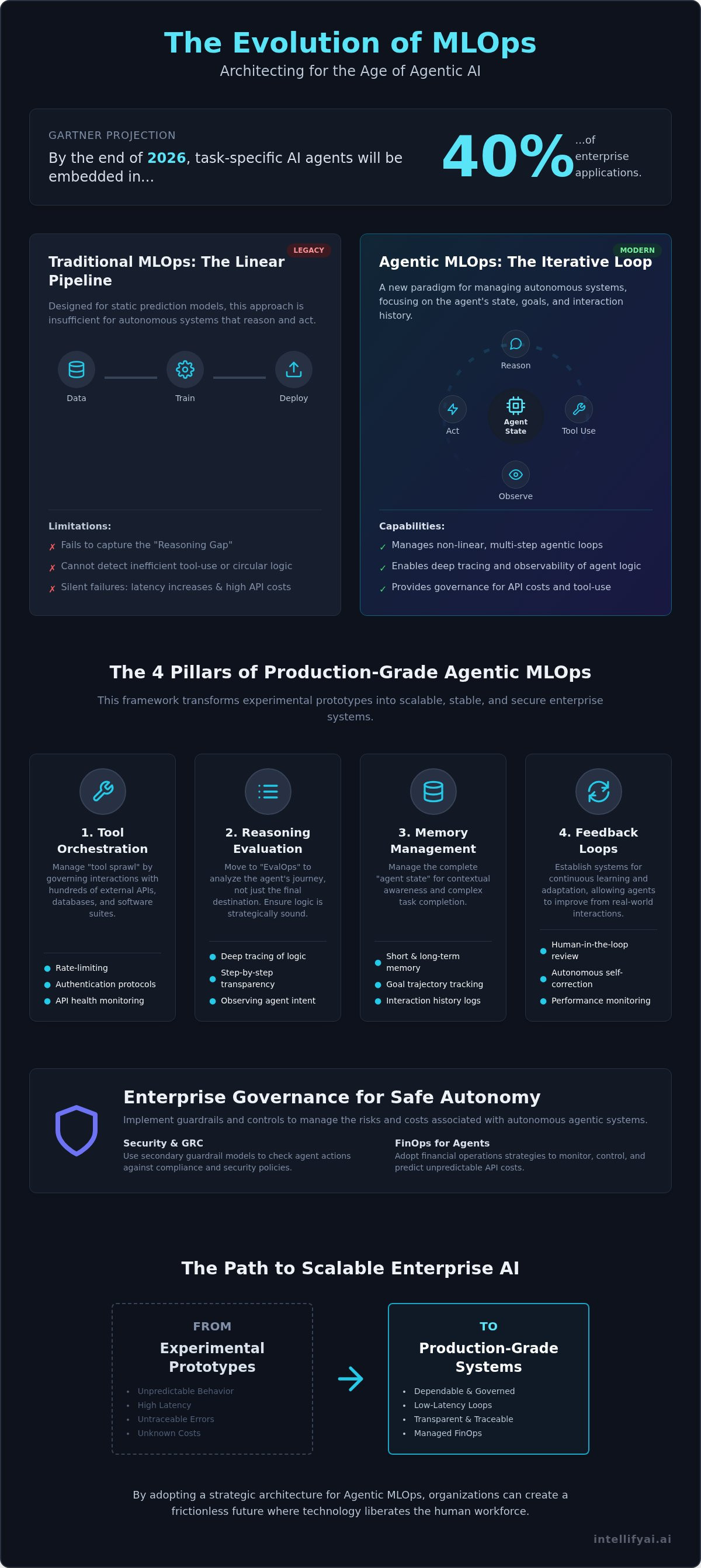
Gartner projects that task-specific AI agents will be embedded in 40% of enterprise applications by the end of 2026. As organizations race to integrate these autonomous systems, the limitations of traditional deployment become clear. You've likely dealt with high latency in reasoning loops or the difficulty of tracing errors in tool-use. Implementing mlops for agentic ai is the only way to solve these bottlenecks and move beyond the prototype phase. It's time to treat agentic reasoning as a core architectural component rather than an experimental add-on.
This article provides a masterclass in transitioning from static model management to scalable, production-grade Agentic AI orchestration. You'll learn how to build a robust AgentOps framework that reduces operational friction and manages unpredictable API costs. We'll preview the specific steps required to architect enterprise-grade autonomous workflows that are both innovative and dependable. By the end of this guide, you'll have a clear path to creating a frictionless future where technology serves as a liberating force for your human workforce.
Key Takeaways
• Shift from traditional linear pipelines to iterative agentic loops that govern autonomous reasoning and complex tool interactions.
• Master the specialized infrastructure of mlops for agentic ai to solve high latency and trace errors in production-grade workflows.
• Implement EvalOps and deep tracing to capture the step-by-step logic of your agents, ensuring every autonomous action is transparent.
• Establish enterprise governance through secondary guardrail models and FinOps strategies to manage the costs of autonomous API calls.
• Transition from experimental prototypes to scalable enterprise systems by adopting a strategic architecture for long-term viability.
Beyond Static Models: Why Agentic AI Needs a New MLOps Paradigm
The evolution of MLOps has reached a critical inflection point. In 2026, the industry has moved beyond the simple deployment of static prediction models. We're now architecting systems that don't just predict, but reason and act. This shift necessitates a specialized approach to mlops for agentic ai, where the infrastructure must support autonomous decision-making rather than just data inference. Traditional monitoring focuses on input-output drift, yet it fails to capture the "Reasoning Gap." This gap occurs when an agent follows a logical path that's technically valid but strategically flawed. Identifying these logic errors requires a transition from monitoring data to observing intent.
To better understand the infrastructure requirements of these systems, watch this breakdown of real-world use cases:
The Failure of Linear MLOps in Autonomous Systems
The legacy pipeline of Data, Train, and Deploy is insufficient for the demands of 2026. Calling "Model.fit()" isn't the finish line. It's barely the starting block. Linear pipelines assume a predictable, one-way path from input to result. Autonomous agents operate in multi-step loops that are inherently non-linear. Standard drift detection can't flag when an agent's tool-use becomes inefficient or when its internal reasoning starts to circularize. These failures are often silent. They manifest as increased latency or ballooning API costs rather than simple accuracy drops. Without a loop-based framework, your enterprise remains stuck in the prototype phase, unable to scale unpredictable reasoning paths.
Transitioning to Agent-Centric Infrastructure
Modernizing your stack requires a shift from managing model weights to managing the "agent state." This includes the agent's memory, its current goal trajectory, and its interaction history. You need robust Tool Governance to ensure agents don't trigger unauthorized API calls or corrupt database schemas. By implementing Agentic AI Engineering Services, enterprises can build the guardrails necessary for safe autonomy. This infrastructure transforms technology from a daunting complexity into a liberating force. Agentic MLOps is the governance of autonomous decision-making loops. It allows your team to focus on high-value creative work while the system manages the burden of repetitive execution.
The 4 Pillars of a Production-Grade Agentic MLOps Architecture
Transitioning from a successful pilot to a scalable enterprise solution requires more than just a capable model. It demands a structural foundation that ensures stability, security, and measurable performance. A production-grade framework for mlops for agentic ai rests on four critical pillars: tool orchestration, reasoning evaluation, memory management, and feedback loops. These components transform a solitary model into a sophisticated Agentic AI system capable of executing complex business logic at scale. Without these pillars, autonomous workflows remain fragile and unpredictable.
Tool Orchestration and API Governance
In 2026, enterprise agents rarely operate in isolation. They interact with hundreds of external APIs, legacy databases, and proprietary software suites. This creates "tool sprawl," where managing the permissions and health of these connections becomes a full-time operational burden. Effective orchestration requires implementing strict rate-limiting and authentication protocols at the agent-tool interface. You don't want an autonomous loop triggering thousands of expensive API calls due to a logic error. Robust data engineering foundations are essential here. They ensure that the tools provided to the agent have reliable, high-quality access to the data they need to function correctly. Governance isn't a bottleneck. It's the safety net that allows for true autonomy.
Reasoning Evaluation: The New Gold Standard
Traditional evaluation metrics focus on the final output. For autonomous agents, the journey is just as important as the destination. We've moved toward "EvalOps," a framework specifically designed for testing agentic logic. This involves Trajectory Evaluation, where we analyze whether the agent took the most efficient and logical steps to reach a conclusion. Did it use the right tool? Did it interpret the tool's output correctly? To answer these questions, we use synthetic data generators to stress-test reasoning paths across thousands of edge cases. This level of rigor is a core component of professional Agentic AI Engineering Services, ensuring that logic errors are caught in staging rather than production.
Beyond orchestration and evaluation, long-term viability depends on sophisticated memory management and continuous feedback. Memory management involves governing the balance between short-term context windows and long-term vector storage. This ensures the agent retains relevant history without becoming bogged down by "context noise." Finally, integrating human-in-the-loop (HITL) feedback loops allows for the continuous refinement of agent behavior. When an agent encounters an ambiguous situation, a human expert provides the necessary steer, which is then used to fine-tune the agent's reasoning for future tasks. This collaborative relationship unlocks human potential by removing the burden of repetitive execution. If you're looking to modernize your operations, exploring custom Agentic AI Engineering Services can provide the bridge you need to move from experimental prototypes to dependable enterprise systems.
Tracing, Observability, and the "AgentOps" Evolution
The rise of autonomous workflows has birthed a new discipline. By 2026, the AgentOps Evolution has become the standard for managing the non-linear behavior of reasoning models. While traditional mlops for agentic ai provides the deployment backbone, AgentOps focuses specifically on the tracing and observability of autonomous loops. We aren't just monitoring if a model is up or down. We're monitoring the health of its decision-making process. This involves capturing the "internal monologue" of an agent to ensure its path toward a goal remains aligned with business objectives. As businesses build their "silicon workforce," the ability to audit these autonomous decisions becomes a non-negotiable requirement for enterprise security.
Capturing the Reasoning Chain
Traditional Application Performance Monitoring (APM) tools are built for deterministic software. They track requests and responses. Agents, however, generate a series of internal thoughts and tool-calls before providing a final answer. Standardizing trace formats for these internal monologues is essential for debugging. Observability in 2026 is about "why" an agent acted, not just "what" it did. This deep tracing allows engineers to pinpoint exactly where a reasoning chain broke down. It might be a misinterpreted tool output or a logical hallucination. Integrating these traces into your broader MLOps Pipelines ensures that every autonomous action is logged, auditable, and repeatable. It transforms a "black box" into a transparent workflow.
Managing State and Context Window Decay
Maintaining agent state across long-running tasks is a significant technical hurdle. In 2026, agents often operate over days or weeks, requiring infrastructure that supports persistent memory beyond a single session. Context window decay occurs when an agent loses track of its primary goal due to the accumulation of irrelevant history. Strategic Architects solve this by optimizing vector database retrieval. We don't just dump everything into a vector store. We implement intelligent "forgetting" mechanisms and priority-based retrieval. This keeps the agent's context window focused on high-value data, reducing latency and preventing reasoning drift. Robust mlops for agentic ai requires this level of sophisticated memory governance to maintain long-term viability. By managing state effectively, you ensure your agents remain focused on delivering measurable business impact without the friction of redundant processing.
Enterprise Governance: Security, GRC, and FinOps for Agents
Governance is the primary hurdle for serious enterprises looking to scale autonomous workflows. The question "How do we control an agent that acts on its own?" is valid but entirely solvable. We address this through a layered approach to mlops for agentic ai. Instead of relying on a single model, we implement "Guardrail Models." These are secondary, specialized models that monitor the primary agent's output and intent in real-time. They act as a digital supervisor, ensuring compliance before any action is executed. This architectural choice aligns perfectly with our AI Enterprise Governance framework. It ensures that autonomy never comes at the expense of accountability.
Security and Prompt Injection Defense
Securing the agent-tool interface is a top priority in 2026. Malicious instructions can bypass standard filters if they're embedded within a data payload. We implement strict Role-Based Access Control (RBAC) specifically for autonomous agents. This limits an agent's ability to access sensitive data or perform high-risk actions without explicit, secondary verification. Achieving SOC2 and GDPR compliance in this context requires a verifiable audit trail of every reasoning step. By August 2, 2026, the EU AI Act mandates that high-risk systems have built-in transparency. Our framework ensures your autonomous workflows meet these rigorous standards while maintaining operational velocity.
Agentic FinOps: Cost Monitoring and Containment
Autonomous agents can quickly deplete cloud budgets if left unchecked. Infinite reasoning loops are a real risk that traditional monitoring often misses. FinOps for agents requires tracking token usage at the task level rather than just the model level. We implement "circuit breakers" that automatically halt an agent if it exceeds a predefined reasoning depth or cost threshold. This prevents runaway processes and ensures that every dollar spent is tied to a measurable business outcome. Identifying high-ROI agentic workflows allows you to justify operational spend and focus resources on the most impactful automation. This strategic oversight is essential for long-term viability. If you're ready to secure your autonomous future, consider our AI Strategy & Consulting to build a governance model that actually works.
Scaling Agentic AI with IntellifyAi Engineering
Transitioning from an experimental pilot to a globally scalable system requires more than just technical skill. It demands a Strategic Architect who understands the intersection of business outcomes and advanced autonomy. At IntellifyAi, we specialize in bridging the gap between prototype and production through our comprehensive Agentic AI Engineering Services. We don't just deploy models. We build the resilient infrastructure necessary for mlops for agentic ai to thrive in high-stakes enterprise environments. Our approach ensures that your autonomous workflows aren't just innovative but also dependable and secure.
Our i_Nova platform serves as a benchmark for production-grade intelligent document processing (IDP). By applying the very principles of mlops for agentic ai discussed throughout this guide, i_Nova extracts intelligence with a level of precision that traditional systems can't match. It demonstrates the power of a "silicon workforce" when governed by a robust architectural framework. Success in 2026 isn't about the number of agents you deploy. It's about the stability and ROI of those agents. This is where our AI Strategy Consulting plays a pivotal role, helping you navigate the complexities of the agentic frontier with confidence.
From Proof-of-Value to Global Scale
Scaling requires a clear roadmap that prioritizes long-term viability. Our CX Improvement Framework leverages agentic MLOps to power sophisticated voice agents that handle complex customer interactions with human-like reasoning. We also focus on modernizing legacy back-office systems by integrating autonomous agentic layers that remove the burden of repetitive tasks. This isn't about replacing human labor. It's about unlocking human potential by providing tools that manage the heavy lifting of data processing and decision-making loops. We help you move beyond the "prototype phase" to achieve measurable impact across your entire organization.
Partnering for the Agentic Future
Global enterprises choose IntellifyAi for end-to-end cloud-native modernization. Our managed MLOps services significantly reduce technical debt, allowing your team to focus on high-value creative work. We provide the stability and security required for serious enterprise operations, ensuring your digital transformation is a lasting investment rather than a temporary fix. Don't let the complexity of autonomous workflows stall your progress. Contact IntellifyAi today to architect your agentic future and lead your industry into the next era of intelligence.
Architecting the Autonomous Enterprise
The shift from static models to autonomous reasoning loops is the definitive challenge for 2026. Mastering mlops for agentic ai ensures that your systems don't just predict outcomes but actively execute strategic business logic. By prioritizing robust tool orchestration, deep tracing through AgentOps, and rigorous governance, you transform daunting complexity into a liberating force for your workforce.
With global expertise across the UK, USA, India, and the UAE, IntellifyAi acts as the Strategic Architect for this enterprise transformation. Our flagship i_Nova platform demonstrates the power of production-grade agentic IDP, while our specialized Agentic AI Engineering Services provide the stability required for national scale operations. Don't let your digital transformation stall in the prototype phase. Secure your organization's long-term relevance by building on a foundation of professional excellence and technical depth.
Architect your enterprise agentic future with IntellifyAi Engineering. The future of automation is here. It's time to build it with a partner you can depend on.
Frequently Asked Questions
What is the main difference between MLOps and AgentOps in 2026?
MLOps manages the lifecycle of static models, focusing on training and deployment. AgentOps is the 2026 evolution that governs autonomous reasoning loops and tool-use errors. It's the specific subset of mlops for agentic ai that monitors an agent's intent rather than just its data drift. While traditional pipelines are linear, AgentOps handles the iterative nature of agents that act, observe, and correct themselves in real-time.
How do you evaluate the reasoning capabilities of an AI agent in production?
You evaluate reasoning through Trajectory Evaluation, which audits the steps an agent takes to reach a goal. Instead of just checking the final answer, engineers analyze the internal monologue and tool-call sequence. Using synthetic data generators to stress-test these logic paths is essential for production-grade systems. This ensures the agent follows the most efficient path and doesn't hallucinate logical connections during complex, multi-step tasks.
What are the best tools for building an agentic MLOps pipeline today?
The most effective pipelines in 2026 utilize LangGraph 1.2.6 for orchestrating non-linear workflows and MLflow 3.15.2 for tracking reasoning experiments. For managing complex agent states, LangChain 1.3.18 provides the necessary framework for tool integration. These tools must work in concert within a specialized architecture for mlops for agentic ai. This allows enterprises to move beyond experimental scripts toward scalable, dependable autonomous systems that deliver measurable business impact.
How can enterprises prevent autonomous agents from incurring excessive API costs?
Enterprises use circuit breakers to stop autonomous reasoning loops that exceed a specific token threshold or cost limit. FinOps strategies now focus on tracking expenditure per agentic task rather than just per model call. By setting granular budget caps on tool-use and API interactions, you prevent runaway processes from depleting cloud resources. High-ROI workflows are prioritized through continuous monitoring to ensure that operational spend remains aligned with strategic returns.
What are the security risks associated with giving agents access to external tools?
Giving agents access to external tools introduces risks like prompt injection and unauthorized data exfiltration. An agent might be manipulated into executing a malicious tool-call if it interprets a data payload as a direct instruction. To mitigate this, implement strict Role-Based Access Control (RBAC) and secondary guardrail models. These layers verify the agent's intent before any high-stakes action is finalized, ensuring compliance with SOC2 and GDPR standards.
Is human-in-the-loop (HITL) still necessary for agentic MLOps?
Human-in-the-loop (HITL) is vital for refining agentic logic and handling ambiguous edge cases. While agents are autonomous, they still require human steering for high-stakes decisions or complex ethical considerations. This collaborative relationship doesn't replace human workers; it allows them to focus on high-value creative work. The feedback from human experts is fed back into the pipeline to improve the agent's reasoning capabilities for future autonomous tasks.
How does Agentic AI impact Intelligent Document Processing (IDP)?
Agentic AI shifts Intelligent Document Processing (IDP) from basic pattern matching to sophisticated intelligence extraction. Platforms like i_Nova use reasoning agents to understand context and intent within unstructured documents. This allows for complex cross-referencing and data validation that traditional IDP systems can't perform. The result is a frictionless, automated workflow that handles diverse document formats with a level of precision that matches human expert analysis.
What role does data engineering play in supporting agentic workflows?
Data engineering is the foundation of every successful agentic workflow. Agents require clean, well-governed data to interact with tools and make logical decisions. If the underlying data pipelines are flawed, the agent's reasoning will be built on inaccurate information. Professional engineering services ensure that the data fed into the agent's context window is reliable and high-quality. This reduces the risk of logical hallucinations and ensures long-term operational stability.









.svg)