
By 2026, the era of the scripted chatbot has officially ended. If your customer service interface still sounds like a recording and acts like a basic FAQ page, you aren't just behind the curve; you're losing market share to competitors who treat voice as a functional layer of their backend orchestration. You likely recognize the frustration of high latency making interactions feel robotic or the risk of agents "hallucinating" during critical multi-step tasks. Integrating advanced AI with legacy contact center stacks remains a significant hurdle for most enterprise engineering teams looking for stability and performance.
This guide demonstrates how to deploy sophisticated voice agentic ai for customer service that doesn't just talk, but executes. You'll learn to move beyond simple generative responses toward autonomous agents that navigate complex workflows and deliver measurable financial returns. We will break down the engineering requirements for sub-800ms latency, secure legacy integration, and the strategic framework needed to transform your contact center into a high-velocity engine for growth. By focusing on custom engineering over off-the-shelf software, you can finally unlock the true potential of your human workforce and build a lasting investment in relevance.
Key Takeaways
• Distinguish between simple generative LLM wrappers and true agentic systems that autonomously plan and execute complex customer workflows.
• Master the technical architecture required for voice agentic ai for customer service, including the orchestration of low-latency reasoning engines with your existing CRM and ERP stacks.
• Evaluate the strategic trade-offs between off-the-shelf software and custom engineering to avoid the common pitfalls of limited customization and scaling difficulties.
• Execute a production-ready roadmap using a CX Improvement Framework to identify high-impact automation opportunities and optimize data through Retrieval-Augmented Generation.
• Transform your contact centre from a cost centre into a growth engine by leveraging agentic intelligence to unlock human potential and drive measurable ROI.
From Generative to Agentic: The Evolution of Voice in CX
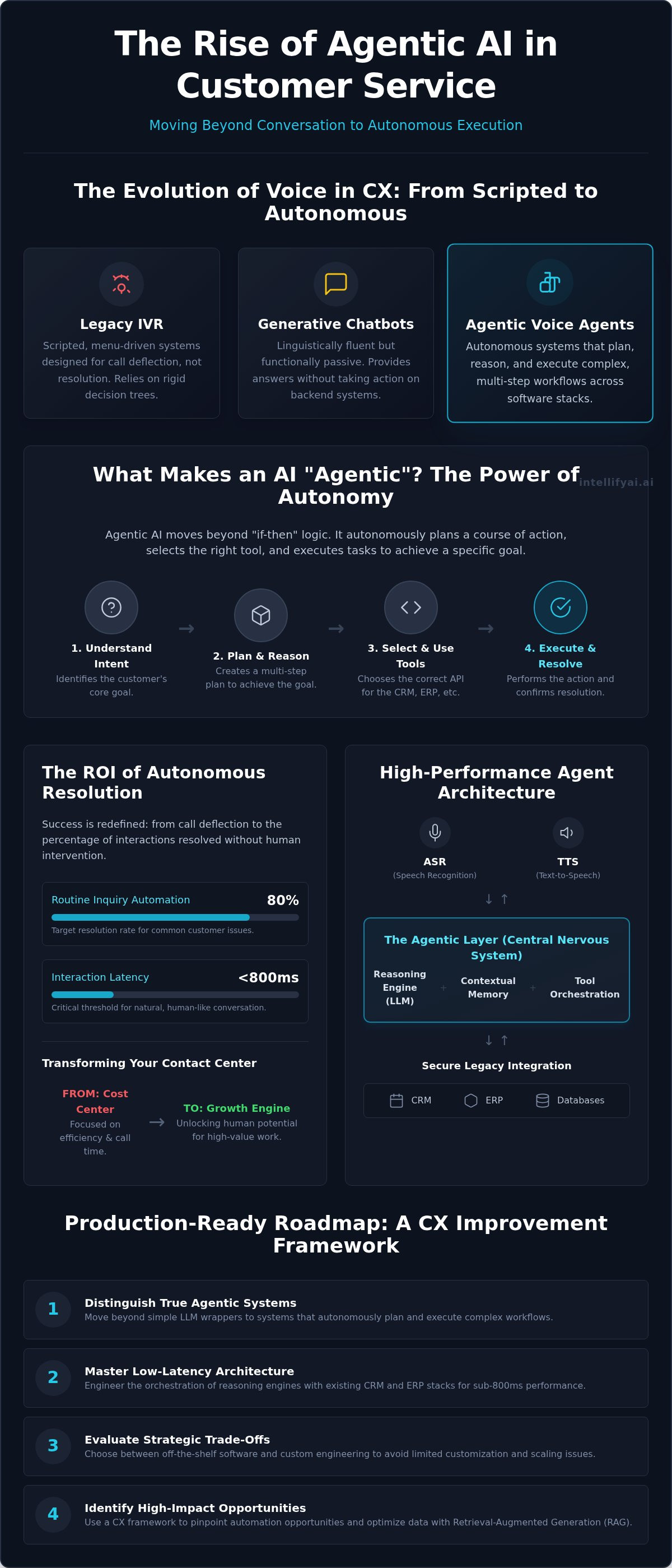
The transition to voice agentic ai for customer service marks a definitive shift in how enterprises approach communication. For decades, the evolution of voice in CX was stalled by rigid Interactive Voice Response (IVR) systems and basic chatbots that focused on deflection rather than resolution. These legacy tools relied on fixed decision trees; if a customer's request didn't fit a pre-defined path, the system failed. By 2026, the industry has moved beyond these limitations. Modern agentic AI doesn't just retrieve information. It plans, interacts with enterprise tools, and executes complex workflows with minimal supervision.
Many organizations initially fell into the "Generative Gap." They deployed simple Large Language Model (LLM) wrappers that were linguistically fluent but functionally paralyzed. These systems could explain a return policy with perfect grammar but couldn't actually initiate the return in a CRM. Agentic AI closes this gap by integrating reasoning with action. It doesn't just discuss the solution; it performs the necessary backend operations to resolve the customer's intent. To understand the 2026 landscape, consider these three core differences:
Legacy IVR
Scripted, menu-driven, and designed to keep customers away from agents.
Generative Chatbots
Conversational but passive; they provide answers without taking action.
Agentic Voice Agents
Autonomous systems that use reasoning to solve multi-step problems across different software stacks.
Why 'Agentic' is the New Standard for 2026
Autonomy is the defining trait of this new era. While traditional automation follows "if-then" logic, agentic systems possess independent decision-making capabilities. During a multi-turn call, the agent evaluates new data, determines the next logical step, and selects the correct internal tool to use. This requires sophisticated planning. Agentic AI is the precise intersection of high-level reasoning and reliable tool-execution. It allows businesses to move away from simple "if-this-then-that" rules toward dynamic, goal-oriented interactions that feel natural to the caller.
The ROI of Autonomous Resolution
Enterprises are now prioritizing autonomous resolution over traditional metrics like CSAT. In 2026, success is defined by how many interactions reach a final conclusion without human intervention. By resolving 80% of routine inquiries, voice agentic ai for customer service drastically reduces the cost-per-interaction. This shift lightens the burden on tier-2 support teams, allowing them to focus on high-value creative work. This isn't just a software update; it's a central business pillar. Custom engineering ensures these agents are deeply integrated into your unique environment, making them a lasting investment in operational stability.
The Architecture of a High-Performance Voice Agent
Building a robust platform for voice agentic ai for customer service requires more than just a collection of APIs. It demands a tightly orchestrated engineering stack where every component is optimized for speed and accuracy. The foundation consists of three core pillars: Automatic Speech Recognition (ASR), a Reasoning Engine powered by Large Language Models (LLMs), and Text-to-Speech (TTS) synthesis. While these handle the interface, the "Agentic Layer" acts as the central nervous system. It's here that the system determines intent, plans a course of action, and interacts with your CRM, ERP, and internal databases to resolve the query.
Contextual memory is what separates a 2026-era agent from its predecessors. A high-performance agent must maintain state across multi-step resolutions, remembering details from the start of the call or even from interactions that occurred months ago. This level of sophistication requires a data engineering framework built with security by design. By implementing contextual governance and strict guardrails, you ensure the agent remains compliant and accurate while navigating complex enterprise environments. For a deeper look at the technical requirements, you can explore our Agentic AI engineering services.
Tool-Use and API Orchestration
Execution is the primary goal of any agentic system. When a customer asks to update their account details or process a complex return, the agent doesn't just explain the steps; it triggers the necessary API calls to legacy systems. This shift toward operational autonomy is supported by research from the Harvard Business Review on Agentic AI, which highlights that the immediate value of these systems lies in their ability to optimize back-end operations. Success depends on building secure, low-latency connections that allow the agent to act as a reliable bridge between the customer and your internal records.
Latency Engineering for Natural Conversations
In 2026, latency is the most critical benchmark for success. The "Uncanny Valley" of voice occurs when response delays exceed 500ms, making the conversation feel disjointed and robotic. Sub-500ms latency is now a non-negotiable standard for enterprise deployments. Achieving this requires a cloud-native architecture and edge computing strategies that process data closer to the user. You must carefully balance reasoning depth with response speed. If the reasoning engine is too slow, the user experience suffers. If it's too fast but lacks depth, the agent may fail on complex tasks. Organizations ready to refine their infrastructure should consider strategic AI consulting to map out a high-velocity deployment plan.
Strategic Implementation: Buy vs. Build vs. Engineer
Selecting the optimal path for voice agentic ai for customer service is a high-stakes strategic decision. Most enterprises begin by evaluating off-the-shelf SaaS solutions. While these platforms offer rapid speed to market, they frequently impose a "customization ceiling" that restricts your ability to mirror unique brand voices or navigate complex internal processes. This limitation often drives teams toward the "Build Trap." Internal departments attempt to construct agents from scratch but soon find themselves overwhelmed by the rigorous demands of MLOps, real-time scaling, and the sub-500ms latency standards required for natural conversation.
The engineering approach provides a superior middle ground. By building custom agents on modular enterprise foundations, you achieve the precision of a bespoke solution without the operational risks of a DIY project. For high-volume contact centres, custom engineering delivers a significantly better ROI by eliminating restrictive per-minute licensing fees and ensuring the system is optimized for your specific resolution goals. It's a move from a temporary software implementation to the creation of a permanent, scalable business asset.
When to Choose Custom Agentic Engineering
Custom engineering is non-negotiable when your operations rely on proprietary data or unique industry-specific workflows that standard models cannot interpret. This level of tailoring is a core component of successful Enterprise Modernization efforts. This path ensures your organization maintains total ownership of the AI models and data governance, which is vital for regulatory compliance in 2026. If your competitive advantage depends on a specialized customer journey, you shouldn't compromise that experience with a generic template.
The Role of AI Strategy Consulting
Technical execution is only half of the equation; success requires a structured roadmap. Many enterprise projects fail in "pilot purgatory" because they lack a clear transition from Proof-of-Value to full-scale production. Engaging in professional AI strategy consulting helps align your voice agents with broader corporate objectives and financial targets. A disciplined engineering framework ensures that your voice agentic ai for customer service is not just a technical experiment, but a dependable driver of autonomous resolution and long-term enterprise relevance.
Deploying Voice Agents: A Roadmap to Production
Success in deploying voice agentic ai for customer service requires a disciplined four-step roadmap to transition from conceptual Proof-of-Value to a hardened production environment. Engineering teams must prioritize stability and scalability at every stage. Avoid the temptation to automate for novelty's sake. Instead, follow a logical progression that anchors technology in business-centric outcomes.
Step 1 begins with defining high-impact use cases using a CX Improvement Framework. Identify repeatable, high-volume workflows where autonomous resolution offers the highest financial return. Step 2 focuses on data preparation and the setup of Retrieval-Augmented Generation (RAG). This ensures the agent accesses real-time, accurate enterprise knowledge, effectively eliminating the risk of hallucinations. Step 3 involves engineering the 'Agentic Loop,' where the system's reasoning is translated into secure tool-use and backend action execution. Finally, Step 4 establishes continuous monitoring through MLOps pipelines to ensure the system remains performant as it scales.
Establishing Governance and Guardrails
Autonomous decision-making demands rigorous oversight. You must implement real-time auditability to track every voice interaction and reasoning path. Managing risk involves setting strict boundaries on the agent's authority, ensuring it knows exactly when to escalate to a human partner. Compliance with global standards like GDPR and SOC2 isn't an optional add-on; it must be baked into the core architecture. This proactive approach to governance reassures stakeholders that advanced technology remains a liberating, yet controlled, force within the enterprise.
Continuous Improvement through MLOps
The launch of voice agentic ai for customer service is merely the starting point for long-term optimization. Use call transcripts systematically to fine-tune reasoning engines and enhance the naturalness of the interaction. You must monitor for model drift and any subtle performance degradation in voice quality or response speed. Maintaining a high-velocity improvement cycle is essential for staying ahead of the curve. For a technical deep dive into building these resilient systems, consult our MLOps Pipelines guide.
Building a production-ready agentic system requires deep technical expertise and a focus on long-term viability. If your organization is ready to modernize its contact centre operations, explore our Agentic AI engineering services to begin your transformation.
Future-Proofing Your Contact Centre with IntellifyAi
IntellifyAi approaches voice agentic ai for customer service as a holistic philosophy rather than a simple software implementation. Our core mission is to empower human workers by removing the weight of repetitive, high-volume tasks. We don't view technology as a replacement for labor. Instead, it's a liberating force that allows your team to focus on high-value creative work and complex problem-solving. Custom engineering represents a lasting investment in enterprise relevance. It ensures your infrastructure is built for the specific needs of a growing company, providing a foundation that is both innovative and dependable.
Scaling your operations in 2026 requires moving beyond isolated tools. You must transition from a single voice agent to a multi-agent orchestrated ecosystem. This approach allows different specialized agents to collaborate, ensuring your voice agentic ai for customer service remains effective across every touchpoint. This level of sophistication turns your contact centre into a strategic asset that drives measurable growth. Ready to transform? Contact our Strategic Architects for a PoV engagement to begin your modernization journey.
Beyond Voice: The Multi-Modal Future
The evolution of enterprise intelligence extends far beyond audio interactions. To achieve true digital transformation, you must integrate your voice agents with Intelligent Document Processing. This integration creates a unified intelligence layer that bridges the gap between voice, chat, and document-based workflows. A customer might start a conversation on the phone and seamlessly transition to uploading documents that the agent analyzes in real-time. This frictionless exchange of information across channels ensures a consistent and professional experience for every client, regardless of how they choose to interact.
Partnering for Long-Term Success
Serious modernization requires moving away from transactional vendor relationships. You need a strategic engineering partner who understands the complexities of cloud-native environments and global scale. IntellifyAi brings deep technical expertise to every implementation, ensuring the stability and security of your operations. Our global presence allows us to support enterprises across diverse markets while maintaining a focus on the bottom line. We're committed to ethical AI and sustainable transformation, positioning your business as a leader in the next era of efficiency. We don't just provide tools; we build the central business pillars that define your future.
Architecting the Future of Autonomous CX
The transition to agentic intelligence represents a fundamental shift in enterprise operations. By 2026, the standard for success is no longer just fluency; it's the capacity to execute complex, multi-step workflows autonomously. Moving beyond simple LLM wrappers to a robust, integrated architecture is essential for achieving the sub-second latency and security that modern callers expect. This shift transforms your contact centre from a cost-heavy deflection point into a high-performance engine for growth.
Implementing voice agentic ai for customer service requires a partner who understands the nuances of Enterprise Modernization. IntellifyAi provides a global delivery model across the UK, USA, and UAE, specializing in the custom engineering needed to bridge abstract technical fields with practical business needs. We focus on sub-second latency engineering to ensure your agents remain natural and dependable during every interaction.
Now is the time to secure your competitive advantage. Scale your CX with custom Agentic AI Engineering and unlock the full potential of your human capital. The future of customer interaction is frictionless, autonomous, and within your reach.
Frequently Asked Questions
What is the difference between a voice bot and a voice agentic AI?
Traditional voice bots rely on rigid decision trees and are primarily designed for simple deflection. In contrast, voice agentic ai for customer service uses advanced reasoning engines to plan and execute complex workflows autonomously. While a bot might only answer a basic question, an agentic system can interact with your backend tools to resolve an entire issue from start to finish. This shift from scripted responses to autonomous action is the core of modern CX engineering.
How do voice agents handle complex customer emotions or frustrations?
Agentic systems use real-time sentiment analysis to detect frustration and adapt their reasoning accordingly. They don't just follow a script; they evaluate the caller's tone and intent to provide a more empathetic and effective response. If a situation becomes too complex or emotionally sensitive for autonomous resolution, the system triggers a seamless escalation to a human agent. This ensures that high-stakes interactions are always handled with the appropriate level of human oversight and professional care.
Can voice agentic AI integrate with my existing legacy CRM?
Custom engineering allows these systems to integrate deeply with legacy CRM and ERP stacks through secure API orchestration. This connectivity enables the agent to perform real-time actions, such as updating account details, processing returns, or verifying shipping statuses. Instead of acting as a standalone tool, the AI becomes a functional extension of your existing data environment. This integration is essential for moving beyond simple information retrieval and achieving true, end-to-end autonomous resolution for your customers.
What is the typical latency for an enterprise-grade voice agent in 2026?
Leading enterprise-grade platforms in 2026 have reached sub-800ms latency, with high-performance custom systems often achieving response times below 500ms. Maintaining this near-instantaneous speed is vital for natural conversation flow and customer trust. Achieving these benchmarks requires a cloud-native architecture that processes data at the edge, closer to the user. This engineering-first approach eliminates the awkward pauses found in legacy systems, ensuring your voice agents provide a frictionless and professional experience for every caller.
How do you ensure data security and compliance with autonomous voice agents?
Data security is maintained through a combination of contextual governance and strict architectural guardrails. These systems are engineered to comply with global standards like GDPR and SOC2, ensuring that all voice interactions are handled with the highest level of professional care. Real-time auditability allows your team to monitor reasoning paths and data access at every step. This proactive approach ensures that your autonomous agents operate within a secure, compliant framework that protects both your enterprise and your customers.
Do I need to replace my entire contact centre software to use voice agents?
You don't need to replace your entire infrastructure to benefit from advanced automation. Most organizations adopt a modular approach by integrating voice agentic ai for customer service into their existing contact centre stacks. This strategy of Cloud-Native & Enterprise Modernization allows you to upgrade specific workflows without the risk of a full rip-and-replace project. It protects your legacy investments while providing a clear path toward a more efficient, agentic future for your customer service operations.
What is the role of a human agent in an agentic AI ecosystem?
Human workers remain the central strategic partners in an agentic ecosystem. By allowing AI to handle repetitive, high-volume tasks, your staff can focus on high-value creative work and complex problem-solving that requires human nuance. The AI acts as a liberating force that removes the burden of administrative labor, allowing your team to perform at their highest potential. This collaborative relationship ensures that your contact centre remains innovative, dependable, and focused on delivering superior customer outcomes.
How much does it cost to engineer a custom voice agent for customer service?
The investment for a custom solution depends on the complexity of your integration requirements and the specific workflows you intend to automate. Enterprises generally start with a strategic Proof-of-Value engagement to establish a clear roadmap and ROI before committing to full-scale production. This bespoke approach eliminates the restrictive per-minute licensing common with off-the-shelf platforms. It ensures your budget is treated as a professional investment in enterprise relevance rather than a recurring and unpredictable operational expense.









.svg)