
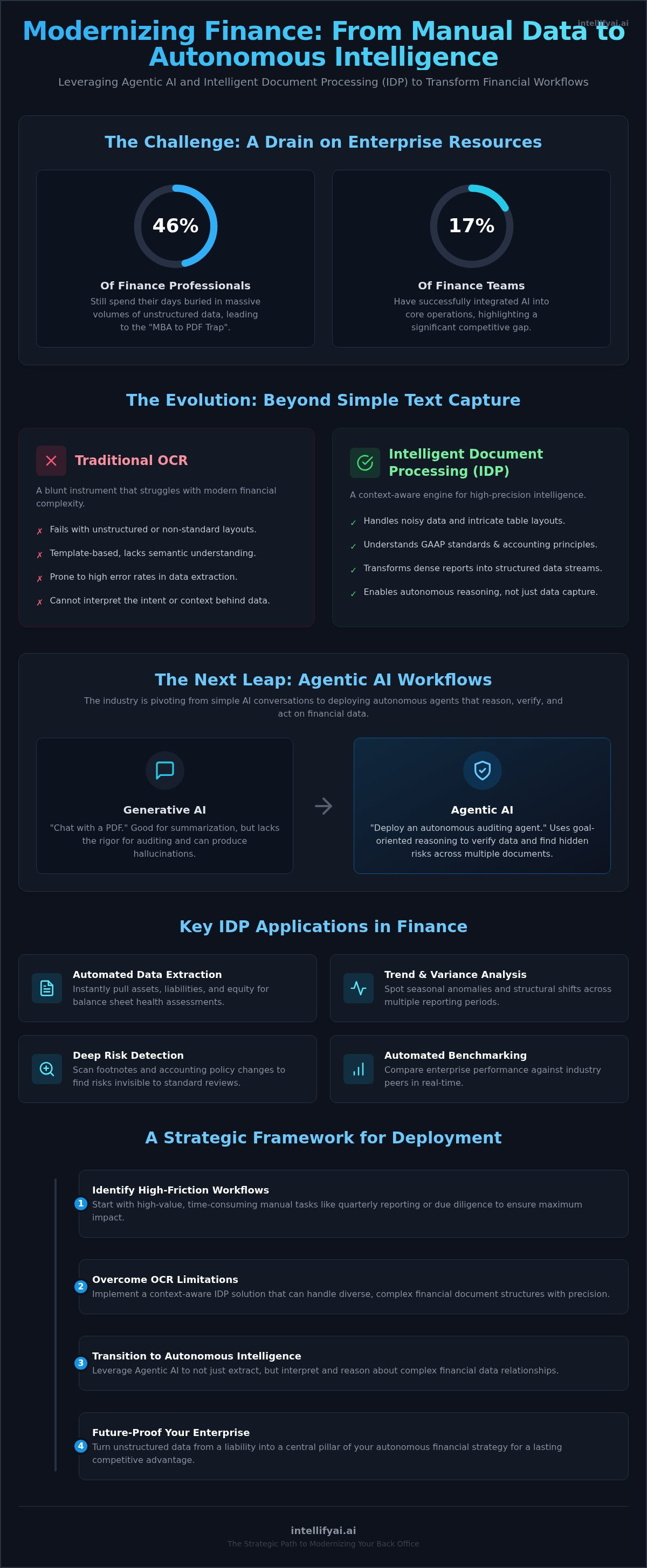
Forty-six percent of finance professionals still spend their days buried in massive volumes of unstructured data, while only 17% of teams have successfully integrated AI into their core operations. This gap represents a significant drain on enterprise resources. For many, the promise of ai for financial document analysis has felt like a distant horizon, yet the 2026 landscape has shifted the goalposts from simple extraction to autonomous reasoning. You know that manual data entry from dense SEC filings and annual reports isn't just slow; it's a liability that invites high error rates and costs millions in missed insights.
It's time to move beyond the copy-paste era. This guide explores how Agentic AI and Intelligent Document Processing (IDP) are transforming these manual workflows into high-precision intelligence engines. We'll demonstrate how the i_Nova platform enables the automated extraction of key financial ratios and provides real-time risk detection across thousands of documents simultaneously. You'll discover a blueprint for a scalable, secure IDP architecture that integrates with your existing workflows to unlock human potential and drive measurable financial returns. This is the strategic path to modernizing your back office and securing a competitive advantage in an increasingly automated market.
Key Takeaways
• Transition from static data capture to autonomous intelligence by leveraging Agentic AI to interpret complex financial structures.
• Accelerate decision-making with automated extraction of assets and liabilities for instant balance sheet health assessments.
• Overcome the limitations of traditional OCR by implementing context-aware IDP that handles noisy data and intricate table layouts with precision.
• Execute a scalable deployment of ai for financial document analysis by first identifying high-friction manual workflows like quarterly reporting.
• Future-proof your enterprise with the i_Nova platform, turning unstructured data into a central pillar of your autonomous financial strategy.
Beyond OCR: The Evolution of AI for Financial Document Analysis
The paradigm for processing corporate intelligence is shifting from simple data capture to autonomous reasoning. For decades, enterprises relied on template-based systems to scrape text, but these tools lacked the semantic depth required for high-stakes decision-making. Modern Document AI leverages foundation models that understand accounting principles, GAAP standards, and complex corporate hierarchies. This evolution allows for a level of precision where the system doesn't just see a number; it understands its role in the broader financial narrative.
Traditional OCR is a blunt instrument that fails when faced with unstructured financial layouts or non-standard SEC filings. True ai for financial document analysis requires a system that can interpret the intent behind the data. By applying context-aware intelligence, enterprises can now transform dense annual reports into structured data streams. This capability is no longer a luxury. It's a fundamental requirement for maintaining a speed advantage in competitive deal sourcing and real-time risk management.
To better understand how these systems operate in real-world scenarios, watch this helpful video:
The Inefficiency of Manual Financial Review
Manual review creates a severe bottleneck known as the MBA to PDF trap. You've likely hired elite analysts for their strategic minds and market intuition, yet many spend significant portions of their time on manual data entry and reconciliation. This is a massive waste of high-value human capital. Beyond the productivity loss, human error in quarterly reconciliation or due diligence represents a significant financial liability. In a fast-moving market, the speed disadvantage of manual processing can mean the difference between securing a prime asset and losing out to a more agile competitor.
From Generative AI to Agentic Workflows
Generative AI sparked initial global interest, but it often lacks the technical rigor required for financial auditing. You can't afford hallucinations when calculating debt-to-equity ratios or evaluating liquidity. This is why the industry is pivoting toward Agentic AI, which introduces goal-oriented reasoning to the workflow. We're seeing a transition from simply chatting with a PDF to deploying autonomous financial auditing agents that verify data points against historical filings. Agentic AI in finance is a system that reasons across multiple documents to find hidden risks.
Key Applications of Intelligent Document Processing (IDP) in Finance
Modern finance teams are often drowning in data but starving for actionable insights. Implementing ai for financial document analysis changes this dynamic by turning static, dense pages into high-velocity intelligence. This technology allows for the automated extraction of assets, liabilities, and equity, providing an instant view of balance sheet health without the friction of manual entry. By mapping these data points to standardized taxonomies, enterprises can ensure consistency across diverse portfolios and global entities.
IDP offers more than just speed; it provides a level of depth that human review cannot realistically sustain at scale. Systems now perform sophisticated trend and variance analysis across multiple reporting periods to spot seasonal anomalies or structural shifts. By scanning footnotes and accounting policy changes, these engines detect risks that remain invisible during standard reviews. Automated benchmarking then places this data into context, comparing enterprise performance against industry peers in real time. This isn't just about numbers; it's about understanding the competitive narrative. For instance, an IDP system can highlight if a competitor's R&D spending as a percentage of revenue is diverging from the industry mean, flagging a potential strategic shift before it becomes public knowledge.
Due Diligence and Underwriting
Accelerating the deal lifecycle requires processing entire data rooms in minutes, not weeks. IDP standardizes inconsistent document formats across global entities, ensuring that every piece of data is comparable and clean. This capability is essential for identifying "off-balance-sheet" risks that traditional keyword-search tools miss. In underwriting, this means moving from a reactive posture to a proactive one. Instead of waiting for a manual summary of a borrower's history, underwriters receive a comprehensive risk profile that includes sentiment analysis of management's discussion and analysis (MD&A) sections from the last five years. When every hour matters, having a strategic architect for your data pipeline is a competitive necessity.
Regulatory Compliance and Auditing
Compliance frameworks are becoming increasingly complex, demanding higher levels of transparency. Automating the extraction of data for Sarbanes-Oxley (SOX) compliance provides a level of precision that manual teams cannot match. These systems generate clear, verifiable audit trails, ensuring transparency for internal and external stakeholders. By reducing the time spent on manual audit reconciliation by up to 90%, firms can redirect their most talented analysts toward strategic risk management. This shift doesn't replace the auditor; it empowers them. It removes the burden of repetitive tasks and replaces it with a frictionless flow of validated data. This long-term investment in relevance ensures that your compliance infrastructure remains robust even as global regulations evolve.
To integrate these capabilities into your existing operations, consider a consultation on our Agentic AI engineering services today.
Traditional OCR vs. Intelligent Document Processing (IDP)
Traditional OCR served its purpose for decades by converting images to text. However, it relies on static templates that break the moment a vendor changes a font or a margin. In contrast, Intelligent Document Processing (IDP) utilizes dynamic, context-aware understanding to interpret the underlying meaning of a document. This is where ai for financial document analysis truly excels. It doesn't just "read" characters; it understands that a specific number represents a net loss even if the document uses unconventional formatting or non-standard terminology.
IDP thrives where OCR fails. It handles "noisy" data, such as skewed scans or smudged ink, and can even interpret human handwriting with high accuracy. Complex table structures, which often cause legacy tools to hallucinate or misalign columns, are parsed with structural integrity. To ensure reliability, these systems provide "confidence scores." These scores allow human analysts to focus only on low-confidence exceptions, creating a high-trust environment for automated reporting. This shift toward the i_Nova platform is a cornerstone of enterprise modernization, moving from legacy fragility to resilient intelligence.
The i_Nova Advantage: Structured Intelligence from Unstructured Data
The i_Nova platform doesn't limit your enterprise to standard PDFs. It leverages multi-format extraction to pull intelligence from Excel files, images, and legacy scans simultaneously, setting a new standard for ai for financial document analysis. The real power lies in agentic reasoning. Instead of treating each page as an isolated island, i_Nova reconciles data across disparate statements to ensure internal consistency. This allows you to scale IDP from a single accounting department to a global enterprise footprint without losing granular control. It's about building a central nervous system for your financial data.
Integrating AI with Financial Ecosystems
Deploying AI is only half the battle; the output must be actionable. We connect AI outputs directly to your existing tech stack, including Excel, ERPs like SAP and Oracle, and internal databases via robust APIs. This is where data engineering plays a vital role. It prepares your raw financial data for AI consumption, ensuring that the pipeline is clean and optimized. By prioritizing low-latency processing, we enable real-time financial decision-making that keeps your business ahead of the curve. This isn't a temporary fix; it's a lasting investment in your operational relevance.
Strategic Framework for Deploying Financial AI
Moving from a high-level vision to practical execution requires a structured roadmap that prioritizes both speed and security. Successful ai for financial document analysis isn't just about the technology; it's about how that technology integrates with your existing human expertise. To achieve a frictionless transition, enterprises must follow a disciplined deployment strategy that moves from identifying friction to scaling intelligence.
Step 1: Identify high-friction manual workflows.
Pinpoint areas where analysts are currently bogged down by repetitive tasks, such as AP/AR processing or quarterly reporting cycles.
Step 2: Establish a robust Data Engineering foundation.
Ensure your data pipeline is clean and structured. High-quality output from an AI agent depends entirely on the quality of the data it consumes.
Step 3: Deploy a Proof-of-Value (PoV) engagement.
Instead of a multi-year overhaul, launch a targeted pilot to measure ROI in weeks. This builds internal confidence and proves the technical viability of the solution.
Step 4: Implement Human-in-the-Loop (HITL) checkpoints.
For critical financial approvals, the AI should provide a recommendation while a human analyst performs the final verification. This maintains accountability.
Step 5: Scale through MLOps pipelines.
Once the pilot succeeds, use automated pipelines to manage model updates and ensure long-term reliability across the global enterprise.
Governance, Risk, and Compliance (GRC) in AI
The primary objection to automation in finance is the risk of hallucinations. We eliminate this by using deterministic validation layers and cross-referencing AI outputs against multiple source documents. Security is anchored through role-based access controls (RBAC), ensuring that only authorized personnel can access sensitive financial records. Our approach to AI strategy consulting prioritizes SOC2 and GDPR compliance from day one. This ensures that your digital transformation is not just innovative, but also dependable and legally sound.
The Role of the Human Analyst
We reframe AI not as a replacement, but as a "Strategic Architect" for your finance team. This shift allows your analysts to move from the drudgery of data entry to the high-value role of "Agent Overseers." By removing the burden of repetitive tasks, you unlock human potential for high-level creative and strategic work that drives growth. This collaborative relationship between technology and human workers is the central pillar of a modern, resilient enterprise. It turns your back office into a high-velocity intelligence engine that is always ahead of the curve.
Ready to modernize your financial workflows? Explore our Agentic AI engineering services to begin your transformation.
The Future of Financial Intelligence with IntellifyAi
The future of financial intelligence isn't a generic software package; it's a specialized architecture designed for precision and performance. IntellifyAi occupies a unique position by combining high-level Agentic AI engineering with deep strategic consulting. We don't just provide tools. We build the autonomous engines that drive enterprise growth. The i_Nova platform serves as the central pillar of this transformation, turning the once-daunting complexity of ai for financial document analysis into a streamlined, high-velocity intelligence stream. This approach ensures that technology acts as a liberating force, allowing your firm to focus on strategic execution while the system handles the burden of repetitive data processing.
A partnership approach is essential for long-term viability. We treat our core methodology as a holistic business pillar rather than a simple software implementation. This means we align our technical expertise with your specific financial goals, ensuring that every automated workflow contributes directly to your bottom line. By positioning our services as a lasting investment in relevance, we help you navigate the rapid shifts of the 2026 financial landscape with confidence. We project the personality of a Strategic Architect, focused on the stability and security of your operations as you scale.
Custom Agentic AI Engineering
Standardized solutions often fail to account for the nuances of specific accounting policies or regional regulatory requirements. We build bespoke agents tailored to your firm’s exact internal standards. By leveraging cloud-native modernization, we ensure your AI operations are scalable and resilient across global footprints. Our engagement doesn't end at deployment. We provide continuous optimization through dedicated MLOps monitoring, ensuring your models remain accurate and reliable as your data evolves. This managed service model provides the deep technical oversight required to maintain a competitive edge without overextending your internal IT resources.
Next Steps: From Strategy to Execution
The transition to an autonomous enterprise begins with a clear, actionable roadmap. Our specialists work with you to identify the highest-impact opportunities for automation, ensuring a logical flow from a specific challenge to a measurable impact. A proof-of-value (PoV) engagement is often the most effective way to secure enterprise buy-in. It provides a clear demonstration of ROI in a matter of weeks, proving the technical viability of the solution in your specific environment. This low-friction entry point allows you to witness the power of the i_Nova platform firsthand before committing to a full-scale deployment.
Now is the time to modernize your enterprise through intelligent automation. Contact our AI strategy consultants to begin your roadmap development session and unlock the full potential of your financial data.
Securing Your Lead in the Autonomous Financial Era
The transition from manual data entry to autonomous intelligence is no longer a future projection; it's a present necessity for the modern enterprise. You've seen how legacy OCR fails to navigate the complexities of 2026 financial reporting and why a strategic roadmap is essential for scaling performance. By implementing ai for financial document analysis through a robust IDP framework, you transform dense filings into high-velocity intelligence engines that unlock your team's creative potential.
IntellifyAi brings a global presence across the UK, USA, India, and the UAE to help you navigate this digital transformation. Our sophisticated i_Nova platform and end-to-end Agentic AI engineering services provide the technical rigor required for serious financial operations. We don't just implement software; we architect a central pillar for your company's long-term growth and stability. Now is the time to move beyond the copy-paste era and secure a frictionless, automated future. Book a Strategic AI Consulting Session to begin your roadmap development today. The path to high-precision financial intelligence is clear, and your firm is ready to lead.
Frequently Asked Questions
How accurate is AI for financial document analysis?
Modern ai for financial document analysis achieves high precision by utilizing vision-language models that understand context rather than just characters. Accuracy levels are maintained through deterministic validation layers that cross-reference extracted data against established accounting rules. While raw extraction is highly reliable, the system uses confidence scores to flag low-certainty entries for human review. This hybrid approach ensures that the final output meets the rigorous standards required for corporate financial reporting and auditing.
Can AI handle complex financial tables and footnotes?
Yes, advanced IDP platforms like i_Nova are specifically engineered to parse non-standard table structures and dense footnotes. Unlike legacy systems, these models recognize the structural relationships between rows and columns, even when formatting is inconsistent. Footnotes are often where hidden risks reside; Agentic AI reasons through these sections to identify accounting policy changes or off-balance-sheet liabilities. This capability turns unstructured text into a structured data stream that reflects the full complexity of the document.
What is the difference between OCR and Intelligent Document Processing (IDP)?
OCR is a foundational technology that converts images into text without understanding the content's meaning. It relies on rigid templates that fail when layouts vary. Intelligent Document Processing (IDP) represents the next generation of this technology, using natural language processing and machine learning to interpret context. IDP systems understand the relationship between data points, allowing for autonomous reasoning across disparate documents. This shift from simple capture to actionable intelligence is the defining feature of enterprise modernization.
How does Agentic AI improve financial due diligence?
Agentic AI transforms due diligence from a reactive manual process into a proactive intelligence operation. These agents don't just extract data; they perform goal-oriented reasoning to reconcile information across entire data rooms. By comparing current filings with historical records and industry benchmarks, Agentic AI identifies anomalies that human analysts might overlook. This reduces the deal lifecycle from weeks to days, allowing your team to focus on high-level strategic evaluation rather than repetitive data entry tasks.
Is my sensitive financial data secure with an AI platform?
Security is a central pillar of enterprise-grade AI implementations. Platforms like i_Nova are built with security-first architectures, incorporating role-based access controls (RBAC) to ensure that only authorized personnel can interact with sensitive records. Compliance with global standards such as SOC2 and GDPR is mandatory to protect data integrity and privacy. By deploying these solutions within secure cloud environments, firms maintain full control over their proprietary financial data while benefiting from the speed of automated processing.
What are the main challenges of implementing AI in finance?
The primary challenges involve data fragmentation and the integration of AI outputs into legacy ERP systems. Many firms struggle with siloed data that hasn't been prepared for AI consumption, making a robust data engineering foundation essential. Additionally, building trust in automated outputs requires clear audit trails and human-in-the-loop checkpoints. Overcoming these hurdles requires a strategic partner who can bridge the gap between abstract technical capabilities and the practical, results-oriented needs of a growing enterprise.
How much does an enterprise-grade AI financial analysis solution cost?
The investment for an enterprise-grade solution varies based on the volume of documents and the complexity of the required workflows. Most organizations begin with a proof-of-value (PoV) engagement to demonstrate measurable ROI before committing to a full-scale deployment. Costs are typically structured around implementation fees and ongoing managed service or platform usage fees; for a better understanding of how to manage recurring software costs, you can discover more about SaaS Subscription Fees and see how IOMI consolidates these digital expenses. You should evaluate these solutions as a long-term investment in operational relevance that significantly reduces the manual cost of reconciliation and data entry.
While a robust data foundation is necessary for ai for financial document analysis, you don't necessarily need an internal team to manage it. Partners like IntellifyAi provide end-to-end engineering services to prepare your financial data for AI consumption. This includes building the MLOps pipelines required for long-term model reliability and scaling. By outsourcing the technical complexity, your internal finance team can remain focused on strategic analysis and creative work rather than managing the underlying infrastructure.









.svg)