
The rigid automation scripts of the last decade have reached their breaking point, necessitating a transition to agentic ai for back office automation. While traditional RPA excels at repetitive tasks, it inevitably fails when faced with the nuance of real-world business logic or minor UI changes. If your enterprise is currently struggling with high exception rates in manual document processing, you've likely hit the "automation plateau" where complex reasoning remains human-dependent. This common friction point limits scale and drains high-value resources.
Master the shift from brittle rules to goal-oriented reasoning to unlock higher accuracy in complex document intelligence and a significant reduction in manual intervention. This article provides a definitive roadmap for moving beyond current limitations using autonomous AI agents. We'll explore the 2026 enterprise strategy for deploying these systems, including the critical role of the i_Nova platform in processing unstructured data and the shift toward a resilient, reasoning-based back office.
Key Takeaways
• Learn why modern enterprises are shifting to agentic ai for back office automation to replace brittle RPA scripts with resilient, goal-oriented reasoning.
• Understand the 'Perceive-Plan-Act' loop and how the i_Nova platform provides the critical sensory input needed for agents to handle complex document intelligence.
• Discover how outcome-oriented autonomy reduces the maintenance burden of automation by adapting to system changes rather than breaking.
• Identify the steps for transitioning Global Business Services (GBS) towers through a structured discovery phase and high-impact Proof-of-Value engagements.
• Explore the methodology for moving from generic software to custom agentic AI engineering that aligns with specific enterprise growth and performance goals.
Beyond Rigid Scripts: The Evolution of Back-Office Automation in 2026
Traditional Robotic Process Automation (RPA) has reached its structural limit. For years, enterprises relied on linear scripts to handle repetitive data entry, yet these bots remain notoriously fragile. A single update to a legacy ERP interface or a slight variation in an invoice layout often brings entire workflows to a halt. In 2026, the strategic focus has shifted toward agentic ai for back office automation, where the goal isn't just to follow a pre-defined path, but to navigate toward a specific business result.
This evolution is a defining characteristic of enterprise modernization. We're moving away from cloud-hosted silos toward AI-native ecosystems. Unlike their predecessors, agentic systems are designed to handle ambiguity, making them the primary solution for breaking through the "automation plateau" where simple task-based bots fail. To better understand how this technology functions, watch this helpful video:
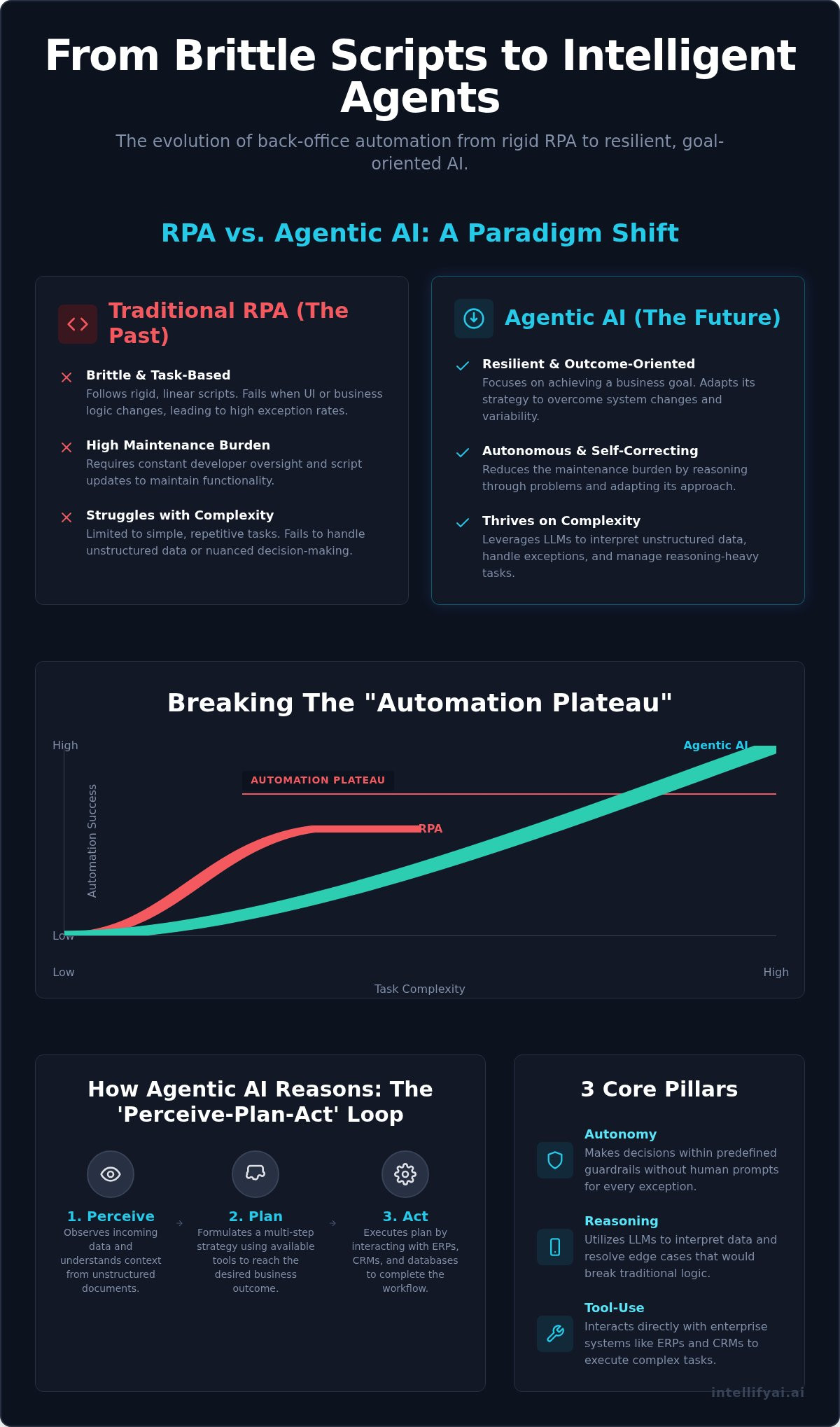
The "automation plateau" occurs when an organization has successfully automated its most basic tasks but finds that a large portion of its volume still requires manual intervention due to complexity. Agentic intelligence breaks this ceiling by applying logic to those exceptions. By leveraging intelligent agents, enterprises can finally address the reasoning-heavy tasks that previously required expensive human oversight and constant script maintenance.
The Core Characteristics of Back-Office Agents
Three pillars define the effectiveness of these digital workers. First is autonomy, the ability to make decisions within predefined guardrails without requiring a human prompt for every minor exception. Second is reasoning, utilizing Large Language Models (LLMs) to interpret unstructured data and resolve edge cases that would break traditional logic. Finally, tool-use enables agents to interact directly with ERPs, CRMs, and databases. They don't just move data; they understand why they're moving it and what the final state should look like, mimicking the workflow of a sophisticated human operator at machine scale.
Why 2026 is the Year of the Agentic Back Office
The convergence of mature LLMs and sophisticated enterprise data engineering has made this transition possible. Global Business Services (GBS) leaders face unprecedented pressure for hyper-efficiency, and traditional methods no longer provide the necessary margins. Deploying agentic ai for back office automation allows firms to scale without proportional increases in headcount. The agentic back office is the transition from scripted bots to goal-seeking digital workers.
The Mechanism of Autonomy: How AI Agents Reason Through Complex Workflows
Autonomous agents don't follow a static flowchart. They operate within a "Perceive-Plan-Act" loop that allows them to adjust their behavior based on the data they encounter. In the context of agentic ai for back office automation, this means the agent first observes the incoming request, assesses the available tools, and formulates a strategy to reach the desired outcome. This cycle allows the system to handle variability that would cause a standard script to fail.
The most critical gap in current enterprise strategies is the disconnect between data extraction and decision-making. High-performing agents require Intelligent Document Processing (IDP) to serve as their primary sensory input. Without this layer, the agent remains blind to the nuances of unstructured documents. By integrating document intelligence directly into the reasoning loop, enterprises can move from simple OCR to true semantic understanding.
Reasoning Over Rules: Handling the Exception Economy
The "exception economy" is where most back-office costs reside. Agents use chain-of-thought prompting to resolve missing data or conflicting information in real-time. Instead of flagging an invoice for manual review due to a missing vendor code, the agent searches the internal ERP to find a match. This reasoning capability, combined with a robust Human-in-the-loop (HITL) model, ensures that human experts only handle the most complex cases. Organizations typically see a 30% to 50% reduction in manual intervention once these reasoning loops are established.
I_Nova: The Foundation of Agentic Intelligence
The i_Nova platform moves beyond simple OCR to provide deep semantic understanding. It extracts actionable intelligence from unstructured formats like complex PDFs, legacy emails, and even handwritten notes. By feeding this data into the agent's planning module, i_Nova ensures that the information used for execution is accurate and verified. This level of data integrity is non-negotiable for any enterprise looking to deploy custom agentic AI engineering to modernize their operations.
Orchestration allows multiple agents to collaborate on cross-functional tasks like "Order-to-Cash." In this model, one agent handles document ingestion while another manages credit validation and a third triggers shipping logistics. This multi-agent approach creates a frictionless workflow that scales 24/7, transforming the back office from a cost center into an engine of high-velocity execution.
Agentic AI vs. RPA: Analyzing the Shift from Task-Based to Outcome-Oriented Automation
Traditional Robotic Process Automation (RPA) was built on the premise of "if-then" logic. It excels at moving data between static fields, but it lacks the capacity to handle change. When an enterprise deploys agentic ai for back office automation, it moves from task-based execution to outcome-oriented autonomy. Instead of following a rigid script, an agent is given a goal, such as "reconcile this disputed invoice," and determines the best path to reach it. This fundamental shift makes agents significantly more resilient to the UI updates and process variations that typically break traditional bots.
The maintenance burden of RPA is a hidden tax on digital transformation. Large organizations often find themselves managing thousands of fragile scripts, requiring a dedicated team just to keep them running. Agentic systems reduce this technical debt through adaptability. Because agents reason through their environment, they don't require a developer to hard-code every possible edge case. To explore the underlying architecture of these systems in greater depth, consult our executive guide on what is agentic ai.
The Value Gap: ROI Beyond Just FTE Savings
While RPA focuses on reducing full-time equivalent (FTE) costs, agentic intelligence creates value through speed and accuracy. Faster back-office turnaround directly influences your CX Improvement Framework by eliminating the bottlenecks that frustrate customers and vendors alike. These agents also serve as a source of business intelligence. They don't just execute transactions; they monitor every step for compliance and flag systemic risks before they escalate. This proactive risk mitigation is a measurable financial return that goes far beyond simple labor replacement.
When to Keep RPA and When to Upgrade to Agents
Architecting an autonomous enterprise doesn't require a total "rip and replace" strategy. High-volume, low-complexity tasks like moving data from a standard web form into a database are still well-suited for traditional RPA. However, you should prioritize the upgrade to agents for "Reasoning-Heavy" workflows where the path to completion isn't always linear. Accounts payable, claims processing, and vendor onboarding are prime candidates for this transition. Hybrid architectures allow you to orchestrate existing bots alongside new agents, creating a single, unified ecosystem that maximizes your legacy investments while driving toward future-proof autonomy. If you're ready to map your specific workflows for this transition, our team provides strategic AI consulting to define your path forward.
Strategic Implementation: Transitioning Your GBS Towers to Agentic Intelligence
Transitioning your Global Business Services (GBS) towers to autonomous operations requires more than just a software license. It demands a rigorous, architectural approach. The first step is a comprehensive Discovery Phase. You must map your 'Function-Process-Workflow' hierarchy to identify where agentic ai for back office automation provides the highest return. Focus on areas where human intervention is currently high due to complex reasoning requirements rather than simple data movement.
Once you identify these friction points, initiate a Proof-of-Value (PoV). Isolated back-office towers like Accounts Payable or Vendor Onboarding serve as ideal testing grounds. These environments are often exception-heavy, providing the perfect stage to demonstrate how agents resolve data mismatches without human aid. Successful PoVs build the internal confidence necessary for broader cloud-native modernization. Modernizing your infrastructure ensures your ecosystem can handle the high-compute demands of agentic workloads while maintaining low latency.
Architecting the Data Foundation
Agents are only as effective as the data they consume. Robust data engineering is the prerequisite for fueling agentic reasoning. You must clean and structure legacy data to eliminate the noise that leads to agent errors. This foundation prevents the "garbage in, garbage out" cycle that plagues many early-stage AI projects. Additionally, implement FinOps practices early. Optimizing cloud costs for high-compute AI agent operations ensures that your scaling remains profitable and sustainable.
Governance, Risk, and Compliance (GRC) for Agents
Governance in an autonomous environment must be contextual. You can't rely on static rules; you need "Contextual Governance" to validate agent outputs against real-world business constraints. This prevents "agent hallucinations" in sensitive financial data. Auditability is equally critical. Every decision an agent makes must be logged and traceable to ensure full accountability during internal or external audits. Finally, prioritize security. Protecting sensitive back-office data requires a zero-trust architecture that limits agent access to only the specific databases required for their tasks.
If you're ready to design a custom roadmap for your organization, our AI Strategy & Consulting team can help you identify the highest-impact entry points for automation.
Partnering for Transformation: How IntellifyAi Architects the Autonomous Enterprise
Generic software solutions often fall short of enterprise-grade requirements. They lack the depth needed for complex, industry-specific workflows. IntellifyAi approaches the challenge as a Strategic Architect. We bridge the gap between abstract technology and practical business needs. By focusing on agentic ai for back office automation, we ensure that technology serves as a liberating force for your workforce. This isn't about replacing human talent. It's about removing the burden of repetitive tasks so your team can focus on high-value creative work. We build for stability, security, and measurable financial returns.
Our approach combines high-level strategic thinking with practical, results-oriented execution. We systematically break down technological complexity into digestible segments. This creates a sense of momentum, leading your organization through the narrative of digital transformation without friction. We don't just implement software; we integrate a holistic philosophy that treats automation as a central business pillar.
End-to-End AI Engineering Services
We provide custom agentic AI engineering that goes beyond off-the-shelf bots. Our team develops agents tailored to your specific Standard Operating Procedures (SOPs). These agents integrate seamlessly with legacy ERPs like SAP, Oracle, and Workday through secure APIs. We don't just deploy and depart. Our services include ongoing MLOps and model optimization. This ensures your agents maintain peak performance as your data environment evolves. The i_Nova platform plays a central role here. It transforms stagnant document silos into actionable intelligence streams. This provides the sensory input agents need to function effectively in a reasoning-heavy environment. We treat every implementation as a lasting investment in your company's relevance.
Strategic AI Consulting and Roadmap Development
Scaling autonomy requires a clear vision and a logical progression. Through our AI Strategy & Consulting, we collaborate with your leadership to identify high-ROI use cases. We help you move from a single Proof-of-Value (PoV) to a full enterprise-wide agent workforce. This journey focuses on long-term viability rather than temporary fixes. We prioritize the relationship between technology and human workers, framing agents as tools that unlock human potential. Our methodology ensures that every technological solution is anchored in business-centric outcomes like growth and performance. IntellifyAi doesn't just sell tools; they architect the future of work.
Realizing the Autonomous Enterprise Strategy
The era of brittle, linear automation has ended. Moving from rigid scripts to goal-oriented reasoning is no longer a luxury for the modern enterprise; it's a fundamental requirement for maintaining relevance in a high-velocity market. By integrating agentic ai for back office automation, organizations can finally break through the automation plateau. This transition replaces brittle workflows with resilient systems that plan, reason, and execute with precision. It allows your human talent to shift away from managing exceptions toward high-value strategic work that drives growth.
Achieving this vision requires a partner who understands the intersection of data engineering and autonomous logic. With a global presence across the UK, USA, India, and the UAE, IntellifyAi combines specialized i_Nova IDP capabilities with end-to-end agentic engineering. We act as your Strategic Architect, focusing on measurable business outcomes rather than generic software implementation. Our methodology ensures your modernization efforts yield long-term viability and operational excellence. We don't just solve today's bottlenecks; we build the foundation for tomorrow's scale.
Architect your autonomous back office with IntellifyAi today. The path to a frictionless, intelligent future is clear.
Frequently Asked Questions
What is the difference between an AI bot and an AI agent in the back office?
AI bots are linear; they follow pre-defined scripts that break when they encounter variability. In contrast, an AI agent is goal-oriented. It uses reasoning to determine the best path forward. This distinction is central to agentic ai for back office automation. While a bot might fail if a button moves on a screen, an agent uses computer vision to find the correct element and complete the task autonomously.
How does Agentic AI handle exceptions in invoice processing?
Agents resolve exceptions by applying logic to unstructured data. If an invoice arrives with a missing vendor code, the agent doesn't simply stop. It queries the ERP to find a match based on the tax ID or company name. This reduces the exception queue for human teams. The agent only escalates the task if the ambiguity exceeds its defined confidence threshold, ensuring that human experts only handle truly unique cases.
Do we need to replace our current ERP system to use AI agents?
You don't need to replace your ERP to modernize. Agents are designed to integrate with existing SAP, Oracle, or Workday environments. They function as an intelligent orchestration layer that sits above your current infrastructure. This allows you to leverage your existing data and business logic while introducing autonomous reasoning. It's a strategic way to extend the life of legacy systems while achieving modern efficiency.
What is the role of Intelligent Document Processing (IDP) in agentic workflows?
Intelligent Document Processing (IDP) acts as the sensory input for autonomous systems. It transforms unstructured documents into the structured data that agents need to make decisions. Without IDP, an agent is essentially blind to the nuances of invoices or contracts. Effective agentic ai for back office automation relies on this data extraction layer to provide the context required for high-accuracy planning and execution within complex business workflows.
How do you ensure AI agents remain compliant with financial regulations?
Compliance is maintained through a combination of hard guardrails and Contextual Governance. Every decision made by an agent is logged in a detailed audit trail for full traceability. We program agents with specific regulatory rules that they cannot bypass. This ensures that every automated transaction remains within the bounds of your internal controls and external financial regulations. You maintain total visibility into how and why every action was taken.
What is the typical ROI timeline for an Agentic AI implementation?
Typical ROI becomes measurable within 6 to 12 months following a successful Proof-of-Value engagement. The primary drivers of this return are the significant reduction in manual error correction and the ability to process higher volumes without adding staff. By automating reasoning-heavy tasks that previously required human oversight, enterprises lower their operational costs while increasing the speed and accuracy of their back-office towers.
Can AI agents work with legacy systems that don't have APIs?
Agents can definitely work with legacy systems lacking modern APIs. They utilize computer vision and UI automation to interact with software exactly like a human operator would. This capability allows you to automate workflows across ancient mainframes and modern cloud applications simultaneously. It eliminates the need for expensive and risky system overhauls, providing a pragmatic path toward full autonomy without disrupting your current technological stability.
How does IntellifyAi's i_Nova platform differ from standard OCR?
Standard OCR merely translates images into text characters without understanding their meaning. i_Nova provides deep semantic intelligence. It understands the context and relationship between different data fields on a page. This allows it to extract accurate information from complex, unstructured documents that would confuse traditional tools. It identifies the intent behind the data, ensuring the agent receives high-quality, actionable intelligence for every transaction it executes.









.svg)