
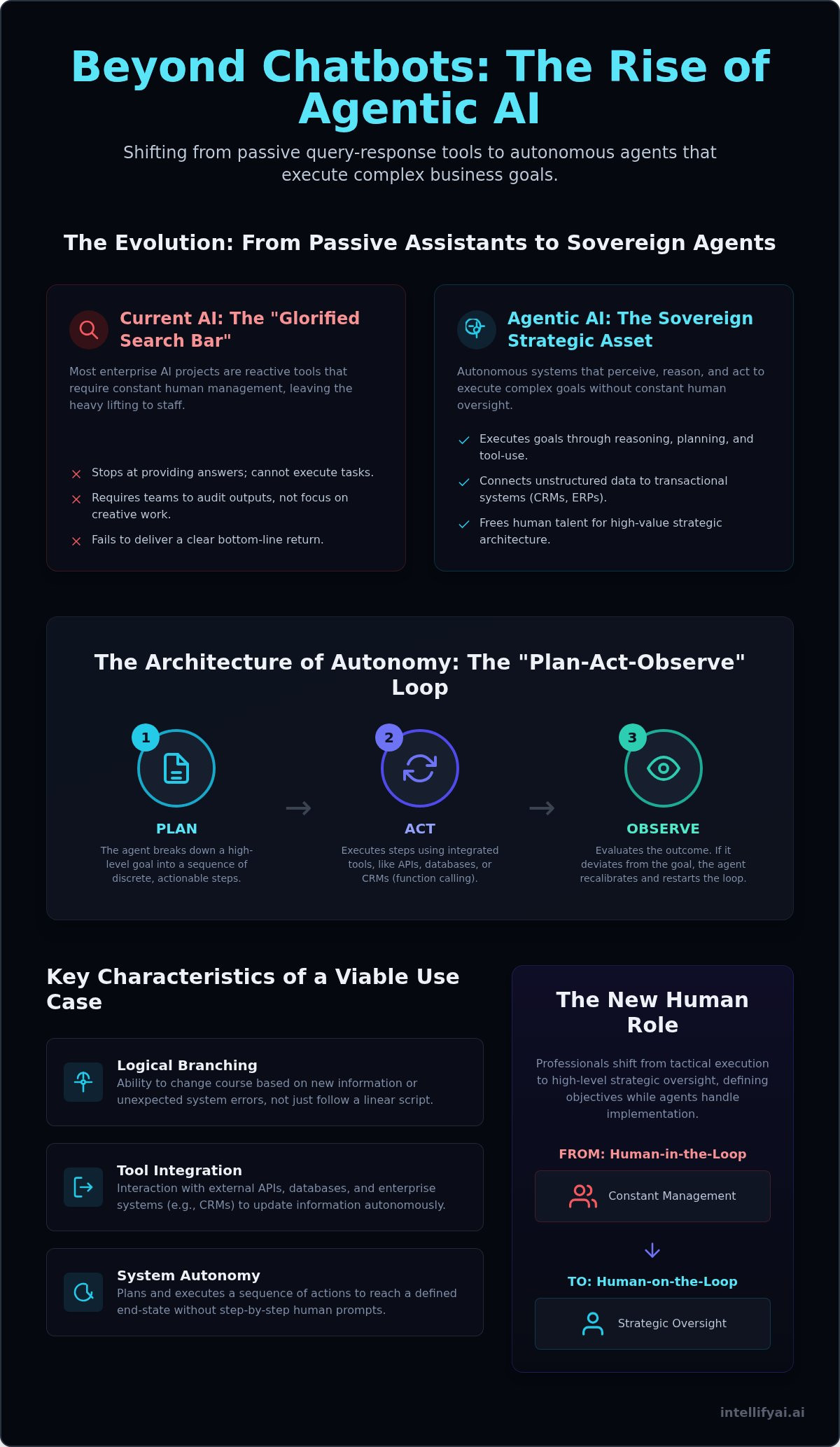
Most current enterprise AI projects are essentially glorified search bars that still leave the heavy lifting to your staff. While the initial promise of generative tools was high, many organizations now face a plateau where basic LLM implementations fail to deliver a clear bottom-line return. This lack of autonomy is a common bottleneck. Identifying high-impact agentic ai use cases that actually execute complex tasks is the defining challenge for leadership heading into 2026. You’ve likely seen your teams spend more time auditing AI outputs than focusing on high-value creative work.
This article provides a strategic roadmap for transforming these reactive tools into sovereign strategic assets. We’ll move past the hype of "smarter chat" to explore how autonomous loops connect your unstructured data directly to transactional systems. You’ll discover the technical requirements for agentic orchestration and learn how to integrate these agents into your legacy stacks without compromising security. By the end of this guide, you’ll understand how to build a collaborative environment where AI handles the repetitive execution, liberating your human talent for the strategic architecture of your business.
Key Takeaways
• Shift from passive query-response models to autonomous agents that execute complex goals without constant human oversight.
• Identify high-impact agentic ai use cases across financial intelligence and customer experience to drive measurable ROI by 2026.
• Master the "Plan-Act-Observe" loop to bridge the gap between abstract reasoning and practical, transactional system execution.
• Apply a rigorous ROI versus Complexity matrix to prioritize your modernization roadmap and target high-value automation opportunities first.
• Recognize why custom engineering is essential for securing sensitive data while integrating autonomous agents into existing enterprise stacks.
Beyond Chatbots: Defining the Scope of Agentic AI Use Cases
The enterprise is currently moving past the era of the passive chatbot. While generative AI models excel at synthesizing information, they often stop at the point of action. An AI agent represents a fundamental shift. These systems don't just provide answers; they execute goals through autonomous reasoning, planning, and tool-use. This distinction is critical for leaders seeking legitimate agentic ai use cases that move the needle on operational efficiency and financial returns.
By 2026, we expect the rise of "Sovereign Agents" that operate with high degrees of independence within secure enterprise boundaries. These agents are built on three essential pillars: perception of the digital environment, complex reasoning to determine the best path forward, and the ability to take action across various software systems. This capability transforms AI from a basic research assistant into a strategic asset that manages its own workflows. It effectively removes the burden of repetitive tasks from your workforce, allowing for a frictionless, automated future.
To better understand how these systems function in a practical environment, watch this helpful video:
The Evolution from Assistants to Agents
Basic chatbots often failed to deliver enterprise-grade ROI because they required constant human management. The industry is shifting from "human-in-the-loop" to "human-on-the-loop" oversight. In this model, professionals define high-level objectives while the agent handles tactical execution. Modern agents use memory and reflection layers to learn from interactions, increasing success rates over time. This allows human talent to focus on high-value creative work. Specialized Agentic AI Engineering Services are essential to ensure the architecture supports true autonomy and stays ahead of the curve.
Key Characteristics of a Viable Agentic Use Case
High-value agentic ai use cases involve multi-step complexity requiring logical branching rather than a linear script. If a task requires dynamic decision-making based on real-time data from multiple sources, it's a prime candidate. These systems don't just follow instructions; they evaluate outcomes and adjust strategies. Key characteristics include:
Logical Branching
The ability to change course based on new information or unexpected system errors.
Tool Integration
Interaction with APIs, databases, and CRMs to update information autonomously.
System Autonomy
Planning a sequence of actions to reach a defined end-state without step-by-step prompts.
This ensures the AI performs work within your existing enterprise stack, acting as a bridge between abstract technical fields and practical business needs. These systems represent a lasting investment in relevance rather than a temporary fix for inefficient workflows.
The Architecture of Autonomy: How Agentic Systems Execute Complex Tasks
The engine behind autonomous ROI is a cycle of continuous refinement. Unlike static models, agentic systems operate within a "Plan-Act-Observe" loop. The agent first breaks down a high-level goal into discrete steps. It then executes those steps using Tool-Use, often referred to as function calling. This connects the AI's reasoning to real-world software like CRMs or ERPs. Finally, it observes the outcome. If the result deviates from the goal, the agent recalibrates. This iterative loop is what makes agentic ai use cases so effective for 2026 enterprise operations.
For an agent to remain effective across long-term projects, it requires Long-term Memory. This allows the system to maintain enterprise context, remembering past interactions to optimize future actions. However, autonomy requires constant oversight. Robust MLOps pipelines are essential for monitoring these agents in real-time. These pipelines ensure agents remain performant and aligned with business objectives. Many organizations find that AI strategy and consulting is necessary to design these complex monitoring frameworks properly.
Orchestration and Multi-Agent Systems
Hierarchical agent structures solve massive enterprise problems that are too broad for a single model. In this paradigm, a "Manager Agent" coordinates several "Worker Agents." Each worker is specialized in a specific domain, such as back-office processing or data retrieval. This orchestration ensures consistency across distributed autonomous workflows. It's a method already being applied to drive smarter decision-making in education, where agents synthesize diverse data sets into actionable policy insights.
Security and Governance in Autonomous Execution
Granting autonomy to software necessitates rigorous security. Companies must implement robust guardrails to prevent hallucinations and unauthorized access to sensitive data. Every decision an agent makes must be recorded in detailed audit trails. This provides the transparency required by compliance teams. Establishing this level of AI Enterprise Governance is the bedrock of trust. It ensures that as your agentic ai use cases scale, they remain secure and dependable pillars of your business operations.
High-Impact Industry Use Cases: From Financial Intelligence to Supply Chain
Realizing the full potential of autonomous systems requires moving beyond generic industry labels. In 2026, the most successful enterprises aren't just "using AI" in banking or logistics; they're deploying specific agentic ai use cases that target deep operational friction. For instance, autonomous KYC (Know Your Customer) remediation doesn't just flag a missing document. It identifies the gap, contacts the client via a secure channel, and updates the compliance record once the data is received. This level of goal-directed execution is a major leap from the static workflows of the past.
The transformation is perhaps most visible in the Back Office. Traditional Intelligent Document Processing (IDP) often stopped at data extraction. By contrast, an agentic approach uses platforms like i_Nova to not only extract intelligence from unstructured legal or medical formats but to act on it. If an invoice contains an anomaly, the agent initiates an exception-handling protocol, cross-referencing shipping manifests and prior contracts before seeking human approval. This shift is validated by a U.S. Government Accountability Office report on AI Agents, which highlights how these systems can turn complex data into actionable insights for high-stakes decision-making.
Intelligent Document Processing (IDP) as an Agentic Anchor
i_Nova serves as the architectural foundation for these sophisticated workflows. It facilitates intelligence extraction from highly complex, unstructured datasets that previously required hours of manual review. When integrated into an agentic framework, the output of IDP doesn't just sit in a database. It triggers a sequence of events across your ERP system, ensuring that data engineering and AI services work in perfect synchronization. This removes the "data silo" problem, allowing information to flow autonomously from receipt to reconciliation. These agentic ai use cases demonstrate that the value lies in the autonomous loop, not just the initial intelligence.
The New Frontier of Voice Agents and Contact Centres
Customer experience is also undergoing a radical evolution. We're moving beyond the rigid structures of traditional IVR systems toward Agentic AI Voice Agents that can solve problems in real-time conversation. These agents don't just route calls; they handle multi-lingual support and complex scheduling by accessing live calendars and customer history. This collaborative relationship between technology and human workers ensures that agents handle the repetitive, high-volume inquiries, while human staff focus on the most nuanced escalations. It's a frictionless future where service is immediate, accurate, and deeply integrated into your core business pillars.
Consider the "Before Agentic" workflow: a document is scanned, data is manually corrected, and a human enters it into the ERP. In the "After Agentic" model, the agent receives the document, reasons through the context, executes the transaction, and only alerts a human if a pre-defined threshold is met. This isn't just a minor improvement; it's a total reimagining of enterprise performance.
Prioritizing Your Roadmap: A Framework for Identifying High-ROI Opportunities
Identifying the right agentic ai use cases requires a disciplined framework rather than a scattershot approach. It's a strategic choice that determines whether your AI investment becomes a core business pillar or remains a sidelined experiment. You should utilize an ROI versus Complexity matrix to map your opportunities. High-impact agents thrive where decision-making is frequent, data is abundant, and the cost of human error is high. Prioritize "low-hanging fruit" found in areas like back-office modernization and data engineering. If your core systems aren't already cloud-native, integrating autonomous agents will face unnecessary friction. A Proof-of-Value (PoV) engagement allows you to test these agents in a controlled environment. This ensures the architecture is sound before you commit significant capital to a full-scale rollout.
Evaluating Data Readiness for Agentic AI
Clean data engineering is the absolute prerequisite for autonomy. You can't have a sovereign agent acting on flawed or fragmented information. Many organizations find their most valuable intelligence is locked in unstructured data silos, such as legacy PDFs, emails, and internal wikis. Mapping these silos is essential. It allows agents to perform actions based on deep intelligence rather than surface-level patterns. Building this foundation often requires specialized Data Engineering & AI Services. By modernizing your data layer first, you ensure your agents have the clarity they need to execute goals without constant human correction. This preparation is what separates a successful implementation from a failed implementation.
Calculating the Measurable Impact
Move past "time saved" as your primary success metric. While efficiency is a welcome benefit, the true value of agentic AI lies in revenue generation and the radical reduction of human error in high-stakes environments like finance or supply chain management. Consider the long-term viability of these investments. Agents that utilize memory and reflection layers aren't just software tools; they're appreciating assets that grow more effective as they process more data. You're building a system that scales without a linear increase in headcount. This shift allows your staff to abandon repetitive tasks and focus on the strategic architecture of the company. To build a customized roadmap that prioritizes your unique business goals, consider an AI Strategy & Consulting session to identify your highest-value opportunities.
Implementing the Vision: Custom Agentic AI Engineering with IntellifyAi
Successfully deploying agentic ai use cases requires more than off-the-shelf software. It demands a partner who acts as a Strategic Architect, bridging the gap between raw technological potential and measurable enterprise returns. IntellifyAi provides this bridge through end-to-end Agentic AI Engineering Services. We don't just implement tools; we build autonomous ecosystems tailored to your specific operational constraints. At the heart of our technical offering is the i_Nova platform. This flagship technology enables sophisticated intelligence extraction from unstructured data, turning dormant information into active strategic assets. By choosing a custom engineering approach, you ensure that your agents are secure, scalable, and deeply integrated into your legacy enterprise stack.
Strategic AI Consulting and Roadmap Development
Your journey begins with a clear, results-oriented strategy. We align agentic capabilities with your specific business KPIs to ensure every implementation drives growth. Our AI Strategy & Consulting services focus on more than just code. We address organizational development, helping your leadership team manage the shift toward a collaborative human-AI workforce. This methodology treats technology as a liberating force. It removes the burden of repetitive tasks and allows your human talent to focus on high-value creative work. We systematically break down your business challenges into digestible segments, moving from initial discovery to a roadmap of high-impact use cases.
Managed Services and Continuous Optimization
Autonomy is not a "set and forget" implementation. Agentic systems require ongoing MLOps and FinOps monitoring to remain performant and cost-effective. Our managed services ensure your AI agents evolve as your business needs change. We maintain the stability and security of your operations while continuously optimizing the agents for better task success rates. This focus on long-term viability positions our services as a lasting investment in your company's relevance. It's time to move past passive chatbots and embrace the future of autonomous execution. Contact our Agentic AI Experts today to begin developing your tailored AI roadmap and secure your competitive advantage for 2026.
Securing Your Enterprise Advantage in the Autonomous Era
The transition from passive tools to autonomous strategic assets is no longer a theoretical projection. It's a competitive necessity for 2026. By identifying high-impact agentic ai use cases, your organization can bridge the gap between unstructured data and transactional execution. This shift liberates your human talent. It allows them to focus on high-value creative work while sovereign agents handle the tactical heavy lifting across your back office and contact centres.
Success requires more than basic implementation. It demands a sophisticated architectural approach that prioritizes security, long-term viability, and measurable financial returns. With a global presence in the UK, USA, India, and UAE, IntellifyAi serves as your Strategic Architect in this transformation. Our proprietary i_Nova platform ensures your data engineering and AI services are synchronized for peak performance. Don't let your modernization efforts plateau with simple chatbots. Build a frictionless, automated future that scales with your ambition.
Partner with IntellifyAi for Custom Agentic Engineering to begin your journey toward autonomous ROI today.
Frequently Asked Questions
What are the most common agentic AI use cases in finance for 2026?
Autonomous KYC remediation and real-time fraud mitigation are the dominant agentic ai use cases in finance for 2026. These agents go beyond simple flagging. They reason through documentation gaps, autonomously initiate secure communication with clients to request missing information, and update compliance records once verified. This reduces the manual burden on compliance officers. It ensures your institution remains agile while maintaining the highest standards of regulatory integrity.
How do AI agents differ from traditional robotic process automation (RPA)?
AI agents differ from RPA through their ability to handle ambiguity and reason through complex goals. RPA follows a rigid, scripted path. If a UI element changes, RPA breaks. Agents use large language models to plan their own actions and use tools dynamically. They don't just follow instructions; they observe outcomes and recalibrate their strategy to ensure the objective is met, even when encountering unexpected system errors or data formats.
Can agentic AI use cases be implemented without a cloud-native infrastructure?
Implementing agentic ai use cases is significantly more effective within a cloud-native infrastructure. While on-premise execution is possible for certain secure functions, the high-velocity nature of agentic orchestration requires the elasticity and API-first connectivity of the cloud. Modern agents need to scale compute resources instantly to process complex reasoning loops. A cloud-native foundation ensures your autonomous systems can communicate seamlessly with your entire enterprise software stack without performance bottlenecks.
What are the security risks associated with autonomous AI agents?
Security risks include prompt injection, unauthorized data exfiltration, and hallucinations that trigger incorrect system actions. Protecting sensitive enterprise data requires robust guardrails and strict role-based access controls for every agent. You must implement real-time monitoring and immutable audit trails to track every decision the agent makes. This transparency is vital for maintaining compliance and ensuring that autonomous systems don't exceed their defined operational boundaries or compromise your internal security protocols.
How do I calculate the ROI of an agentic AI implementation?
Calculate ROI by measuring revenue generated from increased throughput and the direct cost savings from reduced human error. Traditional metrics like "time saved" are helpful but don't capture the full strategic impact. Focus on how agents allow your business to scale without a linear increase in headcount. Factor in the long-term value of agents that improve over time through memory and reflection, turning your initial engineering investment into an appreciating corporate asset.
Does agentic AI require a human-in-the-loop for all use cases?
No, not all workflows require a human-in-the-loop. The industry is moving toward a "human-on-the-loop" model for many high-frequency tasks. Humans provide the high-level strategic architecture and set the objectives, while agents handle the tactical execution. High-risk actions, such as large financial transfers or sensitive legal approvals, still benefit from human oversight. However, routine data engineering and back-office reconciliation can often operate with total autonomy once the system's performance is validated.
How long does it take to deploy a custom enterprise AI agent?
A custom enterprise AI agent typically takes 8 to 12 weeks to move from initial strategy consulting to a functional Proof-of-Value (PoV). This timeframe allows for data engineering, model fine-tuning, and the implementation of security guardrails. Full-scale production deployment across multiple business units can take longer. It depends on the complexity of your legacy systems and the level of integration required. Starting with a focused PoV ensures you validate the ROI before scaling.
What role does Intelligent Document Processing play in agentic workflows?
Intelligent Document Processing (IDP) serves as the "perception" layer for agentic workflows. Platforms like i_Nova extract actionable intelligence from unstructured formats like legal contracts or medical records. Without this layer, an agent has no way to "read" the physical or digital documents that drive business transactions. IDP turns static information into structured data that the agent's reasoning engine can use to plan and execute its next steps within your ERP or CRM.








.svg)