
In 2026, the success of your enterprise intelligence strategy hinges on a single metric: the 200-millisecond threshold where a machine response becomes indistinguishable from human speech. Most organizations still struggle with monolithic AI deployments that create unnatural conversation gaps and brittle scaling bottlenecks. You've likely seen how high latency and poor state management turn a sophisticated customer experience into a disjointed failure. Building a resilient scalable voice agent architecture requires moving beyond basic telephony integrations toward a microservices-driven nervous system.
Master the architectural principles necessary to deploy agentic systems that transform your voice AI into a core engine of enterprise value. This article provides a modular roadmap for voice AI infrastructure, detailing the transition to cloud-native modernization and the vital role of Event-Driven Architecture (EDA). You'll learn how to manage conversation state across distributed agents while maintaining the sub-200ms benchmarks required for fluid, human-centric interaction. Shift your focus from basic implementation to strategic, long-term viability and unlock the full potential of your human workforce.
Key Takeaways
• Transition from brittle, monolithic IVR legacy systems to modular, cloud-native frameworks designed for high-concurrency audio processing.
• Optimize the five pillars of your voice stack by prioritizing low-latency streaming for STT and utilizing LLMs as reasoning engines for complex intent extraction.
• Adopt a scalable voice agent architecture rooted in asynchronous event-driven design to facilitate seamless multi-agent choreography and autonomous system behavior.
• Utilize containerization and Kubernetes orchestration to provide the necessary auto-scaling and self-healing capabilities for production-ready voice services.
• Bridge the gap between abstract AI potential and measurable enterprise results by following a strategic roadmap focused on long-term modernization and operational stability.
Beyond the IVR: Defining Scalable Voice Agent Architecture in 2026
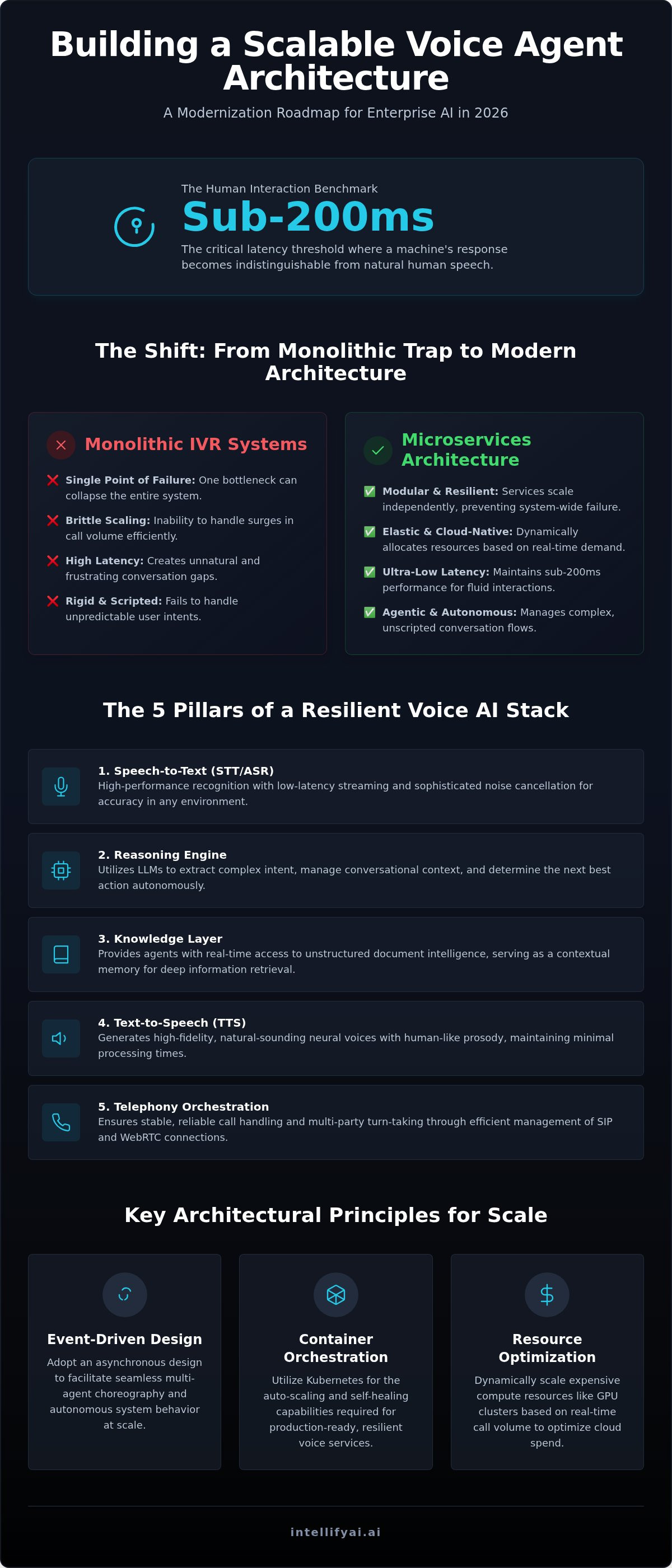
In 2026, defining a scalable voice agent architecture requires looking past simple telephony integrations. It is a modular, cloud-native system engineered specifically for high-concurrency audio processing and real-time inference. Legacy IVR systems and first-generation AI wrappers frequently fall into the "monolithic trap." In this scenario, a single failure point or a sudden surge in call volume collapses the entire customer experience. These rigid structures cannot scale under enterprise loads. They lack the elasticity to handle simultaneous, compute-heavy tasks like speech recognition and natural language reasoning at scale.
Strategic alignment in a scalable voice agent architecture ensures that your speech, reasoning, and telephony layers scale independently. This modularity prevents the "all-or-nothing" performance degradation typical of older systems. It allows for targeted resource allocation where it matters most. Architecture is the primary differentiator in voice-first customer experience. It dictates whether an agent feels like a helpful partner or a frustrating technical hurdle for the caller.
The Shift Toward Agentic Autonomy
The industry is moving rapidly from rigid, scripted decision trees to what is agentic ai in voice workflows. Unlike scripted bots, autonomous agents require a decentralized architecture to navigate unpredictable conversation flows without manual intervention. This transition relies on "Server Intelligence Agents" that manage underlying compute resources for voice inference. These specialized agents monitor system health and distribute workloads across the cluster. They ensure the system remains responsive even as the complexity of the dialogue increases. This autonomy allows businesses to focus on high-value creative work by removing the burden of repetitive tasks.
Resource Optimization and FinOps
Effective scaling is as much about financial discipline as it is about technical capacity. Organizations must scale GPU clusters dynamically based on real-time call volume to avoid paying for expensive idle capacity. Implementing request-based auto-scaling provides a more accurate reflection of operational demand than simple token-based metrics. By decoupling compute-heavy Text-to-Speech (TTS) and Automatic Speech Recognition (ASR) from lightweight orchestration logic, enterprises can optimize their cloud spend. This separation of concerns maintains sub-200ms latency benchmarks while protecting the bottom line. It transforms advanced technology from a daunting complexity into a liberating force for the enterprise.
The Five Pillars of a Resilient Voice AI Stack
A robust scalable voice agent architecture is far more than a simple connection between a phone line and a large language model. It requires a synchronized stack of five core pillars, each optimized for performance and reliability. Without this foundation, systems struggle to maintain the fluid, high-concurrency interactions that modern enterprises demand. A resilient stack must include:
Speech-to-Text (STT/ASR)
High-performance Automatic Speech Recognition must prioritize low-latency streaming and sophisticated noise cancellation to ensure accuracy in diverse environments.
The Reasoning Engine
This is the logic layer where Large Language Models (LLMs) extract intent and determine the next best action based on the conversation's context.
The Knowledge Layer
By integrating the i_Nova platform, agents gain real-time access to unstructured document intelligence, providing a depth of information that standard models lack.
Text-to-Speech (TTS)
The output must use high-fidelity neural voices that offer natural prosody while maintaining minimal processing times.
Telephony Orchestration
Efficient management of SIP and WebRTC connections ensures stable multi-party turn-taking and reliable call handling.
Defining this roadmap often requires strategic AI strategy and consulting to ensure every pillar aligns with your broader business objectives.
Integrating Intelligent Document Processing (IDP)
The i_Nova platform serves as the essential "contextual memory" for your voice agents. It extracts critical data from unstructured sources, such as PDFs or internal wikis, and feeds it directly into the reasoning loop. This capability allows agents to answer complex, high-stakes queries by querying a modular IDP microservice in real-time. Grounding responses in verified enterprise data significantly reduces hallucinations. It transforms the voice agent from a simple interface into a deeply informed representative of your brand.
Latency Management: The Race to Sub-300ms
In 2026, the industry standard for "natural" conversation has moved beyond sub-second response times toward sub-200ms end-to-end latency in containerized environments. Achieving this requires identifying and eliminating bottlenecks across all five pillars. Implementing streaming inference is a critical tactic. It allows the system to begin generating a response before the user even finishes their sentence. Additionally, deploying resources via edge computing reduces round-trip time for global voice deployments. These optimizations ensure that the technology remains a liberating force, allowing humans to focus on high-value work without the frustration of technical delays.
Event-Driven Design: Orchestrating Agentic Autonomy at Scale
Synchronous request-response patterns are the silent killers of enterprise voice systems. In a standard RESTful setup, each component must wait for the previous one to finish before proceeding. This creates a blocking chain that inevitably exceeds the 200ms latency threshold as concurrency increases. Transitioning to an asynchronous, event-driven architecture (EDA) is the only path to a truly scalable voice agent architecture. By decoupling system components, you ensure that a slow database query in the back office doesn't stall the audio stream in the front end.
Message brokers like Kafka or RabbitMQ act as the high-velocity backbone of this design. They manage complex task queues, allowing the reasoning engine to process intent while the telephony layer maintains a stable connection. This structure facilitates the "Observer" pattern, where monitoring services ingest real-time event streams to detect performance drift or hallucinations without adding overhead to the active call. It provides a level of operational visibility and system resilience that is impossible to achieve in monolithic or purely synchronous setups. These brokers also enable high-throughput replayability, which is vital for debugging autonomous agent logic during post-call analysis.
Choreography vs. Orchestration in Voice Workflows
Centralized orchestration is adequate for linear, scripted call flows where a single controller directs every step. However, true agentic autonomy requires service choreography. In this model, individual microservices react to event triggers rather than waiting for a central command. This allows for complex, non-linear workflows where an agent can initiate background processes, such as a multi-stage database lookup, without interrupting the conversation. It ensures the voice response loop remains prioritized and frictionless, even when the underlying logic requires significant processing time.
Distributed State and Conversation Memory
Stateless microservices are essential for horizontal scaling, but they often suffer from "goldfish memory" during long interactions. To solve this, a shared context layer using Redis or Vector DBs is required to maintain continuity. These high-speed data stores act as a distributed conversation memory, keeping track of user intent, sentiment, and history across the entire session. Shared context enables seamless handoffs between specialized AI microservices, ensuring the agent remains coherent across complex, multi-turn interactions. This architecture liberates your technical team from the burden of managing individual session states, allowing them to focus on high-value creative work and system optimization.
The Modernization Roadmap: Deploying Production-Ready Voice Agents
Moving from a proof-of-concept to a production-ready scalable voice agent architecture requires a disciplined deployment roadmap. Many organizations prioritize the model itself while neglecting the underlying infrastructure. This oversight leads to brittle systems that fail under real-world pressure. A successful modernization strategy treats the voice agent as a first-class citizen of your cloud-native ecosystem. This transition follows four critical steps:
Step 1: Containerization.
Package your model wrappers and dependencies into containers. This ensures environment consistency across development, staging, and production, eliminating the "it works on my machine" bottleneck.
Step 2: Orchestration.
Leverage Kubernetes to manage these containers. Kubernetes provides the auto-scaling and self-healing capabilities necessary to maintain high-concurrency audio processing without manual intervention.
Step 3: MLOps Integration.
Implement robust MLOps pipelines for continuous model improvement. Automated CI/CD cycles allow for rapid testing and deployment of updated reasoning logic or speech models.
Step 4: Observability.
Deploy OpenTelemetry to trace voice requests across your distributed stack. This level of visibility is essential for pinpointing latency spikes or state management errors in real-time.
Executing this roadmap transforms your infrastructure into a resilient engine for growth. If you're ready to modernize your stack, explore our Agentic AI engineering services to build a foundation for long-term viability.
Security, Governance, and Compliance
Enterprise voice data demands a Zero Trust architecture. Every interaction must be authenticated and encrypted to protect sensitive information. Automated PII redaction ensures that personally identifiable information is removed from voice transcripts before they reach your storage layers. This level of automation is vital for maintaining SOX and GDPR compliance. By embedding these controls directly into your service mesh, you create an immutable audit trail. This approach secures your operations and builds trust with your global client base while removing the burden of manual oversight.
Testing for Reliability: Beyond the Happy Path
Production environments are unpredictable. You must simulate network jitter and "silent failures" to ensure your scalable voice agent architecture remains stable. Implementing feedback loops allows agents to self-correct when they detect a decline in conversation quality. If a performance threshold is crossed, the system should trigger a seamless handoff to a human operator. Automated load testing is also mandatory. It verifies that your system maintains the sub-200ms latency benchmark even during peak call volumes. This proactive testing ensures that technology remains a liberating force rather than a source of operational complexity.
Engineering the Future: Partnering for Strategic AI Modernization
The role of a Strategic Architect is to design a resilient, voice-first enterprise ecosystem that prioritizes long-term viability over temporary fixes. A robust scalable voice agent architecture serves as the central nervous system of this vision. It's no longer sufficient to deploy off-the-shelf bots that offer only surface-level interactions and brittle logic. Serious enterprises require custom-engineered solutions that integrate deeply with their specific data landscapes and operational workflows. IntellifyAi bridges the gap between abstract AI potential and production-grade reality by delivering Agentic AI engineering services. This sophisticated approach allows businesses to unlock human potential. By removing the burden of high-volume, repetitive call handling, your workforce can pivot toward high-value creative work that drives growth.
Custom Agentic AI for Global Enterprises
Bespoke voice microservices are essential for industries such as Finance, Logistics, and Healthcare where precision is non-negotiable. These sectors require voice agents that understand complex industry-specific workflows and regulatory constraints. By integrating our flagship i_Nova platform, your agents can access and process unstructured document intelligence in real-time. This ensures that every interaction is grounded in verified enterprise data, effectively eliminating the risk of hallucinations. Strategic consulting on enterprise AI strategy ensures that your architecture remains relevant as the industry evolves. It prevents the accumulation of technical debt and aligns your technological modernization with measurable financial returns.
Next Steps for Strategic Leaders
Successful digital transformation begins with a clear assessment of legacy technical debt. Identify high-impact voice automation use cases that can provide immediate operational relief and long-term ROI. We recommend a Proof-of-Value (PoV) engagement to validate your scalable voice agent architecture before committing to full-scale deployment. This structured engagement allows you to verify performance benchmarks and security protocols in a controlled environment. It provides the empirical evidence needed to justify cloud-native modernization to stakeholders. Once the value is established, the path to an autonomous, frictionless enterprise becomes a logical strategic realization. Contact IntellifyAi to begin your modernization journey and secure a dependable partner for your digital future.
Securing the Future of Autonomous Enterprise Voice
The transition from legacy IVR to a modular, event-driven framework is not merely a technical upgrade. It's a strategic imperative for the 2026 enterprise. By prioritizing sub-200ms latency and grounding interactions in verified data through the i_Nova platform, you transform voice agents into high-performance assets. Implementing a scalable voice agent architecture eliminates the bottlenecks of monolithic deployments. This shift allows your human workforce to focus on high-value creative work while technology handles repetitive complexity.
IntellifyAi is a global leader in Agentic AI and cloud-native modernization. With delivery capabilities across the UK, USA, and UAE, we bridge the gap between abstract technical potential and measurable results. Our flagship i_Nova platform ensures your voice systems possess the real-time intelligence required for complex, document-driven workflows. We remain focused on the stability and security of your operations throughout every stage of the digital transformation.
Architect your enterprise AI future with IntellifyAi Engineering Services
The path to a frictionless, automated future is within reach. Embrace the liberation that advanced technology provides and secure your organization’s long-term viability today.
Frequently Asked Questions
What is the ideal latency for a scalable voice agent architecture?
The 2026 benchmark for a high-performance scalable voice agent architecture is sub-200ms end-to-end latency. This threshold is critical because human listeners perceive gaps longer than 300ms as unnatural or mechanical. Achieving this requires optimizing every layer of the stack, from audio ingestion to neural synthesis. Reducing round-trip time through edge deployment and streaming inference ensures that the conversation remains fluid. It allows your enterprise to maintain a professional, human-centric interaction at any scale.
How do microservices improve the reliability of voice AI agents?
Microservices improve reliability by isolating core functions like speech recognition, natural language reasoning, and audio synthesis into independent units. If the reasoning engine experiences a momentary spike in processing time, it doesn't necessarily cause the telephony connection to drop. This modularity prevents a single component failure from collapsing the entire system. It also allows your technical team to update specific models or logic without risking the stability of the broader production environment.
Is Event-Driven Architecture (EDA) necessary for voice agents?
Event-Driven Architecture is essential for managing the high-concurrency demands of enterprise-grade voice systems. Unlike synchronous REST patterns, EDA allows the system to process long-running tasks, such as database lookups or document analysis, without blocking the real-time audio response loop. This asynchronous approach is the prerequisite for multi-agent choreography. It ensures that your scalable voice agent architecture remains responsive and frictionless even as the complexity of the underlying agentic workflows increases.
What is the difference between a voice bot and an agentic voice agent?
A traditional voice bot follows rigid, pre-defined decision trees that struggle with unpredictable user inputs. In contrast, an agentic voice agent uses a reasoning engine powered by Large Language Models to navigate complex conversations autonomously. These agents can extract intent, handle unstructured data, and make logic-based decisions in real-time. This shift from scripted responses to autonomous problem-solving transforms the voice agent into a sophisticated representative capable of managing high-stakes enterprise interactions.
How do I handle state and memory in a distributed voice architecture?
Managing memory in a distributed environment requires a shared context layer, typically utilizing high-speed data stores like Redis or Vector Databases. This external state management allows stateless microservices to access the full history and sentiment of a conversation at any moment. It solves the "goldfish memory" problem by ensuring that user context is preserved during handoffs between different AI microservices. This architecture provides a seamless experience for the caller while maintaining system elasticity.
Can I integrate my existing CRM with a microservices-based voice agent?
Integration with existing CRM systems is a standard requirement for a modern, microservices-based voice agent. By utilizing an API-first design and message brokers like Kafka, you can synchronize customer data in real-time during the call. This allows the agent to personalize the interaction based on recent tickets or purchase history. It turns the voice agent into a powerful front-end for your customer intelligence, driving measurable business value through more relevant and efficient service.
What role does Kubernetes play in scaling voice AI?
Kubernetes serves as the orchestration backbone for scaling voice AI services across a cloud-native environment. It manages the deployment of containerized model wrappers and automatically scales pods based on real-time call concurrency. This ensures that you have the necessary compute resources during peak loads without overpaying for idle capacity. Kubernetes also provides self-healing capabilities, automatically restarting failed services to maintain the high availability levels required for mission-critical enterprise contact centers.
How do I secure voice data in a cloud-native architecture?
Securing voice data requires a Zero Trust approach that enforces strict authentication and encryption at every layer of the architecture. You must implement automated PII redaction to remove sensitive information from transcripts before they are stored. Additionally, using a service mesh allows for automated audit trails, which are vital for maintaining GDPR and SOX compliance. These security measures protect your enterprise from regulatory penalties and build lasting trust with your global client base.









.svg)