
The landscape of enterprise AI is saturated with ambitious claims, leaving strategic leaders to navigate a complex and often confusing vendor market. You are tasked with delivering operational excellence, yet face valid concerns: the complexity of bespoke integration with legacy systems, the risk of deploying a robotic experience that alienates customers, and the challenge of defining ROI beyond simple call deflection. The potential of a truly intelligent ai voice agent for customer service is clear, but the path to successful implementation is not.
This enterprise guide is designed to provide that clarity. We move beyond the hype to deliver a practical framework for evaluation and selection. You will learn to distinguish a conversational IVR from a truly autonomous agent, gain the confidence to build a data-driven business case, and understand how to scale this technology into a strategic asset for creating transformative customer experiences. Consider this your definitive roadmap to intelligent automation.
Key Takeaways
• Shift your success metrics from simple call deflection to measuring the impact on customer lifetime value and operational excellence.
• Access a C-suite framework to evaluate potential solutions, moving beyond feature comparisons to assess true strategic alignment.
• Understand the phased implementation roadmap required to deploy an ai voice agent for customer service for maximum strategic impact and minimal disruption.
• Discover the core components that distinguish a simple chatbot from an enterprise-grade autonomous agent capable of complex problem-solving.
Beyond Call Deflection: The Strategic Value of AI Voice Agents in 2026
The enterprise view of voice support is undergoing a fundamental transformation. For years, the primary metric was call deflection, a narrow focus on minimizing cost-per-interaction. By 2026, this model will be obsolete. Leading organizations are shifting their focus from cost reduction to value creation, measuring success by improvements in Customer Lifetime Value (CLV). The modern ai voice agent for customer service is no longer a simple cost center; it is a strategic asset for driving loyalty, gathering intelligence, and delivering operational excellence at scale. This evolution is increasingly powered by comprehensive AI-Driven Communication and Marketing Automation systems that streamline both inbound service and outbound engagement.
See how this intelligent automation transforms the customer interaction in real-time:
This represents a crucial evolution from legacy Interactive Voice Response (IVR) systems, which merely route frustrated customers through rigid phone trees. Today’s autonomous agents resolve issues. Powered by significant advancements in conversational AI and the underlying virtual assistant technology, these systems function as a 24/7, infinitely scalable front line. More importantly, they unlock the immense potential of unstructured voice data, converting every conversation into actionable business intelligence that can inform product development, marketing strategy, and service improvements.
Redefining Customer Experience (CX)
An intelligent ai voice agent for customer service delivers a frictionless and personalized journey. By integrating with your core business systems in real-time, it can achieve hyper-personalization at a scale previously unimaginable. This means:
Zero Wait Times
Customers receive instant, accurate answers to common queries like "Where is my order?" or "What is my account balance?"
Seamless Escalations
If an issue requires human intervention, the AI agent transfers the call—along with the full conversation context—to the right human agent, eliminating the need for the customer to repeat themselves.
The Human + AI Synergy Model
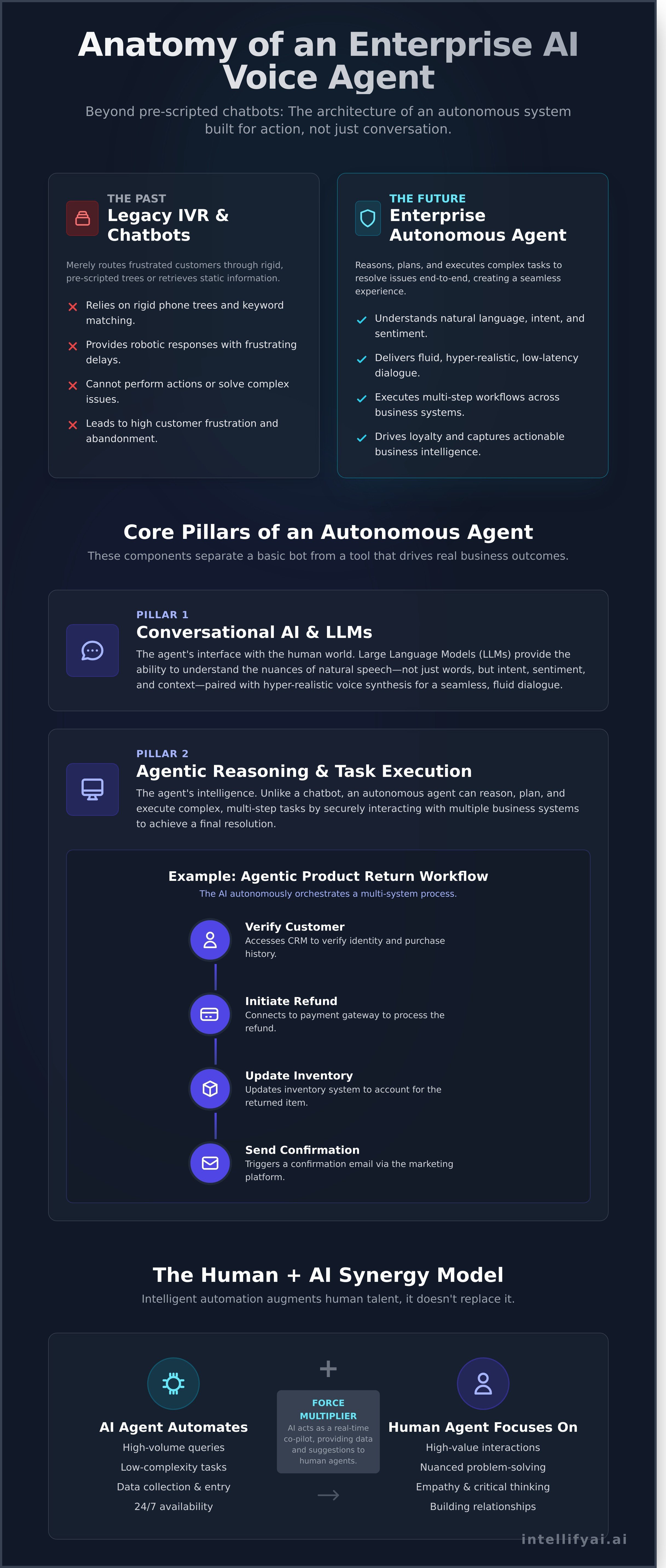
Intelligent automation is not about replacing human talent; it is about augmenting it. This Human-AI Synergy model creates a more efficient and fulfilling work environment. The AI agent becomes a force multiplier for your team, automating high-volume, low-complexity tasks. This liberates your human agents to focus on what they do best: applying empathy, critical thinking, and nuanced problem-solving to high-value interactions. In this model, the AI can even act as a real-time co-pilot, feeding relevant data and suggestions to the human agent during a complex call to accelerate resolution.
Anatomy of an Enterprise-Grade AI Voice Agent
A true enterprise AI voice agent is not a pre-scripted chatbot. It is an autonomous system built on a sophisticated architecture designed for action, not just conversation. Understanding its core components is critical to distinguishing a simple interactive voice response (IVR) from a transformative tool for operational excellence. These pillars separate a basic bot from an autonomous agent capable of driving real business outcomes.
Conversational AI & LLMs
This is the agent's interface with the human world. Large Language Models (LLMs) are the engine, providing the ability to understand the nuances of natural human speech—not just words, but intent, sentiment, and conversational context. This is paired with hyper-realistic voice synthesis and low-latency processing. The result is a seamless, fluid dialogue that eliminates the frustrating delays and robotic responses of legacy systems, creating a genuinely helpful user experience.
Agentic Reasoning & Task Execution
Here lies the agent's intelligence. Unlike a chatbot that retrieves static information, an autonomous agent can reason, plan, and execute complex, multi-step tasks. An agentic workflow in customer service is the autonomous ability of an AI to understand a complex user request, devise a multi-step plan, and execute it by securely interacting with multiple business systems to achieve a final resolution.
For example, processing a product return requires true workflow orchestration:
• Access the CRM to verify the customer and purchase history.
• Connect to the payment gateway to initiate the refund.
• Update the inventory system to account for the returned item.
• Send a confirmation email to the customer via the marketing platform.
Secure Systems Integration
An agent’s ability to act is entirely dependent on its capacity to connect with your core business systems. This is achieved through secure APIs that serve as the bridge to your CRM, ERP, and other backend platforms. An enterprise-grade ai voice agent for customer service must authenticate securely and interact with data under strict protocols. This capability is foundational to the scalable frameworks seen in leading enterprise AI agent solutions. Adherence to compliance standards like GDPR, SOC2, and Sarbanes-Oxley is not optional; it is a core design principle for protecting your data and your customers.
A C-Suite Framework for Evaluating AI Voice Agent Solutions
Selecting the right ai voice agent for customer service is a foundational infrastructure decision, not a tactical software purchase. A myopic focus on feature lists often leads to solutions that fail to scale or adapt to complex enterprise realities. The superior approach is to evaluate potential solutions through a strategic lens, prioritizing long-term partnership, bespoke capabilities, and measurable impact on core business objectives.
This framework shifts the evaluation from "what can the software do?" to "what can we build together?" It assesses a vendor's ability to serve as a true engineering partner, capable of designing an intelligent automation asset that becomes a unique competitive advantage.
| Evaluation Criteria | Off-the-Shelf SaaS | Bespoke Engineered Solution |
|---|---|---|
| Customization | Configuration of pre-built templates. Your workflow must fit the tool. | Ground-up design. The tool is engineered to fit your exact workflow. |
| Integration | Limited to standard, public APIs. Struggles with legacy or proprietary systems. | Deep, system-level integration with any data source, CRM, or backend. |
| Partnership Model | Software license vendor with a tiered customer support desk. | Strategic partner with a dedicated engineering team for ongoing development. |
| Scalability | Scales within the constraints of the platform's multi-tenant architecture. | Architected for enterprise growth and evolving operational complexity. |
Measuring True ROI
Operational efficiency metrics like call deflection and reduced handle time are merely the starting point. The true value of a bespoke ai voice agent for customer service lies in its impact on strategic KPIs. As Gartner's analysis of AI use cases suggests, advanced agent implementations deliver transformative value that must be measured accordingly. Your ROI calculation must account for:
Customer Experience
Direct impact on Customer Satisfaction (CSAT) and Net Promoter Score (NPS) through consistent, 24/7 service.
Employee Experience
Increases in agent retention and satisfaction by automating repetitive tasks and allowing staff to focus on high-value, complex interactions.
Business Intelligence
The immense value of structured data captured from thousands of customer conversations, revealing trends, product feedback, and service gaps.
A strategic partner will help you define these metrics from day one, building a solution designed to achieve and report on them. See how our CX Improvement Framework defines and measures success.
Implementation Roadmap: Deploying AI Voice Agents for Maximum Impact
Transforming your customer service operation with an AI voice agent is not an overnight switch; it is a strategic initiative that demands a structured, disciplined approach. The successful deployment of an ai voice agent for customer service hinges on a crawl-walk-run methodology. This phased roadmap demystifies the process, de-risks your investment, and ensures that each step builds measurable value, paving a clear path from initial concept to enterprise-wide operational excellence.
Phase 1: Strategy & Discovery (Weeks 1-2)
The foundation of a successful deployment is a precise strategy. This initial phase is dedicated to identifying the highest-impact opportunities for automation. We focus on high-volume, low-complexity interactions like order status inquiries or appointment scheduling to secure early wins and demonstrate immediate ROI. Key activities include:
Use Case Identification
Pinpointing repetitive customer queries that are ideal for an initial pilot.
Workflow Mapping
Documenting existing customer service processes and identifying the data sources (CRM, ERP) required for seamless integration.
KPI Definition
Establishing clear success metrics, such as a target reduction in Average Handle Time (AHT) or an increase in First Contact Resolution (FCR).
Phase 2: Pilot Engineering & Testing (Weeks 3-6)
With a clear strategy, we move to execution. This phase involves building and training a bespoke agent on the specific pilot use case in a controlled, sandboxed environment. The objective is to engineer a robust solution before it ever interacts with a customer. We conduct rigorous internal testing to refine conversational flows, validate system integrations, and ensure the agent performs with exceptional accuracy and reliability.
Phase 3: Launch, Monitor & Scale (Weeks 7+)
This is where intelligent automation begins to deliver tangible results. We launch the pilot agent to a limited segment of your customer base, allowing for a controlled go-live. Performance is continuously monitored against the KPIs established in Phase 1. This data-driven feedback loop enables rapid iteration and optimization. From this proven foundation, we develop a strategic roadmap for scaling the ai voice agent for customer service across more complex workflows, progressively unlocking new levels of efficiency and creating the ideal Human-AI synergy.
This structured deployment transforms a complex project into a predictable pathway to intelligent automation. Discover how Intellify AI can architect your success.
IntellifyAi: Your Partner in Engineering Autonomous Customer Service
The strategic framework outlined in this guide—from defining clear objectives to fostering Human-AI Synergy—is the foundation for transformative customer service. Executing this vision requires more than software; it demands a strategic engineering partner. At IntellifyAi, we embody the role of the Strategic Architect, moving beyond pre-packaged solutions to build bespoke, intelligent assets that integrate seamlessly into your operational core.
Our philosophy is simple: technology should serve your strategy, not dictate it. We build an ai voice agent for customer service that is a direct reflection of your brand, your workflows, and your long-term objectives for operational excellence.
Bespoke Agentic AI Engineering
We do not sell a one-size-fits-all product. We engineer a competitive advantage. Our process begins with a deep analysis of your unique business challenges and customer journeys. This allows us to design and deploy autonomous agents that are purpose-built for your ecosystem. Our dedicated teams of AI strategists and engineers ensure success through:
Complex Systems Integration
We ensure your AI voice agent communicates flawlessly with your existing tech stack, from CRMs and ERPs to proprietary knowledge bases, creating a single, unified source of truth.
Custom Workflow Orchestration
Your agent will do more than answer questions. It will execute complex, multi-step tasks, automate post-call actions, and intelligently escalate to human experts when necessary.
Dedicated Technical Partnership
You gain a partner invested in your outcomes, providing the deep technical expertise required to navigate the complexities of enterprise-grade AI implementation.
A Future-Proofed, Strategic Partnership
Implementing an AI voice agent is not a one-time project; it is the beginning of an evolutionary journey. Our solutions are architected for long-term scalability and adaptation, ensuring your investment delivers increasing value over time. We provide ongoing strategic consulting to refine performance, identify new automation opportunities, and align your AI capabilities with your shifting business goals. The objective is to permanently transform your customer service from a cost center into a powerful strategic differentiator that drives loyalty and revenue.
When you are ready to move from theory to execution, partner with a firm that understands the architecture of intelligent automation. Explore how IntellifyAi engineers the future of customer service.
Architecting Your Autonomous Service Future
As we look toward 2026, the mandate for enterprise leadership is clear. The modern ai voice agent for customer service is no longer a tool for simple call deflection but a strategic asset engineered to drive operational excellence and unlock new levels of customer experience. Successfully deploying this technology is not a matter of chance; it hinges on a robust C-suite evaluation framework and a meticulous implementation roadmap that guarantees a seamless transition from vision to measurable value.
Achieving this level of intelligent automation requires a partner with proven expertise in both technology and strategy. IntellifyAi specializes in bespoke Agentic AI engineering, moving beyond generic solutions to build systems that align with your unique operational DNA. Our strategic partnership model and proven CX Improvement Framework are designed to deliver a clear, measurable ROI and future-proof your organization against market disruption.
The future of autonomous service is not a distant vision—it is an achievable reality. Schedule a consultation to architect your enterprise AI voice strategy. Take the definitive step toward engineering your intelligent, autonomous enterprise.
Frequently Asked Questions
How much does an AI voice agent for customer service cost?
The cost of an AI voice agent for customer service is a strategic investment in operational excellence, not a fixed expense. Pricing is tailored to your enterprise needs, factoring in call volume, the complexity of workflow orchestration, and the scope of bespoke integration with your existing systems. To better understand the market landscape, you can learn more about Monthly SaaS Subscription Fees and how they compare to bespoke engineering costs. We focus on delivering a clear and rapid return on investment by calculating the projected gains in efficiency, agent productivity, and customer satisfaction against the total cost of ownership for a transparent business case.
Can an AI voice agent truly sound as natural as a human?
Yes. Modern generative AI models have achieved a level of sophistication where voice agents are virtually indistinguishable from human agents. Through advanced prosody and intonation modeling, our agents replicate the nuances of natural conversation, eliminating the robotic tone of legacy systems. We can even create a custom voice persona that aligns perfectly with your brand identity, ensuring a seamless and consistent customer experience that reinforces brand trust and familiarity across all voice interactions.
How long does it take to implement an AI voice agent?
A standard enterprise implementation follows a high-velocity timeline, typically ranging from 6 to 12 weeks. This process is structured in distinct phases: strategic discovery, secure systems integration, knowledge base ingestion, and phased deployment. The precise timeline depends on the complexity of your required workflows and the depth of the integration. Our process is designed for minimal disruption, ensuring a swift and seamless transition to intelligent automation and a rapid time-to-value for your organization.
How do you ensure the security of customer data when integrating with our systems?
Data security is a foundational pillar of our architecture. We employ end-to-end encryption for all data in transit and at rest, utilizing secure, authenticated API gateways for all system integrations. Our platform is built to exceed enterprise security standards and maintains compliance with key regulations such as SOC 2, GDPR, and CCPA. We treat your customer data with the highest level of integrity, ensuring every interaction is protected and your enterprise remains secure and compliant.
What kind of training is required for the AI to handle our specific business queries?
The AI's training is a sophisticated knowledge ingestion process, not a simple Q&A upload. The agent learns by securely analyzing your existing knowledge bases, historical conversation logs, process documents, and API documentation. This allows the model to understand not just the "what" but the "why" behind your business logic. We then fine-tune the agent to master your specific terminology, policies, and resolution pathways, ensuring it operates as a true extension of your expert team.
Can the AI agent handle multiple languages and accents?
Absolutely. Our AI agents are built on advanced multilingual models designed for global enterprise operations. They can converse fluently in numerous languages and are trained to understand a wide spectrum of regional accents and dialects with high accuracy. This capability ensures you can deliver a consistent, high-quality, and personalized customer experience across all geographic markets, achieving global scale without sacrificing local nuance or comprehension for your diverse customer base.
What happens when the AI agent doesn't know the answer to a customer's question?
Our system is designed for intelligent escalation, embodying true Human-AI synergy. When the agent identifies a query outside its knowledge scope or detects high customer frustration, it does not fail—it triages. The agent executes a seamless and context-aware handoff to the appropriate human expert. The human agent receives the full conversation transcript and customer data instantly, enabling them to resolve the complex issue without forcing the customer to repeat themselves.
How does an AI voice agent differ from a traditional IVR system?
The difference is transformational. Where a traditional IVR presents a rigid, linear menu of predefined options, an AI voice agent for customer service engages in dynamic, natural conversation. It uses Natural Language Understanding (NLU) to interpret customer intent, context, and sentiment in real-time. This allows it to resolve complex, multi-turn queries directly, bypassing frustrating menus and delivering immediate, intelligent solutions that dramatically accelerate resolution times and elevate the customer experience.








.svg)