The modern enterprise call center stands at a critical juncture. Escalating operational costs, high agent turnover, and inconsistent service quality are no longer acceptable liabilities-they are urgent strategic challenges demanding a sophisticated solution. While basic chatbots have offered a glimpse of automation, the future of customer experience is far more intelligent. The strategic implementation of conversational AI for call centers provides a definitive path toward operational excellence, moving your organization from reactive problem-solving to proactive, seamless customer engagement.
This guide is your blueprint for that transformation. We move beyond the hype to deliver a clear, actionable framework for 2026 and beyond. You will learn how to deploy AI to automate complex workflows, empower your human agents with intelligent tools to reduce burnout, and achieve significant improvements in First Contact Resolution and CSAT scores. Prepare to unlock a new level of efficiency and build a customer service operation that is not just a cost center, but a powerful engine for enterprise growth.
Key Takeaways
Table of Contents
What Is Conversational AI? (And How It Differs from a Basic Chatbot)
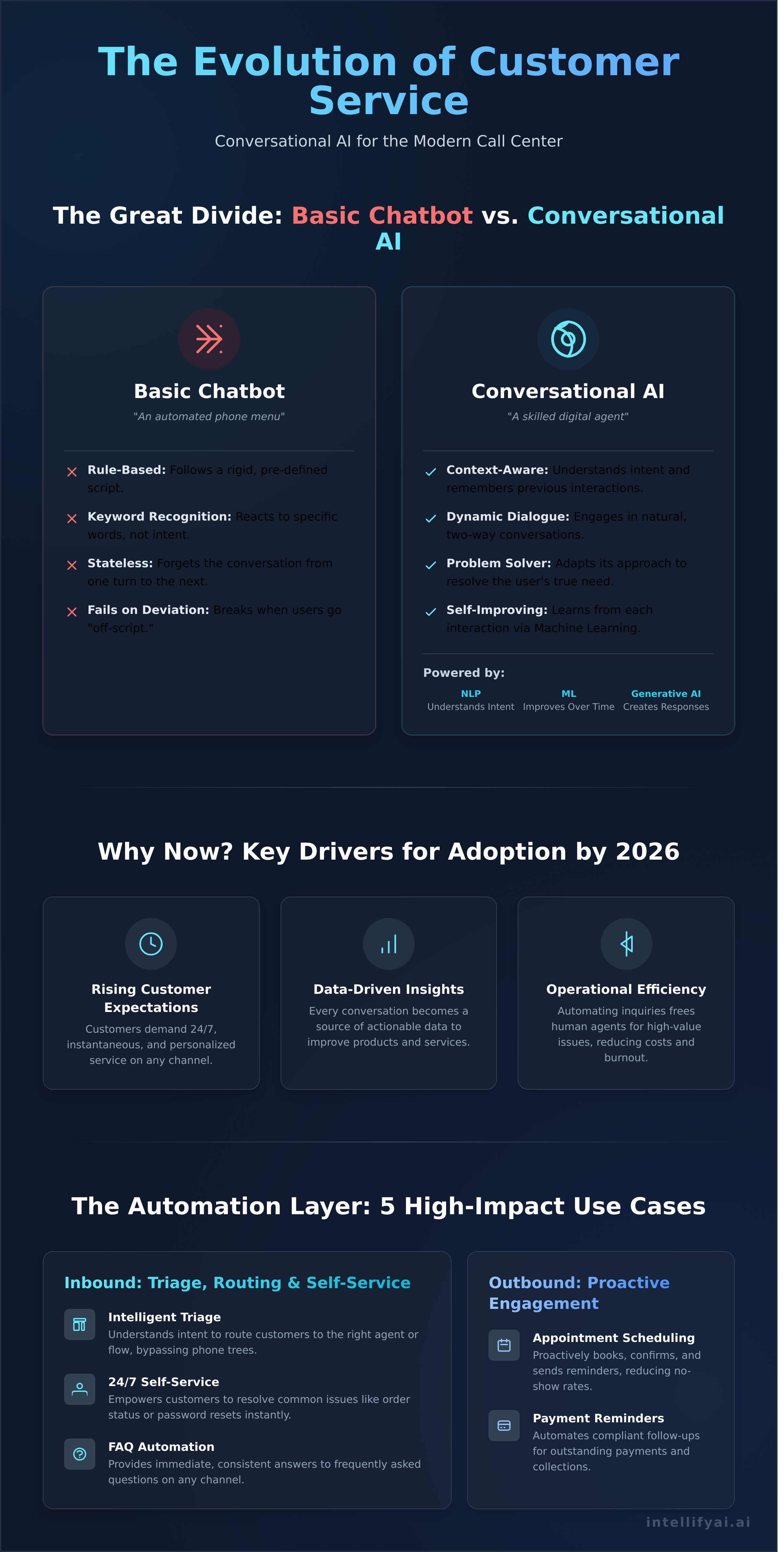
Conversational AI is the technology that empowers machines to understand, process, and respond to human language with human-like nuance and context. It moves beyond simple command-and-response, enabling dynamic, two-way dialogue that solves complex problems. This capability is built on a synergy of critical components, including Natural Language Processing (NLP) to decipher intent, Machine Learning (ML) to improve with each interaction, and Generative AI to create new, relevant responses.
To visualize how these components create a seamless customer experience, consider this overview:
Think of a traditional, rule-based Chatbot as an automated phone menu-it offers a fixed path and fails if you deviate from its script. In stark contrast, Conversational AI operates like a skilled digital receptionist. It understands context, remembers previous parts of the conversation, and adapts its approach to resolve the user's true need, not just recognize a keyword.
The Evolution of Call Center Automation
The call center has evolved from rigid Interactive Voice Response (IVR) systems, which simply routed calls, to today’s intelligent platforms. The integration of Large Language Models (LLMs) marks a pivotal shift from mere command execution to genuine, problem-solving dialogue. The modern application of conversational ai for call centers is not about replacing humans, but augmenting their capabilities for operational excellence.
Why Now? Key Drivers for Adoption in 2026
The widespread adoption of this technology is not a trend; it is a strategic imperative driven by clear market forces:
The Automation Layer: 5 High-Impact Use Cases for Call Centers
The foundation of a transformed contact center is intelligent automation. By deploying autonomous agents to handle high-volume, repetitive tasks, you liberate your human team to focus on complex, high-value interactions. This is the first pillar of value: achieving operational excellence through strategic workflow orchestration. This layer addresses both inbound service requests and outbound engagement with seamless efficiency.
Inbound: Triage, Routing, and Self-Service
Inbound operations are frequently strained by inefficient call routing and a high volume of simple, recurring questions. Conversational AI for call centers directly addresses these core challenges, creating a frictionless customer journey from the first point of contact.
Outbound: Proactive Engagement and Follow-ups
Manual outbound campaigns are resource-intensive and often yield inconsistent results. Intelligent automation transforms these workflows for maximum efficiency and impact, ensuring every outreach is timely, compliant, and effective.
The Augmentation Layer: Elevating Human Agent Performance
Beyond automating routine inquiries, the second and most strategic pillar of value is augmentation: transforming your best agents into truly exceptional ones. The narrative that AI replaces jobs is fundamentally flawed. Instead, intelligent automation liberates your team from repetitive, low-value tasks, allowing them to focus on complex problem-solving and building customer relationships. This is the core of Human-AI Synergy-a partnership where technology elevates human potential, reduces stress, and drives operational excellence. Implementing conversational ai for call centers is not about replacement; it is about empowerment.
Real-Time Agent Assist
Empower your agents with an intelligent co-pilot on every call. Our AI listens to conversations in real time to provide instant, context-aware support. This seamless integration delivers:
Automated Call Summarization & Analysis
Eliminate the burden of after-call work (ACW) and unlock powerful business intelligence. Once a call concludes, our conversational AI instantly generates a perfect, structured summary, noting key details, customer sentiment, and outcomes. This frees up significant agent time to handle the next customer. On a macro level, this data provides an unparalleled view of customer trends, service gaps, and emerging issues across thousands of calls.
Hyper-Personalized Coaching and Training
Move beyond generic training modules and toward data-driven performance improvement. Our platform analyzes agent interactions to identify specific, actionable coaching opportunities for each individual. Managers can pinpoint areas for improvement-from tone and empathy to product knowledge-backed by real-world examples. This approach not only accelerates proficiency for seasoned agents but also drastically reduces onboarding time for new hires, creating a consistent standard of excellence.
A Strategic Framework for Implementing Conversational AI
A successful deployment is not a technological event; it is the outcome of a deliberate business strategy. The most transformative applications of conversational ai for call centers are built on a foundation of clear objectives, measurable outcomes, and meticulous planning. Adopting a phased, strategic approach de-risks the implementation process and guarantees a clear return on investment. This framework moves beyond the technology to provide an actionable path toward achieving operational excellence.
Step 1: Identify and Prioritize Your Core Problem
Begin by isolating a single, high-impact business challenge. Your primary objective must be defined: are you solving for escalating operational costs, inconsistent CSAT scores, or unsustainable agent churn? Resist the impulse to "boil the ocean" with an all-encompassing initial project. Instead, select a pilot use case that is high-volume, repetitive, and has a clear success metric, such as password resets or order status inquiries. This focused approach ensures a quick, measurable win and builds crucial momentum for future-proofing your entire support operation.
Step 2: Define Success Metrics and KPIs
To measure transformation, you must first establish a precise baseline. You cannot prove ROI without a clear "before" picture. Document your current performance across core contact center metrics:
With this data, set specific, realistic goals tied to a timeline, such as "achieve a 20% reduction in AHT for our pilot use case within 90 days." This discipline is essential for quantifying the platform’s impact and building a powerful business case for wider adoption.
Step 3: Evaluate Technology and Integration Needs
The right strategy dictates the right technology-not the other way around. A comprehensive audit of your existing tech stack is critical. Assess your CRM, contact center platform (CCaaS), and internal knowledge bases to map out integration requirements. A truly intelligent automation solution requires seamless, bespoke API connectivity to orchestrate workflows across disparate systems. Furthermore, prioritize platforms that offer enterprise-grade data security, meet critical compliance standards like SOC2 and GDPR, and are architected to scale with your business demands.
Executing this strategic framework is the first step toward unlocking the full potential of intelligent automation. To see how our consultative approach and bespoke integration capabilities can align with your business goals, explore our solutions at Intellify AI.
Engineering Your Solution: Partnering for Success with IntellifyAI
The strategic framework we have outlined provides the blueprint for transformation. However, a blueprint requires an architect and an engineer to become reality. True operational excellence is not achieved by deploying off-the-shelf software; it is engineered through a bespoke partnership. This is where IntellifyAI moves beyond theory and into execution, co-creating an intelligent automation ecosystem tailored to your specific business reality.
Beyond Software: Agentic AI Engineering Services
Generic bots solve generic problems. Your call center, however, has unique workflows, proprietary knowledge, and specific compliance requirements. We deliver true transformation by engineering custom autonomous agents, not simply installing chatbots. Our process involves deep integration with your existing systems, orchestrating complex workflows that a pre-packaged solution cannot handle. We provide custom model training on your data and deploy on dedicated infrastructure, ensuring unparalleled performance, security, and accuracy for your conversational ai for call centers.
AI Strategy & Consulting: Your Roadmap to Transformation
Implementing powerful technology without a clear strategy leads to wasted investment. IntellifyAI acts as your strategic partner, guiding you through every stage of the transformation roadmap. We collaborate with your teams to:
This is a partnership, not a transaction. We are invested in building a future-proof solution that scales with your enterprise and delivers measurable value. The successful deployment of conversational ai for call centers is a strategic initiative, and we provide the expertise to ensure it succeeds.
Stop searching for a product and start building a solution. Architect your intelligent call center with our experts.
From Cost Center to Value Engine: Your AI Transformation Awaits
The evolution to an intelligent contact center is a present-day strategic imperative. This transformation is driven by a dual strategy: deploying AI for high-impact automation while augmenting human agents to elevate performance. A successful implementation of conversational ai for call centers is not about technology alone. It requires a deliberate framework engineered for measurable business outcomes and long-term scalability.
The path to operational excellence is architected. IntellifyAI is your strategic partner, providing End-to-End Enterprise AI Strategy Consulting and Bespoke Agentic AI Engineering. We leverage our Proven CX Improvement Framework to design and build your future-proof solution, transforming your operations from the ground up. The next step is clear. Schedule a strategic consultation to architect your AI-powered contact center and begin building your competitive advantage.
Frequently Asked Questions
How much does conversational AI for a call center typically cost?
The cost is a strategic investment in operational excellence, not a simple expense. Pricing is typically based on factors like call volume, the complexity of automated workflows, and the depth of integration required. Models range from per-minute usage to comprehensive subscription plans. The primary focus should be on the significant ROI generated through reduced agent handling time, increased first-call resolution, and 24/7 operational capacity, which delivers a clear and measurable business impact.
Will my customers know they are talking to an AI, and will they accept it?
We advocate for transparency. Customers readily accept AI when it delivers immediate, accurate, and effective resolutions to their needs. The goal is not to mimic a human but to provide a superior, frictionless service experience. Our AI agents handle routine, high-volume queries instantly, which customers appreciate. This intelligent automation frees your human team to manage complex, high-value interactions, creating an optimal model of Human-AI synergy that enhances overall customer satisfaction.
How long does it take to implement a conversational AI solution?
Implementation timelines are designed for velocity and minimal disruption. A focused pilot program addressing a specific high-impact use case can be launched in as little as 4 to 6 weeks. A full-scale, enterprise-wide deployment with multiple bespoke integrations typically requires 3 to 6 months. Our structured process-from discovery and data analysis to system integration and launch-is engineered to deliver measurable value at every stage and accelerate your path to operational transformation.
What kind of data is needed to train a conversational AI for my business?
To achieve peak performance, the AI is trained on your specific operational data. This includes historical call transcripts, agent chat logs, internal knowledge base articles, and existing customer support documentation. This data allows us to build a bespoke language model that understands your unique customer intents, product terminology, and resolution pathways. Our team guides you through a secure data curation process to ensure the highest level of accuracy and effectiveness from day one.
How does conversational AI integrate with my existing CRM and CCaaS platform?
Our solutions are engineered for seamless, bespoke integration. Using robust APIs, our conversational AI connects directly with leading CRM and CCaaS platforms such as Salesforce, Zendesk, Genesys, and Talkdesk. This allows the AI to access customer history for personalized interactions and to update records with call summaries and outcomes automatically. The result is a unified technology stack, streamlined workflow orchestration, and a single source of truth for every customer interaction.
What is the difference between an AI voice agent and a traditional IVR system?
The difference is transformational. A traditional IVR is a rigid, one-way menu that forces callers down a predefined path. In contrast, an AI voice agent engages in dynamic, two-way conversation using Natural Language Understanding. It comprehends user intent, asks clarifying questions, and can autonomously execute complex tasks. It moves beyond simple call routing to become a true resolution engine, eliminating the friction and frustration inherent in legacy IVR systems.
How do you ensure data security and compliance with regulations like GDPR?
Security and compliance are foundational to our architecture. We employ end-to-end encryption for all data in transit and at rest, alongside robust data anonymization and pseudonymization techniques. Our platform is built on secure, certified cloud infrastructure and is designed to meet stringent global standards, including GDPR, CCPA, and HIPAA. We provide a dependable, enterprise-grade solution that protects your customer data and minimizes your operational and regulatory risk.
Can conversational AI handle multiple languages and accents?
Yes. A key advantage of modern conversational AI for call centers is its advanced multilingual and multi-accent capability. Our models are trained on vast, diverse global datasets, enabling them to understand and respond fluently in dozens of languages. They are also highly adept at recognizing a wide spectrum of regional accents and dialects with remarkable accuracy. This ensures you can deliver a consistent, intelligent, and accessible customer experience across all your target markets.








.svg)