
Your enterprise moves at the speed of its slowest component. For many leaders, that component is a monolithic application-a rigid, interconnected system that slows innovation, complicates scaling, and creates a formidable barrier to adopting modern AI. This is a structural challenge, not a personnel one, and the solution lies in a new architectural philosophy: microservices. The term is often buried in technical jargon, but its true value is not in the code; it is in the operational agility and strategic freedom it unlocks for your business.
This guide demystifies the concept. We move beyond the technical complexities to deliver a clear, business-focused framework for enterprise leaders. You will learn the strategic pros and cons, gain a model for deciding if and when to migrate from your current monolith, and understand the resources required for a successful transition. Prepare to re-architect your technology to build a more resilient, innovative, and AI-ready enterprise for 2026 and beyond.
Key Takeaways
- Pinpoint the exact business constraints imposed by legacy monolithic systems and why a new architectural model is essential for growth.
- Reframe the conversation from technical features to strategic outcomes, connecting a microservices architecture directly to accelerated innovation and ROI.
- Access a pragmatic decision framework to determine if and when this architectural shift is the right strategic move for your enterprise.
- Demystify the migration process with a high-level strategic roadmap designed to ensure a seamless and successful modernization journey.
What Are Microservices? From Monolithic Limits to Modern Agility
In today's high-velocity market, enterprise agility is a core requirement for survival and growth. The traditional monolithic architecture, where an entire application is engineered as a single, indivisible unit, fundamentally constrains this agility. It creates bottlenecks that slow innovation and impede scalability. To move from these rigid structures toward a more dynamic operational model, enterprises must adopt a new architectural paradigm. This is the strategic function of the microservice architecture.
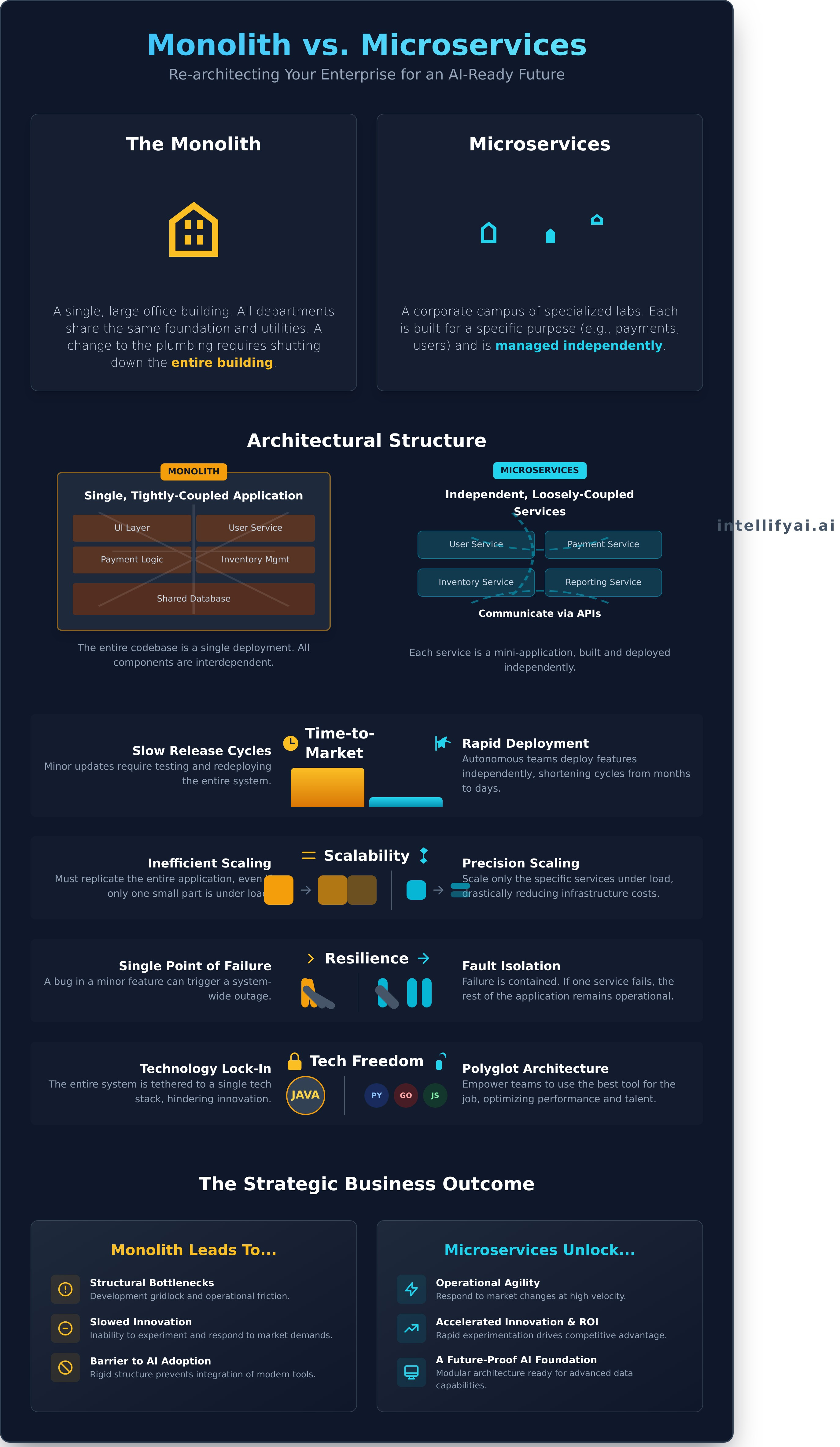
To grasp the concept, consider an analogy. A monolith is a single, large office building. Every department is under one roof, sharing the same foundation and utilities. A change to the plumbing requires shutting down the entire building. In contrast, microservices are a corporate campus of specialized, independent labs. Each lab is built around a specific business capability-like payment processing or user authentication-and is managed by a small, dedicated team. This modularity is a core principle. For a foundational definition, it's helpful to explore the question of What Are Microservices? in the context of their predecessor's limitations.
The Monolithic Architecture: A Single Point of Failure
A monolithic application bundles its entire codebase into a single, tightly coupled deployment. This unified structure creates significant operational friction and risk. A minor update to one feature requires testing and redeploying the entire system, dramatically slowing release cycles. Scaling becomes a blunt, inefficient instrument; you must replicate the entire application, even if only one function is under heavy load. This inefficiency is compounded by technological stagnation, as the system is tethered to a single tech stack, making it difficult to innovate or adopt modern tools.
The Microservice Architecture: A Business-Aligned Approach
Microservices dismantle this single point of failure by design. The architecture is composed of loosely coupled, independently deployable services that communicate via well-defined APIs. This structure directly mirrors a modern, agile business organization, empowering autonomous teams to take full ownership of their service's lifecycle. This is not merely a technical adjustment; it is a transformative strategic shift. It redefines how software is built, managed, and scaled, aligning technology directly with business objectives to achieve operational excellence and build a resilient, future-proof foundation for growth.
The Business Case for Microservices: Beyond Technical Benefits
Adopting a microservices architecture is not merely a technical upgrade; it is a strategic business decision that fundamentally redefines operational agility and competitive positioning. While developers appreciate the clean separation of concerns, the true value is realized in the C-suite through enhanced resilience, innovation velocity, and financial efficiency. This architectural approach dismantles the constraints of a monolithic system, enabling the enterprise to operate as a collection of focused, high-performance units.
The core business advantages are direct and measurable. They transform how an organization builds, deploys, and maintains its digital assets, leading to superior operational excellence and enabling digital partners like Due Elle Communication to execute more agile and effective online strategies.
- Improved Resilience: In a monolithic application, a single point of failure can trigger a system-wide outage. With microservices, failure is contained. If a reporting service fails, the customer-facing checkout process remains fully operational, protecting revenue streams and brand reputation.
- Technological Freedom: Empower teams to use the best tool for the job. Your data science team can build a recommendation engine in Python while your transaction-processing service uses a high-performance Java stack, optimizing both performance and talent acquisition.
- Precision Scalability: Move beyond scaling your entire application. This architecture allows you to scale only the specific services under load, drastically reducing cloud infrastructure costs. The ongoing debate over Microservices vs. Monolith often highlights this unparalleled control over operational expenditure, a cornerstone of a mature FinOps strategy.
Accelerating Time-to-Market and Innovation
Small, autonomous teams can develop, test, and deploy features independently and in parallel. This decoupling eliminates development bottlenecks and shortens release cycles from months to days. The result is a culture of rapid experimentation and iteration, allowing your business to respond to market demands and launch new capabilities faster than monolithic competitors. This speed is a direct driver of competitive advantage.
Unlocking Advanced AI and Data Capabilities
A modern AI strategy demands a modular, scalable foundation. Deploying complex AI models as discrete services-such as a fraud detection unit or a personalization engine-is critical. This approach allows data science teams to update, retrain, and scale individual models without redeploying the entire application. It ensures your AI initiatives are agile and future-proof, preventing them from becoming the next-generation monolithic bottleneck.
Microservices vs. Monolith: A Pragmatic Decision Framework
The critical question for any technology leader is not "which architecture is better?" but "which architecture is right for my business right now?" Adopting a microservices architecture is a significant strategic commitment, not a silver bullet for development challenges. It introduces powerful capabilities but also new layers of complexity. To make a sound decision, leaders need a Pragmatic Decision Framework that weighs the distinct trade-offs against specific business objectives and operational maturity.
This balanced view is essential for future-proofing your enterprise. The following table provides a high-level comparison across key strategic criteria:
| Criterion | Monolithic Architecture | Microservices Architecture |
|---|---|---|
| Initial Development Speed | High. Unified codebase simplifies initial setup and deployment. | Lower. Requires upfront investment in infrastructure and CI/CD pipelines. |
| Operational Complexity | Low. Single application to deploy, monitor, and manage. | High. Involves managing a distributed system of services. |
| Scalability | Limited. The entire application must be scaled together. | Granular. Individual services can be scaled independently. |
| Team Autonomy | Low. Teams are tightly coupled to a single codebase. | High. Small, independent teams can own and deploy services. |
| Cost | Lower initial cost, but can become expensive to scale. | Higher initial infrastructure cost, but optimized for long-term ROI. |
When a Monolith Is Still the Right Choice
For early-stage startups, MVPs, or applications with a simple domain, a monolith is often the most effective path to market. The "Monolith First" strategy prioritizes speed and validation, allowing a small team to build and deploy rapidly without the overhead of a distributed system. In this context, premature optimization toward a complex architecture is a costly distraction from achieving product-market fit.
Key Indicators Your Enterprise Needs Microservices
Evaluate your current state. If your organization is facing the following challenges, it is a strong signal that a strategic migration to microservices is necessary for future growth and operational excellence:
- Slowing Development Cycles: Are feature deployments becoming slower and more complex as your engineering team expands and the codebase grows?
- Inefficient Scaling: Do you need to scale specific, high-demand functions of your application independently to manage performance and control infrastructure costs effectively?
- Technology Stagnation: Is your legacy monolithic stack preventing the adoption of modern technologies, such as bespoke AI integrations or specialized databases, for different business functions?
Once you've identified these indicators, the next step is planning the migration. This is a complex process, and it can be helpful to explore Custom Software/Web Development options to understand the resources and expertise required for such a fundamental architectural shift.
Strategic Migration: A Phased Roadmap to a Microservices Architecture
Transitioning from a monolithic architecture is not a technical gamble; it is a calculated business evolution. The process must be demystified and approached as a strategic, phased initiative, not a high-risk "big bang" rewrite. This roadmap prioritizes incremental value and operational stability, ensuring your organization can adapt and scale without disrupting core business functions. A successful migration is as much about organizational readiness as it is about technological change.
Step 1: Deconstruct the Monolith with Domain-Driven Design (DDD)
Begin with a strategic analysis of your business domain. Domain-Driven Design (DDD) provides a framework to identify and isolate core business capabilities into distinct "bounded contexts"-such as inventory management, user authentication, or payment processing. These contexts serve as the architectural blueprints for your future microservices. This critical mapping phase requires deep collaboration between technical leaders and business stakeholders to ensure the resulting services align perfectly with business value streams.
Step 2: Implement the Strangler Fig Pattern
To mitigate risk and avoid service disruption, adopt the Strangler Fig Pattern. This proven strategy involves building new, modern services around the legacy monolith. New features are developed as independent services, and existing functionality is gradually carved out and replaced. Over time, this new ecosystem of services intercepts traffic and 'strangles' the original monolith, which can eventually be decommissioned. This delivers continuous value and avoids the immense risk of a complete system rewrite. This approach is particularly effective for integrating specialized third-party services. For example, a company modernizing its fintech platform could use a dedicated API for bank aggregation; if this is a capability your team needs, you can check out Wealthreader.
Step 3: Establish the Right Tools and Culture
Technology is only half of the equation. A distributed architecture demands a new operational mindset and a modern toolchain. This includes:
- CI/CD Pipelines: For automated, reliable, and frequent deployments.
- Observability Platforms: To monitor the health and performance of distributed services.
- Service Orchestration: Tools like Kubernetes to manage containerized applications at scale.
More importantly, this transition requires a cultural shift toward a DevOps model of team ownership, often summarized as "you build it, you run it." This investment in tools and culture is an investment in a more agile, accountable, and resilient organization. Executing this roadmap transforms not just your architecture, but your capacity for innovation. Learn how IntellifyAi architects future-proof solutions to accelerate your journey.
Partnering for Success: Accelerating Your Modernization Journey with IntellifyAi
The transition from a monolithic architecture to a distributed system is a defining strategic move, not merely a technical update. This journey is complex, carrying inherent risks to operational stability and budget. Success demands precision, foresight, and deep expertise. Attempting this transformation without a seasoned guide can lead to extended timelines, budget overruns, and a final architecture that fails to deliver on its promised agility.
IntellifyAi’s Cloud-Native & Enterprise Modernization services are designed to navigate this complexity. We act as your strategic architect, ensuring your migration to microservices is not just successful, but transformative. Partnering with our experts de-risks the entire process, accelerates your timeline to value, and guarantees that every technical decision is directly aligned with your core business objectives. We transform architectural theory into measurable business impact.
From Strategic Architecture to Agentic AI
Modernization is the foundation, not the final destination. A flexible, resilient architecture enables the next leap forward: intelligent automation. Our approach future-proofs your enterprise, creating the ideal environment for the seamless deployment of IntellifyAi's agentic AI solutions. We transform legacy systems into a dynamic platform engineered for operational excellence and sustained competitive advantage.
Your Next Step Towards an Agile Enterprise
Consider your organization's position. Are your systems an enabler of growth or a barrier to innovation? A strategic roadmap is the critical first step towards agility and intelligence. Engage with our specialists to architect a modernization plan that aligns with your long-term vision and delivers a clear return on investment.
From Strategy to Execution: Your Next Chapter in Agility
The journey from monolithic constraints to modern agility is a strategic imperative, not merely a technical update. It demands a deliberate, phased migration to unlock true scalability, foster innovation, and secure a competitive edge. Adopting a microservices architecture is the foundational step toward building a resilient, future-proof enterprise that is ready for the demands of 2026 and beyond.
However, this transformation is a complex undertaking that requires more than a blueprint; it requires a strategic partner. At IntellifyAI, our deep expertise in Cloud-Native and Enterprise Modernization is matched by our end-to-end AI strategy and implementation capabilities. We leverage a proven framework to de-risk complex migrations, ensuring your transition is both seamless and impactful, liberating your teams to focus on high-value work.
Architect your future-proof enterprise. Engage our AI strategy consultants today.
The future of your enterprise is not built by chance, but by design.
Frequently Asked Questions
What is the main disadvantage of microservices?
The primary disadvantage is increased operational complexity. Instead of managing a single, monolithic application, you must deploy, monitor, and secure a distributed system of many independent services. This requires sophisticated automation, robust CI/CD pipelines, and advanced observability tools to manage inter-service communication and potential failure points. This shift introduces significant overhead that can challenge teams without mature DevOps practices, making the management of microservices a strategic consideration. For businesses looking to offload this burden, solutions from providers of managed IT services for business Coventry can be a valuable option.
Are microservices faster than a monolith?
The answer depends on the context of "faster." Development velocity is often higher, as small, autonomous teams can build and deploy their services independently and rapidly. However, runtime performance for a single user request can sometimes be slower due to network latency from communication between multiple services. A monolith handles requests within a single process, which can be faster than remote procedure calls across a network. The strategic trade-off is between development speed and potential network overhead.
How small should a microservice be?
A microservice should not be defined by lines of code but by business capability. The ideal size is aligned with a "bounded context" from Domain-Driven Design, meaning it should fully own a single, discrete area of business functionality (e.g., user authentication, payment processing). The service should be small enough to be managed by a single team but large enough to deliver meaningful business value without excessive communication with other services.
What is an example of a company that successfully uses microservices?
Netflix is a preeminent example of successfully implementing a microservices architecture. They transitioned from a monolith to hundreds of fine-grained services to achieve massive scalability and high availability for their global streaming platform. This architecture allows their teams to innovate independently, deploy updates frequently, and build resilience by isolating failures to individual services. This prevents a single component failure from causing a system-wide outage, ensuring operational excellence at scale.
What is an API Gateway and why is it important for microservices?
An API Gateway is a server that acts as a single entry point for all client requests into a microservices ecosystem. It is critical because it decouples clients from the internal service structure. The gateway routes requests to the appropriate downstream service, aggregates results from multiple services, and handles cross-cutting concerns like authentication, rate limiting, and SSL termination. This simplifies client-side code and centralizes essential security and traffic management policies.
Do microservices increase costs?
Initially, yes. A microservices architecture often requires a greater upfront investment in infrastructure and tooling. You need container orchestration platforms like Kubernetes, service meshes, and advanced monitoring systems, which increases operational overhead. However, this investment can lead to long-term cost savings through improved developer productivity, better scalability to handle traffic efficiently, and the ability to use the most cost-effective technology for each specific service, optimizing total cost of ownership.
Is it possible to have a hybrid monolithic-microservices architecture?
Yes, a hybrid approach is not only possible but often a recommended strategy for modernizing legacy systems. This is commonly implemented using the "Strangler Fig Pattern," where new features are built as microservices that interact with the existing monolith. Over time, functionality is gradually carved out of the monolith and replaced with new services until the original application is phased out. This allows for an incremental, lower-risk migration toward a fully distributed architecture.
How do you handle data consistency across different microservices?
Achieving data consistency is a significant challenge, as each microservice typically owns its own database. Instead of traditional ACID transactions, distributed systems often rely on a concept called "eventual consistency." This is managed using patterns like the Saga pattern, where a sequence of local transactions is orchestrated across services. If one transaction fails, a series of compensating transactions is triggered to revert the changes, ensuring the system returns to a consistent state.









.svg)