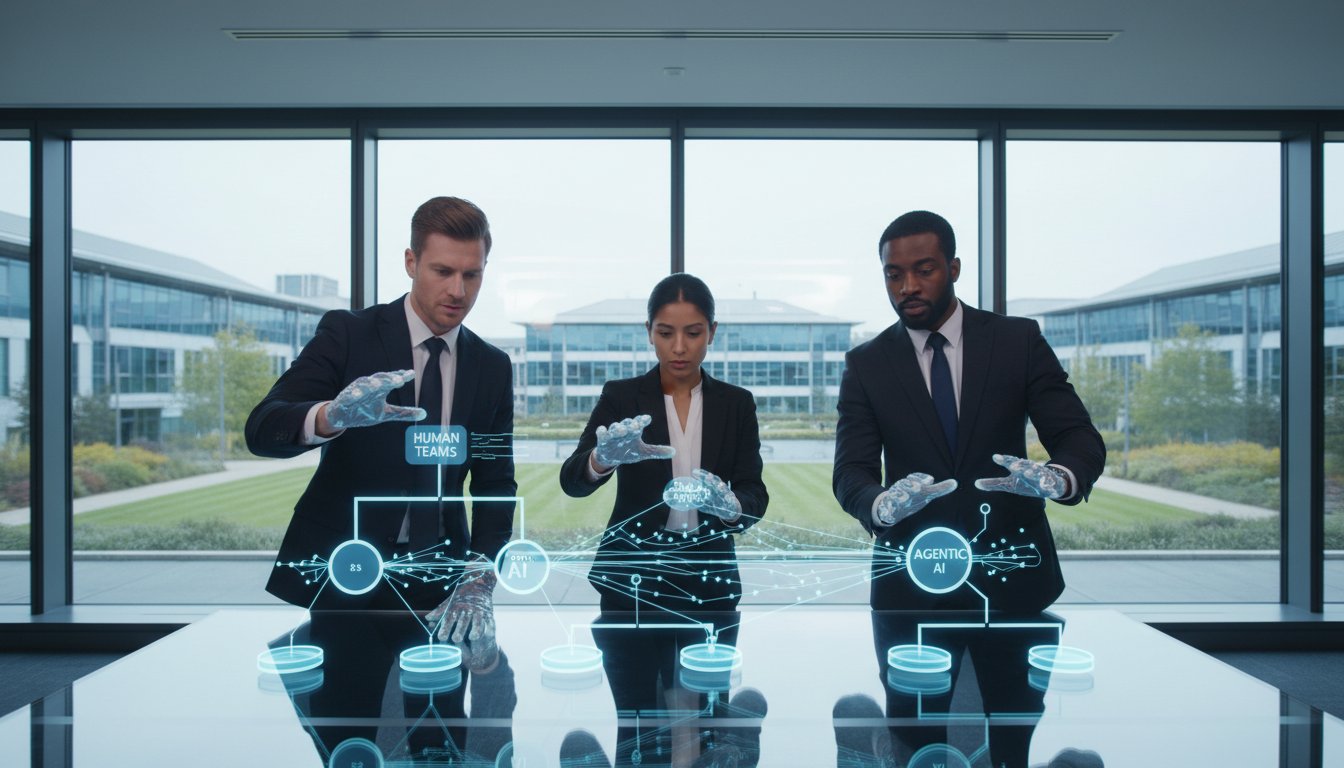
By 2026, your change management playbook will be obsolete. Agentic AI won't just augment your workflows; it will fundamentally restructure them, demanding a new operational philosophy. You're likely already feeling this tension. Rigid legacy systems create friction against agile AI adoption, human teams struggle to synergize with automated processes, and measuring the ROI on organizational change feels like a shot in the dark. This is the new frontier of organizational development, and outdated maps won't get you there.
It's time to move beyond reactive adjustments. This guide delivers a practical, forward-looking framework designed for decisive action, not just theory. We will show you how to master the evolution from traditional management to intelligent, AI-native workflow orchestration and build a culture of genuine Human-AI synergy. Prepare to receive a definitive roadmap for unlocking seamless operational excellence, future-proofing your enterprise, and achieving transformative, measurable scalability.
Key Takeaways
- Learn how modern organizational development is shifting from managing human change to orchestrating integrated Human-AI workflows.
- Discover the "Agentic Pivot," a strategic model for placing intelligent automation at the very center of your operational structure.
- Master the techniques to cultivate Human-AI Synergy, empowering your team to focus on high-value creative work instead of repetitive tasks.
- Uncover a 5-phase implementation roadmap for identifying high-impact AI opportunities and executing a seamless transformation.
What is Organizational Development in the 2026 AI Era?
Organizational development has always been a science-based effort to improve an enterprise’s effectiveness. Traditionally, this involved planned interventions in strategy, structure, and processes. The foundational principles, outlined in resources that explore What is Organizational Development?, focused on optimizing human systems. Today, that definition is dangerously incomplete. By 2026, the concept of a "human-only" system is obsolete. We are now engineering integrated workflows where human talent collaborates directly with autonomous, agentic AI.
This video provides a foundational overview of the core principles that are now being radically transformed:
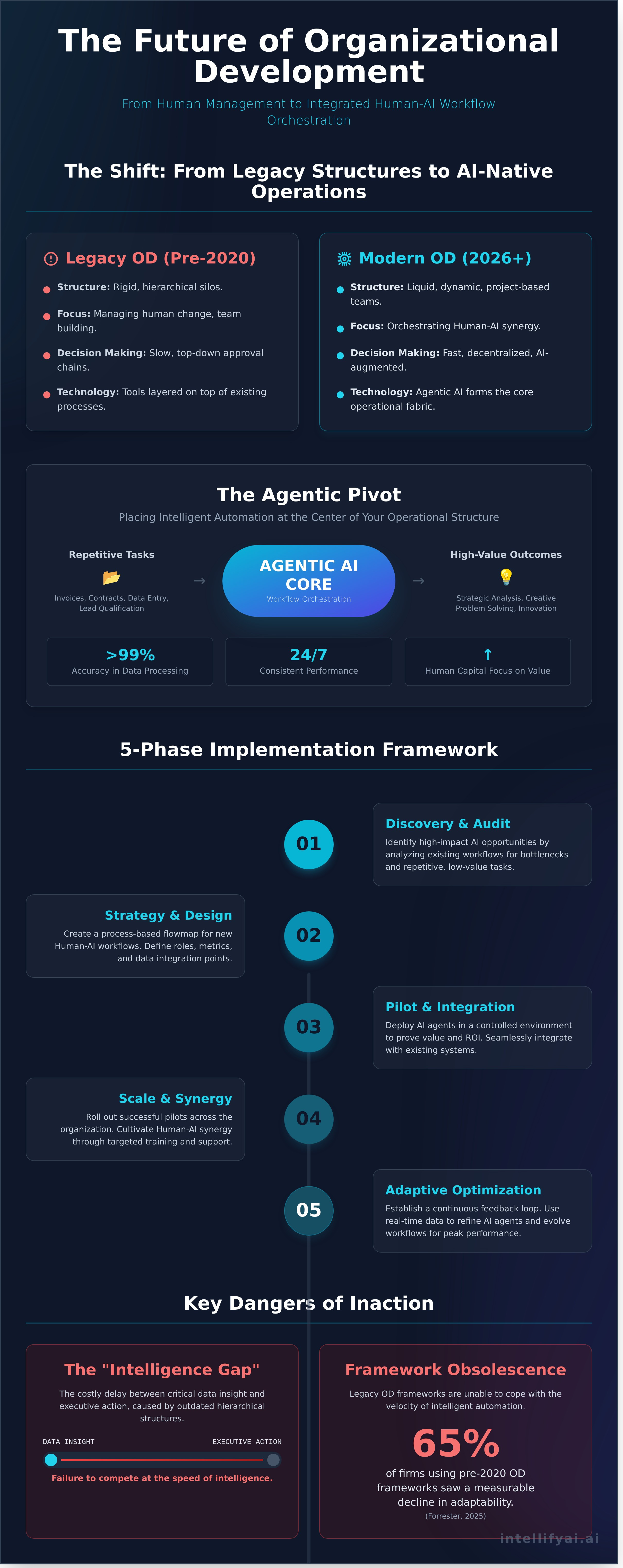
Legacy OD models, developed for a world of quarterly reports and annual planning, simply cannot account for the velocity of intelligent automation. A 2025 Forrester study found that 65% of companies still using pre-2020 OD frameworks saw a measurable decline in their ability to adapt to real-time market shifts. These outdated models create friction, not flow. The core objective of modern organizational development is no longer just improvement; it's about building a future-proof enterprise that learns, adapts, and evolves as fast as its data streams.
The Evolution from HR Support to Strategic Architecture
OD has decisively moved beyond its historical perception as a function of HR focused on team-building exercises and morale. It is now the discipline of complex system orchestration. A tactical software update, like implementing a new CRM, isn't a fundamental shift. A true organizational redesign integrates an AI sales agent that autonomously qualifies leads, schedules meetings, and provides human account executives with real-time sentiment analysis during calls. This changes roles, metrics, and power structures. 2026 OD is the deliberate alignment of human potential and autonomous intelligence.
Why Your Current Organizational Structure is Likely Obsolete
Hierarchical silos are liabilities in a real-time data environment. Information flows up a chain of command for approval, losing context and speed with every step. In an environment where an AI can analyze global supply chain data in 45 seconds to predict a disruption, a decision-making process requiring three levels of management over five business days is a critical failure. This lag creates an "Intelligence Gap," the costly delay between data insight and executive action. To close this gap, forward-thinking enterprises are adopting:
- Liquid Structures: Dynamic, project-based teams that form and dissolve around specific objectives, empowered with the data and AI tools to execute.
- Decentralized Decision-Making: Pushing authority to the edges of the organization, where employees augmented by AI can make faster, more informed choices without bureaucratic delay.
Your current framework was built for a different era of information. To compete, you must redesign for the speed of intelligence itself.
The Agentic Pivot: Redefining Structure for Intelligent Automation
True digital transformation demands more than new software. It requires a fundamental restructuring of the enterprise. We call this the Agentic Pivot: a strategic shift that places intelligent, autonomous AI agents at the very center of workflow design. This isn't about layering automation on top of existing processes. It's about rebuilding your operational model from the ground up, treating platforms like i_Nova not as tools, but as the core connective tissue of the modern firm. This approach is the future of effective organizational development, moving beyond theory and into tangible, automated execution.
This principle of foundational redesign isn't unique to technology; it's a core concept in any field focused on structure and performance. In fashion, for instance, designers constantly revisit classic staples to meet modern demands. To see this in practice, you can explore Doyenne Jean dark wash and how a timeless silhouette is re-engineered for a contemporary fit.
The impact of this pivot is most visible in back-office health. By deploying Intelligent Document Processing (IDP), firms can eliminate the manual bottlenecks that cripple efficiency. An AI agent can process, categorize, and extract data from thousands of invoices or contracts in the time it takes a human to handle one, achieving accuracy rates exceeding 99% with consistent performance 24/7. This frees human capital from low-value data entry and allows a focus on high-value analysis and decision-making.
In marketing, a similar shift occurs when teams use specialized platforms to automate the discovery and management of brand partnerships. When you discover Influencer, for example, you see how technology can handle the logistics, freeing up strategists to focus on creative campaign development. This is where partnering with a full-service agency like Five Channels can help orchestrate these diverse digital efforts into a single, cohesive strategy.
This same principle of automating logistics to free up human expertise is reshaping other industries as well. In real estate, for example, modern marketing tools now handle initial viewings through immersive virtual tours. To see how this technology is applied, you can visit PanoMagic.
Similarly, the investment side of the industry is being redefined by all-in-one educational platforms; for example, Multifamily Intelligence provides specialized tools and a community for real estate investors to navigate this new landscape.
Workflow Orchestration as the New Org Chart
Discard the static, department-based org chart. The future is the process-based flowmap, a dynamic visualization of how work actually gets done. In this model, autonomous agents act as relentless executors, breaking down the cross-functional barriers that create friction and delay. An agent can initiate a client onboarding process in sales, trigger a compliance check in legal, and provision resources in finance without human handoffs. For specialized sectors like law, dedicated platforms such as retainerengine.com are already automating the entire client intake system. This is transformative for document-heavy sectors; a 2023 Deloitte analysis found IDP can automate over 80% of data extraction tasks, reducing operational costs in finance and legal departments by up to 70%.
This shift redefines human contribution entirely. Your team’s value moves away from repetitive task execution and elevates toward higher-impact functions. The new roles are not about 'doing' but about 'directing.' This change requires a new leadership mindset, a core challenge in effective organizational design in the age of AI. Your most valuable employees become:
- Agent Overseers: Experts who monitor, fine-tune, and manage fleets of AI agents, ensuring they meet performance KPIs and handling complex exceptions.
- Strategy Orchestrators: Visionaries who design new automated workflows, identifying opportunities to deploy agents to solve complex business challenges and drive growth.
Scaling Intelligence Without Scaling Headcount
The mathematics of enterprise growth have changed. Historically, a 2X increase in revenue required a near-2X increase in operational headcount. Agentic AI breaks this linear model. A small, highly-skilled team can orchestrate a digital workforce of thousands, achieving exponential increases in output with minimal staff expansion. Of course, guiding this new form of growth requires expert financial oversight, which is why many companies now check out SA Unlimited for fractional CFO services. For enterprises on such a rapid growth trajectory, exploring funding options like private equity is a natural next step, and you can check out BGS Capital for a complete guide on the subject. This is operational excellence, achieved through cloud-native modernization that provides the elastic, scalable infrastructure these agents require. While off-the-shelf automation tools provide baseline efficiency, true market leadership is built on proprietary systems. Creating these unique competitive advantages is where bespoke AI engineering delivers transformative, long-term ROI.
Human-AI Synergy: Solving the #1 Objection to OD
The single greatest barrier to AI adoption isn't technical; it's human. The fear of replacement paralyzes progress and undermines even the most sophisticated AI integrations. We solve this objection by reframing the narrative. AI isn't a replacement for human talent. It's a liberator of human potential, a tool designed to amplify creativity and strategic impact by automating the mundane.
This shift requires leaders to become "Strategic Architects," building new operational models with AI, not in reaction to it. The goal is to cultivate an environment of profound psychological safety, where employees see AI as a partner in their success. This is the foundation of effective digital transformation. Without it, you’re simply deploying software. With it, you are engineering a new, more resilient corporate structure. Success in this new paradigm is measured by the "Synergy Quotient" (SQ) of your teams-a metric reflecting how effectively humans and AI collaborate to exceed previous performance benchmarks.
From Labor to Leverage: The New Employee Value Proposition
Automating repetitive tasks does more than improve efficiency; it fundamentally redefines the employee value proposition. By removing the 8-10 hours per week an average knowledge worker spends on automatable tasks like data compilation, you unlock capacity for high-value work. This shift directly boosts employee engagement and, consequently, the customer experience. Our CX Improvement Framework is built on this principle: an engaged team focused on strategic problem-solving delivers superior service and innovation.
Training for the Future: Upskilling in the Age of Agents
Future-proofing your workforce means investing in the precise skills needed to manage intelligent systems. The skills required for 2026 are a direct response to emerging trends in AI-driven organizational development, which predict that over 60% of OD initiatives will have a significant AI component. Core competencies now include prompt engineering, autonomous agent oversight, and advanced data literacy. A robust Human-in-the-loop (HITL) protocol isn't just a suggestion; it's essential for maintaining ethical AI governance and quality control.
Alongside these technical competencies, clear and effective communication remains a critical skill, especially for global teams interacting with colleagues and AI systems alike. For professionals aiming to enhance their clarity in an international business environment, specialized programs leveraging modern technology can be highly effective—you can find out more about these approaches.
A successful AI integration is, at its core, a successful change management initiative. The objective is to build a culture of professional optimism and continuous learning, where upskilling isn't a one-time event but a constant, dynamic process. This proactive approach to organizational development transforms apprehension into ambition. It positions your team not as passive users of technology, but as active conductors of an intelligent, automated enterprise. True synergy isn't a feature you can install. It's a capability you must build.
The Modern OD Lifecycle: A 5-Phase Implementation Framework
True transformation isn't a single event; it's a structured, iterative process. Traditional approaches to organizational development often fail in the digital age because they lack a technical blueprint for execution. We've engineered a modern, five-phase lifecycle that fuses strategic business goals with intelligent automation, ensuring every initiative is measurable, scalable, and built for long-term operational excellence. This framework moves beyond theory and provides a clear path to tangible results.
Our methodology deconstructs the complexity of AI integration into a manageable, high-velocity sequence:
- Phase 1: Entry & Strategic Alignment. We begin by identifying high-impact AI opportunities that support C-suite objectives, from reducing operational overhead to increasing customer retention. To ensure this transformation resonates externally, many firms also explore Brand evaluation consulting to align their market positioning with their new operational capabilities.
- Phase 2: Data & Workflow Diagnosis. Our teams map your existing data ecosystems and legacy workflows to uncover the precise points of friction and inefficiency that stifle growth.
- Phase 3: Agentic Intervention. We deploy bespoke solutions, from custom voice agents that resolve 70% of inbound service queries to Intelligent Document Processing (IDP) platforms that eliminate manual data entry.
- Phase 4: Synergy Evaluation. Performance is rigorously measured against predefined KPIs. We track ROI, system scalability, and the cultural adaptation of your teams to new Human-AI workflows.
- Phase 5: Continuous Evolution. The project transitions into a continuous improvement model. Through a managed service and MLOps, we ensure your AI systems learn, adapt, and consistently deliver value.
Diagnosis: Extracting Actionable Intelligence from Chaos
A successful organizational development strategy is built on a precise diagnosis. We deploy our proprietary i_Nova analytics engine to audit unstructured data troves like contracts, emails, and support logs, often uncovering over $250,000 in hidden operational costs within the first 60 days. This process pinpoints "bottleneck roles" where repetitive tasks consume more than 50% of an employee's time, making them prime candidates for intelligent automation. Clean, structured data engineering serves as the non-negotiable foundation for any meaningful OD diagnosis.
Evaluation: The ROI of Organizational Modernization
We measure success with hard metrics, not just "soft" cultural improvements. Our evaluation frameworks move beyond subjective feedback to track concrete ROI, such as a 40% reduction in cloud compute costs or an 85% acceleration in client onboarding document processing. Through dedicated MLOps pipelines, we continuously monitor the performance of deployed AI models, ensuring they meet and exceed accuracy benchmarks of 99.5%. This data-first approach transforms your AI Strategy & Consulting engagement from a cost center into a documented profit driver.
This structured lifecycle ensures that AI is not just implemented, but deeply integrated into the fabric of your organization. It’s about building a resilient, intelligent enterprise prepared for the future. By systematically addressing alignment, diagnosis, intervention, and evaluation, we create a powerful engine for continuous growth and market leadership. Execute your own AI-driven transformation with a strategic partner who understands the complete lifecycle.
Partnering with a Strategic Architect for Global Transformation
Executing a successful AI-driven transformation requires more than just executive buy-in. While internal teams are experts in your company’s culture, they often lack the deep, specialized engineering expertise required to build and deploy agentic AI systems. A 2023 report from Forrester indicates that 65% of internally-led enterprise AI projects fail to move past the pilot stage due to unforeseen technical complexity and integration challenges. This is the critical gap where a strategic partner becomes essential, translating high-level vision into a robust, scalable technical reality.
IntellifyAi operates as your dedicated architectural partner, guiding your enterprise from initial concept to full-scale modernization. Our process begins with a focused Proof-of-Value (PoV) designed to deliver measurable ROI within 90 days, de-risking your investment and building internal momentum. From there, we architect and implement a comprehensive modernization strategy. With a strategic presence in the UK, USA, India, and UAE, we leverage a 24-hour development cycle and a global talent pool to accelerate delivery and ensure compliance with regional data governance standards like GDPR and CCPA.
In dynamic business hubs like the UAE, complementing a global strategy with local expertise is key. For instance, firms like Reflechir Consultancy provide the essential accounting and business advisory services needed to ground large-scale transformations in the specific financial and regulatory realities of the region.
This level of international expansion also demands a sophisticated legal strategy, especially when facilitating investment and operations between major economic hubs. For example, a specialized practice like the Israel Cross Border Law Firm is essential for navigating the complexities of U.S.-Israel business corridors.
Managing such a complex global rollout requires that executive teams operate with maximum efficiency, often relying on agile logistics partners like private aviation specialists FlyEliteJets to bridge geographical gaps and maintain project momentum.
Beyond Software: Bespoke Engineering for Unique Challenges
Off-the-shelf AI software promises a quick fix but rarely delivers for complex enterprise needs. These generic tools can’t navigate your unique data silos, legacy systems, or proprietary processes. We build differently. By leveraging cloud-native modernization, we create scalable, resilient workflows that form the bedrock of true intelligent automation. We then engineer a proprietary intelligence layer atop your existing infrastructure, creating a cohesive system that drives operational excellence across your entire organization.
Future-proofing your enterprise isn't an accident; it’s a direct result of superior design. Our commitment to ethical AI and transparent governance is embedded into every solution we build. This includes ensuring digital platforms are fully accessible, a key compliance and ethical consideration detailed by resources like helplee.fr. By establishing clear protocols for data handling, model monitoring, and human oversight from day one, we deliver a framework for sustainable organizational development that builds trust and ensures long-term compliance. This proactive approach transforms AI from a potential risk into your most reliable competitive advantage.
Your Roadmap to Digital Excellence Starts Here
The transition from yesterday's logic to an agentic reality is the defining business challenge of this decade. Success demands a clear understanding of your current capabilities and a precise, actionable plan for the future. The first step is not a massive software purchase; it's a comprehensive AI-readiness organizational audit. This foundational analysis identifies the highest-impact opportunities for automation and establishes the baseline for your transformation journey.
Stop reacting to change. Start architecting your future. Discover your organization's true potential for intelligent automation. Schedule a Strategic AI Consultation with IntellifyAi.
Architect Your 2026 Enterprise Today
The path to 2026 is clear. It's not about incremental improvements; it's about a fundamental redesign centered on Agentic AI. This strategic pivot requires a new operational model where intelligent automation and human expertise converge seamlessly. True competitive advantage won't come from technology alone, but from a deliberate approach to organizational development that fosters this Human-AI synergy at every level. The 5-phase framework we've outlined provides the tactical roadmap for this deep integration, ensuring your transformation is both swift and stable. IntellifyAi is the strategic architect for this journey. Our expertise in Agentic AI and Cloud-Native Modernization, demonstrated through our flagship i_Nova IDP Platform, empowers global enterprises across 4 major economic hubs to achieve unparalleled operational excellence.
Ready to architect your enterprise's future? Explore our Strategic AI Consulting services.
Your future isn't waiting to be discovered. It's waiting to be built.
Frequently Asked Questions
What is the difference between Organizational Development and Human Resources?
Organizational Development (OD) architects system-wide change and effectiveness, while Human Resources (HR) focuses on managing the employee lifecycle. OD acts as the strategic designer of the entire business ecosystem, optimizing workflows for peak performance. HR executes critical functions within that system, such as talent acquisition—often supported by specialized partners like McGlynn Personnel and vetting services like Instant Background Checks—and reskilling programs, ensuring a seamless transition during large-scale transformations like AI integration.
How does Agentic AI change traditional organizational structures?
Agentic AI flattens traditional hierarchies by automating complex workflows and delegating tactical decisions to autonomous systems. It transforms rigid, top-down command chains into dynamic networks of human-AI teams. For example, an AI agent can manage supply chain logistics, escalating only the 5% of exceptions that require human strategic intervention. This dissolves middle management layers, with McKinsey reporting that AI-augmented workflows can reduce management overhead by up to 30%.
Can Organizational Development help with AI adoption and digital transformation?
Yes, organizational development is the critical framework for successful AI adoption. It addresses the human elements of technological change, which account for over 70% of transformation failures, according to a 2023 Boston Consulting Group study. OD initiatives diagnose cultural readiness, redesign roles for human-AI synergy, and implement change management strategies. This ensures technology isn't just installed but is deeply integrated to drive measurable operational excellence. Establishing a certified quality management system is often a key part of this foundation, a process guided by specialists like Align Quality.
What are the key phases of an AI-driven OD process in 2026?
An AI-driven OD process has four key phases: Diagnostic & Scoping, Bespoke AI Integration, Workforce Augmentation, and Continuous Optimization. It begins with an AI-powered diagnostic to identify automation opportunities with at least a 25% efficiency gain potential. Next, bespoke AI agents are integrated into core workflows. The process then focuses on reskilling the workforce for higher-value strategic tasks, followed by a continuous feedback loop where models are refined to future-proof the organization.
How do you measure the success of an organizational development initiative?
Success is measured through a combination of quantitative performance metrics and qualitative behavioral indicators. Key Performance Indicators (KPIs) provide hard data, such as a 15-20% reduction in process cycle time or a 10% increase in team productivity. We also track qualitative metrics like employee engagement scores and adoption rates for new AI tools. A successful initiative delivers a clear ROI and a tangible shift toward a more agile, data-driven culture.
Is Organizational Development only for large enterprises or can startups benefit?
No, OD is critical for startups seeking to build scalable systems from day one. It helps prevent the operational debt that cripples growth for over 60% of new ventures. For a startup, OD means designing agile team structures and embedding intelligent automation into core processes early. This establishes a foundation for rapid, efficient scaling, a key factor for survival, as noted in a 2024 analysis by Startup Genome.
What skills do leaders need for OD in an AI-driven environment?
Leaders require a fusion of data literacy, strategic change management, and ethical AI governance. They must interpret AI-driven analytics to make informed decisions and possess the emotional intelligence to guide teams through technological transitions. A 2025 Deloitte report highlights that leaders who can articulate a clear vision for human-AI collaboration see 40% higher employee adoption rates for new technologies, creating a culture of innovation instead of fear.
How does Intelligent Document Processing (IDP) impact organizational health?
Intelligent Document Processing (IDP) directly improves organizational health by eliminating manual data entry and accelerating information flow. IDP automates the extraction and analysis of data from unstructured documents, reducing error rates by over 95% compared to manual processes. This liberates employees from repetitive tasks, allowing them to focus on high-value strategic analysis. The result is higher employee morale, enhanced operational efficiency, and faster, more accurate decision-making. For instance, solutions tailored to specific markets, like Számlázó Programom for Hungarian SMEs, exemplify how this automation is applied in practice to streamline invoicing and administrative tasks. To see how such specialized systems handle detailed local compliance, you can read more.









.svg)