
What if your AI strategy isn't failing because of the models, but because you're still treating them as chatbots instead of digital employees? By May 2026, the gap between experimental prototypes and industrialized assets has widened into a chasm. You've likely felt the frustration of watching a promising pilot stall out due to a lack of scalable MLOps pipelines or the complexity of integrating with legacy enterprise architecture. It's a common challenge. While 72% of enterprises have adopted AI this year, many remain trapped in pilot purgatory without a clear path to production.
Strategic artificial intelligence engineering services are the bridge that transforms these raw models into autonomous, agentic assets. You'll discover how to move beyond basic automation toward a future of human-AI synergy where intelligent agents, powered by systems like GPT-5.5 Instant or Claude Opus 4.7, execute complex business logic with precision. This guide provides a clear roadmap for AI industrialization, helps you identify the right engineering partner, and outlines how to achieve quantifiable efficiency gains through agentic automation.
Key Takeaways
• Master the three foundational pillars of Data Orchestration, MLOps, and Agentic Execution to transition from static models to proactive business assets.
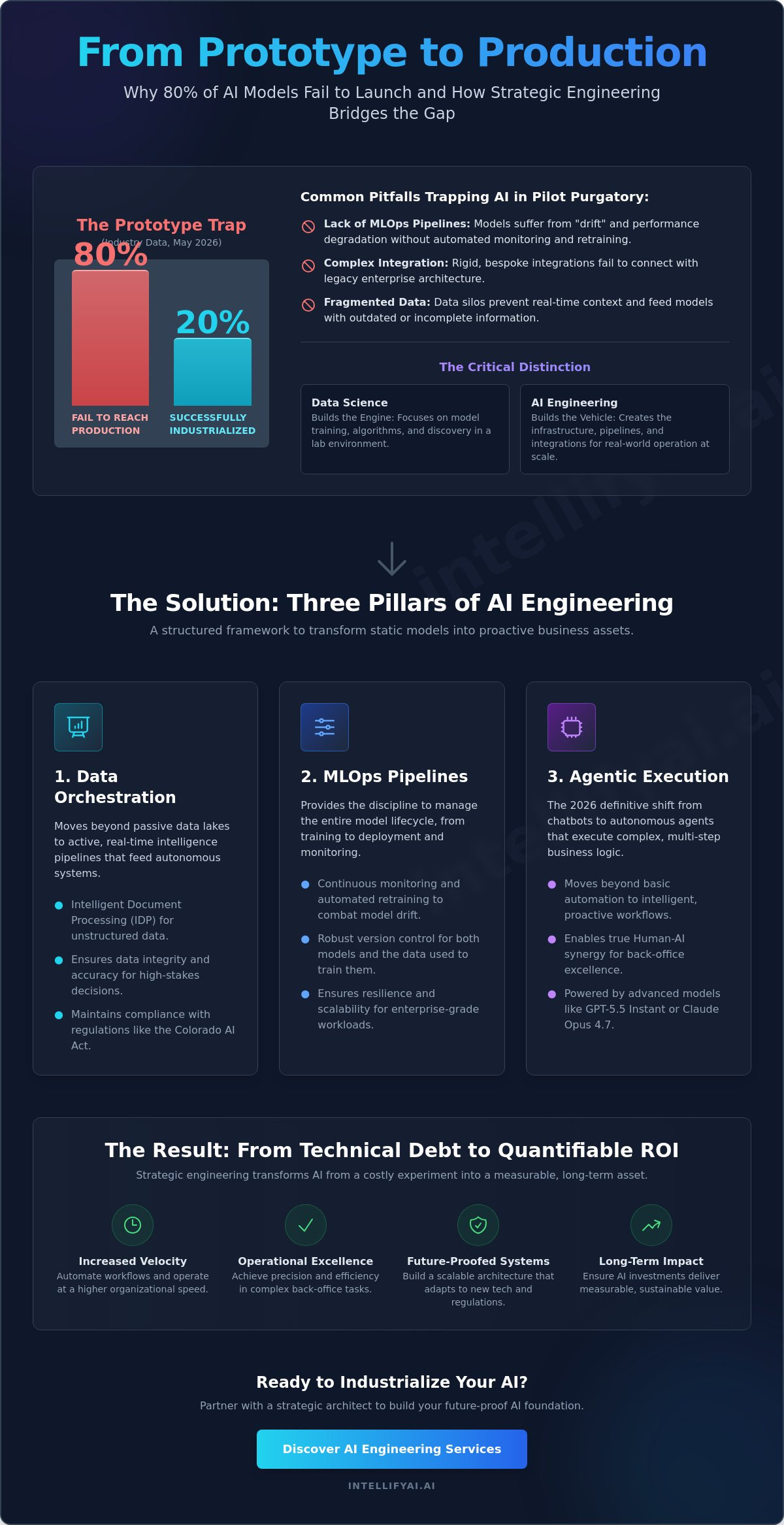
• Learn why specialized artificial intelligence engineering services are essential to overcome the Prototype Trap that prevents 80% of models from reaching production.
• Establish a rigorous framework for selecting a Strategic Architect partner who offers global reach and deep technical expertise for your enterprise.
• Implement a phased engineering roadmap that moves from strategic discovery to bespoke architecture to ensure long-term scalability and ROI.
• Discover how the i_Nova platform leverages intelligent document processing to drive operational excellence and human-ai synergy across your back office.
Bridging the Performance Gap: Why AI Models Require Specialized Engineering
Deploying a model is the beginning, not the end. While data science focuses on the academic exercise of model training and discovery, artificial intelligence engineering services provide the structural discipline required to move a vision from a local notebook to a global infrastructure. This distinction is critical in 2026. Data science builds the engine, but engineering builds the vehicle, the fuel system, and the navigation logic that allows it to operate safely in the real world.
The "Prototype Trap" remains a significant hurdle for the modern enterprise. Industry data from May 2026 indicates that approximately 80% of AI models fail to reach production. These projects often stall because they lack the robust orchestration needed for enterprise-scale workloads. Engineering transforms these isolated experiments into resilient assets. It's the difference between a chatbot that answers questions and an autonomous agent that executes a multi-step back-office workflow. Artificial intelligence engineering (AI engineering) is now the standard for organizations that prioritize operational excellence over experimental novelties.
From Experimental Lab to Production-Grade Asset
Moving from a "Proof of Concept" to a "Proof of Value" (PoV) requires a shift in perspective. In an experimental lab, data is often clean and static. In production, your systems must navigate the chaos of unstructured data environments and high-velocity streams. Scalability isn't just about adding more compute; it's about ensuring the architecture can handle 50,000 concurrent requests without a spike in latency. AI engineering serves as the bridge between theoretical algorithms and secure business ROI.
The Cost of Poor Engineering: Technical Debt and Drift
Neglecting the engineering layer leads to rapid technical debt. Models are not "set and forget" software. They suffer from model drift, where performance degrades as real-world data patterns evolve. Without continuous monitoring and automated retraining pipelines, your once-accurate system becomes a liability. Common pitfalls include:
• Fragmented data silos that prevent real-time context engineering.
• Rigid bespoke integration that fails to communicate with legacy enterprise architecture.
• Lack of version control for both models and the data used to train them.
Strategic engineering ensures these systems are future-proofed against regulatory shifts and technological advancements. To understand how this fits into your broader digital strategy, read our analysis on Enterprise Modernization 2026. By prioritizing a well-architected foundation, you ensure your AI investments deliver measurable, long-term impact rather than temporary gains.
The Three Pillars of Modern AI Engineering in 2026
The landscape of 2026 has moved past simple API integrations. Today, artificial intelligence engineering services are defined by three core structural pillars: Data Orchestration, MLOps, and Agentic Execution. These pillars transform AI from a siloed tool into a cohesive operational layer. By focusing on workflow orchestration, enterprises remove the administrative burden of repetitive tasks, allowing the organization to operate at a higher velocity. This is supported by cloud-native modernization, which provides the elastic infrastructure necessary to scale these intelligent systems across global departments without performance degradation.
Data Engineering and Intelligent Orchestration
Data is no longer just "stored." It is designed. Modern engineering moves away from passive data lakes toward active intelligence pipelines that feed autonomous systems in real time. This requires sophisticated processing of unstructured formats, such as PDFs and emails, through Intelligent Document Processing (IDP). Maintaining data integrity across these flows is impossible without robust MLOps Pipelines. These pipelines ensure that the information feeding your models remains accurate, compliant with 2026 regulations like the Colorado AI Act, and ready for high-stakes decision-making.
Engineering Agentic AI: The Era of Autonomous Execution
2026 marks the definitive shift toward autonomous execution. Unlike traditional AI that requires constant prompting, Agentic AI systems can plan, use specialized tools, and execute multi-step business processes independently. We are seeing the rise of the "Server Intelligence Agent" within IT infrastructure. These agents act as a proactive layer that manages cloud-native environments and optimizes resource allocation without human intervention. To understand the strategic implications of this shift, explore What Is Agentic AI? for an executive overview of autonomous enterprise workflows.
Human-AI Synergy: Designing for Collaboration
Engineering for the modern enterprise is not about replacing labor. It is about creating Human-AI Synergy. This philosophy prioritizes human-in-the-loop (HITL) frameworks, ensuring that while AI handles high-volume friction, humans retain oversight on strategic outcomes. Bespoke integration ensures these tools feel like native colleagues rather than foreign software. This synergy liberates your team's creativity from the weight of administrative friction. If you're ready to build this foundation, consider how our specialized engineering services can modernize your current architecture and drive measurable ROI.
Evaluating AI Engineering Partners: A Framework for Selection
Distinguishing between a standard software vendor and a Strategic Architect is the first step toward industrializing your AI initiatives. In 2026, the market is saturated with providers who offer basic model implementation. However, a serious enterprise requires a partner who can bridge the gap between high-level corporate goals and the technical rigors of agentic execution. Selecting the right artificial intelligence engineering services determines whether your project becomes a scalable asset or remains a costly experiment.
Global reach is a non-negotiable requirement for the modern enterprise. To maintain operational excellence and ensure the stability of your autonomous workflows, your partner should provide follow-the-sun support through established hubs in the UK, USA, India, and the UAE. This geographic distribution ensures that your agentic systems are monitored and optimized regardless of the time zone. It's about more than just availability; it's about having a partner who understands the diverse regulatory and cultural nuances of the global digital economy.
Technical Capability Checklist
Modern engineering demands more than just coding skills. You must assess a partner's depth in cloud-native modernization and FinOps. With the total global AI market reaching $538 billion in 2026, managing the cloud costs of large-scale models is now a core competency. Your evaluation should include a rigorous technical checklist:
Multi-modal IDP Proficiency
Can they demonstrate experience with advanced platforms like i_Nova to process unstructured data?
Agentic Voice Engineering
Do they have a track record of building bespoke autonomous voice agents for contact center transformations?
Security and Compliance
Are they prepared for the California AI Training Data Transparency Act (AB 2013) and SOC2 requirements?
By May 2026, the regulatory environment has shifted from abstract guidelines to concrete legal mandates. Your engineering partner must navigate a complex patchwork of laws, including the Texas Responsible AI Governance Act and the federal Take It Down Act. They should implement robust AI Governance, Risk, and Compliance (GRC) frameworks that include automated watermarking and transparency disclosures as required by California's SB 942. Technical depth is meaningless if the resulting system exposes the enterprise to legal or ethical liability.
Strategic Alignment and ROI Focus
Move away from traditional per-hour billing models. These structures often incentivize inefficiency and delay. Instead, prioritize value-based engagements focused on a "Proof of Value" (PoV) that demonstrates measurable business impact. A true partner insists on a clear AI Strategy Consulting roadmap before a single line of code is written. This ensures that every engineering effort aligns with your long-term ROI goals. For organizations looking to begin this journey with precision, our consulting services provide the necessary architectural blueprint for sustainable growth.
The Engineering Roadmap: From Strategic Roadmap to Scalable ROI
Industrializing artificial intelligence is not a matter of chance. It is the result of a disciplined, four-phase roadmap designed to move your enterprise from fragmented experiments to a unified, agentic ecosystem. By integrating specialized artificial intelligence engineering services into your growth strategy, you ensure that every technological deployment serves a specific, measurable business outcome. This structured approach mitigates the risk of pilot fatigue and ensures that your infrastructure is ready for the high-velocity demands of the 2026 digital economy.
Phase 1 & 2: Building the Foundation
The journey begins with a rigorous audit of your current data ecosystems. We focus on identifying high-friction areas within your back-office and contact center operations where unstructured data flows create bottlenecks. These "low-hanging fruit" opportunities provide the fastest path to ROI. During the Bespoke Architecture phase, we design the initial Agentic AI framework tailored to your specific use cases. This involves moving beyond a simple Proof of Concept to a robust Proof of Value that validates the architecture's ability to handle real-world enterprise logic.
Key activities in this stage include:
• Mapping unstructured document flows to identify automation gaps.
• Designing secure, bespoke integrations with legacy ERP and CRM systems.
• Establishing the initial control plane for autonomous agents using tools like Microsoft Agent 365, launched on May 1, 2026.
Phase 3 & 4: Scaling for Operational Excellence
Once the foundation is secure, the focus shifts to MLOps integration and enterprise modernization. This phase is about operationalizing your models so they can function as dependable business assets. We implement robust version control and real-time monitoring to detect model drift before it impacts your bottom line. As of May 2026, 58% of enterprises are using AI in production workloads; staying competitive requires this level of industrial rigor to avoid the technical debt of unmonitored systems.
The final phase involves scaling these agentic workflows across the entire organization. We utilize FinOps-driven engineering to optimize cloud costs, ensuring that as your AI footprint grows, your margins remain protected. Continuous optimization is essential. We refine your autonomous voice agents based on live CX metrics to ensure they deliver a seamless, human-like experience. This iterative cycle of training and refinement turns your AI infrastructure into a self-improving engine of growth. If you're ready to move from strategy to execution, explore how our Agentic AI Engineering Services can accelerate your roadmap to ROI.
IntellifyAi: Engineering the Future of Agentic Intelligence
IntellifyAi operates as a global technology firm dedicated to the industrialization of transformative intelligence. We provide the end-to-end artificial intelligence engineering services necessary to navigate the complex regulatory and technical environment of May 2026. Our focus is on turning the raw potential of autonomous agents into operational reality. Through our i_Nova platform, we've revolutionized intelligent document processing. This system allows enterprises to convert unstructured data into actionable assets with speed and accuracy that traditional methods cannot match. We don't just build models; we architect resilient business foundations.
Future-proofing your operations requires a shift from static software to intelligent automation. By May 2026, the total global AI market has reached $538 billion, and the generative AI segment alone accounts for $136 billion of that total. This scale demands a partner who can integrate these technologies into core business pillars. We position ourselves as the bridge between the abstract world of machine learning and the practical needs of a growing company. Our goal is to ensure your enterprise remains relevant and secure in an increasingly automated marketplace.
Bespoke Solutions for Complex Enterprises
We design scalable workflows that eliminate the friction of repetitive administrative tasks. This process is about more than just cost-cutting. It is about Human-AI synergy. We frame AI as a tool to unlock human potential, ensuring your team can focus on high-value creative work while autonomous agents handle the volume. Ethical governance is at the heart of our architecture. Every system we build complies with the latest standards, including the Colorado AI Act and California’s SB 942 transparency requirements. Our Engineering Services provide the bespoke integration required to make these technologies feel like a native part of your enterprise fabric.
Partner with Strategic Architects
Choosing a partner in 2026 requires more than a technical checklist. It requires a Strategic Architect who understands the bottom line. With a robust presence in the UK, USA, India, and the UAE, IntellifyAi offers the global reach and technical depth needed for cloud-native modernization. We guide you through the entire lifecycle, from initial strategic consulting to long-term managed service optimization. Our approach ensures your operations are future-proofed against the rapid shifts in model versions like GPT-5.5 or Claude Mythos. Take the next step toward operational excellence. Contact our AI experts to begin your digital transformation today.
Architecting Your Agentic Future
The transition from experimental pilots to industrialized assets is the defining challenge for the modern enterprise in 2026. Success requires a shift in focus from model training to the disciplined orchestration of autonomous agents. By integrating the three pillars of data orchestration, MLOps, and agentic execution, businesses move beyond simple automation to achieve true operational excellence. Our artificial intelligence engineering services provide the structural integrity needed to support this evolution.
IntellifyAi brings a global perspective with hubs in the UK, USA, India, and the UAE. We combine deep technical expertise in cloud-native modernization with our flagship i_Nova IDP platform to deliver measurable impact. This approach ensures your systems remain compliant with shifting regulations while liberating your workforce for high-value creative work. The path to scalable ROI is clear. Start your transformation today and secure your position as a leader in the agentic frontier.
Schedule a Strategic AI Engineering Consultation to begin your journey toward intelligent automation.
Frequently Asked Questions
What is the difference between AI development and AI engineering?
AI development focuses on the creation and training of machine learning models; AI engineering focuses on the operationalization and scalability of those models. Engineering is the bridge between a theoretical algorithm and a production-grade asset. While development builds the intelligence, engineering builds the vehicle and infrastructure that allow it to operate safely in a global enterprise environment.
How do AI engineering services handle data privacy and GDPR compliance?
We implement automated compliance frameworks that align with GDPR and May 2026 regulations like the California AI Training Data Transparency Act (AB 2013). This includes data anonymization, encryption at rest, and the watermarking of AI-generated content. These measures ensure your agentic workflows remain secure and legally sound across all jurisdictions.
What are the core components of an enterprise-grade AI engineering project?
The core components include Data Orchestration, MLOps Pipelines, and Agentic Execution frameworks. These elements ensure that models aren't just intelligent; they are also scalable, observable, and integrated into existing architecture. Successful projects prioritize workflow orchestration to remove administrative friction and drive measurable ROI.
Can AI engineering services help with legacy system modernization?
Yes, artificial intelligence engineering services are specifically designed to bridge the gap between modern agents and legacy ERP or CRM systems. We use bespoke integration techniques to allow autonomous agents to communicate with older databases without requiring a complete overhaul of your IT stack. This approach protects your previous technology investments while enabling modernization.
What is the expected ROI for Agentic AI engineering in the first year?
Enterprises typically see ROI through a 30% reduction in operational costs in the first 12 months by automating repetitive back-office tasks. By May 2026, 58% of enterprises using AI in production report measurable efficiency gains. These improvements stem from the deployment of autonomous agents that execute multi-step workflows with minimal human intervention.
How does IntellifyAi ensure the security of bespoke AI models?
We utilize SOC2-compliant infrastructure and the NIST AI Risk Management Framework to secure every bespoke model. Security involves continuous monitoring for adversarial attacks and the implementation of robust version control. This ensures your intellectual property and sensitive enterprise data remain protected within your private cloud environment.
What industries benefit most from intelligent document processing (IDP) engineering?
Healthcare, finance, and legal sectors see the highest impact from Intelligent Document Processing. These industries manage high volumes of unstructured data that our i_Nova platform processes with high precision. Engineering these solutions allows for the rapid extraction of insights from complex documents, accelerating decision-making cycles and reducing manual entry errors.
How do you manage model drift in production environments?
We manage model drift through automated MLOps monitoring pipelines that trigger retraining when performance metrics deviate from established baselines. This proactive approach prevents the degradation of system accuracy over time. It's a critical component of artificial intelligence engineering services, ensuring your autonomous systems remain dependable as real-world data patterns evolve.









.svg)