
The relentless pace of AI innovation can feel overwhelming, with new terminology often obscuring real business value. While generative AI captured the world's attention, it represents only the first step in a much larger transformation. The next strategic evolution is already underway, moving beyond simple instruction-based tools toward autonomous systems capable of independent action. For leaders focused on future-proofing their operations, having agentic ai explained is no longer an academic exercise-it is a competitive necessity for achieving operational excellence in 2026 and beyond.
Yes, an enterprise can develop its own agentic AI, but it demands significant in-house expertise in machine learning, data engineering, and complex systems architecture. The process is resource-intensive and requires a mature data infrastructure. For many organizations, exploring professional Ai Solutions or a strategic partnership with a specialized firm accelerates deployment, reduces risk, and ensures the final solution is a bespoke, scalable system engineered for maximum business impact and a clear return on investment.
This guide delivers that essential clarity. We will dismantle the hype to provide a precise framework for understanding the critical shift from AI tools to autonomous AI teammates. You will discover concrete enterprise use cases that drive tangible ROI, explore how to manage the complexities of implementation, and learn the foundational steps for integrating this transformative technology. Prepare to move beyond prompting and begin orchestrating intelligent workflows that unlock unprecedented levels of efficiency and empower your teams to focus on high-value strategic work.
Key Takeaways
- Distinguish between directing a generative AI tool and delegating complex, end-to-end goals to an autonomous AI agent.
- With agentic ai explained in detail, learn to identify the multi-step enterprise workflows where autonomous systems deliver maximum strategic value.
- Understand the core operational loop (Perceive, Reason, Act) to accurately assess where AI agents fit within your technology stack.
- Access a high-level framework for adoption, treating intelligent automation not just as a software tool but as a transformative operating model.
What is Agentic AI? The Shift from Generative Tools to Autonomous Teammates
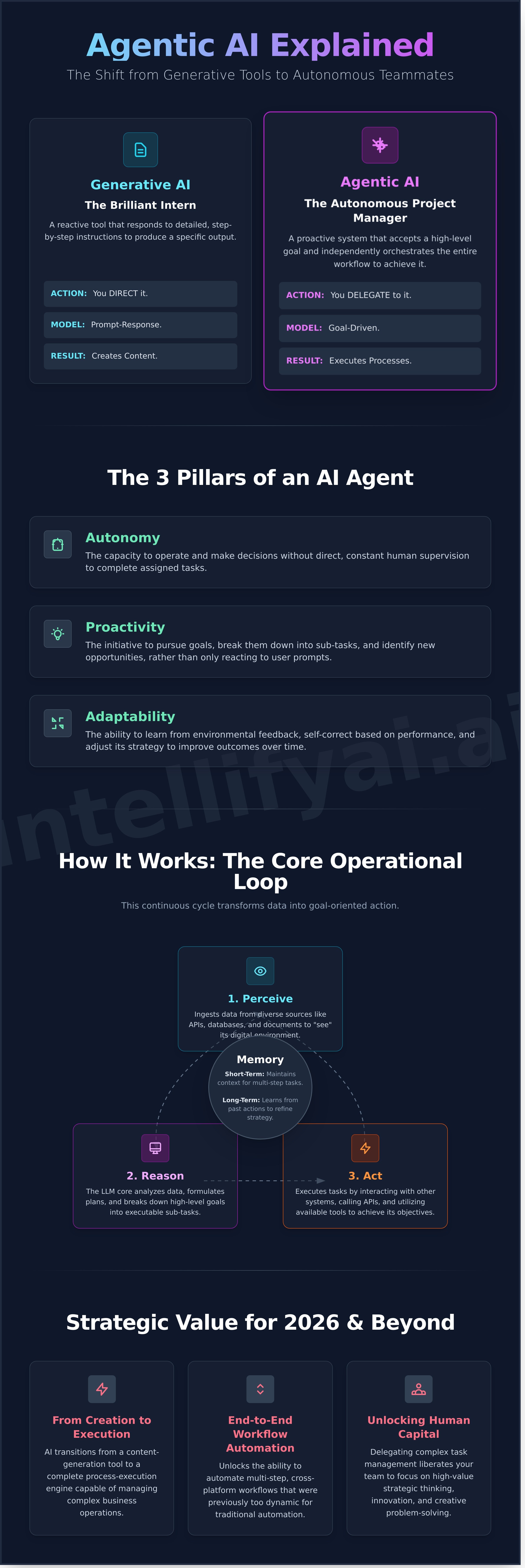
Agentic AI represents a fundamental evolution in artificial intelligence. These are not simply tools; they are autonomous systems designed to perceive their environment, reason through complex problems, and act decisively to achieve a specified goal. This capacity for independent action is central to understanding What is an AI Agent? and how it differs from previous technologies. It marks the critical transition from a reactive, prompt-response model to a proactive, goal-driven operational model.
Consider the distinction this way: Generative AI is a brilliant intern. You provide a detailed prompt, and it produces an excellent output. Agentic AI, however, is a project manager. You delegate a high-level objective-like ‘launch the Q3 marketing campaign’-and it orchestrates the entire workflow, from drafting emails to analyzing performance data, without step-by-step instruction.
To have the concept of agentic AI explained visually, the following overview provides a clear breakdown of its core mechanics:
The Defining Characteristics of an AI Agent
Three core principles separate an AI agent from a simple program. These characteristics work in synergy to enable sophisticated, independent action.
- Autonomy: The capacity to operate and make decisions without direct, constant human supervision to complete its assigned tasks.
- Proactivity: The initiative to pursue goals, break them down into sub-tasks, and identify new opportunities, rather than only reacting to user prompts.
- Adaptability: The ability to learn from environmental feedback, self-correct based on performance, and adjust its strategy to improve outcomes over time.
Why This Matters for Business Leaders in 2026
This technological shift is not incremental; it is transformative. For forward-thinking enterprises, it represents the critical next step for unlocking true operational excellence and a durable competitive advantage.
- From Creation to Execution: AI transitions from a content-generation tool to a complete process-execution engine capable of managing complex business operations.
- End-to-End Workflow Automation: It unlocks the ability to automate multi-step, cross-platform workflows that were previously too dynamic for traditional automation.
- Unlocking Human Capital: By delegating complex task management, it liberates your team to focus on high-value strategic thinking, innovation, and creative problem-solving.
How Agentic AI Works: The Anatomy of an Autonomous System
Beneath the surface of any autonomous system lies a clear and powerful operational framework. To truly understand how these systems achieve intelligent automation, this section on agentic ai explained deconstructs their core architecture. At its heart, an AI agent is a system designed to perceive its environment, reason about its observations, and execute actions to achieve specific goals-a definition that aligns with the authoritative GAO's explanation of AI agents. This continuous, cyclical process is the engine that drives a new era of operational efficiency.
The Perception-Reasoning-Action Cycle
This three-stage loop is the engine driving every autonomous agent. It transforms raw data into decisive, goal-oriented action, creating a system that continuously adapts to new information. This entire process is underpinned by a sophisticated memory system. Short-term memory maintains immediate context for multi-step tasks, while long-term memory allows the agent to learn from past interactions, refine its strategies, and improve its performance over time.
- Perception: The agent 'sees' its digital environment by ingesting data from diverse sources. This includes monitoring APIs for a new customer order, scanning a database for changes in stock levels, or parsing incoming documents for key information.
- Reasoning: With the data acquired, the agent's Large Language Model (LLM) acts as its cognitive 'brain'. It analyzes the situation against its objectives, strategizes potential responses, and makes a calculated decision on the optimal course of action.
- Action: The agent executes its decision by interacting with other software and digital tools. It can 'act' by updating a record in your CRM, dispatching a confirmation email via an API, or automatically placing a purchase order with a supplier through an integrated system.
The Power of Multi-Agent Systems
While a single agent is powerful, true operational excellence is unlocked when specialized agents collaborate. A multi-agent system orchestrates a team of agents to tackle complex, multi-stage problems that a lone agent cannot. Imagine a 'researcher' agent tasked with gathering market data and competitive intelligence. It passes its structured findings to a 'writer' agent, which then drafts a comprehensive analysis report for executive review. This model of distributed intelligence enables the seamless, end-to-end automation of sophisticated, cross-departmental workflows, transforming fragmented processes into a unified, intelligent operation. It is the key to achieving transformative scale and efficiency.
Agentic AI vs. Other Automation: A Clear Comparison for Strategists
In the rapidly evolving landscape of automation, terminology can become a significant barrier to strategic implementation. To move beyond buzzwords and architect a truly intelligent enterprise, leaders must discern the fundamental differences between available technologies. This section provides a clear breakdown, ensuring the unique value of agentic AI explained is not lost in a sea of acronyms.
The core distinction lies not in what a system knows, but in what it can do. While other forms of automation execute predefined instructions or generate content, agentic AI operates with a degree of autonomy to achieve complex, multi-step goals.
| Technology | Core Function | Decision-Making Style | Best Use Case |
|---|---|---|---|
| Agentic AI | Autonomous task and workflow execution | Dynamic, goal-oriented, and context-aware | Complex, multi-system processes with unpredictable variables (e.g., supply chain optimization, autonomous customer support). |
| Generative AI | Content creation and data synthesis | Probabilistic, based on patterns in training data | Drafting communications, summarizing research, generating code snippets, creating marketing assets. |
| Robotic Process Automation (RPA) | Mimicking human clicks and keystrokes | Static, following a rigid, predefined script | High-volume, repetitive, and stable data entry or system-to-system data migration. |
Agentic AI vs. Generative AI: Action vs. Creation
Think of Generative AI as a world-class specialist-a brilliant copywriter or analyst. You provide a prompt, and it produces high-quality content. Agentic AI, by contrast, is the project manager. It takes a high-level objective, breaks it down into tasks, and executes them. For example, a generative model can draft a sales email. An agentic system can draft the email, send it, monitor the reply, and then schedule a follow-up or a meeting based on the response.
Agentic AI vs. RPA: Dynamic Intelligence vs. Static Rules
RPA is the foundation of traditional automation, built for operational stability. It excels at linear, predictable tasks where the rules do not change. However, if a button on a webpage moves, the RPA script breaks. Agentic AI is designed for dynamic environments. It perceives its digital surroundings and adapts its strategy to achieve its goal, a level of autonomy that requires a robust governance structure. Indeed, leading enterprises are now consulting resources like Singapore's comprehensive AI governance framework for agentic AI to ensure accountability and control over these powerful systems.
Enterprise Use Cases: Where Agentic AI Delivers Strategic Value
The theoretical power of autonomous agents becomes tangible when applied to complex enterprise workflows. Unlike rule-based automation, which struggles with dynamic environments, agentic AI excels at orchestrating multi-step processes that require reasoning, adaptation, and tool usage. This is where the value of agentic ai explained moves from concept to strategic imperative, delivering measurable ROI across core business functions.
Autonomous Customer Service and Support
Imagine an AI agent that manages a support ticket from initial diagnosis to final resolution and follow-up. By integrating seamlessly with your CRM, knowledge bases, and ticketing systems, these agents can understand customer intent, troubleshoot issues, and execute solutions autonomously. This intelligent automation extends to advanced voice agents, providing a consistent, high-quality experience that resolves issues faster, reduces operational overhead, and frees human experts to handle the most complex escalations.
Intelligent Supply Chain and Logistics Orchestration
Agentic AI introduces a new level of resilience and efficiency to your supply chain. These autonomous systems are designed for dynamic workflow orchestration, enabling them to:
- Monitor global inventory levels and predict demand fluctuations in real-time.
- Automatically place purchase orders with suppliers to prevent stockouts.
- Dynamically re-route shipments in response to unforeseen events like weather or carrier delays.
The result is an optimized supply chain that minimizes costs, improves delivery timelines, and adapts to disruption without constant human intervention.
Proactive Financial Analysis and Reporting
In finance, accuracy and timeliness are paramount. Agentic AI automates the laborious process of data consolidation from disparate financial platforms, ERPs, and market data sources. It can autonomously generate complex month-end reports, perform continuous compliance checks, and identify anomalies that signal potential fraud or financial risk. This proactive capability transforms the finance function from a reactive reporting center into a strategic source of data-driven insight, enhancing decision-making and mitigating risk.
Implementing Agentic AI: Your Roadmap to an Autonomous Enterprise
Understanding the technology is the first step. Executing a successful transition to an autonomous enterprise is the next. With the core principles of agentic ai explained, this roadmap outlines how to move from concept to operational reality. This is not merely a software deployment; it is the adoption of a new, intelligent operating model designed for speed, precision, and scalability.
A successful journey begins with a focused, strategic approach. We recommend a two-phase initiation:
- Step 1: Identify Pilot Projects. Begin with high-value, low-risk workflows. Target areas like automated financial reconciliation, intelligent IT support ticket resolution, or proactive supply chain monitoring. A successful proof-of-concept builds momentum and demonstrates clear ROI.
- Step 2: Ensure Foundational Readiness. Autonomous agents depend on high-quality data and seamless system access. This requires clean, structured data sources and a robust API infrastructure that allows agents to interact with your existing software stack securely and efficiently.
Building the Business Case: From Cost Savings to New Capabilities
Frame your investment in agentic AI around transformative business outcomes. The initial ROI is clear: hyper-efficiency through automated workflows, significant error reduction in repetitive tasks, and unparalleled scalability. Beyond this, the true strategic value lies in creating entirely new, AI-driven business processes and services that unlock new revenue streams and competitive advantages.
The Importance of Governance and Human-in-the-Loop
Autonomy requires oversight. A robust governance framework is essential to manage risk and ensure agentic systems operate within defined ethical and operational boundaries. We champion a Human-AI Synergy model, where a human-in-the-loop is designated for critical decision points and final approvals. This approach empowers your team, augmenting their capabilities rather than replacing them.
Partnering for Success with Agentic AI Engineering
Building enterprise-grade agentic systems is a specialized discipline. It demands deep expertise in workflow orchestration, bespoke integration, security, and scalable architecture. A strategic partner is critical to navigate these complexities and avoid common pitfalls. At IntellifyAi, we transform the potential of agentic AI into tangible business performance. Discover how IntellifyAi's engineering services can accelerate your journey.
The Autonomous Enterprise: Your Next Strategic Move
The transition from generative AI tools to autonomous teammates is no longer a distant vision; it is the next frontier of operational excellence. As this guide to agentic ai explained, these systems represent a fundamental paradigm shift. They are not mere task automators but strategic assets designed to execute complex, multi-step workflows with minimal human intervention. This evolution frees your team to focus on innovation and high-value strategic work, establishing a powerful human-AI synergy that drives unprecedented growth and efficiency.
However, harnessing this transformative power requires more than just technology; it demands a clear strategy and deep engineering expertise. At IntellifyAi, we are the strategic architects for this new era. We provide specialized Agentic AI engineering services and strategic AI consulting focused on delivering measurable ROI. Our global enterprise experience-spanning the UK, USA, India, and UAE-ensures your integration is not just successful, but a future-proof foundation for lasting competitive advantage.
The era of intelligent automation has arrived. It's time to move from understanding to implementation. Begin your transformation with a strategic AI partner. Contact IntellifyAi today.
Frequently Asked Questions About Agentic AI
What is the difference between an AI agent and an AI assistant?
An AI assistant, such as Siri or Alexa, is reactive and executes specific, direct user commands. In contrast, an AI agent is proactive and autonomous. It can perceive its environment, make independent decisions, and execute complex, multi-step tasks to achieve a strategic goal without continuous human intervention. An agent orchestrates entire workflows, moving beyond simple task completion to deliver comprehensive outcomes.
Is Agentic AI the same as Artificial General Intelligence (AGI)?
No, agentic AI is not the same as AGI. AGI describes a hypothetical future AI with human-like intelligence across any domain. Today’s agentic AI systems demonstrate high autonomy but operate within specific, defined contexts, such as managing supply chains or executing digital marketing campaigns. They are powerful tools for achieving operational excellence within a business framework, not a form of generalized, conscious intelligence.
What are the main risks or challenges of implementing agentic AI?
The primary challenges involve security, systems integration, and governance. Granting autonomous systems access to critical data requires robust security protocols to prevent unauthorized actions. Integrating these advanced agents with legacy enterprise software can be complex and is vital for achieving ROI. Establishing clear ethical guidelines and human oversight is also essential to ensure the agent's actions remain aligned with strategic business objectives and company values.
What programming languages are used to build AI agents?
Python is the predominant language for developing AI agents, valued for its extensive ecosystem of machine learning libraries like TensorFlow and PyTorch. Frameworks specifically designed for agentic workflows, such as LangChain and Auto-GPT, are also built on Python. For enterprise-grade applications demanding high performance and scalability, languages like Java and C++ are also utilized for core components and seamless integration into existing tech stacks.
How do AI agents learn and improve over time?
AI agents improve through continuous learning cycles driven by machine learning, particularly Reinforcement Learning (RL). In this model, the agent performs actions, measures the outcomes against its goals, and receives a digital reward or penalty. This feedback loop allows the agent to refine its decision-making strategies over time. When getting agentic ai explained, this capacity for self-optimization is a core concept that drives its transformative potential for business efficiency.
Can a business build its own agentic AI systems?
Yes, an enterprise can develop its own agentic AI, but it demands significant in-house expertise in machine learning, data engineering, and complex systems architecture. The process is resource-intensive and requires a mature data infrastructure. For many organizations, a strategic partnership with a specialized firm accelerates deployment, reduces risk, and ensures the final solution is a bespoke, scalable system engineered for maximum business impact and a clear return on investment.









.svg)