
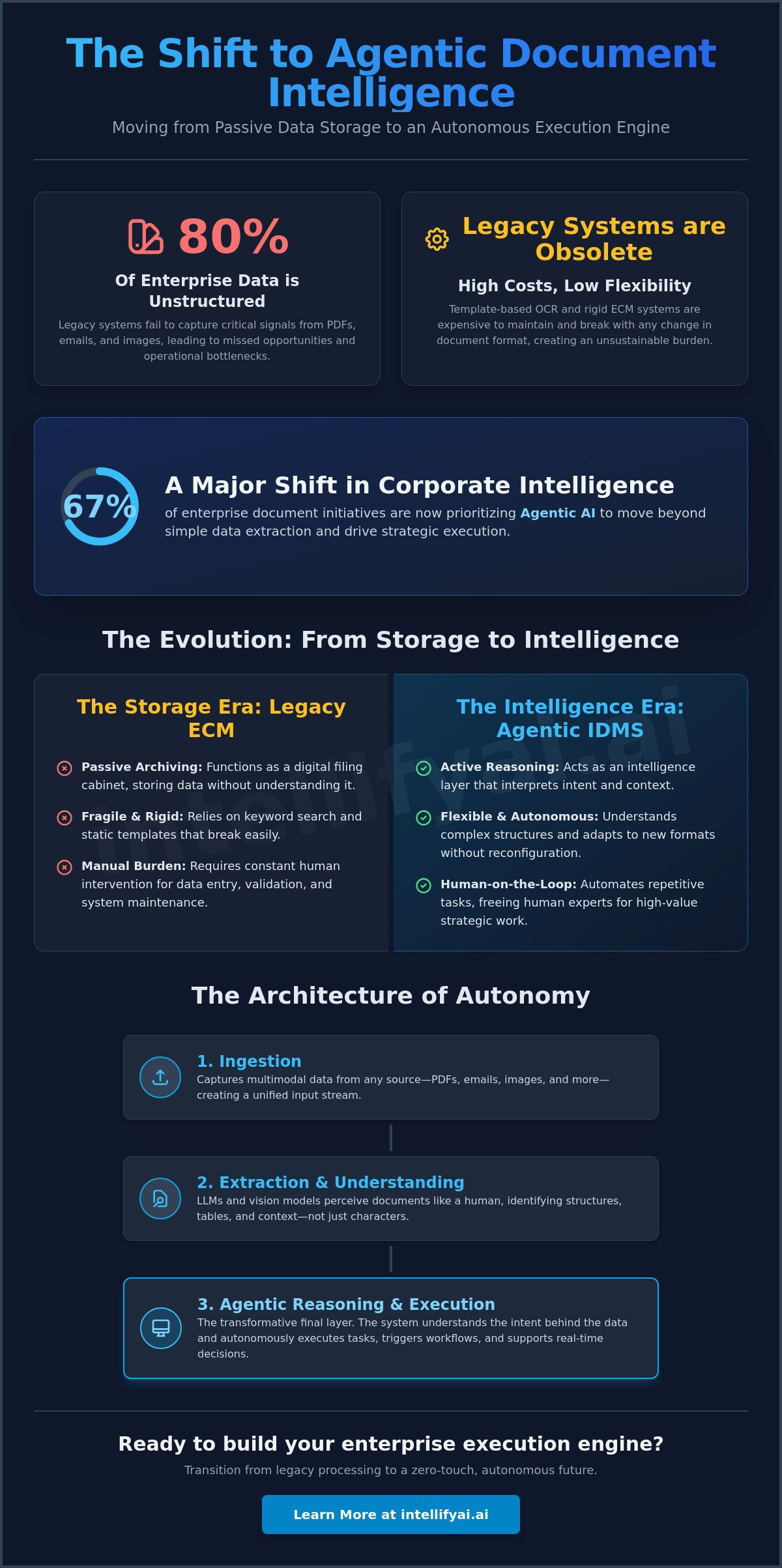
Recent research shows that 67% of enterprise document initiatives are now prioritizing agentic AI, signaling a major shift in corporate intelligence. You've likely experienced the operational bottlenecks of manual entry and the rising costs of template-based OCR systems that struggle with unstructured PDFs. These legacy tools fail to capture signals from the 80% of enterprise data that lacks a fixed format. Adopting next generation intelligent document processing allows you to move beyond simple extraction. It's time to transition toward autonomous systems that understand context and drive strategic execution without constant human intervention.
This article outlines how to master the move from passive data storage to a system that functions as a strategic execution engine. You'll learn how to implement zero-touch workflows that provide real-time intelligence and support scalable modernization. We'll explore the transition from traditional document management to agentic frameworks that solve the 2026 data crisis. By focusing on multimodal AI and system autonomy, you can remove the burden of repetitive tasks and focus your team on high-value creative work. Let's look at the path toward a frictionless, automated future for your enterprise.
Key Takeaways
• Transition from passive storage to active reasoning by leveraging next generation intelligent document processing to turn unstructured data into a strategic asset.
• Understand the architecture of autonomy where agentic AI executes tasks based on document content rather than just extracting text.
• Evaluate the financial impact of moving from legacy manual processing to high-efficiency autonomous systems that drive real-time decision support.
• Follow a clear implementation roadmap to audit existing workflows and identify high-value targets for enterprise-wide modernization.
• Learn how the i_Nova platform facilitates global transformation by bridging the gap between technical complexity and practical business outcomes.
The 2026 Data Crisis: Why Traditional Document Management is Obsolete
The corporate world has reached a critical tipping point. By mid-2026, the sheer volume of unstructured data has rendered traditional filing methods completely inadequate. Organizations no longer need better filing cabinets; they need an autonomous reasoning layer capable of interpreting the intent behind every page. This is the essence of next generation intelligent document processing. It marks a definitive transition from the "Storage Era," characterized by passive archiving, to the "Intelligence Era," where active reasoning drives every business process. Companies that fail to adapt are finding themselves buried under a mountain of digital noise.
To better understand this concept, watch this helpful video:
Mining unstructured data is now a non-negotiable survival requirement for global firms. Research indicates that 80% of enterprise data remains unstructured, locked away in PDFs, emails, and images. Traditional systems that rely on static templates can't keep up with the fluid nature of modern business communication. We're moving toward a model of human-on-the-loop oversight. In this framework, technology handles the cognitive heavy lifting while human experts provide high-level strategic direction. This shift is supported by advancements in Intelligent Document Processing (IDP), which integrates machine learning and natural language processing to extract meaning rather than just characters.
The Limitations of Legacy ECM and Basic OCR
Legacy Enterprise Content Management (ECM) systems were built for a static world. They rely heavily on keyword-based searches that fail in the complex, multi-format environments of 2026. When you search for a specific term, you're often met with a flood of irrelevant results rather than actionable signals. These systems also suffer from structural rigidity. If a vendor changes an invoice layout or a client submits a non-standard contract, traditional OCR breaks. The high cost of maintaining these fragile, template-based systems is an unsustainable burden on the bottom line. They lack the flexibility to adapt to new formats without manual reconfiguration.
The Strategic Shift Toward Document Intelligence
True modernization requires moving from document "processing" to document "understanding." It's the difference between seeing a string of numbers and knowing they represent a critical financial risk. An Intelligent Document Management System (IDMS) serves as a central pillar for enterprise modernization. By implementing next generation intelligent document processing, businesses can finally remove the burden of repetitive administrative tasks. This isn't about replacing workers; it's about liberating them. When systems handle the data entry, your team can focus on the high-value creative work that actually drives growth and performance.
The Architecture of Autonomy: How IDP and Agentic AI Converge
Modern IDP isn't a single software tool; it's a sophisticated multi-layered stack. It begins with ingestion, which captures data from any source, and moves to extraction, which identifies key data points. The final layer is agentic reasoning. This is where the transformation occurs. Unlike previous iterations that simply handed off a flat file, next generation intelligent document processing uses this reasoning layer to understand the underlying intent of the data. It's the difference between reading a date and knowing that date triggers a specific contractual obligation.
We've moved past the era of fragile, template-based extraction. Traditional OCR systems often failed when a logo moved or a form layout changed. Today, Large Language Models (LLMs) and advanced vision models perceive documents much like a human eye and brain. They identify complex structures, tables, and even handwritten notes regardless of the physical layout. This shift is a central component of the future of AI-powered document processing. For serious enterprises, a cloud-native architecture is no longer optional. It provides the elastic compute power and high-velocity processing needed to handle next generation intelligent document processing at a global scale.
From Extraction to Execution: The Agentic Advantage
An AI agent within a document workflow is a goal-oriented entity rather than a simple script. Consider an agent tasked with managing accounts payable. Instead of just reading an invoice amount, it autonomously cross-references that invoice against the original contract and the warehouse receipt. If all parameters align, it initiates the payment within the ERP system. This is fundamentally different from Robotic Process Automation (RPA). RPA follows rigid, pre-defined rules. Agentic intelligence uses reasoning to handle exceptions and make informed decisions based on the nuance of the content. This level of autonomy allows your team to step away from administrative oversight and focus on high-level strategic realization.
Handling the Unstructured: PDFs, Images, and Beyond
Processing unstructured formats at scale requires advanced techniques that go beyond simple character recognition. It involves using semantic search to discover contextual relationships between disparate documents. For instance, a system can now link a series of shipping manifests to a specific global trade agreement based on context rather than just a matching ID number. In 2026, contextual organization is the ability to map document relationships across the entire data estate to ensure every piece of information is instantly actionable for downstream engineering. This approach ensures that your data engineering efforts result in measurable financial returns. Enterprises looking to build these robust frameworks should explore Agentic AI Engineering Services to ensure their architecture remains both innovative and dependable.
Legacy ECM vs. Agentic IDMS: A Strategic Comparison
Legacy Enterprise Content Management (ECM) systems are essentially digital graveyards. They store data but offer no inherent insight. In contrast, an Agentic Intelligent Document Management System (IDMS) functions as an active participant in your business strategy. The financial shift is stark. Manual processing relies on expensive human hours and is prone to a consistent error rate in typical data entry. Next generation intelligent document processing achieves near-perfect accuracy while operating at machine speed. This isn't just about saving money; it's about reallocating your most valuable asset, human intelligence, to higher-order tasks that drive growth.
Traditional systems rely on "Keyword Search," which requires you to know exactly what you're looking for before you start. Modern IDMS utilizes "Intelligent Semantic Discovery." Instead of matching characters, the system understands concepts. It can identify a "liability risk" even if that specific phrase never appears in the text. This capability collapses fragmented data silos into a unified intelligence layer. It ensures that critical signals are never lost in the noise of a legacy archive. You no longer just have files; you have an accessible, organized knowledge base that supports real-time decision-making.
Operational Speed and Error Reduction
AI-driven extraction eliminates the friction of human oversight. In 2026, autonomous systems handle complex data validation by cross-referencing external databases and internal policies in real-time. This reduces the "Time-to-Insight" for critical documents like legal contracts from days to seconds. When your system can validate a 50-page master service agreement against your corporate compliance standards instantly, you gain a massive competitive advantage in deal velocity. You're not just moving faster; you're moving with a level of precision that manual workflows simply can't replicate.
Security, Compliance, and GRC
Security has evolved from simple permission folders to AI-driven intelligent redaction. Next generation intelligent document processing automatically identifies and masks Personally Identifiable Information (PII) across millions of files. This ensures GDPR compliance without manual intervention. This level of governance is a core pillar of modern AI strategy consulting. By automating compliance checks against industry-specific regulations, you ensure your enterprise remains secure and audit-ready at all times. This proactive approach transforms document management from a back-office burden into a robust pillar of your Governance, Risk, and Compliance (GRC) framework.
The Implementation Roadmap: Deploying Scalable Document Intelligence
Deploying an autonomous document system requires a structured, architectural approach. It's not a simple software installation. It's a strategic business evolution. To achieve a frictionless future where technology removes the burden of repetitive tasks, follow this rigorous implementation roadmap:
Step 1: Audit existing document workflows.
Identify high-value automation targets where high volume meets high complexity. Focus on processes that currently consume significant human capital or create operational bottlenecks.
Step 2: Cleanse and prepare data.
Robust data engineering ensures your models ingest high-quality signals. This step is the foundation for any successful AI deployment.
Step 3: Select a platform that supports next generation intelligent document processing.
Prioritize systems built for Agentic AI and custom engineering flexibility. Avoid rigid tools that can't adapt to your specific business logic.
Step 4: Integrate with existing enterprise systems.
Use APIs to connect your document intelligence with ERP and CRM platforms. This ensures extracted data drives live execution and real-time actionable intelligence.
Step 5: Establish MLOps.
Continuous model optimization and monitoring are essential for long-term viability. A static model is a failing model.
The Role of Custom AI Engineering
Off-the-shelf software often fails to meet the complex requirements of a global enterprise. These rigid solutions can't handle the unique nuances of your specific industry or internal workflows. This is where agentic ai engineering services become essential. Bespoke workflows allow you to modernize legacy infrastructure while supporting cloud-native AI models effectively. By building custom solutions, you ensure the technology adapts to your business, not the other way around. This approach transforms advanced technology into a liberating force for your workforce, allowing them to focus on high-value creative work.
Maintaining Excellence with MLOps and FinOps
Document models are not static assets. They require continuous monitoring and retraining through dedicated MLOps pipelines to prevent performance degradation. Model drift occurs when document classification or extraction accuracy declines as real-world data patterns evolve. Without active management, your system's reliability will fade over time. FinOps practices provide the visibility needed to scale next generation intelligent document processing while maintaining a lean, performance-oriented cost structure. This ensures your investment remains focused on the bottom line and long-term financial returns.
Ready to architect your transition to autonomous workflows? Schedule an AI Strategy Consultation to begin your implementation roadmap today.
Engineering Autonomy: The IntellifyAi Approach to IDMS
IntellifyAi operates as a Strategic Architect for global enterprise transformation. We don't just provide software; we build the foundational systems that allow your business to scale autonomously. Our methodology creates a direct synergy between high-level consulting services and technical execution. We're committed to unlocking human potential by automating the mundane administrative tasks that stifle innovation. By implementing next generation intelligent document processing, we help you transition from manual oversight to a model of high-velocity strategic execution. This approach ensures your modernization efforts are grounded in practical, results-oriented outcomes that impact the bottom line immediately.
i_Nova: Beyond Intelligent Document Processing
i_Nova is our flagship platform designed to extract actionable intelligence from the most complex document environments. It's built specifically to handle the 80% of enterprise data that traditional systems ignore. The platform is engineered for the scalability requirements of global enterprises across the UK, US, and UAE. i_Nova doesn't just read documents; it understands them in the context of your specific business goals. Key features include:
• Autonomous reasoning layers that interpret document intent and trigger workflows.
• Native, cloud-native integration with existing ERP and CRM ecosystems via secure APIs.
• Advanced vision models that process multi-format unstructured data without templates.
The real-world impact of i_Nova is measurable. Clients see significant returns on their document intelligence investments through drastically reduced cycle times and improved data accuracy. This high-performance framework ensures that next generation intelligent document processing is a driver of financial growth rather than just a technical upgrade. We focus on removing friction from your operations so your leaders can focus on high-value creative work.
Partnering for Long-Term Viability
Our collaborative philosophy frames technology as a partner to human labor. We believe advanced tools should liberate workers, not replace them. This perspective adds a layer of ethical consideration to every project we undertake. We focus on long-term viability by developing a strategic roadmap for sustainable AI implementation. We ensure your systems remain relevant as regulatory landscapes and market demands shift. It's about building a central business pillar that supports your organization's growth for years to come. This is a lasting investment in relevance. Ready to modernize your document workflows and unlock your team's creative potential? Consult with our AI Strategists today to begin your transformation.
Architecting a Frictionless Future for Enterprise Intelligence
The 2026 data landscape demands a shift from passive filing to active, autonomous reasoning. You've seen how legacy systems fail to manage the noise of unstructured data, leading to operational bottlenecks and missed strategic signals. By integrating agentic AI into your core workflows, you transform documents into a dynamic intelligence layer that drives real-time execution. Adopting next generation intelligent document processing is no longer a luxury; it's a strategic necessity for global enterprises seeking to maintain relevance. It's time to move beyond extraction and embrace full system autonomy.
IntellifyAi stands as your partner in this transformation. With a global presence across the UK, USA, UAE, and India, we provide the end-to-end expertise required for enterprise modernization. Our flagship i_Nova platform is specifically engineered to extract actionable intelligence from the most complex unstructured data environments. This isn't just about software implementation; it's about a holistic philosophy that pairs advanced technology with human potential. Transform your document workflows with i_Nova and IntellifyAi expertise. The path to a frictionless, automated future is clear. We're ready to help you lead the way.
Frequently Asked Questions
What is the difference between IDP and traditional document management?
Intelligent Document Processing uses AI to understand and act on data, while traditional management is limited to passive storage and manual tagging. Traditional systems rely on human intervention for classification and keyword-based retrieval. IDP automates these processes by extracting meaningful insights from unstructured formats. This transition allows your organization to move from simply filing documents to utilizing them as active strategic assets that drive business logic.
How does Agentic AI improve document processing in 2026?
Agentic AI shifts the focus from simple data reading to autonomous task execution based on document content. Instead of just flagging an extraction error for human review, an agent can reason through the context to resolve discrepancies. It can cross-reference an invoice against a master service agreement and trigger a payment workflow independently. This reduces the administrative burden on your team and focuses human effort on high-level strategic realization.
Can intelligent document management systems handle handwritten or poor-quality scans?
Modern vision models and LLMs excel at interpreting complex visual data that traditional OCR systems often fail to process. These advanced architectures perceive spatial relationships and semantic context, allowing them to decipher skewed text or handwriting with high precision. This capability is a core feature of next generation intelligent document processing. It ensures that even legacy archives or non-standard physical forms are successfully integrated into your digital ecosystem.
How do these systems ensure data security and compliance with GDPR?
Security is maintained through automated, AI-driven redaction and real-time monitoring of sensitive information. The system identifies Personally Identifiable Information (PII) and masks it across millions of files without requiring manual oversight. This proactive approach ensures your enterprise remains compliant with evolving regulations like the EU AI Act. By automating these governance tasks, you protect your organization from the financial and reputational risks associated with data breaches or non-compliance.
What is the expected ROI for implementing an intelligent document management system?
ROI is primarily realized through the elimination of manual processing costs and the significant acceleration of business cycle times. By reducing the "Time-to-Insight," your enterprise can reallocate expensive human capital to high-value creative work. While specific returns depend on your document volume, the shift to autonomous workflows consistently drives measurable financial performance. It transforms document management from a back-office cost center into a high-velocity engine for strategic growth.
How do I integrate an IDMS with my existing ERP or CRM?
Integration is achieved through secure, cloud-native APIs that facilitate a frictionless data flow between your document intelligence layer and your core systems. This ensures that the data extracted from your documents is instantly actionable within your existing business environment. Custom engineering services are often utilized to tailor these connections to your specific architectural requirements. This approach maintains the stability of your operations while providing the benefits of advanced system autonomy.
What role does data engineering play in document automation?
Data engineering provides the essential foundation for high-quality AI model performance and long-term system reliability. It involves the systematic cleansing and preparation of unstructured data to ensure the reasoning layer operates with maximum accuracy. Without robust engineering, even next generation intelligent document processing models can produce inconsistent results. High-performance data pipelines are necessary to maintain the integrity of the information flowing into your autonomous enterprise workflows.
How does the i_Nova platform handle unstructured data differently than other IDP tools?
i_Nova utilizes a proprietary autonomous reasoning layer to interpret the underlying intent of unstructured data rather than just matching characters. It's designed specifically for the scalability needs of global enterprises and integrates directly with complex modernization initiatives. Unlike standard tools that offer one-size-fits-all solutions, i_Nova adapts to your specific business logic. This ensures that every document processed contributes directly to your bottom line and supports long-term operational viability.









.svg)