
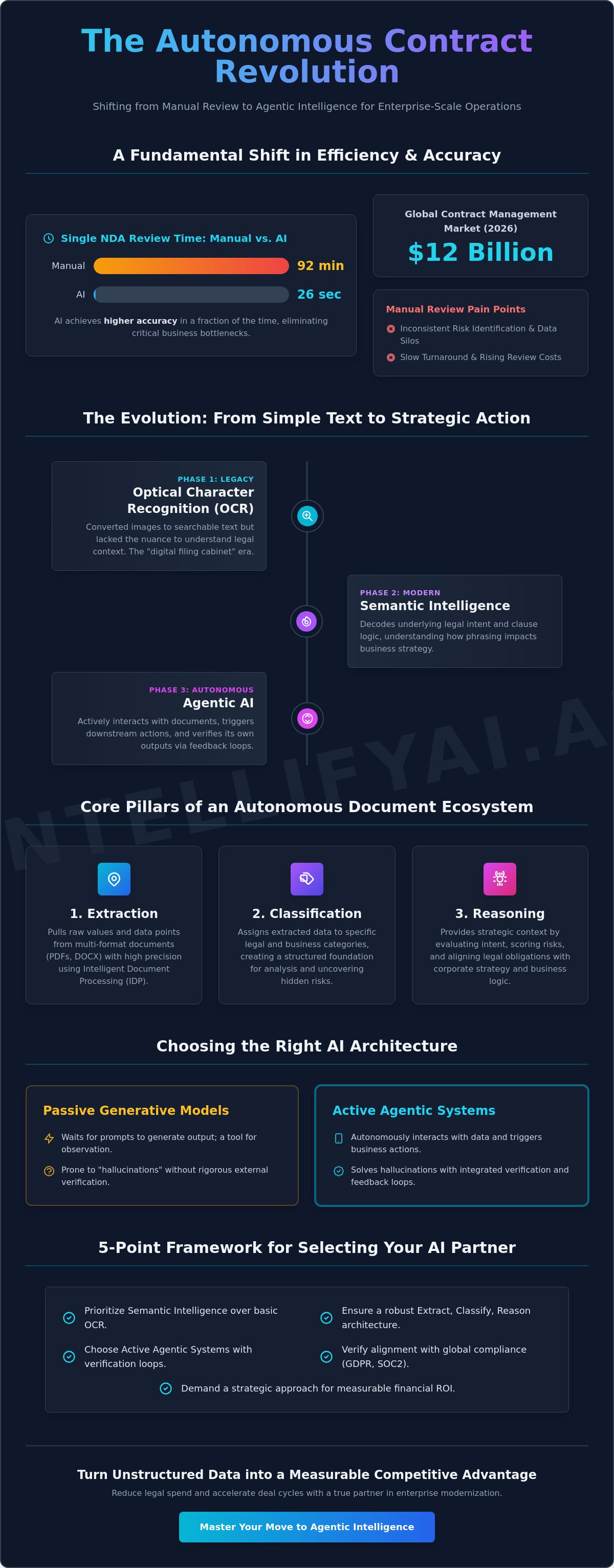
Why would your legal team spend 92 minutes reviewing a single NDA when contract analysis ai software can achieve higher accuracy in just 26 seconds? This isn't just a minor efficiency gain. It's a fundamental shift in how modern enterprises handle their most critical data. By 2026, the global contract management market has reached 12 billion dollars, yet many organizations still struggle with inconsistent risk identification and data silos that stall growth. You've likely felt the friction of slow contract turnaround times and the rising costs of manual document review.
Your chosen solution must be cloud-native to handle the massive data volumes typical of enterprise operations. Legacy on-premise systems or poorly ported cloud wrappers cannot provide the high-velocity processing required in 2026. This architecture also allows for the implementation of FinOps practices. By monitoring the cost of large-scale document processing and SaaS Subscription Fees in real-time, you can optimize your spend while maintaining peak performance. Ask your vendors specifically about their API-first architecture. A truly modern system should allow your internal developers to build custom triggers and actions on top of the core intelligence layer.
We understand that the transition from manual extraction to a truly autonomous system feels like a significant leap. You need more than just digital filing; you require strategic intelligence that executes on your specific business logic. This guide will show you how to master the move toward agentic contract intelligence for enterprise-scale operations. We'll explore the impact of the EU AI Act on your workflows, the power of automated compliance monitoring, and how to turn unstructured data into a measurable competitive advantage that reduces legal spend and accelerates deal cycles.
Key Takeaways
• Understand the shift from basic OCR to semantic intelligence that decodes legal intent for high-scale enterprise operations.
• Identify the three technical pillars—extraction, classification, and reasoning—necessary for building a robust autonomous document ecosystem.
• Compare passive generative models with active agentic systems to solve the challenge of AI hallucinations through integrated verification loops.
• Utilize a professional 5-point framework to select contract analysis ai software that aligns with global compliance standards like GDPR and SOC2.
• Explore how a strategic architecture approach bridges the gap between abstract AI potential and measurable financial returns in the back office.
The Evolution of Contract Analysis: From OCR to Agentic Intelligence
In 2026, contract analysis ai software is no longer a luxury for the legal department; it is a foundational requirement for the modern enterprise. The definition of this technology has shifted from simple data extraction to a sophisticated system of strategic intelligence. It doesn't just read text. It reasons across your entire document ecosystem to align legal obligations with corporate strategy. This evolution marks the end of the "digital filing cabinet" era and the beginning of autonomous execution.
The transition from basic text recognition to a deep semantic understanding of legal intent is the most significant leap in Contract lifecycle management (CLM) history. Legacy systems relied on Optical Character Recognition (OCR) to convert images into searchable text, but they lacked the nuance to understand context. Modern intelligence layers now decode the underlying logic of clauses, identifying not just the presence of a "Force Majeure" term, but how that specific phrasing impacts your global supply chain during a regional disruption.
To better understand this concept, watch this helpful video:
Why Traditional Document Review is Failing Modern Enterprises
Manual review is a bottleneck that serious enterprises can no longer afford. In high-velocity global markets, the time required for human lawyers to parse thousands of pages leads to missed deal windows and stagnant revenue. Data silos in procurement and sales further complicate the issue. When contract data lives in isolation, leadership loses visibility into aggregate risk and spend. The cost of inaction regarding unanalysed contract data is a compounding liability that erodes profit margins through missed obligations and hidden regulatory penalties.
The Rise of Agentic AI in Contract Lifecycle Management
We are witnessing the rise of Agentic AI, a technology that moves beyond the passive nature of traditional Large Language Models. While you can learn more about the foundations in our guide on What is Generative AI?, agentic systems are distinct because they are "active." These autonomous agents don't just wait for a prompt. They interact with unstructured document formats, trigger downstream business actions, and verify their own outputs through rigorous feedback loops. This shift ensures that your contract analysis ai software isn't just a tool for observation, but a partner in enterprise modernization.
Core Capabilities of Enterprise-Grade Contract Analysis Software
Precision is the baseline for high-scale document management. To move beyond simple text retrieval, enterprise-grade contract analysis ai software must excel in three technical pillars: extraction, classification, and reasoning. Extraction pulls raw values from the page. Classification assigns them to specific legal categories. Reasoning provides the strategic context. This architecture relies on Intelligent Document Processing (IDP) to ingest multi-format files, from legacy PDFs to complex Word documents, without losing structural integrity.
Unstructured intelligence allows the system to uncover hidden risks that traditional search tools miss. However, 55% of contract managers cite data output quality as a significant barrier to AI adoption. High-velocity execution requires data that is both clean and accessible. This highlights the vital role of data engineering in preparing your repositories. Without a structured data foundation, even the most advanced AI will fail to deliver actionable ROI. If you are ready to build this foundation, our team can help you align your AI strategy with enterprise goals.
Beyond Extraction: Semantic Reasoning and Risk Scoring
2026 standards demand a shift from keyword matching to "intent" evaluation. Modern software understands the difference between a standard liability cap and a non-standard clause that creates uncapped exposure. Automated risk scoring facilitates this by comparing new documents against your established "gold standard" templates. The true value lies in cross-document intelligence. By identifying patterns across 10,000 contracts simultaneously, the AI can alert you to systemic risks or volume-discount opportunities that were previously invisible in departmental silos.
Agentic Workflows: Automating Post-Signature Obligations
The contract lifecycle doesn't end at the signature. Agentic workflows transform passive documents into active business drivers. These autonomous agents monitor your repository to trigger alerts for renewal dates, price escalations, or specific performance milestones. By integrating directly with ERP systems, the AI ensures that your financial execution matches your legal terms. This level of automation is a core component of enterprise modernization, allowing your team to focus on high-value negotiation while the software handles the burden of repetitive compliance monitoring.
Agentic AI vs. Traditional LLMs: Choosing the Right Architecture
Most organizations mistakenly treat contract analysis ai software as an advanced search tool. Traditional Large Language Models (LLMs) are essentially passive; they respond to prompts but don't own the workflow. Agentic AI represents a fundamental architectural shift toward process autonomy. It's the difference between a tool that simply highlights a clause and an agent that cross-references that clause against global compliance standards, flags deviations, and prepares a summary for the legal team without being asked. Passive AI acts like a high-speed librarian. It can find what you ask for, but it cannot act on that information. Agentic AI acts as a digital junior associate. It understands the strategic goal, identifies the necessary steps, and executes the process from ingestion to reporting.
Maintaining this level of precision requires more than a simple API call. It demands robust MLOps pipelines to ensure model accuracy doesn't drift as legal regulations like the EU AI Act evolve. These pipelines facilitate continuous testing and deployment, allowing the software to remain a dependable asset rather than a technical liability. Without this engineering rigor, enterprise systems risk falling behind the rapid pace of regulatory change and technological advancement.
A common objection to AI in legal tasks is the risk of "hallucinations" or fabricated data. Agentic systems solve this through iterative verification loops. Instead of providing a single output, the agent reasons through its logic, checking its work at each step against the source document. This multi-step process ensures that every extraction is grounded in reality, providing a level of reliability that general-purpose models cannot match.
Mitigating Risk: Hallucinations and Data Governance
Agents use "Chain of Thought" reasoning to verify legal citations. This means the AI documents its logical path, providing transparency that traditional black-box models lack. We also implement strict enterprise guardrails to ensure every action complies with your specific internal policies and data governance requirements. Setting these parameters is a core component of AI strategy consulting, ensuring the technology serves your business logic without compromise. This structured approach prevents the system from operating outside of its intended scope, protecting the integrity of your legal repository.
Human-in-the-Loop: The Role of the Strategic Architect
The goal of advanced contract analysis ai software isn't to replace the legal professional. It's to elevate them. We favor a collaborative model where the AI manages the high-volume, repetitive tasks of data extraction and initial classification. This allows the human worker to focus on the nuance of negotiation and high-level strategy. By removing the administrative burden, the professional transforms from a manual reviewer into a strategic architect of the company’s future. Advanced technology is not a replacement for human expertise, but a liberating force that unlocks our highest creative and strategic potential.
A Strategic Framework for Selecting Contract Analysis Software
Selection of enterprise technology is a high-stakes decision that dictates your operational trajectory for years. For serious organizations, the evaluation of contract analysis ai software must move beyond surface-level feature lists. You aren't just buying a tool; you're investing in a central pillar of your business architecture. To ensure this investment remains relevant, we recommend a 5-point evaluation framework focused on strategic alignment and technical rigor:
Strategic Intent
Does the software understand your specific business logic or just generic legal terms?
Architectural Autonomy
Can the system execute agentic workflows or is it a passive "search and find" tool?
Compliance Integrity
Does it meet non-negotiable standards including SOC2, GDPR, and Sarbanes-Oxley?
Integration Depth
Is the platform API-first, allowing for frictionless connection with your existing ERP and CRM systems?
Scalability
Can the infrastructure handle a sudden 10x increase in document volume without performance degradation?
When assessing these points, shift your focus from "Time-to-Value" to "Time-to-Intelligence." While many tools can be "turned on" quickly, the real metric is how fast the system adapts to your unique legal intent and starts providing actionable strategic insights. This distinction ensures your software is a lasting investment in relevance rather than a temporary fix for a cluttered repository.
Technical Scalability and Cloud-Native Integration
Your chosen solution must be cloud-native to handle the massive data volumes typical of enterprise operations. Legacy on-premise systems or poorly ported cloud wrappers cannot provide the high-velocity processing required in 2026. This architecture also allows for the implementation of FinOps practices. By monitoring the cost of large-scale document processing in real-time, you can optimize your spend while maintaining peak performance. Ask your vendors specifically about their API-first architecture. A truly modern system should allow your internal developers to build custom triggers and actions on top of the core intelligence layer.
Governance, Risk, and Compliance (GRC) Requirements
Security is the foundation of legal technology. Beyond SOC2 and GDPR, your contract analysis ai software must offer robust version control for its AI models. This ensures every automated decision is auditable and reproducible, which is essential for regulatory compliance and internal forensics. We view GRC not as a hurdle, but as a competitive advantage. If you need a partner to help you navigate these complexities, contact us for a custom GRC evaluation to ensure your deployment is both secure and high-performing.
Implementing Contract Intelligence with i_Nova and IntellifyAi
Implementation is where strategy meets reality. For the modern enterprise, deploying contract analysis ai software is not a simple installation process; it's a fundamental modernization of how the business reasons with its own data. While many competitors offer standalone products, we recognize that true digital transformation requires a collaborative approach that blends sophisticated technology with deep engineering expertise. Our methodology ensures that your intelligence layer is a lasting investment in relevance rather than a temporary fix for a cluttered repository.
i_Nova: Turning Unstructured Documents into Actionable Intelligence
The i_Nova platform serves as our flagship solution for intelligent document processing. It's built to handle the immense volume and complexity of enterprise contract repositories without the friction of legacy systems. One of its most significant advantages is its ability to integrate seamlessly with our voice agents and back-office frameworks. This creates a unified ecosystem where contract data informs every customer interaction and operational decision. We offer tiered pricing based on processing complexity, ensuring that your costs remain aligned with the specific value delivered to your organization. This transparency allows for predictable budgeting while you scale your autonomous capabilities.
The IntellifyAi Roadmap: From Strategy to Managed Services
Successful deployment follows a rigorous, logical flow. We begin with AI Strategy & Consulting to define your specific business challenge and identify the highest-impact use cases. This leads to a Proof-of-Value (PoV) phase, where we demonstrate the practical impact of our Agentic AI Engineering Services on a subset of your data. Once the value is proven, we move to a full-scale Cloud-Native & Enterprise Modernization. This roadmap ensures that your contract analysis ai software is not just a tool, but a central pillar of your operational philosophy.
Our commitment extends beyond the initial launch. We provide ongoing optimization through our managed services, utilizing MLOps to maintain model accuracy and adapt to new regulatory requirements. This long-term focus prevents technical debt and ensures your systems remain at the cutting edge of the industry. By removing the burden of repetitive tasks, we empower your team to focus on high-value creative work. Advanced technology is the liberating force your business needs to stay ahead. Explore our AI Strategy & Consulting services to begin your transformation today.
Architecting Your Autonomous Legal Future
The transition from manual review to autonomous execution is no longer a distant vision; it's a strategic necessity. By adopting agentic contract analysis ai software, your enterprise moves beyond simple text extraction to a system that understands and acts on legal intent. You've seen how the right architecture mitigates risk through verification loops and how a cloud-native foundation ensures long-term scalability. This shift allows your organization to focus on high-value creative work by removing the burden of repetitive tasks.
We are here to lead that transformation. With a global presence across the UK, USA, and UAE, we combine deep expertise in Agentic AI and MLOps to deliver measurable financial returns. Our flagship i_Nova platform provides the high-velocity document processing required to turn unstructured data into a competitive asset. Don't let manual bottlenecks stall your growth. It's time to elevate your legal professionals from reviewers to strategists. Partner with IntellifyAi to architect your autonomous contract future. We look forward to building a frictionless, automated future for your enterprise.
Frequently Asked Questions
How does AI contract analysis software handle different document formats?
AI contract analysis software utilizes Intelligent Document Processing (IDP) to ingest a wide array of formats including Word, PDF, and legacy scanned images. The system applies advanced OCR and semantic layers to ensure structural integrity is maintained across all document types. This allows the software to extract data from unstructured sources as effectively as it does from native digital files.
Can AI accurately identify non-standard clauses or missing terms?
Yes, modern systems use semantic reasoning to compare incoming documents against your organization’s established "gold standard" templates. Instead of simple keyword matching, the AI evaluates the legal intent of the text to flag deviations or identify critical omissions. This automated risk scoring ensures that non-standard liabilities are surfaced before they become operational hazards.
What is the difference between Generative AI and Agentic AI in contract review?
The primary difference lies in autonomy. Generative AI is a passive tool that responds to specific prompts to summarize or draft text. Agentic AI is an active partner that can execute multi-step workflows, trigger alerts for renewal dates, and verify its own outputs through iterative reasoning loops. While GenAI assists with content, Agentic AI manages the entire process.
How do you ensure data security when using cloud-based AI for contracts?
We implement a multi-layered security architecture that includes SOC2, GDPR, and Sarbanes-Oxley compliance as baseline requirements. Data is protected through end-to-end encryption and hosted in secure, cloud-native environments with strict access controls. Additionally, version control for your contract analysis ai software models ensures that every automated decision remains auditable for internal forensics.
Does contract analysis AI replace the need for legal professionals?
No, the technology is designed to act as a liberating force that removes the burden of repetitive, high-volume tasks. By handling the initial extraction and classification, the software allows legal professionals to focus on the nuance of negotiation and high-level strategy. The professional moves from being a manual reviewer to a strategic architect of the company’s future.
What are the typical integration requirements for enterprise AI software?
Enterprise-grade systems require an API-first architecture to ensure frictionless connectivity with your existing ERP, CRM, and financial platforms. Successful implementation also depends on robust data engineering to prepare your contract repositories for ingestion. This cloud-native approach allows the system to scale its processing power dynamically as your document volume grows.
How does i_Nova compare to off-the-shelf contract management tools?
i_Nova is a flagship platform for intelligent document processing that offers deep customizability compared to static, off-the-shelf software. Unlike retail applications, i_Nova is designed to integrate directly with back-office workflows and voice agents. It is supported by our custom engineering services to ensure the technology aligns perfectly with your unique business logic.
What is the expected ROI for implementing intelligent document processing?
ROI is measured through significantly reduced legal spend and accelerated deal cycles. For example, AI can review a Non-Disclosure Agreement in about 26 seconds compared to the 92 minutes typically required for human review. These efficiency gains, combined with automated compliance monitoring, provide a measurable impact on performance and long-term financial returns.









.svg)