
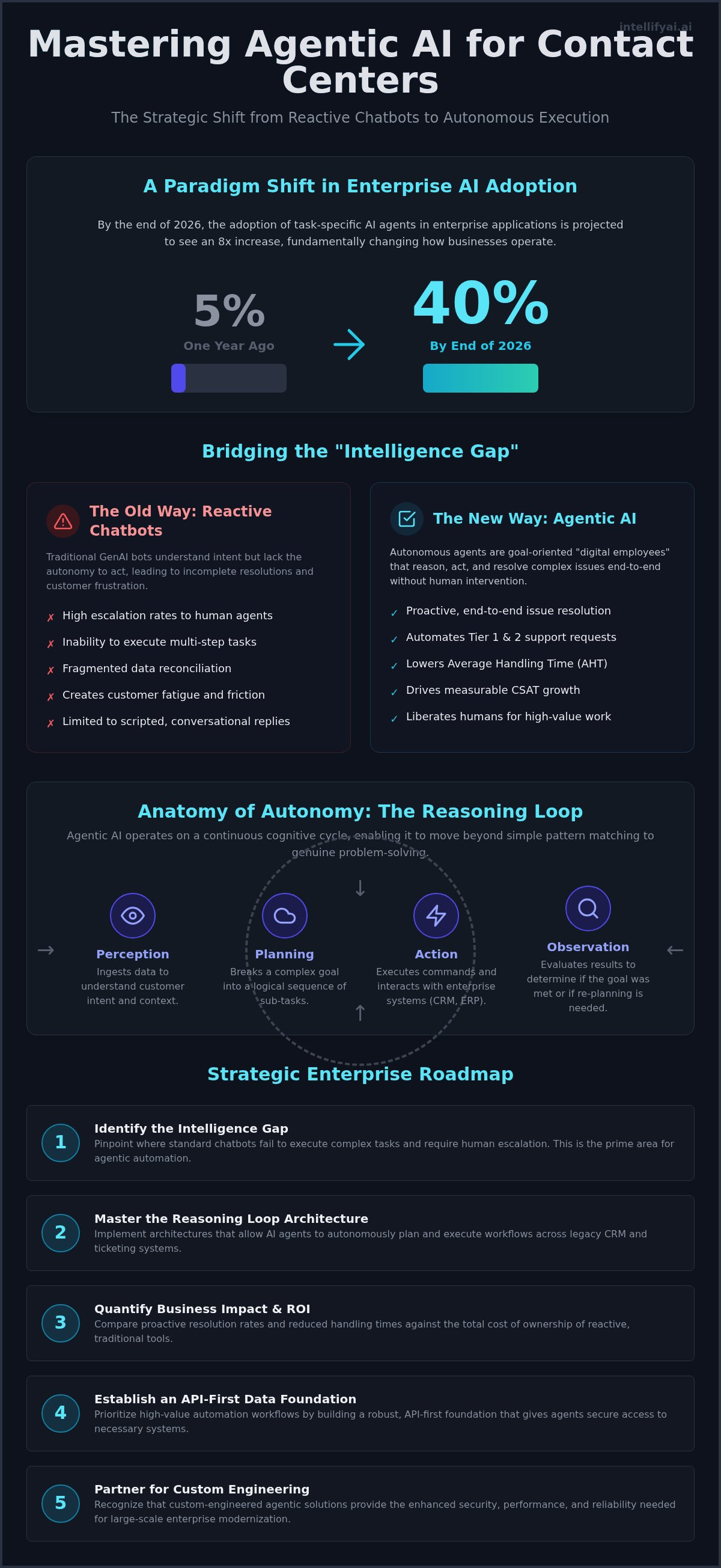
By the end of 2026, 40% of enterprise applications will embed task-specific AI agents, representing a massive leap from the 5% seen just one year ago. This shift marks the end of the era of the scripted chatbot and the beginning of a truly autonomous age. You likely recognize the frustration of high escalation rates where first-generation GenAI bots fail to resolve complex issues, forcing human agents to step in and reconcile fragmented data across legacy systems. It's clear that simply prompting a bot is no longer enough to meet modern customer expectations or achieve operational excellence.
This article provides a strategic roadmap to master agentic ai for contact centers, moving your operations from reactive responses to goal-oriented execution. You'll learn how to deploy digital employees that reason, act, and resolve issues end-to-end without constant human intervention. We will examine the architectural shift from simple chat interfaces to sophisticated agentic workflows that lower Average Handling Time and drive measurable CSAT growth. We also preview the path toward a scalable AI workforce that empowers your team to focus on high-value work while technology handles the burden of repetitive tasks.
Key Takeaways
• Identify the critical "Intelligence Gap" that prevents standard chatbots from executing complex tasks and why a pivot to autonomous reasoning is required.
• Master the "Reasoning Loop" architecture that enables AI agents to autonomously plan and execute workflows across legacy CRM and ticketing systems.
• Quantify the business impact of agentic ai for contact centers by comparing proactive resolution rates to the total cost of ownership of reactive tools.
• Follow a structured enterprise roadmap to prioritize high-value automation workflows while establishing a robust, API-first data foundation.
• Recognize why custom-engineered agentic solutions provide the security and performance necessary for large-scale enterprise modernization.
Beyond Reactive Bots: Why Contact Centers Are Pivoting to Agentic AI
The contact center industry is moving past the era of the helpful but helpless chatbot. In 2026, the priority is no longer just conversation; it's execution. Most enterprises have realized that agentic ai for contact centers is the only way to bridge the "Intelligence Gap" that leaves standard GenAI bots unable to complete multi-step tasks. While a traditional bot can explain a return policy, it can't verify purchase history, check warehouse stock, and issue a return label without human intervention. This limitation creates friction, high escalation rates, and customer fatigue.
To better understand this concept, watch this helpful video:
Agentic AI represents a fundamental shift from "Chat-First" to "Action-First" service models. It relies on autonomous reasoning to plan a sequence of steps toward a specific goal. Instead of just predicting the next word in a sentence, a software agent understands the objective, selects the appropriate tools, and executes the necessary actions across fragmented legacy systems. This ability to reason through a problem allows the system to handle exceptions and edge cases that would normally trigger a human escalation.
The Evolution from Scripted to Autonomous CX
The journey to modern customer experience has moved through three distinct phases, each offering a higher level of sophistication:
Phase 1
Rule-based IVR systems and rigid decision trees that offered limited, scripted options.
Phase 2
Conversational AI and LLM-powered chatbots that could understand intent but lacked the autonomy to act on it.
Phase 3
Agentic AI, where goal-oriented digital workers operate with reasoning capabilities to solve problems end-to-end.
The Business Case for Agentic Orchestration
Agentic AI is a system that uses reasoning to use tools and complete tasks. By deploying agentic ai for contact centers, enterprises can automate Tier 1 and Tier 2 support requests that previously required human oversight. This doesn't just cut costs; it removes the repetitive administrative burdens that lead to agent burnout. When technology handles the data entry and system navigation, your human workforce is liberated to focus on high-value, creative work that requires empathy and complex judgment. This is a strategic investment in long-term viability and operational stability.
The Anatomy of Autonomy: How AI Agents Reason and Execute Workflows
True autonomy in agentic ai for contact centers stems from a continuous cognitive cycle known as the Reasoning Loop. This framework allows a digital worker to move beyond simple pattern matching. It begins with Perception, where the agent ingests raw data to understand the customer’s intent and emotional state. Next comes Planning, where the system breaks down a complex goal into logical sub-tasks. The cycle completes with Action and Observation, as the agent executes a command and evaluates the result to determine if the goal was met. This iterative process is supported by Kennesaw State University research on multi-agent AI, which highlights how orchestrated architectures improve task accuracy in high-pressure service environments.
Execution requires more than just logic; it requires access. Modern agents act as digital orchestrators that interact directly with your existing enterprise stack. They don't just suggest a solution. They log into CRMs to update records, query ERPs for real-time inventory, and close tickets in systems like Zendesk or ServiceNow. This deep integration transforms the AI from a conversational interface into a functional member of your operations team. If you are looking to build these capabilities, exploring custom agentic engineering is often the most direct path to enterprise-grade results.
Integrating i_Nova for Unstructured Data Intelligence
A significant hurdle for traditional automation is unstructured data. Most customer interactions involve documents like invoices, IDs, or contracts that standard bots cannot read. By integrating IDP platforms like i_Nova, agents can process these files in real-time. The agent extracts relevant data points from a customer-uploaded image and immediately uses that information to advance the workflow. This capability removes the manual verification steps that typically stall automated resolutions and ensures the agent has all the facts necessary to reach a final decision.
Memory and Persistence in Agentic Systems
Friction often arises when a system loses track of the conversation. Sophisticated agentic systems solve this through distinct memory layers. Short-term memory maintains context during an active, multi-turn session across different channels. Long-term memory stores historical preferences and past interactions. This dual-layered approach prevents the common "please repeat your order" frustration point. It ensures the agent always operates from a single source of truth, provided by robust data engineering. When an agent remembers a customer's history, it builds trust and significantly improves the overall quality of the interaction.
Evaluating the ROI: Agentic AI vs. Traditional GenAI Chatbots
The financial justification for agentic ai for contact centers rests on a fundamental shift from defensive cost-cutting to offensive value creation. Traditional GenAI chatbots operate on a reactive model; they provide information but lack the agency to resolve the underlying request. This creates a "resolution ceiling" where complex tasks are inevitably passed to human agents. In contrast, agentic systems are proactive. They don't just answer questions about an order; they autonomously navigate the supply chain data to provide a definitive resolution. This distinction is critical for leaders calculating the true return on investment in 2026.
Scaling a contact center traditionally required a linear increase in headcount to manage rising ticket volumes. Agentic AI breaks this dependency. By deploying a digital workforce capable of autonomous reasoning, enterprises can handle exponential growth in customer interactions without a corresponding spike in operational expenses. This allows the organization to maintain high performance during peak periods while keeping fixed costs stable. The result is a scalable infrastructure that protects profit margins even as the business expands.
The Cost of Inaction: Why GenAI Alone is Not Enough
Deploying non-agentic bots often introduces hidden costs that erode initial savings. "Hallucination management" remains a significant drain on resources, requiring constant human auditing to ensure the AI isn't providing fabricated information. Without the ability to execute tasks, these bots act as a friction-filled layer that actually increases human escalation rates. To avoid these pitfalls, many organizations utilize AI Strategy Consulting to map their ROI and identify the specific workflows where autonomy will have the most immediate financial impact.
Measurable Impact on Contact Center Metrics
The transition to agentic models delivers immediate improvements to core performance indicators. Because agents can interact directly with enterprise tools, Average Handling Time (AHT) drops significantly; the system no longer waits for a human to toggle between screens. First Contact Resolution (FCR) also sees a marked increase as the AI completes the task during the initial interaction. By transitioning from dialogue to delivery, agentic ai for contact centers fundamentally redefines the department as a high-performance value driver rather than a defensive cost center. This frictionless resolution directly correlates with higher CSAT scores and long-term customer loyalty.
The Enterprise Roadmap: Implementing Agentic AI Without Friction
Successful deployment of agentic ai for contact centers is not a simple software update; it is a calculated transition from legacy automation to autonomous orchestration. Enterprises must move beyond off-the-shelf bots that offer limited control over data and decision-making logic. A custom-engineered roadmap ensures that AI agents are deeply integrated into your unique operational fabric. This structured approach mitigates risk while maximizing the speed of adoption across your organization.
The implementation begins by identifying "High-Value, High-Frequency" workflows. These are the repetitive tasks that currently consume the most human bandwidth but follow logical, documentable patterns. Once identified, you must establish a robust data foundation and API layer. Without clean, accessible data from your legacy systems, even the most advanced agent will fail to execute accurately. This leads to the deployment of Proof-of-Value (PoV) agents in controlled, low-risk environments. These pilots allow your team to observe reasoning patterns and refine tool-use capabilities before a full-scale rollout. Finally, establishing MLOps pipelines ensures continuous monitoring and optimization, allowing the system to learn from every successful resolution and adapt to changing customer needs.
Governance and the Human-in-the-Loop Model
Maintaining control over autonomous systems requires strict governance frameworks. You must design digital "guardrails" that prevent agents from stepping outside compliance boundaries or making unauthorized financial decisions. Compliance with the EU AI Act, which took full effect for high-risk systems on August 2, 2026, requires explicit transparency and human oversight in these interactions. Human supervisors remain essential in this model; they act as the final authority for high-stakes exceptions and sensitive customer issues. This collaborative relationship ensures that autonomy doesn't come at the cost of security or brand trust. For a deeper look at these frameworks, read our guide on What Is Agentic AI? to understand the executive requirements for autonomous workflows.
Cloud-Native Infrastructure for Scalable Agents
Scalability at the enterprise level depends entirely on the underlying architecture. Serverless and cloud-native environments are essential to minimize latency during complex reasoning cycles that require multiple API calls. If your infrastructure can't handle the burst capacity required during peak traffic periods, your customer experience will suffer from delayed responses. Modernizing your stack is not a luxury; it is a prerequisite for a functional agentic workforce. Read our insights on Enterprise Modernization to learn how to prepare your backend for high-velocity intelligence.
To begin your transition with a partner who understands these complexities, explore our Agentic AI Engineering Services today and build a foundation for long-term operational excellence.
Partnering for Performance: Custom Agentic AI Engineering
Off-the-shelf retail software often fails to meet the rigorous demands of large-scale enterprise operations. For serious organizations, agentic ai for contact centers requires a bespoke architectural approach that generic products cannot provide. Custom engineering allows for deep integration with proprietary data and legacy infrastructure, ensuring your AI workforce is a central pillar of your digital strategy rather than a disconnected silo. This level of customization is essential for maintaining the security and stability that enterprise-grade CX demands.
The IntellifyAi approach combines high-level strategic consulting with deep technical execution. We leverage our flagship i_Nova platform for document intelligence, allowing agents to ingest and act on unstructured data instantly. By orchestrating custom LLMs tailored to your specific business logic, we build systems that understand your unique industry regulations and customer needs. This methodology treats advanced technology as a liberating force, removing the burden of repetitive tasks and allowing your business to focus on high-value creative work. Preparing your workforce for this transition is a collaborative effort that unlocks human potential rather than replacing it.
Strategic AI Consulting and Roadmap Development
We act as a bridge between abstract technical fields and the practical needs of a growing company. Our process begins with AI Strategy & Consulting to build a clear path toward measurable business returns. We utilize custom Proof-of-Value (PoV) engagements to demonstrate the impact of autonomous reasoning before you commit to a full-scale deployment. This data-driven approach ensures that every step of your evolution is grounded in performance and financial viability. Our Agentic AI Engineering Services then translate this strategic vision into a scalable, high-performance reality.
The Future of the Agentic Contact Center
The contact center is evolving into a hub of autonomous intelligence. As the global call center AI market is projected to grow to $13.52 billion by 2034, the move toward goal-oriented digital workers is no longer optional. Enterprises that invest in custom, orchestrated systems today will secure a lasting competitive advantage through superior efficiency and customer satisfaction. This is a journey toward a frictionless, automated future where technology and human workers collaborate to drive the bottom line. Modernize your enterprise with a partner who is ahead of the curve but remains focused on the stability of your operations. Contact Us today to schedule a strategic consultation and begin your evolution.
Secure Your Competitive Advantage in the Autonomous Era
The transition to agentic ai for contact centers is a strategic necessity for enterprises aiming to maintain operational relevance. By moving from reactive chatbots to goal-oriented digital workers, your organization can achieve true self-service resolution while liberating your human workforce for high-value, creative tasks. This evolution requires a robust data foundation and a commitment to custom engineering that off-the-shelf retail software simply cannot match.
IntellifyAi is a global leader in Agentic AI engineering and IDP solutions. Our expert consultants focus on enterprise-grade MLOps and modernization, ensuring your technology strategy translates into measurable financial returns. We frame advanced technology as a liberating force that removes the burden of repetitive tasks and secures your long-term viability.
Schedule your Agentic AI strategy consultation with IntellifyAi today and transform your contact center into a hub of autonomous intelligence. The path to a frictionless, automated future is clear, and your business is ready to take the first step.
Frequently Asked Questions
What is the difference between a chatbot and an AI agent in a contact center?
Traditional chatbots are reactive and follow rigid intent-based scripts to provide information. In contrast, AI agents are goal-oriented and use autonomous reasoning to execute multi-step workflows. While a chatbot can explain a policy, an agent uses tool-use capabilities to log into your CRM and solve the problem. This transition to agentic ai for contact centers allows for full task resolution without human hand-offs.
How does agentic AI handle customer data security and compliance?
Security is maintained through custom engineering and strict governance guardrails. As of August 2026, compliance with the EU AI Act is a critical requirement for high-risk systems, necessitating explicit transparency and human oversight. Agentic systems use secure API layers to access only the necessary data points. By establishing robust MLOps pipelines, enterprises ensure that every autonomous action remains within legal and ethical boundaries while protecting sensitive customer information.
Can agentic AI agents actually process refunds or schedule appointments?
Yes, autonomous agents can execute these transactions end-to-end by interacting directly with your existing enterprise tools. An agent can verify refund eligibility in your billing system or check real-time availability in your scheduling software to book an appointment. This "Action-First" approach removes the need for repetitive data entry. It transforms the AI from a simple conversational interface into a functional digital worker that delivers measurable results.
What is the role of a human agent in an agentic contact center?
Human agents pivot to high-value roles as strategic supervisors and empathy specialists. They handle sensitive escalations and complex exceptions that require nuanced judgment. The agentic workforce is designed to augment human potential by removing administrative burdens and repetitive tasks. This collaboration allows your human team to focus on building deep customer relationships while the technology manages high-frequency workflows with precision and speed.
How long does it take to deploy an agentic AI solution for a contact center?
A typical Proof-of-Value (PoV) engagement takes four to eight weeks to prove core functionality. Full-scale enterprise integration depends on the complexity of your legacy systems and the maturity of your data foundation. Starting with high-frequency, well-documented workflows allows for rapid initial wins. A phased roadmap ensures that each stage of the implementation is optimized through continuous monitoring before moving to broader, more complex contact center modernization.
Does agentic AI require a complete replacement of my current CRM or IVR?
No, agentic solutions are designed to integrate with your existing infrastructure as an intelligent orchestration layer. These agents use well-defined API layers to read and write data across your legacy environments without requiring a "rip and replace" strategy. This approach protects your previous technology investments while adding autonomous reasoning capabilities. It allows your organization to modernize its stack incrementally, reducing friction and maintaining operational stability during the transition.
What is the ROI of implementing agentic AI compared to standard GenAI?
The ROI of agentic ai for contact centers is significantly higher because it achieves full resolution rather than just providing answers. Standard GenAI often increases costs by requiring human agents to fix "hallucinations" or complete unresolved tasks. Agentic systems lower Average Handling Time (AHT) and improve First Contact Resolution (FCR) by executing the work themselves. This shift from dialogue to delivery turns the contact center into a scalable value driver.
How do you prevent AI agents from "hallucinating" during customer calls?
Hallucinations are minimized through Retrieval-Augmented Generation (RAG) and strict reasoning loops that ground the agent in your specific enterprise data. Agents only provide information from verified sources and follow logical steps toward a goal. Using platforms like i_Nova for document intelligence provides agents with factual, unstructured data. Continuous monitoring through MLOps pipelines allows for real-time auditing of decision-making logic, ensuring the AI stays within defined compliance and accuracy boundaries.









.svg)