
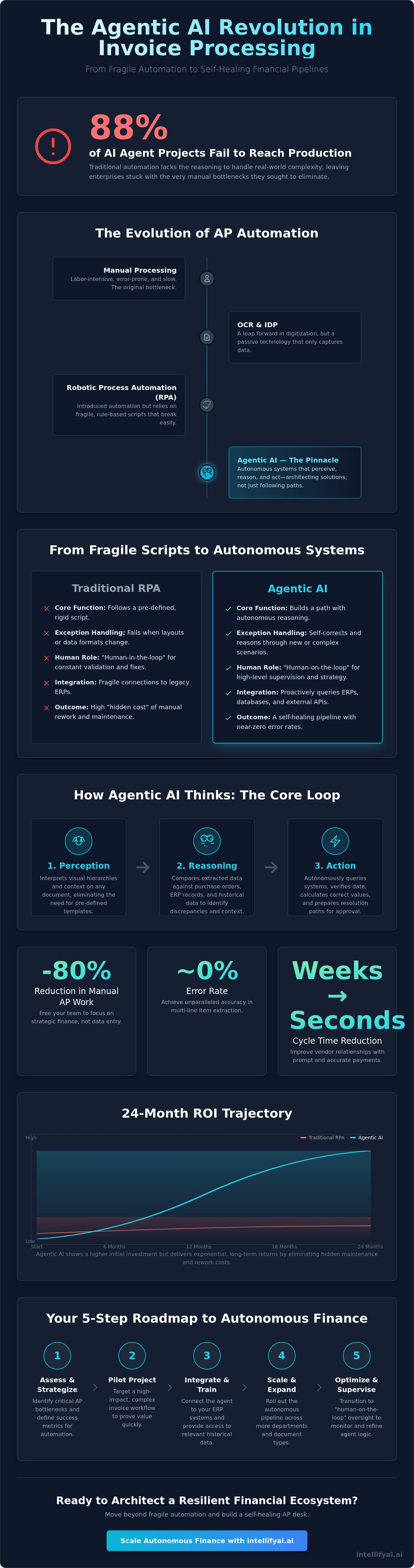
88% of AI agent projects fail to reach production, leaving most enterprises stuck with the very manual bottlenecks they tried to solve. This failure rate persists because traditional automation lacks the reasoning capability to handle real-world complexity. Transitioning to agentic ai for invoice processing represents a fundamental shift from rigid scripts to autonomous systems that can self-correct and reason through exceptions. It's the difference between a tool that follows a path and an architect that builds one.
The strategic shift in 2026 moves from "Human-in-the-loop" to "Human-on-the-loop" oversight. In this model, humans don't perform the task. They supervise the agent’s logic. This transition is a core component of Enterprise Modernization. By modernizing the underlying data architecture, businesses allow agents to access the full context of the supply chain—a process that is further enhanced in the logistics sector by AI-powered platforms like Logivo.ai which streamline haulage and container transport workflows. The impact is measurable. Cycle times drop from weeks to seconds. Vendor relationships improve because payments are accurate and on time. You aren't just processing invoices. You're architecting a resilient financial ecosystem.
You've likely felt the frustration of fragile RPA workflows that break with every minor layout change. We'll show you how Agentic AI transcends traditional automation to deliver reasoning-based invoice processing that scales with enterprise complexity. This guide explores the transition from fragile RPA to self-healing pipelines, demonstrating how to reduce manual AP work by 80% while achieving near-zero error rates in multi-line item extraction.
Key Takeaways
• Distinguish between static data extraction and autonomous reasoning to understand how agentic systems navigate complex, non-standard financial documents.
• Master the "Perception-Reasoning-Action" loop that enables agentic ai for invoice processing to query ERP systems and verify purchase orders without human intervention.
• Analyze the 24-month ROI trajectory of agentic systems compared to traditional RPA to build a sustainable, long-term business case for autonomous finance.
• Follow a structured five-step roadmap to transition your back office from manual oversight to a self-healing, agentic pipeline.
• Leverage the i_Nova platform to scale high-accuracy document processing while maintaining strict compliance and operational stability across global markets.
The Evolution of Accounts Payable: From IDP to Agentic Invoice Processing
Accounts payable is undergoing a fundamental transformation. We've moved past simple OCR and basic data capture. Today, AI agents represent the pinnacle of this evolution. Unlike traditional systems that merely digitize paper, agentic ai for invoice processing functions as an autonomous entity that perceives data, reasons through discrepancies, and executes actions. By 2026, the era of template-based extraction has effectively ended. Modern enterprises no longer rely on rigid rules that break when a vendor moves a logo or changes a font. Instead, they deploy agents capable of understanding the context of a multi-line item invoice just as a human auditor would.
To better understand this concept, watch this helpful video:
The ultimate objective is the "Self-Healing AP Desk." This isn't just about speed. It's about a system that identifies its own errors, queries the ERP for missing purchase orders, and resolves exceptions without human intervention. While traditional Intelligent Document Processing (IDP) was a significant leap forward, it remained a passive technology. Agentic AI is proactive. It doesn't just wait for a human to fix a mismatch; it searches for the solution itself.
The Limitations of Legacy Automation
Existing automation strategies often hit a ceiling. Robotic Process Automation (RPA) and basic Generative AI (GenAI) frequently struggle with complex, multi-page invoice exceptions. RPA is notoriously fragile. If a layout changes, the workflow collapses. This creates a high "hidden cost" of manual validation. Organizations often find themselves employing large teams just to double-check the work of their "automated" systems. Rigid ERP integrations further exacerbate this friction. Older models can't navigate the nuances of legacy databases. This leads to data silos and manual entry workarounds that defeat the purpose of automation.
Defining the Agentic Advantage in 2026
The strategic shift in 2026 moves from "Human-in-the-loop" to "Human-on-the-loop" oversight. In this model, humans don't perform the task. They supervise the agent’s logic. This transition is a core component of Enterprise Modernization. By modernizing the underlying data architecture, businesses allow agents to access the full context of the supply chain. The impact is measurable. Cycle times drop from weeks to seconds. Vendor relationships improve because payments are accurate and on time. You aren't just processing invoices. You're architecting a resilient financial ecosystem.
How Agentic AI Reasons Through Complex Invoice Workflows
Reasoning is the bridge between simple data capture and true process autonomy. While traditional systems extract text, agentic ai for invoice processing operates through a sophisticated "Perception-Reasoning-Action" loop. This cycle begins with multi-modal LLMs that interpret visual invoice hierarchies, recognizing that a bolded figure at the bottom signifies a total, while a similar figure in a table represents a line-item subtotal. This visual understanding allows agents to process documents without pre-defined templates. Once the data is perceived, the agent doesn't just store it; it reasons. It compares the extracted figures against purchase orders and historical data stored in your ERP to identify discrepancies before they reach the human eye.
Modern agents are defined by their ability to use tools. They don't operate in a vacuum. A high-functioning agent can autonomously query SAP or Oracle, verify tax IDs against government databases, and check receiving reports. If the agent detects a mathematical discrepancy, such as a tax calculation error, it doesn't simply flag it for a human. It calculates the correct value, identifies the source of the error, and prepares a resolution path. This level of autonomy is essential for a digitally-enabled workforce where efficiency is driven by machine intelligence.
Cognitive Architectures for Finance Agents
The core of this intelligence is the ReAct (Reason + Act) framework. This architecture allows the agent to generate a verbal reasoning trace before executing a specific task. For example, the agent might "think" that a price mismatch requires a PO lookup before it actually performs the search. Long-term memory enables agents to recall historical vendor context, such as a specific supplier's tendency to omit shipping fees from the subtotal. This context prevents the agent from flagging "false positives" on unstructured edge cases that would typically crash a legacy RPA script.
Autonomous Exception Handling
When an agent encounters missing data, it takes the initiative. Rather than stopping the workflow, the agent can autonomously draft and send a clarification email to the vendor, requesting the missing information. It then tracks the response and resumes processing once the data arrives. Dynamic approval routing further streamlines this process. If an agent processes an invoice with a 99% confidence score, it may bypass standard reviews and move straight to payment. However, if the score drops due to a complex discrepancy, the agent routes it to a specialist with a detailed summary of the issue. To build these sophisticated reasoning pipelines, enterprises often require specialized Agentic AI Engineering Services to ensure seamless tool integration.
Comparing RPA, GenAI, and Agentic Systems for AP
Architectural maturity determines the long term viability of your automation strategy. In the current market, enterprises typically navigate three distinct tiers of technology: legacy RPA, standalone Generative AI, and autonomous agentic systems. RPA functions as a digital tape recorder, repeating pre-defined steps. Standalone GenAI acts as a sophisticated translator, capable of summarizing text but lacking the agency to execute workflows. In contrast, agentic ai for invoice processing serves as a reasoning engine that can interact with external tools and self-correct when data is missing or incorrect. For a deeper conceptual foundation, consult our executive guide on What is Agentic AI?
The ROI trajectory for these systems varies significantly over a 24 month period. RPA often delivers immediate results, but its value plateaus as maintenance costs rise due to "template rot." Standalone GenAI projects frequently struggle to reach production, with research indicating an 88% failure rate for agentic projects that lack proper engineering. However, agents that successfully reach production deliver an average ROI of 171% by 2026. This high return is driven by the system's ability to handle complex multi-line item extraction with 99% accuracy, compared to the 3 to 5% error rates common in manual data entry.
RPA vs. Agentic AI: The End of Templates
RPA relies on linear workflows. If a vendor moves a tax ID to a different corner of the page, the RPA script fails. This fragility requires constant developer intervention. Agents use dynamic goal seeking behaviors to locate information regardless of document structure. You no longer need to "program" every possible scenario. Instead, you move toward orchestration. You define the goal, such as "verify this invoice against the PO," and the agent determines the most efficient path to completion. This shift eliminates the need for thousands of brittle templates.
GenAI vs. Agentic AI: Beyond Simple Summarization
A standalone LLM is insufficient for financial operations because it lacks grounding. Without a connection to your private enterprise data, a basic LLM might hallucinate figures or fail to recognize specific internal vendor codes. Auditability is the primary concern here. Agentic systems solve this by using MLOps Pipelines to stabilize outputs and ensure every action is logged for compliance. These pipelines ensure the agent remains tethered to reality, querying your actual ERP data rather than guessing. This creates a transparent, enterprise grade solution that meets the rigorous standards of modern finance departments.
A Strategic Roadmap for Implementing Agentic Invoice Processing
Deploying agentic ai for invoice processing is not a simple software installation. It's a fundamental architectural shift. While 79% of enterprises have begun adopting AI agents, only 11% have successfully moved them into production as of 2026. This gap exists because many organizations attempt to bypass the foundational strategy required for autonomous systems. A successful roadmap moves from manual oversight to a "Human-on-the-loop" model where agents handle the heavy lifting while specialists manage strategic exceptions. This transition requires a disciplined five-step approach that prioritizes data integrity and system reasoning over simple speed.
Phase 1 & 2: Audit and Data Engineering
Success begins with a rigorous process audit. We identify high-value opportunities by pinpointing where manual exception handling currently causes the most friction. This discovery phase, often led by AI Strategy Consulting, ensures that the agent's goals align with your broader financial objectives. Simultaneously, you must build a robust data lake to house your invoice history. This prepares your unstructured data for agentic consumption. A Proof of Value (PoV) stage serves as a controlled environment to validate an agent's reasoning capabilities against your specific historical data before committing to a full-scale rollout.
Phase 3 & 4: Orchestration and Integration
Once the foundation is set, you must select the appropriate LLMs and agent frameworks. Financial data requires models that prioritize accuracy and tool-use over creative generation. Secure integration with ERPs like SAP, Oracle, or Microsoft Dynamics is non-negotiable. The agent must be able to "read and write" to these systems to verify purchase orders and update payment statuses. During this phase, we implement strict "Guardrails." These are programmatic constraints that ensure the agent follows financial compliance rules and flags potential fraud before any funds are moved.
Phase 5: Scaling with MLOps and Continuous Optimization
The final stage involves transitioning from a single-agent pilot to a multi-agent orchestration layer. This is where the true scale happens. However, agentic systems are not "set and forget." They require ongoing monitoring through MLOps to detect "drift" in reasoning or changes in vendor document formats. Managed services play a critical role here, optimizing agent performance and managing cloud costs as your volume grows. This continuous optimization ensures your autonomous pipeline remains resilient against the complexities of global trade. Ready to architect your autonomous back office? Explore our AI Strategy & Consulting to begin your roadmap.
The i_Nova Advantage: Scaling Autonomous Finance with IntellifyAi
The gap between adopting a tool and achieving production-grade results is often the difference between a generic software purchase and a strategic partnership. IntellifyAi bridges this divide through i_Nova, our premier Intelligent Document Processing platform designed specifically for agentic workflows. In an era where 88% of AI agent projects fail to reach production, i_Nova stands as a proven architecture for agentic ai for invoice processing. It's built to handle the vertical complexities of industries like banking and healthcare, where precision isn't just a metric but a regulatory requirement.
Our role as a Strategic Architect means we don't just provide an interface; we build the underlying reasoning logic that mirrors your specific financial policies. By combining Agentic AI Engineering with your unique business rules, we create a system that doesn't just extract data. It understands it. This synergy allows for a 40% reduction in compliance breach incidents within 90 days of implementation. We treat technology as a liberating force, removing the burden of repetitive tasks so your finance team can focus on high-value creative work and strategic growth.
Why Custom Engineering Beats Off-the-Shelf
Generic "black box" agents present significant risks for sensitive financial data. These off-the-shelf solutions often lack the transparency required for internal audits. IntellifyAi builds transparent reasoning chains, ensuring every decision an agent makes is logged and verifiable. We avoid superficial AI overlays that sit on top of broken processes. Instead, we advocate for end-to-end modernization. This approach automates 85% of manual QA work, providing a level of stability that simple retail software cannot match. It's about building a lasting investment in relevance rather than a temporary fix.
Partnering for Long-Term Transformation
Transformation is a collaborative journey. Our approach combines strategic consulting with deep engineering expertise to ensure your autonomous back office is both innovative and dependable. We operate under an Ethical AI framework, framing advanced tools as a means to unlock human potential rather than replace human labor. This philosophy ensures that your transition to an autonomous enterprise is sustainable and value-driven. The future of finance is frictionless, and the architecture is ready. Contact IntellifyAi today to schedule your strategic roadmap session and begin your journey toward autonomous AP.
Architecting the Future of Autonomous Finance
Transitioning to agentic ai for invoice processing represents a fundamental shift from managing software to orchestrating intelligence. By moving beyond the fragility of RPA and the limitations of standalone LLMs, your enterprise gains a self-healing pipeline capable of handling complex financial exceptions with 99% accuracy. This is not merely a technical upgrade; it's a strategic modernization that allows your team to focus on high-value creative work while the system handles the burden of repetitive execution.
IntellifyAi supports this transformation through our flagship i_Nova platform and deep expertise in custom agentic engineering and MLOps. With a global presence spanning the UK, USA, India, and the UAE, we provide the technical depth and strategic vision required for serious enterprise modernization. The path to a frictionless, autonomous back office is clear, and it starts with a dedicated strategy focused on long-term viability.
Consult with our Strategic Architects to build your Agentic AI roadmap. We're ready to help you turn advanced technology into a liberating force for your business.
Frequently Asked Questions
What is the difference between Agentic AI and standard AI for invoice processing?
Standard AI identifies data, while agentic AI reasons and acts upon it. Traditional intelligent document processing focuses primarily on extraction accuracy. Agentic systems use that extracted information to execute complex workflows, such as querying an ERP to verify a purchase order or calculating tax discrepancies. This shift turns a passive data tool into an active participant in your financial operations.
Can Agentic AI handle handwritten or poorly scanned invoices?
Yes, modern multimodal models interpret low-quality documents with high accuracy by using visual context. These systems don't just look for text strings; they understand the spatial relationships on a page. If an agent encounters an illegible field, it can cross-reference other data points on the invoice or automatically request a cleaner copy from the supplier to maintain data integrity.
How does an AI agent handle multi-line item matching with POs?
Agents perform granular, line-by-line validation against purchase orders and receiving reports. They use reasoning to match descriptions that don't perfectly align, such as differing SKU formats or abbreviated product names. This process ensures that every individual charge is verified against actual goods received before the invoice is approved for payment, reducing the risk of overpayment.
Is Agentic AI secure enough for enterprise financial data and GDPR compliance?
Agentic systems are built with enterprise-grade security protocols and full GDPR compliance at their core. Data is processed within secure cloud environments using encryption and strict access controls. Because agents follow programmatic guardrails, they actually reduce the risk of human-based data leaks or unauthorized access to sensitive financial records during the processing cycle.
Does Agentic AI require a complete overhaul of our existing ERP system?
No, agentic ai for invoice processing integrates with your existing legacy systems through secure APIs or database connectors. It functions as an intelligent orchestration layer that sits on top of your current infrastructure. This allows you to modernize your accounts payable department without the disruption of a full ERP overhaul. You keep your current records while gaining autonomous reasoning capabilities.
What is the typical ROI timeline for implementing an Agentic AI solution in AP?
How do we maintain control over autonomous agents in a financial audit?
You maintain control through comprehensive audit logs and "Human-on-the-loop" oversight. Every reasoning step and action taken by the agent is documented in a transparent, immutable chain. This allows internal and external auditors to verify the logic behind any specific transaction. You aren't losing control; you're gaining a more detailed map of your financial workflows.
What happens if the AI agent encounters an invoice format it has never seen before?
Agentic ai for invoice processing
adapts instantly to unknown layouts without the need for manual template creation. It uses multimodal reasoning to understand the visual hierarchy of a document, identifying fields like tax totals and vendor names based on context. If an agent encounters a truly ambiguous format, it flags the document for human review while learning from that correction to handle similar cases in the future.









.svg)