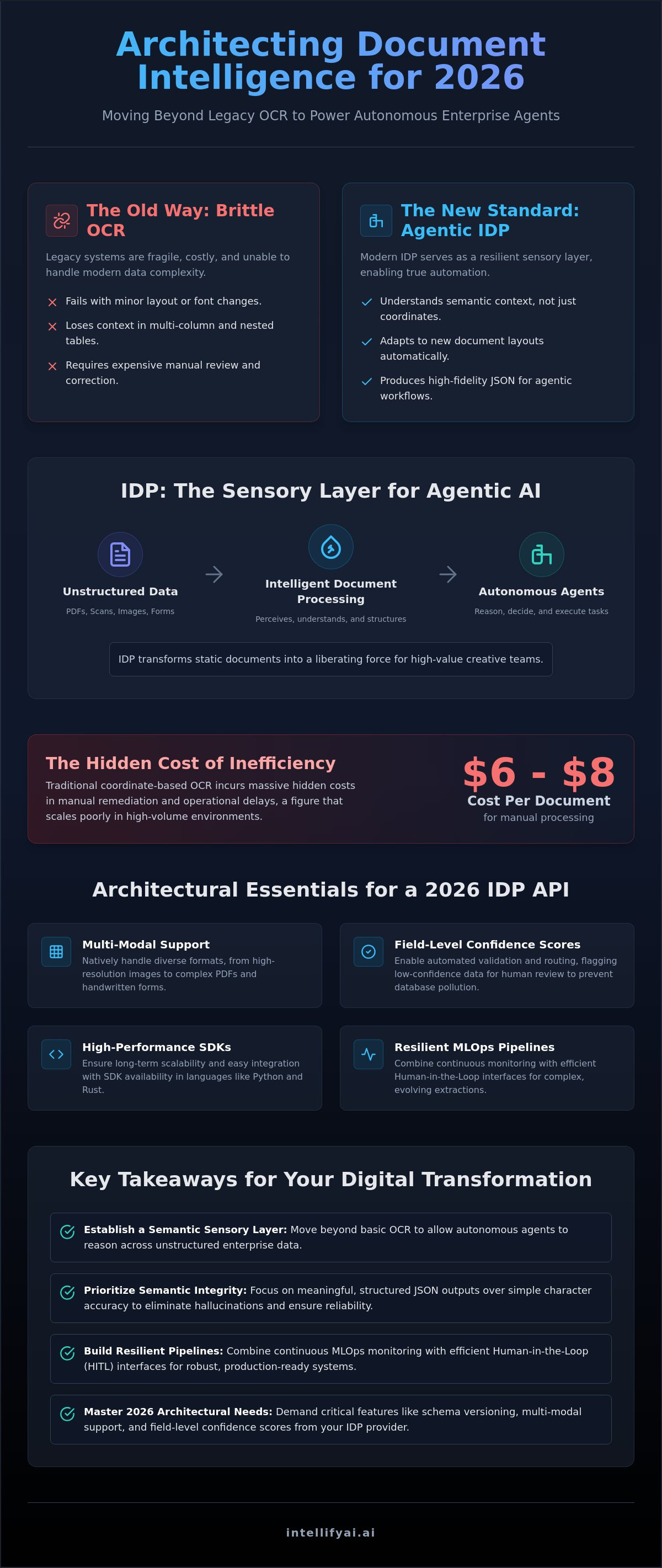
In 2026, the value of document processing isn't found in converting paper to pixels. It's found in architecting the sensory layer that allows autonomous agents to reason across your most complex unstructured data. You've likely felt the frustration of brittle legacy OCR systems that collapse at the first sight of a layout change or a multi-column table. These technical bottlenecks don't just slow down operations; they prevent your enterprise from achieving true system autonomy.
Successfully integrating idp into enterprise systems requires moving beyond simple extraction toward a robust, cloud-native architecture. This article provides the strategic framework you need to master these requirements and build production-ready pipelines that align with 2026 standards. We'll examine how to transform raw documents into frictionless JSON, integrate with existing MLOps stacks, and leverage the i_Nova platform to eliminate the burden of manual schema tuning. By the end of this guide, you'll understand how to position document intelligence as a central pillar of your digital transformation, turning static information into a liberating force for your high-value creative teams.
Key Takeaways
• Move beyond basic OCR to establish a semantic sensory layer that allows autonomous agents to reason across unstructured enterprise data.
• Identify the critical architectural requirements for integrating idp into enterprise systems, including schema versioning and multi-modal support for 2026 standards.
• Prioritize semantic integrity over simple character accuracy to eliminate hallucinations and ensure the reliability of structured JSON outputs.
• Build resilient, production-ready pipelines by combining continuous MLOps monitoring with efficient Human-in-the-Loop interfaces for complex extractions.
• Accelerate your digital transformation by utilizing the i_Nova platform to convert high-volume unstructured formats into actionable intelligence.
Beyond OCR: Reframing IDP as the Sensory Layer for Agentic AI
The traditional definition of document processing is undergoing a fundamental shift. For decades, Optical Character Recognition (OCR) served as a simple translation tool, turning images of text into machine-readable strings based on spatial coordinates. This approach is no longer sufficient. In a landscape defined by autonomous workflows, Intelligent Document Processing (IDP) acts as the sensory layer for the enterprise. It doesn't just read; it perceives and understands. While Identity and Access Management (IAM) often shares the IDP acronym in IT circles, for the modern data architect, IDP represents the bridge between unstructured physical reality and structured digital logic.
Integrating idp into enterprise systems is the prerequisite for building Agentic AI. Autonomous agents require high-fidelity, structured data to function as reasoning engines. If the data input is garbled or lacks context, the agent's output will inevitably fail. Legacy systems were built for human review, providing read-only outputs that required manual intervention. Modern reasoning APIs, however, are designed to drive action. They provide the semantic integrity necessary for an agent to "see" a contract, "understand" its obligations, and "execute" a downstream procurement task without human hand-holding.
To better understand how these systems connect across the organization, watch this helpful video:
The Failure of Traditional OCR in Complex Workflows
Standard coordinate-based extraction is notoriously brittle. When a vendor changes a font or moves a table two inches to the left, traditional OCR templates break. This leads to a massive hidden cost in manual remediation. Industry data suggests manual document processing can cost between $6 and $8 per document, a figure that scales poorly in high-volume environments. Multi-column layouts and nested tables present even greater challenges, often resulting in fragmented data strings that lose all relational context. Moving to layout-aware semantic models allows the system to recognize a "Total Balance" regardless of where it sits on the page, transforming document capture from a fragile task into a resilient asset.
Defining Agentic Intelligent Document Processing
The evolution from simple parsing to agentic intelligence is powered by Large Language Models (LLMs) and Vision-Language Models (VLMs). These technologies interpret document context rather than just character patterns. When you are integrating idp into enterprise systems today, you aren't just installing a parser; you're deploying a reasoning engine. These APIs feed directly into what is agentic ai frameworks, providing the structured JSON payloads that agents use to make decisions. This transition allows your business to extract actionable intelligence, such as sentiment analysis in legal disputes or risk markers in financial statements, rather than just raw text.
Architectural Essentials: What Developers Need in a 2026 IDP API
Building a resilient architecture for 2026 starts with a shift in perspective. Integrating idp into enterprise systems is no longer a peripheral IT task; it's a core infrastructure requirement. Developers must look beyond basic extraction capabilities. They need APIs that offer multi-modal support for diverse document types, including high-resolution images and handwritten forms. Field-level confidence scores are equally vital. These scores allow for automated validation and routing, ensuring that low-confidence data is flagged for human review before it pollutes your database. For serious enterprise builds, evaluate SDK availability in high-performance languages like Python and Rust to ensure long-term scalability.
Schema Management and Versioning
Static schemas fail when business environments evolve. A model update shouldn't break your entire production line. Implementing schema versioning is the only way to protect downstream consumer agents and databases from sudden changes in output structure. This is a critical part of Transforming Enterprise Processes with IDP, where the goal is a self-healing data pipeline. Using evaluation frameworks (Evals) allows teams to maintain automated quality control, ensuring that every schema iteration meets rigorous semantic standards without manual oversight.
Performance Modes: Balancing Latency and Accuracy
Not every document requires the same level of computational intensity. High-velocity environments benefit from "Fast-path" modes that prioritize latency for standard layouts. Conversely, "Deep-reasoning" modes leverage larger models for complex, multi-page contracts. When integrating idp into enterprise systems, the focus must remain on long-term viability and cost control. Rust-based engines are increasingly favored for these tasks due to their memory safety and speed. Optimizing these API calls is essential for managing operational costs and meeting FinOps objectives. A well-architected system balances these modes to meet both performance targets and financial constraints. If your team is struggling to design these complex layers, exploring Agentic AI Engineering Services can provide the technical blueprint needed for success.
Evaluating Extraction Accuracy vs. Semantic Reasoning
Traditional metrics often focus on character-level accuracy, but this is a narrow lens for the modern architect. In 2026, getting the characters right is table stakes. The real challenge lies in semantic integrity. It's the difference between a system that reads "12/05/26" and one that understands it as a "Net Due Date" within the context of a specific vendor agreement. When integrating idp into enterprise systems, the focus must shift from raw OCR precision to the model's ability to reason through complex document logic without human intervention.
Hallucinations remain a primary concern for transactional business systems. High-quality document APIs address this by using verification layers that check extracted data against known business rules. If a model extracts a line-item total that doesn't sum correctly with the tax field, the system should flag it immediately. This level of semantic reasoning ensures that the structured JSON output is not just accurate in its characters, but logically sound in its business context. Built-in evaluation tooling is no longer optional; it's a necessity for catching accuracy regressions before they impact production workflows.
The RAG Requirement: Clean Markdown for LLMs
Preserving the reading order of a document is critical for embedding models and vector search. If your extraction process flattens a multi-column PDF into a single stream of text, the relational context is lost. This breaks Retrieval-Augmented Generation (RAG) pipelines. Modern document processing must output clean, layout-aware Markdown that preserves table structures and headings. This approach allows your generative ai strategy to flourish, as LLMs can navigate the document's hierarchy as easily as a human reader. Tables shouldn't be dumped as raw text; they must maintain their semantic relationships to remain useful for downstream reasoning agents.
Enterprise-Grade Security and Compliance
Trust is the foundation of any automation framework. Processing sensitive documents in the cloud requires rigorous adherence to SOC2 and GDPR standards. For many serious enterprises, the ability to deploy via on-prem or private cloud options is a non-negotiable requirement to maintain data sovereignty. Ensuring data residency is particularly critical for integrating idp into enterprise systems across global markets. With a presence in the UK, USA, India, and the UAE, IntellifyAi understands the nuances of local regulations. Your architecture must support these residency requirements to ensure that sensitive financial or legal data never leaves its designated jurisdiction, providing long-term viability for your digital investments.
Developer Implementation: Building Resilient Document Pipelines
Strategy provides the blueprint, but engineering resilience determines the long-term success of your automation. When integrating idp into enterprise systems, the focus must shift toward building pipelines that can withstand the variability of real-world data. A production-ready environment requires a sophisticated MLOps pipeline designed for continuous monitoring. This infrastructure allows teams to manage the entire lifecycle of a document model, from initial training to real-time performance tracking. To empower autonomous agents, developers should utilize Model Context Protocol (MCP) servers. These servers expose document-processing tools directly to AI agents, allowing them to request specific extractions on demand as they navigate complex workflows.
Low-confidence extractions shouldn't halt your operations. Integrating Human-in-the-Loop (HITL) interfaces ensures that technology and human workers operate in a collaborative partnership. This approach uses advanced tools to remove the burden of repetitive tasks while keeping experts available for high-value validation. For high-volume batch processing, your pipeline must include automated retry logic and robust error handling. These safeguards prevent temporary API timeouts or malformed files from disrupting the broader system, ensuring that your data flows remain consistent and dependable.
Integration Patterns: APIs, SDKs, and Webhooks
Scale dictates your choice between synchronous and asynchronous processing. For real-time user feedback, synchronous calls provide the immediate response needed for a seamless experience. However, enterprise-scale workflows often favor asynchronous processing. Leveraging webhooks for event-driven document automation allows your system to receive real-time updates only when a task is complete. This reduces unnecessary polling and optimizes resource usage. When handling large file uploads, use multipart/form-data and implement chunked uploading to manage memory constraints and network stability effectively.
Monitoring and Continuous Improvement
Extraction drift is a silent threat to automation. Tracking accuracy regressions over time is critical to maintaining system integrity. Version control must extend beyond simple code repositories; it must encompass your models, schemas, and evaluation datasets. This rigorous approach ensures that every update is a step toward greater efficiency rather than a potential point of failure. Scaling from a Proof-of-Value to full enterprise modernisation requires this level of discipline. If you are ready to architect these resilient layers for your organization, explore our Agentic AI Engineering Services to begin your transformation.
Accelerating Transformation with i_Nova and IntellifyAi Services
Modernizing your document infrastructure is not just a technical upgrade; it's a strategic move toward business agility. Integrating idp into enterprise systems requires a partner who understands the intersection of cloud-native architecture and high-level corporate strategy. IntellifyAi serves as this partner, providing the tools and expertise to turn unstructured data into a competitive advantage. Our approach focuses on long-term viability, ensuring that every implementation delivers measurable financial returns while reducing the burden of repetitive tasks. We position technology as a liberating force that allows your organization to focus on high-value creative work.
i_Nova: The Intelligent Document Processing Platform
The i_Nova platform represents the next generation of document intelligence. It moves beyond standard capture to offer Agentic OCR and automatic schema tuning. These features allow the system to adapt to new document formats without manual intervention, maintaining high-fidelity extraction even as layouts change. i_Nova supports a wide range of unstructured formats, providing the multi-format support necessary for complex global operations. By integrating i_Nova into your cloud-native modernization efforts, you don't just improve back-office efficiency. You enhance the entire customer experience by accelerating response times and ensuring data accuracy across every touchpoint. This platform is the engine that converts raw data into actionable intelligence.
Partnering for Strategic AI Success
Off-the-shelf APIs often fall short when faced with bespoke enterprise needs. This is where IntellifyAi’s engineering services provide the necessary depth. We specialize in custom Agentic AI builds that align specifically with your unique operational requirements. Our global presence in the UK, USA, India, and the UAE allows us to bring a diverse perspective to every challenge. We ensure that your AI strategy is both innovative and compliant with regional regulations. This isn't a temporary fix; it's a lasting investment in relevance. Moving from simple document parsing to autonomous enterprise workflows requires this level of custom-engineered intelligence.
The journey toward a frictionless future starts with a clear plan. As a Strategic Architect, we don't just provide software; we provide a vision for the future of your business. We invite leaders to explore our consulting services to develop a tailored strategy. This roadmap bridges the gap between abstract technical potential and practical, results-oriented execution. Integrating idp into enterprise systems is the first step toward a more autonomous, efficient, and profitable enterprise. Let us help you navigate this digital transformation with confidence and precision.
Architecting the Future of Document Intelligence
The era of brittle OCR has ended, replaced by a landscape where document understanding serves as the vital sensory organ for your autonomous workflows. Successfully integrating idp into enterprise systems requires a fundamental shift from simple character recognition to deep semantic reasoning. This ensures your agents operate with the high-fidelity data they need to drive meaningful action. By adopting robust MLOps pipelines and layout-aware parsing, you create a system that is not only efficient today but resilient against the technological shifts of 2026 and beyond.
IntellifyAi stands ready as your partner in this transformation. With our global presence in the UK, USA, India, and the UAE, we offer the specialized expertise in Agentic AI engineering needed to modernize your back-office operations. Our flagship i_Nova platform provides the scale and intelligence required to eliminate repetitive manual tasks, allowing your team to focus on high-value creative work that drives growth. We view advanced technology not as a daunting complexity, but as a liberating force for your enterprise.
Architect your enterprise AI future with IntellifyAi
The journey toward a frictionless enterprise is a strategic investment in your organization's long-term viability and success. We look forward to building that future with you.
Frequently Asked Questions
What is the difference between a document processing API and traditional OCR?
Traditional OCR translates pixels into text strings based on fixed spatial coordinates; a modern IDP API uses semantic reasoning to understand the relationships between data points. While OCR provides a raw data dump, IDP interprets the context to differentiate between a "Total" and a "Subtotal" regardless of layout shifts. This intelligence is a prerequisite for anyone seriously integrating idp into enterprise systems to achieve true automation.
How do I choose the best document extraction API for a RAG pipeline?
Prioritize APIs that provide layout-aware parsing and clean Markdown output for your Retrieval-Augmented Generation (RAG) pipelines. Embedding models require the original reading order and table structures to be preserved to maintain semantic context. If an API flattens the document into a single text stream, your vector search accuracy will suffer. Look for tools that treat document structure as a first-class citizen.
Can modern IDP APIs handle scanned PDFs and handwritten text effectively?
Modern IDP solutions utilize Vision-Language Models (VLMs) to process low-resolution scanned PDFs and complex handwritten text with high fidelity. These models don't just look for character patterns; they interpret the visual context of the entire page to resolve ambiguities. This allows businesses to automate back-office tasks that previously required human eyes for manual transcription, significantly reducing operational friction and human error.
What security standards should I look for in an IDP API provider?
Demand SOC2 Type II compliance and GDPR adherence to ensure your sensitive data is handled with enterprise-grade security. When integrating idp into enterprise systems, you must also verify that the provider offers data residency options in your specific operating regions, such as the UK, USA, or UAE. On-premise or private cloud deployment options are also essential for highly regulated sectors like finance and healthcare.
How does schema versioning prevent production failures in document pipelines?
Schema versioning creates a layer of abstraction that prevents model updates from breaking downstream consumer agents or databases. By tagging output structures with specific version numbers, you can roll out improved extraction models without forcing immediate updates across your entire architecture. This decoupling is a cornerstone of resilient MLOps pipelines. It ensures that your automated workflows remain stable even as the underlying AI evolves.
Is it better to use a hyperscaler API or a specialised IDP platform like i_Nova?
Hyperscaler APIs offer broad utility for simple tasks, but specialized platforms like i_Nova provide the deep reasoning and automatic schema tuning required for complex enterprise workflows. i_Nova is architected specifically for high-accuracy extraction from unstructured formats, offering a more tailored solution than generic cloud services. This focus translates to higher semantic integrity, fewer hallucinations, and lower manual remediation costs for the business.
How should developers evaluate the accuracy of a document processing API?
Developers should move beyond simple Character Error Rate (CER) and implement automated "Evals" that measure semantic integrity. This involves testing how well the API preserves the logical relationships between data fields, such as matching line items to invoice totals. Use a representative "golden dataset" to run these evaluations continuously. This process allows you to catch accuracy regressions before they impact your production environment.
What is the role of a Model Context Protocol (MCP) server in document parsing?
A Model Context Protocol (MCP) server acts as a standardized interface that exposes document-processing tools directly to AI agents. It allows an agent to "know" which document tools are available and call them as needed to retrieve specific data points. This protocol is essential for building autonomous systems where the agent must actively seek out and process unstructured information to complete a complex reasoning task.








.svg)