Most enterprise AI initiatives are currently stalled in "pilot purgatory" because they were built for simple chat interactions rather than true operational autonomy. You've likely felt the friction of fragmented data silos and the mounting pressure of new regulations, such as Illinois’ SB 315, which now mandates rigorous audits for catastrophic risk management. Understanding how to develop an ai roadmap that survives this complexity requires a shift from viewing AI as a mere add-on to treating it as a strategic architect of your core business processes.
We recognize that your primary challenge isn't just adopting technology; it's ensuring that every implementation delivers a clear financial return while remaining compliant with transparency laws like California’s AB 2013. This guide promises to help you master the transition from experimental GenAI to autonomous, agentic workflows. You'll gain a clear sequence for high-impact initiatives that align IT and business units under a single, scalable architecture. We will explore the framework necessary to move beyond testing and into a future where AI removes the burden of repetitive tasks, allowing your leadership team to focus on high-value creative work.
Key Takeaways
• Transition from experimental generative tools to autonomous agentic workflows to escape pilot purgatory and drive measurable enterprise value.
• Build a high-integrity data foundation using intelligent document processing to turn unstructured silos into actionable intelligence for AI agents.
• Discover how to develop an ai roadmap through a structured six-step framework that aligns technological capability with strategic business modernization.
• Prioritize initiatives using a Proof-of-Value matrix to balance immediate ROI with the long-term feasibility of complex autonomous systems.
• Secure your competitive advantage by partnering with a Strategic Architect to navigate evolving 2026 compliance standards and multi-agent orchestration.
Why Traditional AI Strategy Roadmaps Fail in 2026
The era of speculative AI experimentation has ended. In 2026, the divide between market leaders and laggards is defined by execution. Traditional roadmaps fail because they treat AI as a peripheral software update rather than a fundamental shift in enterprise architecture. Most organizations remain trapped in pilot purgatory because their strategies lack the scalability required for autonomous agents. Developing a sophisticated understanding of artificial intelligence is no longer a competitive advantage; the real value lies in the orchestration of these tools within a resilient framework.
High-velocity data is the fuel for this transformation. Without a constant stream of high-integrity information, even the most advanced models fail to deliver accuracy. Leaders who successfully master how to develop an ai roadmap prioritize data engineering as a core strategic pillar. They recognize that a roadmap isn't a static document, but a commitment to building a system that learns and adapts.
To visualize the shift toward execution-focused strategy, watch this breakdown of 2026 priorities:
The Death of the Static 3-Year Plan
Rigid planning is a liability in a high-velocity market. When model pricing and capabilities change quarterly, a three-year static plan becomes obsolete before the ink dries. Modern roadmaps must be modular and iterative. They should incorporate feedback loops from deployed agents to adjust strategy based on real-world performance. The 2026 AI Roadmap is a living architecture for business intelligence.
From Task Automation to Workflow Autonomy
Task automation is a relic of the early GenAI era. True competitive advantage now comes from workflow autonomy. This involves moving beyond basic bots to Agentic AI engineering, where systems plan and execute complex sequences with minimal supervision. For instance, autonomous voice agents in a modern contact centre don't just answer questions; they resolve disputes and update back-office records simultaneously. When you evaluate how to develop an ai roadmap, you must align these technical milestones with measurable business KPIs like financial returns and operational growth. This ensures that every technological leap translates directly into bottom-line performance.
The 5 Strategic Pillars of a Future-Proof AI Roadmap
A resilient enterprise requires a blueprint that outlasts specific model versions or temporary market trends. When leaders evaluate how to develop an ai roadmap in 2026, they must focus on five structural pillars that move beyond superficial chatbots toward deep operational autonomy. These pillars ensure that your investments translate into a scalable, high-performance architecture rather than a collection of disconnected tools.
Pillar 1: Data Engineering and IDP
Unstructured data remains the primary obstacle to true enterprise intelligence. Historical records, complex PDFs, and siloed communication logs contain the critical context your models need to perform accurately. The i_Nova platform acts as a specialized extraction engine, converting this raw information into high-integrity data. Without this foundation, fine-tuning agentic models is impossible. High-quality data ensures that your autonomous systems operate on verified facts, which is essential for maintaining accuracy as you scale.
Pillar 2: Agentic AI Engineering
The most significant shift in 2026 is the move from "suggestive" AI to "executive" AI. Traditional systems provide answers; agentic systems perform actions. By integrating Agentic AI engineering services into your core strategy, you create a framework where multi-agent systems collaborate across departments. For example, a finance agent might identify a billing discrepancy and automatically trigger a resolution agent in your back office. This level of orchestration is what separates a modern roadmap from a basic automation script.
Pillar 3: Governance and AI Ethics
Regulatory compliance is a central business pillar. New laws, such as Illinois SB 315 and California’s AB 2013, now mandate transparency in training data and rigorous risk management frameworks. Your roadmap must include contextual governance and "Human-in-the-loop" (HITL) checkpoints. These safeguards ensure that autonomous workflows remain within ethical and legal boundaries. Validating model outputs at scale is critical for maintaining organizational trust and avoiding the legal pitfalls of algorithmic discrimination.
Pillars 4 & 5: Talent and Scalable Infrastructure
Success requires a workforce prepared for AI collaboration and a cloud-native infrastructure that supports robust MLOps. You aren't replacing human workers; you're liberating them to focus on high-value strategy by removing repetitive tasks. A scalable architecture ensures your systems can handle the increased computational demands of reasoning models without compromising the stability of your operations. Learning how to develop an ai roadmap means preparing your infrastructure to grow as rapidly as the technology itself.
If you're ready to solidify these pillars, consider partnering with an AI strategy consultant to assess your current maturity and identify the most impactful entry points for transformation.
Prioritizing Use Cases: ROI vs. Feasibility Analysis
Selecting the right entry point is the difference between a successful transformation and a costly experiment. When determining how to develop an ai roadmap, you must weigh potential return against technical feasibility. This requires a "Quick Win" vs. "Strategic Transformation" matrix. Quick wins provide immediate financial returns and build organizational confidence, while strategic transformations reshape your competitive position over the long term. Balancing these two categories prevents your strategy from becoming either too short-sighted or too abstract to execute.
Evaluating "Agentic potential" is the primary filter for 2026. You should prioritize workflows where an AI system can make decisions and execute multi-step tasks rather than just providing text summaries. Processes that are currently bottlenecked by manual data entry or repetitive human intervention are prime candidates for autonomy. Beyond traditional ROI, you must calculate the Cost of Inaction (COI). Every month your back office remains reliant on legacy manual processing is a month of lost market share and increased operational risk.
High-Impact Use Case: Intelligent Document Processing
Document-heavy processes are the ideal starting point for most enterprises. By automating back-office operations through advanced data extraction, you can significantly reduce the time-to-insight for critical business decisions. You can Unlock Value with IDP by converting unstructured contracts, invoices, and reports into a high-integrity data stream. The ROI here is measurable through drastic error reduction and the liberation of your staff from low-value administrative tasks.
High-Impact Use Case: Autonomous Voice Agents
Revolutionizing the contact centre is another high-priority initiative for leaders learning how to develop an ai roadmap. Modern Agentic AI voice agents move beyond simple IVR systems to provide complex, context-aware customer resolution. These agents can handle real-time disputes and account updates without human intervention. When assessing feasibility, focus on your existing voice data quality and latency requirements. Systems that can operate with sub-second response times are essential for maintaining a sophisticated customer experience that feels natural and frictionless.
By focusing on these high-impact areas first, you establish a proof-of-value that justifies further investment in more complex agentic architectures. This phased approach ensures your roadmap remains grounded in results while building toward a fully autonomous future.
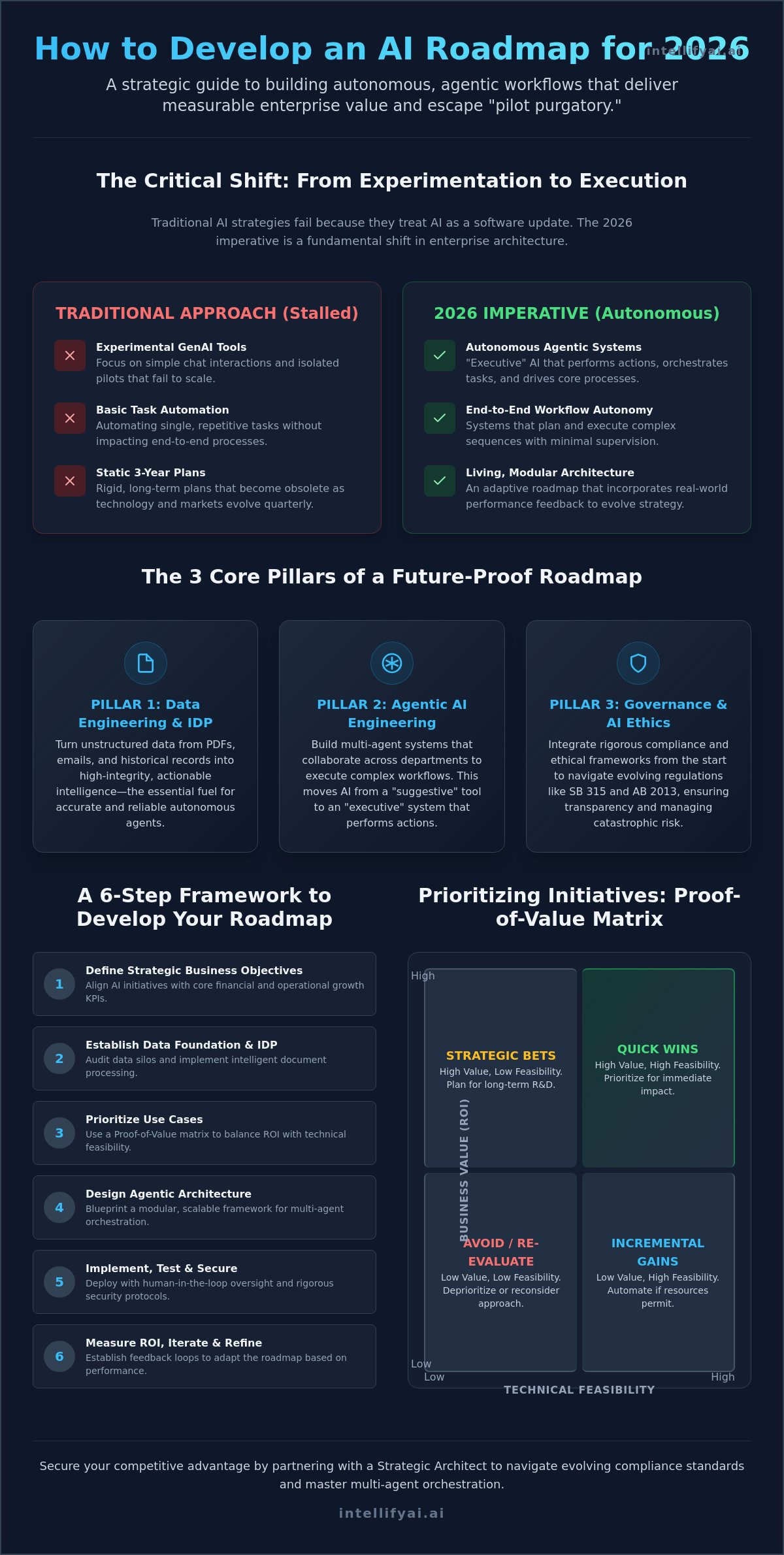
A 6-Step Framework to Develop Your AI Roadmap
A successful transition to autonomous systems requires more than just a list of desired features. It demands a rigorous, engineering-led approach that bridges the gap between high-level vision and technical reality. When you determine how to develop an ai roadmap, you must follow a structured sequence that validates your assumptions at every stage. This ensures each investment builds toward a cohesive, scalable architecture. Learning how to develop an ai roadmap for a global enterprise requires a commitment to both strategic foresight and practical execution.
The 2026 framework for enterprise transformation consists of six critical phases:
Step 1: Discovery & Assessment
– Evaluating your current AI maturity and data readiness.
Step 2: Strategy Definition
– Aligning AI goals with enterprise modernization.
Step 3: Use Case Selection & Prioritization
– Applying the ROI-Feasibility filter.
Step 4: Proof-of-Value (PoV) Development
– Testing hypotheses in a secure sandbox.
Step 5: Architectural Design & Engineering
– Scaling from PoV to production environments.
Step 6: Continuous Optimization & MLOps
– Monitoring performance and model drift.
Step 1 & 2: Discovery and Alignment
The first phase focuses on identifying strategic gaps in your current digital infrastructure. You can't build agentic workflows on top of brittle, legacy systems. By partnering with an AI strategy consultant, you can define a "North Star" that aligns your technological goals with broader enterprise modernization. This involves setting clear, non-vanity KPIs for the first 12 months, such as specific reductions in manual processing time or measurable improvements in customer resolution rates. Establishing these benchmarks early prevents the roadmap from drifting into aimless experimentation.
Once you've aligned on strategy, you must filter use cases through the ROI-Feasibility lens. This leads directly into the development of a Proof-of-Value. A PoV isn't just a technical demo; it's a controlled test of your hypothesis within a secure environment that mirrors your operational reality.
Step 4 & 5: From PoV to Enterprise Scale
Moving from a successful PoV to production is where most roadmaps fail. This transition must include a comprehensive security and compliance audit to ensure adherence to 2026 standards like the Colorado AI Act. Transitioning to cloud-native modernization is often necessary to support the high computational demands and latency requirements of agentic intelligence. Scaling AI is an engineering challenge, not just a data science one. It requires a robust foundation that can handle multi-agent orchestration without compromising system stability.
The final step is establishing Continuous Optimization through MLOps. This involves monitoring model performance and addressing model drift to ensure your autonomous agents remain accurate over time. If you're ready to begin this journey, contact our team to schedule a discovery session and map out your strategic path forward.
Executing the Roadmap: Partnering for Strategic Intelligence
Execution is the ultimate test of any strategic vision. In 2026, the complexity of multi-agent systems and evolving regulatory landscapes means you can't afford a "set and forget" strategy. Success requires a Strategic Architect who manages the delicate balance between high-level business goals and the technical nuances of custom implementation. When you master how to develop an ai roadmap, you aren't just planning for software. You're designing a resilient ecosystem where technology and human workers collaborate to drive financial returns and operational growth.
IntellifyAi bridges the gap between abstract consulting and the rigorous demands of custom engineering. By leveraging the i_Nova platform, we accelerate the critical data foundation phase. This ensures your agents operate with high-integrity intelligence from day one. This acceleration allows your enterprise to move from strategy to measurable impact faster than traditional methodologies allow. We treat every implementation as a central business pillar, focusing on the stability and security of your operations as you scale.
Building for long-term viability is a core component of our methodology. We implement robust MLOps frameworks to monitor performance and address model drift in real time. This continuous optimization ensures your autonomous workflows remain accurate as your business data evolves. It transforms your AI investment from a temporary fix into a lasting asset that maintains relevance in a high-velocity market.
IntellifyAi’s Roadmap Development Services
Our approach to how to develop an ai roadmap is comprehensive and results-oriented. We provide tailored strategic AI consulting to align your leadership team on a unified vision. Our end-to-end Agentic AI engineering then brings that vision to life through custom-built autonomous systems. We also integrate FinOps and cloud optimization strategies to ensure your AI spend remains sustainable and your infrastructure is optimized for performance.
Next Steps: Your 2026 AI Audit
The most effective way to begin is with an immediate audit of your document workflows. These high-volume, unstructured data streams often hide the most significant opportunities for rapid ROI. Identifying these "quick wins" allows you to build momentum and prove value to stakeholders early in the transformation process. It provides the empirical evidence needed to justify broader architectural investments.
We invite you to contact the IntellifyAi team to discuss a Proof-of-Value engagement. Our architects will help you assess your current maturity and define a clear path to operational autonomy. The roadmap is the engine of your digital transformation, but high-integrity data and precision engineering are the fuel that drives it forward.
Architecting Your Autonomous Future
The transition from experimental generative tools to autonomous agentic workflows is no longer a luxury; it's a requirement for enterprise relevance. By prioritizing high-integrity data extraction through the i_Nova platform and building on a foundation of scalable engineering, you move beyond the stagnation of pilot purgatory. Understanding how to develop an ai roadmap is the first step toward reclaiming your team's creative potential while driving measurable financial returns.
Success in 2026 requires a partner who understands the global nuances of AI governance and technical orchestration. With delivery capabilities across the UK, USA, and India, IntellifyAi specializes in the custom engineering required to turn high-level strategy into operational reality. Don't let legacy silos or regulatory complexity stall your progress. It's time to build a living architecture that grows with your business and empowers your workforce.
Ready to define your path forward? Schedule a strategic AI roadmap consultation with IntellifyAi today and start your transformation. The future of enterprise intelligence is waiting.
Frequently Asked Questions
What is an AI roadmap and why does my business need one in 2026?
An AI roadmap is a strategic blueprint that aligns technological investments with core business objectives and operational growth. In 2026, your business needs one to navigate the shift from passive tools to autonomous agents while ensuring compliance with state-level regulations like the Colorado AI Act. Without a clear plan, enterprises risk fragmented implementation and wasted expenditure on tools that don't scale.
How long does it take to develop a comprehensive enterprise AI roadmap?
Developing a comprehensive strategy typically takes four to eight weeks, though execution is an ongoing engineering process. The discovery and assessment phase requires deep dives into your current data maturity and infrastructure. Leaders learning how to develop an ai roadmap should expect the first Proof-of-Value to be operational within ninety days of the strategy's finalization.
What is the difference between a GenAI roadmap and an Agentic AI roadmap?
A GenAI roadmap focuses on content generation and passive assistance, whereas an Agentic AI roadmap prioritizes systems that plan and execute complex workflows autonomously. Agentic systems move beyond answering questions to performing actions, such as resolving customer disputes or updating back-office records. This shift requires a more robust focus on multi-agent orchestration and architectural stability.
How do I calculate the ROI of an AI roadmap initiative?
ROI is calculated by measuring specific business outcomes such as reduced operational latency, error rate decreases in document processing, and the reallocation of human talent to high-value creative work. You must also consider the Cost of Inaction (COI). Every month spent in manual processing is a month of lost market share to competitors who have already achieved operational autonomy.
What are the biggest risks in AI roadmap development?
The primary risks include "pilot purgatory," where initiatives fail to scale, and non-compliance with evolving laws like Illinois SB 315. Data silos also pose a significant threat by preventing model accuracy. A successful roadmap mitigates these risks by establishing a high-integrity data foundation and clear governance checkpoints from the outset.
Should we build our AI infrastructure in-house or partner with a consultant?
Partnering with a Strategic Architect is often the most efficient path for serious enterprises looking to modernize. While in-house teams understand internal processes, external consultants provide the deep technical expertise and global perspective required for Agentic AI engineering. This collaboration ensures your roadmap remains ahead of the curve while maintaining the security and stability of your operations.
How often should an AI roadmap be updated?
Your strategy should be treated as a living architecture rather than a static document. We recommend a quarterly review cycle to adjust for rapid changes in model capabilities and pricing, such as the aggressive token pricing shifts seen in July 2026. This dynamic approach ensures that you don't become locked into obsolete technologies or inefficient cost structures.
What role does Intelligent Document Processing (IDP) play in a roadmap?
IDP is the essential extraction engine for the "Data Foundation" phase of your strategy. Platforms like i_Nova transform unstructured documents into actionable intelligence, which is the fuel for agentic models. When determining how to develop an ai roadmap, prioritizing IDP allows you to unlock high-value data from contracts and invoices, ensuring your autonomous systems operate on verified facts.









.svg)