
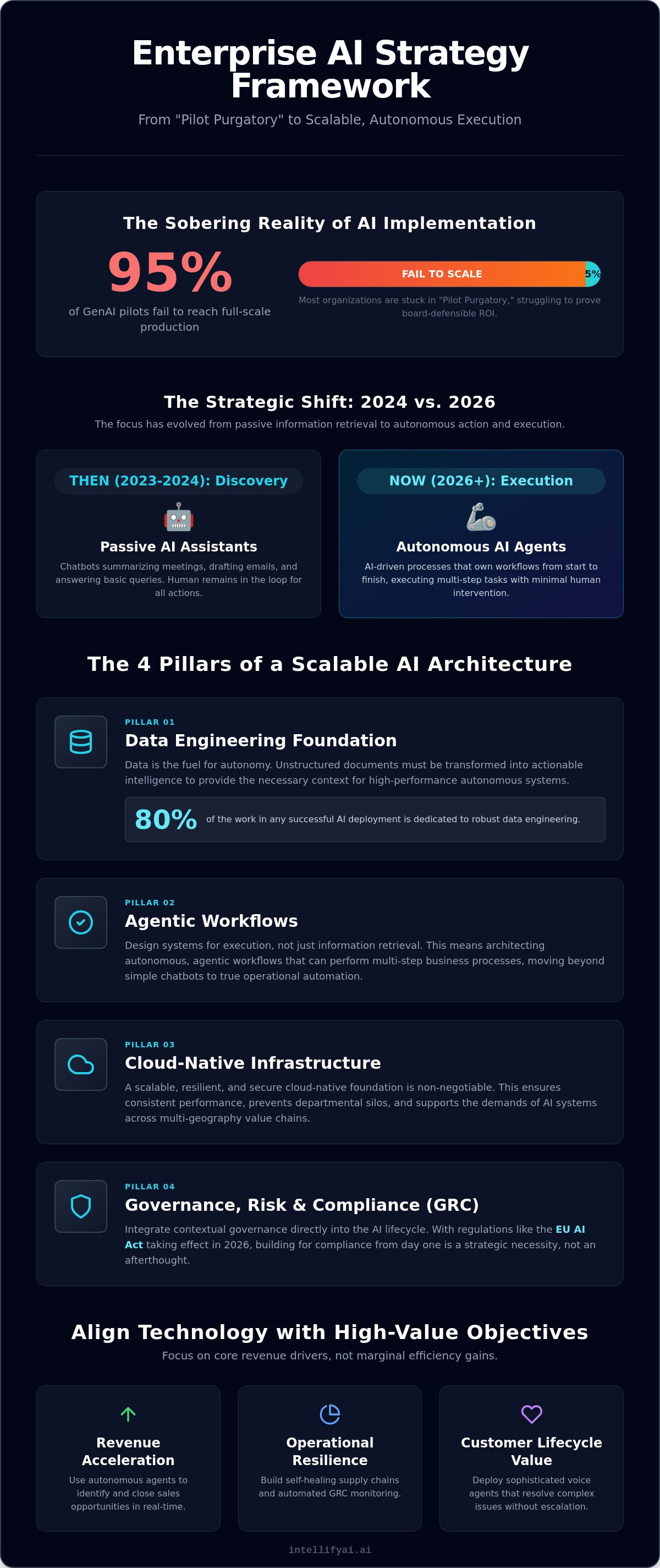
Recent data reveals a sobering reality for the C-suite: 95% of generative AI pilots fail to reach full-scale production. While the initial hype surrounding large language models felt like a gold rush, most organizations remain stuck in "Pilot Purgatory," struggling to prove a board-defensible ROI. You’ve likely realized that simply layering a chatbot over existing processes doesn’t drive transformation. To move beyond isolated experiments, you need a robust enterprise ai strategy framework that prioritizes system-first orchestration over model selection.
The landscape has shifted. With the EU AI Act transparency obligations taking effect in August 2026 and global AI spending projected to exceed $2.5 trillion, the mandate is clear: evolve or stagnate. This guide provides the architectural blueprint you need to transition from passive tools to autonomous, agentic workflows. We’ll examine how to build a repeatable framework for deploying Agentic AI, establish governance structures that satisfy 2026 compliance standards, and turn unstructured data into a measurable competitive advantage. It’s time to stop testing and start executing.
Key Takeaways
• Transition from passive generative tools to autonomous agentic execution to drive measurable operational efficiency.
• Architect a scalable enterprise ai strategy framework built on four foundational pillars: data engineering, agentic workflows, cloud-native infrastructure, and GRC.
• Prioritize execution-first methodologies and Proof-of-Value cycles over traditional, high-friction waterfall planning.
• Integrate contextual governance directly into your AI lifecycle to maintain compliance with evolving global regulations.
• Transform unstructured documents into actionable intelligence to provide the necessary context for autonomous system performance.
Beyond the Pilot: Why Your 2026 Enterprise AI Strategy Framework Must Be Agentic-First
In 2026, the era of technological novelty has concluded. The enterprise ai strategy framework for this decade isn't a collection of disparate tools; it's a holistic blueprint for autonomous intelligence. While 78% of enterprises have embedded AI into their operations, a mere 10% report seeing full-scale ROI. This gap exists because many organizations are trapped in "Pilot Purgatory," where isolated experiments fail to scale into meaningful business outcomes. These companies are finding that Industrial AI applications require more than just a chat interface to deliver value. They require a system designed for execution.
To better understand the shift toward a results-oriented architecture, watch this analysis on building a winning strategy for the current year:
The Evolution of AI Intent: From Information to Action
The years 2023 and 2024 were defined by discovery. We asked chatbots to summarize meetings, draft emails, and answer basic queries. By 2026, the focus has shifted entirely to autonomous execution. We're no longer satisfied with "AI-powered" features that act as passive assistants. We require "AI-driven" processes that own the workflow from start to finish. This transition marks the death of the chatbot as the primary enterprise interface. Agentic AI is the next frontier of enterprise modernization, moving from systems that suggest answers to autonomous systems capable of executing multi-step business processes with minimal human intervention.
Identifying High-Value Strategic Objectives
A successful enterprise ai strategy framework demands that you align technology with core revenue drivers. Marginal efficiency gains in back-office administration won't move the needle for a global enterprise. You need the perspective of a Strategic Architect to bridge the technical divide between IT departments and the C-suite. This role ensures that business logic remains the master of every technological implementation. If a system doesn't directly support your financial growth, operational performance, or customer experience metrics, it's a distraction. Organizations that succeed in 2026 do so by focusing on three specific pillars:
Revenue Acceleration
Using autonomous agents to identify and close sales opportunities in real-time.
Operational Resilience
Building self-healing supply chains and automated GRC monitoring.
Customer Lifecycle Value
Deploying sophisticated voice agents that resolve complex issues without escalation.
Stop chasing the hype of isolated use cases. Start architecting a system that prioritizes long-term viability and measurable performance. The transition from generative experimentation to agentic execution is not just a technical upgrade; it's a strategic necessity for remaining relevant in a high-velocity market.
The Four Pillars of a Scalable Enterprise AI Architecture
Scaling intelligence across a global organization requires more than just a collection of licensed models. It demands a structural shift. A unified enterprise ai strategy framework prevents the formation of departmental silos and ensures consistent performance across multi-geography value chains. To achieve this, your architecture must rest on four specific pillars: Data Engineering, Agentic Workflows, Cloud-Native Infrastructure, and GRC. For organizations ready to move beyond the experimental phase, our Agentic AI Engineering Services provide the technical blueprint necessary for this transition.
Pillar 1: The Data Engineering Foundation
Data is the fuel for autonomy. Industry consensus suggests that data engineering accounts for 80% of the work in any successful AI deployment. Gartner predicts that 60% of AI projects through 2026 will be abandoned if they aren't supported by AI-ready data. You must prioritize modernizing legacy data lakes into "Agent-Ready" knowledge bases that provide the context autonomous systems require. Intelligent Document Processing (IDP) is a critical component of this foundation. Our i_Nova platform serves as a prime example of this pillar in action, converting unstructured documents into actionable intelligence that agents can use to make informed decisions.
Pillar 2: Agentic Workflows and System Autonomy
Traditional Robotic Process Automation (RPA) is no longer sufficient for the modern enterprise. While RPA follows rigid scripts for repetitive tasks, Agentic AI engineering creates systems that reason, learn, and adhere to complex business logic autonomously. These agents move beyond simple automation to cognitive execution. They can manage entire workflows in the back office, resolve complex inquiries in contact centers, and optimize logistics in supply chains without constant human oversight. By designing agents that act as collaborative partners, you liberate your workforce to focus on high-value creative work while the enterprise ai strategy framework handles the operational burden.
This architectural approach ensures that your AI initiatives are built for long-term viability rather than temporary fixes. If you're looking to align your technical capabilities with your financial goals, consider how a strategic AI consultation can refine your roadmap. By integrating Cloud-Native Infrastructure and robust GRC standards, including the NIST AI Risk Management Framework, you create a resilient environment where autonomous intelligence can thrive at scale.
Execution-First vs. Waterfall Planning: A Comparative Framework
Traditional IT planning relies on stability. In the context of 2026, stability is a liability. The classic "Waterfall" approach assumes that business requirements remain static for years; this is no longer true. A modern enterprise ai strategy framework must prioritize an "Execution-First" methodology. This shift moves the focus from long-term theoretical roadmaps to rapid "Proof-of-Value" (PoV) engagements. While Waterfall planning seeks to mitigate risk through exhaustive documentation, Execution-First mitigates risk through real-world validation.
Many leaders hesitate, claiming their data isn't "clean" enough to begin. This is a strategic error. Waiting for perfect data ensures you'll never start. Instead, utilize agentic systems to identify and rectify data inconsistencies during the execution phase. This proactive approach turns data preparation into a continuous, automated process rather than a multi-year hurdle. By designing for the future of enterprise AI architecture, you build systems that improve themselves as they operate.
The Death of the Multi-Year Roadmap
A 24-month plan is obsolete before it's signed. The pace of AI evolution in 2026 demands a "Perpetual Iteration" mindset. Stop thinking in years. Start thinking in 90-day execution cycles. These high-velocity sprints allow you to demonstrate measurable impact and adjust to technological breakthroughs in real-time. Each cycle should deliver a production-ready component that integrates into your broader strategic framework. This ensures that your investment remains relevant and defensible to the board.
Building an Execution-Ready Organization
Transitioning from an experimental mindset to an operational one is the final bridge to ROI. This requires a cultural shift where AI is treated as a core business pillar, not a side project. To support this, robust engineering is non-negotiable. Implementing MLOps Pipelines is essential for continuous performance monitoring and model governance. These pipelines ensure that your agents remain aligned with business logic as they learn and scale. By automating the lifecycle of your AI systems, you create a frictionless path from deployment to long-term scalability.
Operationalizing GRC: Governance, Risk, and Compliance in the AI Era
Governance in 2026 isn't a checklist; it's an architectural requirement. As federal agencies establish frameworks under Executive Order 14409, your enterprise ai strategy framework must move beyond static policies. We call this "AI Contextual Governance." Traditional GRC models were built for human-led processes or rigid software scripts. Autonomous agents, however, operate in high-velocity environments where a one-size-fits-all rulebook creates a "Governance Paradox." If you restrict an agent too tightly, you lose the operational speed that justifies the investment. If you leave it unchecked, you risk compliance violations under the EU AI Act’s August 2026 enforcement deadlines.
Integrating SOC2, GDPR, and SOX compliance directly into the AI lifecycle is the only way to maintain board-defensible operations. This requires immutable audit trails and version control for every automated decision. You must be able to reconstruct an agent’s reasoning at any point in time to satisfy regulatory inquiries. By embedding these guardrails into the system-first orchestration layer, you ensure that autonomy doesn't come at the expense of security or ethical alignment. Build a secure foundation for your autonomous systems by engaging our AI Strategy & Consulting team today.
The Human-in-the-Loop (HITL) Advantage
We frame advanced technology as a means to unlock human potential, not replace it. The most effective 2026 strategies utilize "Exception Centers" where autonomous agents hand off complex or high-stakes cases to human experts. This collaborative relationship ensures that while agents handle the burden of repetitive execution, human workers remain the final authority on nuanced business logic. This approach maintains accountability in autonomous workflows and ensures that your digital transformation remains grounded in human-centric values.
Risk Mitigation and Hallucination Management
Hallucinations remain a threat to enterprise stability if left unmanaged. To solve this, we utilize Neurosymbolic AI to ground large language models in business-specific rules and symbolic logic. This hybrid approach ensures that agents operate within the factual boundaries of your organization’s data. Additionally, a robust enterprise ai strategy framework must incorporate FinOps to manage the hidden costs of cloud-native AI. Proactive monitoring for model drift and data integrity is non-negotiable. Without continuous oversight, the very systems designed to drive efficiency can become sources of financial and operational risk. You need a partner who views GRC not as a barrier, but as a central pillar of long-term viability.
Scaling Intelligence: Implementing Your Framework with IntellifyAi
Implementing a high-velocity enterprise ai strategy framework requires more than just a theoretical blueprint. It requires a partner who acts as a Strategic Architect, bridging the gap between abstract technical fields and your bottom line. At IntellifyAi, we provide an end-to-end execution model that moves your organization from initial strategy to custom Agentic AI engineering. We don't just suggest solutions; we build the autonomous workflows that redefine your operational performance and financial returns.
A central component of this execution is our i_Nova platform. As established in the data foundation pillar, unstructured data is often the greatest bottleneck to enterprise intelligence. i_Nova solves this by converting complex, unstructured documents into the actionable intelligence your agents need to function. This isn't off-the-shelf retail software. It's a sophisticated tool for serious enterprises looking to modernize their document processing at scale while maintaining deep technical integrity.
Strategic AI Consulting and Roadmap Development
Navigating the Agentic Frontier requires a deliberate focus on high-impact revenue drivers rather than marginal gains. Our Strategic AI Consulting team works with your leadership to develop a custom roadmap that prioritizes performance over hype. We systematically break down your business challenges into digestible technological segments, ensuring every initiative remains grounded in your financial goals. We recommend initiating a Proof-of-Value (PoV) engagement to validate your strategy and demonstrate measurable impact before moving to full-scale production.
Continuous Optimization and Managed Services
Transformation is a lasting investment in relevance, not a temporary fix. To maintain your competitive edge in a rapidly shifting market, we provide ongoing maintenance for your MLOps pipelines and cloud-native infrastructure. This includes proactive cloud cost optimization and continuous performance monitoring to prevent model drift. Our managed services ensure that your enterprise ai strategy framework remains efficient, secure, and aligned with the latest global regulatory standards.
Your journey toward autonomous execution starts with a single realization: technology should be a liberating force, not a daunting complexity. Let us remove the burden of repetitive tasks and unlock your team’s creative potential through professional, results-oriented implementation. Contact us today to start your transformation and architect a future that is simultaneously innovative and dependable.
Architecting Your Autonomous Future
The transition from generative experimentation to agentic execution is the defining challenge of 2026. Success requires more than just deploying models; it demands a unified enterprise ai strategy framework that integrates data engineering with autonomous workflows and contextual governance. You've seen how moving from passive tools to active systems can unlock human potential and drive measurable ROI. By prioritizing execution-first cycles over theoretical roadmaps, you ensure your organization remains resilient in a high-velocity market.
IntellifyAi stands ready to be your Strategic Architect in this journey. With our global expertise in Agentic AI engineering and our proprietary i_Nova IDP platform, we bridge the gap between complex technology and your financial goals. We have a proven track record in enterprise modernization, helping serious organizations build stable, secure, and high-performing autonomous systems. It's time to stop testing and start executing.
Design your autonomous future with IntellifyAi's strategic consulting.
The path to digital transformation is no longer a daunting complexity but a liberating force for your business.
Frequently Asked Questions
What is an enterprise AI strategy framework?
An enterprise ai strategy framework is a holistic blueprint for integrating autonomous intelligence into core business processes. It moves beyond simple tool selection to address data engineering, architecture, governance, and talent development. This framework ensures that AI initiatives are scalable and aligned with specific financial returns. It acts as a strategic roadmap for transitioning from isolated experiments to a system-wide execution model that drives long-term viability.
How do I avoid 'Pilot Purgatory' in my AI projects?
Avoid "Pilot Purgatory" by shifting from a model-first to a system-first orchestration approach. Most failures occur because pilots lack a clear path to production or fail to address underlying data silos. You must prioritize "Proof-of-Value" engagements that validate business logic early in the cycle. Establishing MLOps pipelines and clear GRC standards from the outset prevents projects from stalling. This ensures your initiatives scale effectively across the entire organization.
What is the difference between AI-powered and AI-driven systems?
AI-powered systems use technology as a passive assistant to enhance specific features within existing software. AI-driven systems treat intelligence as the primary engine for autonomous execution. In an AI-driven model, the system owns the workflow from start to finish, requiring minimal human intervention to achieve goals. This shift is central to a modern enterprise ai strategy framework, moving businesses from simple information retrieval to complex, self-executing processes.
How does Agentic AI differ from traditional RPA?
Traditional RPA follows rigid, pre-defined scripts to automate repetitive, rule-based tasks. Agentic AI uses cognitive reasoning to make decisions and adapt to new information autonomously. While RPA is fragile and breaks when variables change, agents learn and adhere to business logic in real-time. This allows for the automation of complex back-office and contact center operations that were previously too nuanced for standard software scripts to handle effectively.
What role does data engineering play in an AI strategy?
Data engineering provides the "agent-ready" knowledge base necessary for autonomous system performance. It typically accounts for 80% of the work in any successful implementation. Without structured, high-quality data pipelines, agents cannot reason effectively or maintain accuracy. Leveraging tools like the i_Nova platform for Intelligent Document Processing ensures that unstructured data becomes a measurable asset rather than a liability in your digital transformation journey.
How can I ensure AI compliance with GDPR and SOC2?
Ensure compliance by integrating contextual governance directly into the AI lifecycle through immutable audit trails and version control. You must be able to reconstruct an agent's decision-making process at any time to satisfy regulatory inquiries. Implementing standards like the NIST AI Risk Management Framework provides a solid foundation for security. By automating compliance monitoring, you balance the need for agentic speed with the strict requirements of global data protection laws.
What are the key AI trends for 2026?
The primary trends include the rise of Agentic AI, the democratization of development through low-code platforms, and a heightened focus on AI GRC. Organizations are moving away from "Model-First" thinking toward "System-First" orchestration. We are also seeing a significant shift toward Neurosymbolic AI to ground large language models in symbolic logic. These trends reflect a broader move toward practical, production-ready execution rather than speculative generative hype.
How do I calculate the ROI of an enterprise AI implementation?
Focus on three specific pillars to calculate ROI: revenue acceleration, operational efficiency, and customer lifetime value. Move beyond "soft" metrics to board-defensible financial returns. Calculate the reduction in manual processing hours, the increase in lead conversion rates, and the cost savings from automated GRC monitoring. A successful framework treats AI as a central business pillar with clear, measurable impacts on the organization's bottom line.









.svg)