
The pressure to scale AI innovation is immense, yet the risk of deploying unreliable autonomous agents often paralyzes progress. This "Velocity Paradox" creates a significant barrier to growth, compounded by the daily challenge of managing unpredictable AI behavior and the fragmented data silos that prevent true operational autonomy. While many organizations remain stalled, the most forward-thinking enterprises are already moving beyond experimentation. They are building a strategic foundation for the most impactful agentic ai use cases 2026 will demand, preparing for a future where intelligent automation is a core business pillar.
This article delivers the strategic roadmap required to lead this transformation. We move beyond abstract theory to provide a clear management framework for governing your emerging silicon workforce, ensuring both performance and reliability. You will discover specific, high-ROI applications poised to redefine operational excellence across industries and gain the clarity needed to bridge the gap between AI strategy and engineering execution. Prepare to deploy and manage autonomous agents not as a technological novelty, but as a seamless, integrated, and highly productive component of your enterprise.
Key Takeaways
- Grasp the strategic shift from generative AI (content creation) to agentic AI (workflow execution) to redefine your enterprise automation roadmap.
- Discover how Intelligent Document Processing (IDP) serves as the essential sensory system for AI agents, enabling them to perceive and act on complex enterprise data.
- Identify high-ROI agentic ai use cases 2026 in finance, healthcare, and supply chain that automate end-to-end processes, not just isolated tasks.
- Learn the management frameworks for governance and orchestration required to deploy your autonomous "silicon workforce" safely and at enterprise scale.
The Shift from Generative to Agentic: Defining the 2026 Enterprise Landscape
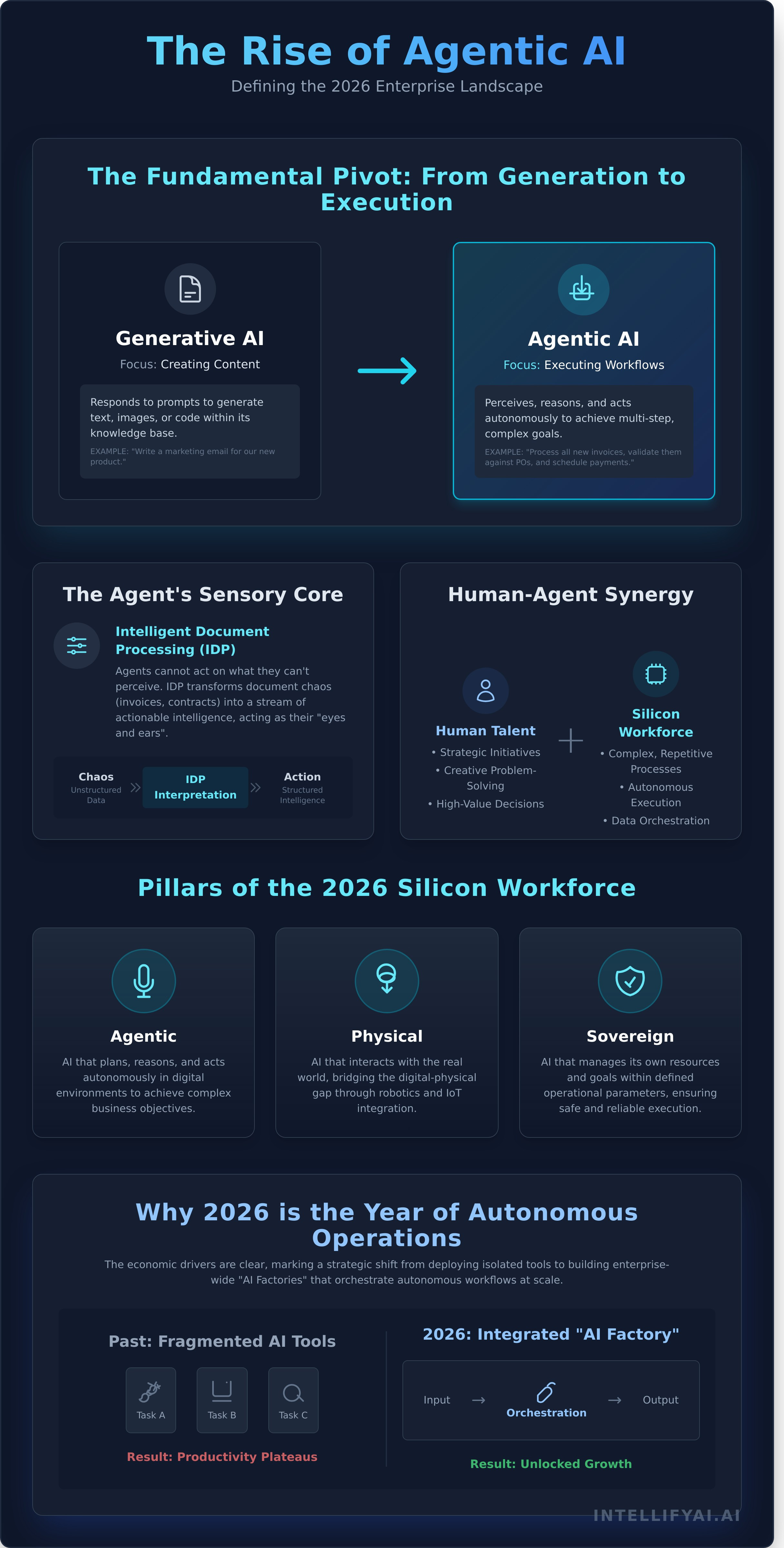
The enterprise AI narrative is undergoing a fundamental pivot. Where Generative AI focused on creating content, Agentic AI focuses on executing workflows. The landscape of agentic ai use cases 2026 is not about better content; it's about autonomous execution. We are moving beyond prompts that generate text to instructions that trigger action. An agentic system perceives its digital environment, reasons through multi-step plans, and acts to achieve complex goals with minimal human oversight.
To visualize this leap from generation to action, consider the following overview of agentic capabilities.
The year 2026 represents a crucial level-set for the enterprise. The era of experimental hype is giving way to architectural maturity, where the focus shifts from isolated tools to integrated, autonomous systems. The core of this new operational model is Human-Agent Synergy—a framework where intelligent automation handles complex, repetitive processes, liberating human talent for high-value strategic initiatives and creative problem-solving.
The Evolution of the Silicon Workforce
The traditional silicon workforce of static bots is obsolete. We are now deploying dynamic, reasoning intelligent agents capable of navigating ambiguity. This capability, known as agentic reasoning, allows systems to decompose a high-level business objective into a sequence of executable tasks. This evolution is built on three core pillars of 2026 AI:
- Agentic: AI that plans, reasons, and acts autonomously in digital environments.
- Physical: AI that interacts with the real world via robotics and IoT integration.
- Sovereign: AI that manages its own resources and goals within defined parameters.
Why 2026 is the Year of Autonomous Operations
The economic drivers are clear. Faced with productivity plateaus, enterprises are turning to agentic efficiency to unlock new growth. This marks a fundamental shift from deploying individual AI tools to building enterprise-wide "AI Factories" that orchestrate autonomous workflows at scale. The most impactful agentic AI use cases will not be about replacing humans, but about augmenting them. This is intelligent automation as a liberating force, transforming operational excellence and creating the headspace for human creativity to thrive.
Intelligent Document Orchestration: The Sensory Core of Agentic AI
Autonomous agents cannot act on what they cannot perceive. The primary barrier to enterprise autonomy is not a lack of processing power, but a deluge of unstructured data locked within documents—invoices, contracts, and reports. For an autonomous agent to perform complex business functions, a concept expertly detailed in MIT Sloan's overview of Agentic AI, explained, it must first interpret its digital environment. Intelligent Document Processing (IDP) provides these essential "eyes and ears," transforming document chaos into a stream of actionable intelligence.
This is where our i_Nova platform operates. It moves beyond simple data extraction to deliver true operational awareness. The goal is not just to digitize text, but to equip your autonomous agents with the contextual understanding needed to make decisions, trigger workflows, and execute tasks with precision.
From Extraction to Execution: The i_Nova Advantage
Legacy OCR tools merely scrape data; i_Nova interprets it. Leveraging its own agentic logic, the platform deconstructs complex formats—from multi-page legal agreements to non-standardized shipping manifests. Our integrated "Server Intelligence Agents" act as specialized cognitive units, managing document classification, validation, and routing autonomously. This shift from basic text recognition to deep contextual understanding is fundamental to the advanced agentic ai use cases 2026 will demand, making data a catalyst for action, not just a record of it.
Building the Data Foundation for Autonomy
True autonomy requires a modern data architecture. Our approach begins with strategic data engineering to consolidate and modernize legacy document silos, eliminating the friction that stalls automation. A cloud-native infrastructure is a non-negotiable prerequisite for agentic scaling, providing the elasticity and connectivity required for high-velocity operations. Ultimately, i_Nova provides the critical translation layer, converting raw, unstructured document data into the structured, context-rich fuel that autonomous agents require to execute complex tasks.
Top Industry-Specific Agentic AI Use Cases for 2026
By 2026, enterprise strategy will shift from automating isolated tasks to deploying end-to-end autonomous workflows. The most impactful agentic ai use cases 2026 will solve the "Velocity Paradox"—the challenge of accelerating complex operations without sacrificing precision, safety, or compliance. This transition to intelligent automation unlocks transformative ROI in key sectors by empowering autonomous agents to manage entire value chains. Below, we outline high-impact applications in BFSI, Supply Chain, and Customer Experience.
BFSI: Autonomous Claims and Compliance Agents
In Banking, Financial Services, and Insurance, autonomous agents will execute the entire claims lifecycle. This seamless workflow—from intelligent document intake and fraud detection to policy verification and final settlement—will reduce processing times from days to mere minutes. These agents are engineered to navigate the complex 2026 regulatory landscape of GDPR and SOX, ensuring auditable compliance at machine speed. As government bodies explore the opportunities and challenges of this technology, highlighted in the GAO Science & Tech Spotlight on AI Agents, building in compliance from the ground up is critical. We project a 35-40% reduction in claims processing costs for early adopters.
The efficiency of these AI agents in finance is directly tied to the quality of the data they process, especially when it involves credit histories and financial assessments. As automation handles the workflow, the importance of professional guidance on credit management itself remains a critical component of the broader financial ecosystem. For those interested in this specialized field, you can learn more about Allen & Allen, Inc., a firm dedicated to credit consulting and education.
Supply Chain: Self-Healing Logistics Workflows
Logistics will achieve a new level of operational resilience through self-healing workflows. Agentic AI will not just report disruptions; it will predict them using real-time IoT data and autonomously reroute shipments to optimize for cost and delivery time. This deep integration of digital agents with physical AI systems creates a truly intelligent, self-correcting supply chain. By 2026, enterprises can expect a 20-25% reduction in disruption-related costs and a significant improvement in on-time delivery rates, future-proofing their operations against volatility.
The success of such automated systems hinges on the integrity of data from physical IoT devices. For example, if industrial scales aren't properly calibrated, the entire workflow can be compromised. For a look into the specialized services that ensure this foundational accuracy, you can check out Independent Scale Service.
Customer Experience: Hyper-Personalized Voice Agents
The traditional "call centre" is rapidly evolving into the "agent-led contact centre." By 2026, hyper-personalized voice agents will manage complex customer journeys, understanding nuanced sentiment, accessing full contextual history, and resolving multifaceted issues without requiring a human handoff. This represents a quantum leap beyond simple chatbots. IntellifyAi’s CX Improvement Framework leverages these advanced voice agents to deliver empathetic and efficient service at scale, boosting first-call resolution by over 30% and dramatically improving customer lifetime value.
Overcoming the Implementation Gap: Managing the Silicon Workforce
The primary objection to deploying autonomous agents at scale is risk. This is a valid concern, but a solvable engineering challenge that the advanced agentic ai use cases 2026 will demand. Unmanaged AI is a liability; a well-managed "silicon workforce" is a transformative asset. The key is a robust management layer that provides complete operational oversight. This framework consists of three core pillars:
- Orchestration: Directing agent workflows, ensuring tasks are executed in the correct sequence and with the right resources for maximum efficiency.
- Governance: Establishing clear rules, permissions, and ethical boundaries that agents must operate within, hardcoded into their operational logic.
- MLOps: Implementing rigorous processes for monitoring, updating, and versioning agents to ensure consistent, predictable, and auditable performance.
For high-stakes decisions, this framework mandates a Human-in-the-Loop (HITL) checkpoint, ensuring strategic oversight is never compromised. This creates true Human-AI Synergy. Effective guardrails are not constraints; they are enablers of confident, high-velocity execution, allowing agents to operate autonomously within safe, predefined parameters.
Agentic Governance and Risk Management
True enterprise autonomy requires "AI Contextual Governance"—the ability to see and understand what every agent is doing in real time. We leverage disciplined MLOps and strict version control to prevent model "drift" and eliminate unpredictable behavior. This technical rigor is essential for building agentic architectures that are not only powerful but also compliant with critical standards like SOC2 and GDPR from day one.
The Role of the Strategic AI Consultant
The most impactful agentic ai use cases 2026 will not come from an off-the-shelf box. They must be custom-engineered to your specific operational DNA. A Strategic Architect approach is required to build a scalable, future-proof roadmap. At Intellify AI, we partner with enterprises through focused "Proof-of-Value" (PoV) engagements to demonstrate tangible ROI before full-scale deployment, de-risking your investment in intelligent automation. Explore our PoV process to build your strategic advantage.
Future-Proofing Your Enterprise with IntellifyAi
Understanding the strategic potential of agentic AI is the first step. Translating that potential into operational excellence is the critical next one. IntellifyAi serves as the essential bridge between high-level strategy and bespoke AI engineering, transforming your vision for autonomy into a tangible, high-performance reality. Our proprietary i_Nova platform provides the robust, scalable foundation for your agentic ecosystem, orchestrating autonomous agents to execute complex workflows with precision.
We build intelligent systems grounded in a core philosophy of Human-AI Synergy. Our commitment is not to replace your expert teams, but to augment their capabilities, liberating them from repetitive tasks to focus on strategic growth, innovation, and high-value decision-making. This ethical approach to automation ensures technology serves your people and your bottom line.
Bespoke Integration and Scalability
With strategic hubs in the UK, US, India, and the UAE, our global presence is matched by localized expertise. We deliver an end-to-end service model—from initial roadmap design to development and ongoing managed services. Every solution we build is guided by an ROI-first engineering philosophy, ensuring that your investment in intelligent automation delivers measurable, impactful returns and prepares you for the most advanced agentic ai use cases 2026.
Next Steps: Launching Your Agentic Pilot
Moving from observation to strategic realization is the defining action of an industry leader. A targeted Proof of Value (PoV) engagement is the most direct path to validate the impact of agentic AI within your unique operational environment. Our process is designed for clarity and velocity:
- Strategic Discovery: We collaborate with your stakeholders to identify and prioritize high-impact workflows primed for intelligent automation.
- Custom PoV Design: Our architects design a bespoke agentic solution tailored to solve a specific, measurable business challenge.
- Agile Deployment & Analysis: We rapidly deploy the pilot, meticulously tracking performance against your core KPIs to build a data-driven business case for expansion.
This structured approach de-risks innovation and provides a clear path to scalable enterprise autonomy. The future is not a distant concept; it is an engineering decision. Ready to build yours?
Modernize your enterprise with IntellifyAi’s Agentic Services.
Architecting Your Autonomous Future
The transition from generative AI to autonomous agents is the definitive enterprise evolution of the next decade. Realizing this potential hinges on two core principles: mastering intelligent data orchestration to create a sensory network for your agents, and adopting a strategic framework to manage and scale this new silicon workforce. This strategic approach is what transforms theoretical agentic ai use cases 2026 into tangible operational value and a sustainable competitive advantage.
At IntellifyAI, we specialize in this transformation. Powered by our flagship i_Nova IDP platform and supported by a global engineering presence in the UK, USA, India, and UAE, we don't just discuss the future—we build it. Our specialized focus on high-value enterprise voice agents and modernization ensures your roadmap is both ambitious and achievable.
The path to enterprise autonomy is clear. It is time to move from planning to execution. Contact our Strategic Architects to build your 2026 Agentic Roadmap and begin architecting an intelligent, future-proof enterprise today.
Frequently Asked Questions
What is the difference between an AI agent and a standard chatbot in 2026?
By 2026, the distinction is one of action versus interaction. A standard chatbot is reactive, operating within a conversational script to answer queries. An autonomous AI agent is proactive and goal-oriented. It can independently plan and execute multi-step tasks across various applications—such as analyzing sales data, drafting a report, and emailing it to stakeholders—without continuous human input. It moves beyond conversation to true workflow orchestration.
How do agentic AI use cases differ for small vs. large enterprises?
Effective agentic AI use cases 2026 will differ based on operational scale and strategic goals. Small enterprises will leverage agents for tactical efficiency, automating tasks like customer support triage, lead qualification, and content scheduling to maximize resource impact. Large enterprises will deploy them for strategic transformation, orchestrating complex, end-to-end processes like supply chain optimization, autonomous financial auditing, and dynamic resource allocation across global business units.
Is agentic AI secure enough for highly regulated industries like banking?
Yes, when implemented within a zero-trust architectural framework. Security is paramount. Our approach ensures agentic AI operates with encrypted data, role-based access controls, and immutable audit logs for every action. For critical functions, we engineer human-in-the-loop approval gates, requiring explicit human verification before an agent can execute a high-stakes transaction. This provides a secure, compliant, and fully auditable path to intelligent automation.
What is the expected ROI for implementing autonomous agentic workflows?
The return on investment extends beyond simple cost reduction. While direct labor savings are significant, the primary value drivers are increased operational velocity and enhanced decision-making accuracy. Clients typically see a 30-40% reduction in process cycle times and a measurable decrease in error rates. This frees high-value human talent to focus on strategic growth initiatives, compounding the financial impact and creating a sustainable competitive advantage.
How does the i_Nova platform support agentic AI initiatives?
The i_Nova platform is the central nervous system for your enterprise autonomy. It provides a unified, low-code environment to build, deploy, and manage autonomous agents at scale. Featuring a library of pre-built connectors to systems like SAP and Salesforce, advanced monitoring dashboards, and built-in governance protocols, i_Nova accelerates your path to intelligent automation. It transforms abstract AI potential into a tangible, controllable operational asset.
What is the "Velocity Paradox" in AI adoption, and how can we solve it?
The Velocity Paradox occurs when the rapid pace of AI advancement causes organizational paralysis, as leaders delay action waiting for a future "perfect" solution. This inaction creates a widening competitive gap. We solve this with an agile, iterative methodology. Begin with high-impact, clearly defined use cases to build momentum and demonstrate value quickly. A modular platform allows you to scale capabilities incrementally, ensuring your adoption strategy is both ambitious and achievable.
Do I need to modernize my cloud infrastructure before using agentic AI?
A complete overhaul is not always required, but a modern, API-driven architecture is essential for success. Autonomous agents need seamless access to data and applications to function effectively. Your infrastructure must support scalable services and provide robust APIs for interaction. We begin with a strategic assessment of your current technology stack to create a phased modernization roadmap that aligns directly with your intelligent automation objectives.
How does IntellifyAi ensure human-in-the-loop safety for autonomous agents?
Our framework is built on the principle of Human-AI Synergy, where technology empowers human oversight. We embed configurable approval checkpoints for high-risk actions, requiring an agent to pause for human verification before proceeding. Every action is recorded in a detailed, auditable log. This layered approach ensures you retain full strategic control, leveraging agents for speed and efficiency while entrusting final judgment to your expert teams.









.svg)