
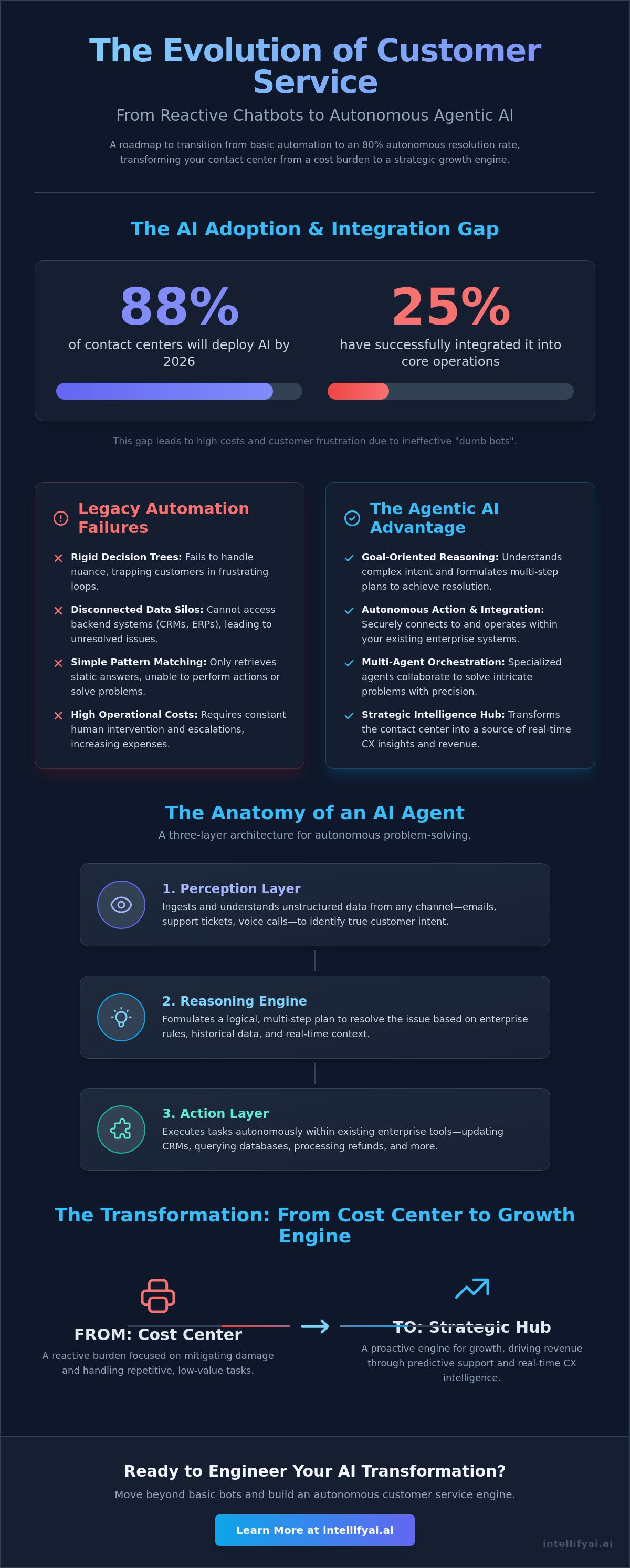
88% of contact centers have deployed some form of AI by 2026, yet only 25% have successfully integrated it into their core operations. Most enterprises remain trapped in a cycle of high operational costs and customer frustration driven by rigid, "dumb" chatbots that can't communicate with legacy backend systems. Implementing effective ai for customer service automation is no longer about installing a simple chat widget. It's about engineering autonomous systems that reason, act, and resolve complex issues without constant human intervention.
You've likely realized that traditional call center models are reaching a functional and financial breaking point. This strategy guide provides a clear roadmap to transition from basic automation to Agentic AI, targeting an 80% autonomous resolution rate while maintaining seamless human-in-the-loop handoffs. We will examine how to modernize your contact center into a high-velocity engine for growth through sophisticated voice agents, cloud-native architecture, and real-time CX insights that drive strategic decision making.
Key Takeaways
• Transition from reactive pattern matching to goal-oriented Agentic AI to move beyond the functional limitations of traditional chatbots.
• Orchestrate complex workflows using multi-agent systems that collaborate to solve intricate support tickets through autonomous reasoning.
• Shift your contact centre from a cost-heavy burden to a strategic intelligence hub that drives revenue through predictive support.
• Secure your transformation by prioritizing the data engineering and organizational readiness required for successful ai for customer service automation.
• Leverage strategic architecture and intelligent processing frameworks to ensure the long-term viability and security of your enterprise modernization.
The Evolution of Support: From Reactive Chatbots to Agentic AI
The year 2026 marks a definitive boundary in the customer service sector. Enterprises are moving away from the rigid structures of early automation toward sophisticated, autonomous systems. Traditional IVR and basic chatbots can't keep pace with modern user expectations. They fail to resolve issues, leading to the high operational costs mentioned in our strategic overview. True ai for customer service automation now requires more than just pre-programmed responses; it requires a system capable of independent execution and contextual understanding.
We are witnessing the rise of Agentic AI. Unlike previous iterations that relied on simple pattern matching, these systems utilize goal-oriented reasoning to navigate complex customer journeys. They don't just talk. They act. This shift allows businesses to remove the burden of repetitive tasks from their workforce, framing technology as a liberating force that unlocks human potential for high-value creative work. By automating the mundane, you empower your team to focus on relationship building and strategic problem solving.
To better understand how these autonomous agents function in a real-world support environment, watch this demonstration:
Why Legacy Automation Fails the Modern Customer
Legacy systems create friction through decision-tree logic that can't handle nuance. Customers feel trapped in repetitive loops that offer no resolution. While early generative AI suffered from "hallucination" risks that damaged brand trust, architected Agentic systems are grounded in enterprise data. Looking back at the evolution of chatbots, it's clear that the primary hurdle has always been disconnected data silos. When an AI can't access backend systems or understand context across channels, customer satisfaction (CSAT) inevitably drops. Modern enterprises can't afford these silos.
The Intelligent Automation Foundation
Successful implementation starts with a robust data layer. Our i_Nova platform utilizes Intelligent Document Processing (IDP) to extract actionable intelligence from unstructured communications like emails and support tickets. This capability is a cornerstone of broader enterprise modernization efforts. By leveraging cloud-native infrastructure, businesses can build scalable, high-velocity support workflows that adapt to fluctuating demand without increasing headcount. This isn't just a patch. It's a fundamental rebuild of how your company interacts with its market. This is the new standard for ai for customer service automation.
How Agentic AI Orchestrates Complex Customer Service Workflows
Orchestration is the defining characteristic of modern ai for customer service automation. An AI Agent is more than a conversational interface; it is a functional system designed to navigate complex business logic. The anatomy of these agents consists of three critical layers:
Perception
The ability to ingest unstructured data and identify specific customer intent across multiple channels.
Reasoning
The process of formulating a multi-step plan to address that intent logically based on enterprise rules.
Action
The execution of tasks within existing enterprise tools, such as ERPs, CRMs, and logistics databases.
This architecture allows for multi-agent systems where specialized agents collaborate. One agent might handle data retrieval from a shipping database while another manages the conversational tone. This modularity ensures that complex tickets are resolved with surgical precision. By integrating directly with backend systems autonomously, these agents close the loop on customer requests without human intervention.
Reasoning Over Retrieval: The Agentic Difference
Traditional automation relies on simple retrieval. A user asks a question, and the bot finds a static answer. Agentic AI shifts this paradigm toward execution. Instead of just explaining a refund policy, the agent plans and executes the refund by verifying the transaction in the billing system and updating the customer's record. This is achieved through Retrieval-Augmented Generation (RAG) coupled with semantic understanding. Every action is grounded in verified business logic, ensuring accuracy and security.
Voice Agents and the New Contact Centre
The modern contact centre relies on high-fidelity voice agents to manage high-volume spikes. These are not the robotic menus of the past. They provide natural, low-latency conversations that build immediate trust. Consider a tier-2 support issue regarding a delayed shipment. An architected agent can identify the delay, offer a discount code, and reschedule delivery in real-time. This level of autonomy transforms support into a growth engine.
High-stakes issues still require the human touch. We implement sophisticated handoff protocols that ensure a seamless transition when a situation demands emotional nuance or executive override. This collaborative relationship ensures that your human agents are only brought in for high-value interactions. If you're looking to modernize your operations, exploring our Agentic AI Engineering Services is a logical next step toward achieving enterprise-grade autonomy and superior ai for customer service automation.
Beyond Efficiency: Driving Revenue through Intelligent CX Automation
Visionary leaders don't view ai for customer service automation merely as a tool for reducing overhead. They recognize it as a high-velocity engine for growth. The transition from a cost-heavy contact centre to a strategic intelligence hub represents a fundamental shift in enterprise value. By moving beyond reactive ticket resolution, businesses can utilize automated systems to anticipate customer needs and drive measurable financial returns.
Predictive support is the next frontier. Advanced systems now identify and resolve potential issues before a customer even recognizes a problem exists. When an AI agent detects a pattern in logistics delays or software glitches, it can proactively reach out with a resolution or a compensatory offer. This level of proactivity, combined with hyper-personalization based on historical data, transforms support into a sales-enablement channel. Targeted upselling and cross-selling opportunities arise naturally from a place of helpfulness, directly increasing Customer Lifetime Value (CLV) and brand loyalty.
The Strategic Impact of CX Insights
Every automated interaction generates a wealth of structured data. Sentiment analysis now allows enterprises to monitor the emotional pulse of their market in real-time. These insights inform product development and marketing strategy by pinpointing systemic friction points that human reporting might miss. We specialize in bridging the gap between Generative AI and actionable business intelligence. Instead of wading through thousands of transcripts, executives receive synthesized strategic summaries that drive rapid decision-making across the entire organization.
Liberating Human Potential in the Contact Centre
Advanced technology acts as a liberating force rather than a replacement. By automating repetitive, low-value inquiries, you remove the primary cause of agent burnout. Human workers are no longer burdened by the mundane. Instead, they are empowered with AI-driven co-pilots that provide real-time assistance and data retrieval for high-stakes resolutions. This evolution transforms the support role into a "Customer Success Strategist." Your team is free to focus on emotionally nuanced interactions and complex problem-solving that requires a human touch. This collaborative relationship ensures your workforce remains an asset in a world of high-velocity ai for customer service automation. It fosters a culture of professional optimism where technology and humans work in tandem toward a frictionless future.
Engineering the Transition: A Roadmap for Enterprise AI Modernization
Transitioning to enterprise-grade ai for customer service automation demands a departure from "plug-and-play" mentalities. It's a rigorous engineering journey. Success begins with a candid assessment of organizational readiness. You must evaluate if your current data infrastructure can support high-fidelity model performance. Robust data engineering is the only way to ensure security and model accuracy. Without a clean, accessible data layer, even the most advanced reasoning engines will falter.
Moving into the "Proof of Value" (PoV) phase ensures strategic alignment from day one. This stage isn't just about technical feasibility. It's about demonstrating how autonomous agents will interact with your specific legacy systems to produce measurable ROI. It bridges the gap between abstract potential and concrete business results. A successful PoV serves as the architectural blueprint for your full-scale deployment.
The Architecture of a Scalable AI System
Scalability requires a foundation that off-the-shelf retail software simply cannot provide. These generic tools often fail when faced with the unique complexities of enterprise-scale logic. Our Agentic AI engineering services focus on building custom, cloud-native pipelines. These systems allow for continuous optimization and real-time training. We prioritize MLOps to combat model drift. This keeps your resolution accuracy consistent and reliable as your business evolves. It turns ai for customer service automation into a lasting investment in relevance.
Governance and Risk Management in CX
High-velocity automation must operate within strict ethical and legal guardrails. Compliance with GDPR, SOC2, and emerging AI regulations is non-negotiable for serious enterprises. Our AI strategy consulting helps you navigate these regulatory waters with confidence. We implement comprehensive version control and audit trails. This ensures every interaction is transparent and accountable, especially for financial or sensitive data. It's about building a system that is as dependable as it is innovative.
Secure your enterprise's future by partnering with our AI Strategy & Consulting experts to build a compliant, high-performance automation roadmap.
Transforming Customer Experience with IntellifyAi’s Strategic Architecture
Adopting ai for customer service automation is a strategic commitment to long-term relevance. It isn't a task to be checked off; it's an architectural shift that requires a dependable partner. IntellifyAi serves as that partner, guiding enterprises through the complexities of the Agentic frontier. We don't provide generic fixes. We engineer custom solutions that align with your specific business logic and operational goals. This ensures your technology stack remains an asset rather than a legacy burden.
Our i_Nova platform is the engine behind this transformation. It specializes in intelligent document and data processing, turning unstructured customer communications into actionable intelligence. By integrating i_Nova into your workflow, you eliminate the data silos that traditionally hinder automation performance. This ensures your autonomous agents have the high-fidelity information they need to execute complex tasks with surgical precision. Our collaborative approach ensures the AI we build is not a black box. It is a transparent extension of your brand's values and your human workforce.
Why Serious Enterprises Choose IntellifyAi
We bring global expertise from our hubs in the UK, USA, India, and the UAE. This international perspective allows us to architect solutions that meet diverse regulatory and market demands. Our value lies in providing end-to-end services. We manage everything from your initial strategic roadmap to ongoing managed MLOps. This comprehensive approach guarantees your investment in CX modernization delivers a measurable ROI. We focus on long-term viability, ensuring your ai for customer service automation remains effective as the technological landscape evolves.
Initiate Your Transformation
The transition to a high-velocity, autonomous support model is the defining challenge for 2026. You don't have to navigate this complexity alone. Begin by exploring our full suite of Intelligent AI Products to see how our tools integrate with your existing infrastructure. To understand the philosophy behind our architected approach, learn about our Strategic Consulting methodology. When you're ready to modernize your operations and secure your competitive advantage, contact our strategists to architect your autonomous future.
Architecting a Frictionless Future for Enterprise Support
The transition toward 2026 demands a shift from reactive scripts to goal-oriented autonomy. Enterprises that successfully implement ai for customer service automation don't just reduce costs; they convert support functions into high-velocity engines for growth. By moving beyond basic retrieval and embracing Agentic AI, your organization can achieve autonomous resolution rates that were previously impossible. This evolution allows your human workforce to focus on high-value creative work while technology handles the repetitive burden.
IntellifyAi provides the strategic architecture needed to navigate this frontier. With our flagship i_Nova IDP platform and end-to-end Agentic AI engineering, we bridge the gap between abstract technology and practical business outcomes. Our global presence across key technology hubs ensures your implementation is secure, compliant, and built for long-term viability. It's time to move beyond the limitations of legacy systems and embrace a frictionless future. Your path to modernization is clear.
Partner with IntellifyAi to architect your autonomous CX future.
Frequently Asked Questions
What is the difference between traditional chatbots and Agentic AI for customer service?
Agentic AI moves beyond the rigid, rule-based logic of traditional chatbots by employing goal-oriented reasoning to execute end-to-end business tasks. While traditional bots are limited to retrieving static answers from an FAQ, Agentic systems can plan and carry out multi-step workflows. This includes interacting with backend databases to process refunds or update account details autonomously. It transforms the interaction from a simple conversation into a functional resolution.
How does AI customer service automation handle complex or emotional customer issues?
Sophisticated ai for customer service automation uses sentiment analysis to identify interactions requiring emotional nuance or complex judgment. When the system detects high levels of frustration or a situation outside its autonomous parameters, it triggers a seamless handoff to a human strategist. This ensures that human agents are only deployed for high-value, sensitive interactions where their empathy and creative problem-solving are most effective.
Can AI for customer service automation integrate with our existing legacy CRM and ERP systems?
Custom-engineered AI solutions are designed specifically to bridge the gap between modern autonomous agents and legacy CRM or ERP systems. By leveraging cloud-native modernization and robust data engineering, we create secure pipelines that allow AI to read from and write to your existing infrastructure. This integration ensures that your automated systems have full contextual visibility and the authority to execute real-time updates within your established business tools.
What are the security risks associated with autonomous AI agents in support roles?
Primary security risks involve data privacy and the potential for unauthorized system actions, which we mitigate through rigorous GRC frameworks and technical guardrails. We implement enterprise-grade encryption and ensure compliance with standards such as GDPR and SOC 2 Type II. By establishing strict operational boundaries and comprehensive audit trails, enterprises maintain full observability over every autonomous interaction, ensuring that agents only access data necessary for their specific tasks.
How long does it take to see a measurable ROI from AI customer service modernization?
Measurable financial returns often become evident during the initial Proof of Value stage, where we demonstrate specific cost reductions and efficiency gains. While implementation timelines vary based on system complexity, enterprises typically see a reduction in per-ticket costs as autonomous resolution rates climb toward our 80% target. Long-term ROI is further driven by improved Customer Lifetime Value as predictive support models minimize friction and foster brand loyalty.
Will AI customer service automation replace our human support staff?
Technology acts as a liberating force that augments your human workforce rather than replacing it. By automating repetitive, low-value inquiries, you remove the primary drivers of agent burnout and allow your team to focus on high-stakes, strategic work. This collaborative relationship evolves the support role into a more sophisticated position, where human agents oversee AI performance and handle the most complex customer challenges that require human intuition.
How does IntellifyAi’s i_Nova platform support customer service automation?
The i_Nova platform serves as the foundational data layer for effective ai for customer service automation by utilizing Intelligent Document Processing. It extracts actionable intelligence from unstructured customer communications, such as emails and complex support tickets, and feeds this data into your reasoning engines. This ensures your autonomous agents operate with high-fidelity information, enabling them to resolve issues that would otherwise require manual data entry or extensive human intervention.
What is the role of MLOps in maintaining a customer-facing AI agent?
MLOps is essential for the continuous monitoring and optimization of customer-facing AI to prevent model drift and maintain resolution accuracy. It involves building automated pipelines for model retraining and validation, ensuring the agent's reasoning remains aligned with evolving business logic and customer behavior. This technical oversight guarantees the long-term viability of your automation strategy, providing the stability and security required for serious, high-velocity enterprise operations.









.svg)