
The key to unlocking enterprise AI's true potential isn't a better prompt; it's removing the prompter from the equation entirely. You've likely invested significant resources into generative AI. Yet, as a Q1 2024 Forrester report confirms, over 60% of enterprises find "prompt fatigue" and high manual oversight are the primary barriers to scaling their initiatives. While these tools generate impressive content, they don't execute complex tasks, leaving the operational ROI you were promised just out of reach.
This analysis provides the definitive framework for moving beyond simple content creation. We will dissect the fundamental architectural differences in the agentic ai vs generative ai debate and give you a clear roadmap to implement autonomous workflows that deliver measurable, enterprise-scale returns. Prepare to shift your strategy from generating outputs to orchestrating outcomes, future-proofing your operations for 2026 and beyond.
Key Takeaways
Table of Contents
Defining the Shift: From Generative Content to Agentic Action
The enterprise conversation around AI is undergoing a fundamental transformation. For the past two years, the focus has been squarely on generation: creating text, images, and code with unprecedented speed. But by 2026, "generative" will no longer be the finish line; it will be the starting block. The strategic imperative is shifting from creating content to executing outcomes. This marks the critical distinction in the agentic ai vs generative ai debate, moving from models that answer to systems that act.
To better understand this evolution from passive generation to proactive execution, this video offers a clear breakdown:
Generative AI is the engine of content creation and pattern recognition. Powered by Large Language Models (LLMs), it excels at processing vast datasets to generate novel outputs based on a user's prompt. It can draft a marketing email, summarize a 50-page report, or write a Python script. This technology represents a monumental leap in the broader field of Artificial intelligence, giving businesses a powerful tool for content and data synthesis. It's an intelligent content producer.
Agentic AI, in contrast, is the architecture of autonomous goal-seeking and task execution. It doesn't just create content; it completes processes. Agentic AI is a system that uses reasoning to use tools and complete multi-step goals. It leverages a generative core but wraps it in a framework that allows it to plan, delegate, and execute tasks across multiple applications. It's an intelligent workflow orchestrator.
The Evolution of AI Capabilities
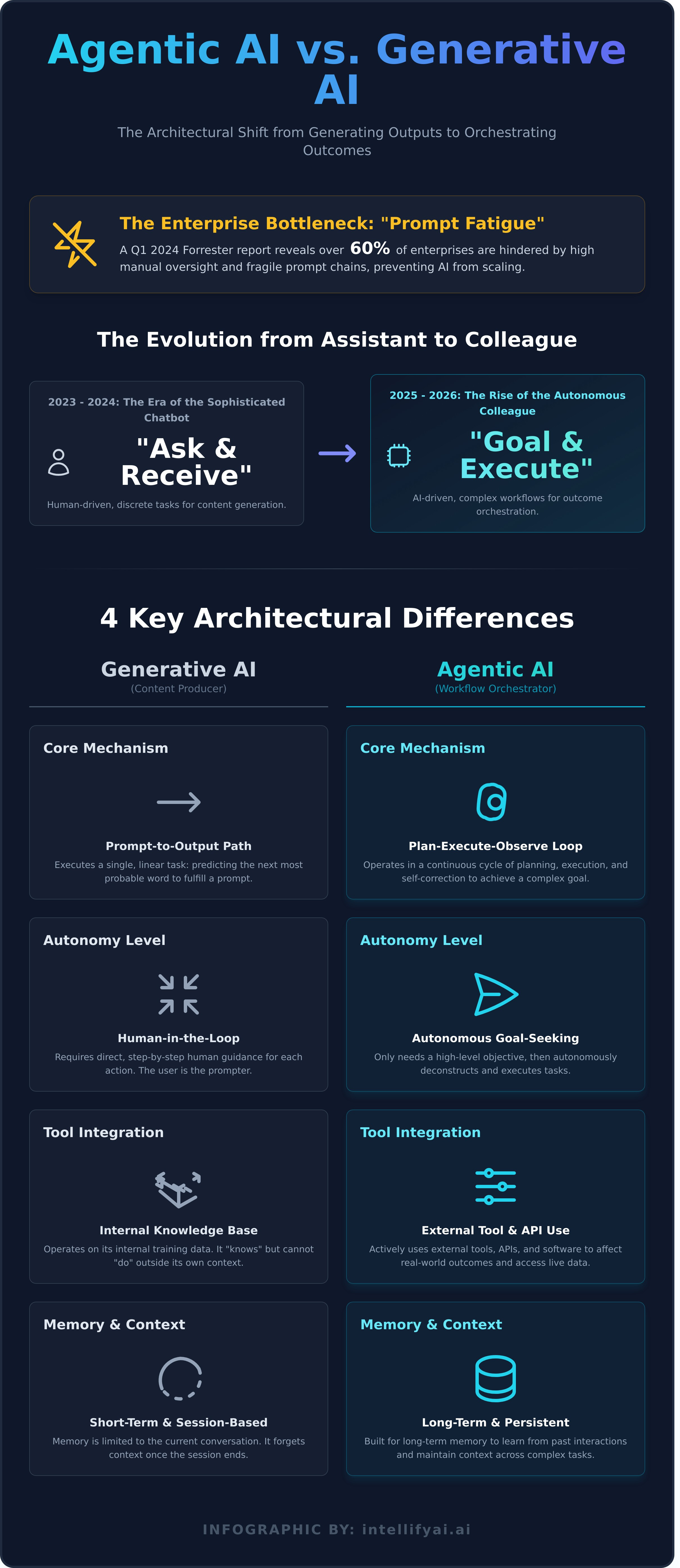
The period between 2023 and 2024 will be remembered as the era of the sophisticated chatbot. Businesses rapidly adopted GenAI for discrete tasks, improving efficiency by up to 40% in content-related functions, according to a 2024 McKinsey report. But the coming years, 2025-2026, will see the rise of the autonomous digital colleague. This evolution from an "Ask & Receive" model to a "Goal & Execute" paradigm is critical. True scalability isn't achieved by asking an AI to perform 100 separate tasks; it's achieved by giving it one complex goal that requires 100 automated steps to complete.
Why Enterprises are Re-evaluating their AI Stack
The limits of isolated prompts are becoming clear in complex business environments. A single prompt can't manage inventory, coordinate a product launch, or resolve a multi-layered customer support issue. These processes require a system that moves from passive intelligence to proactive workflow orchestration. The demand is for an AI that "does" rather than just "says." It's not enough for an AI to suggest a sales strategy; it must be able to analyze CRM data, identify top leads, draft personalized outreach emails, schedule follow-ups, and update the pipeline. This is the future of intelligent automation and the core value proposition driving the enterprise shift from generative to agentic systems.
Agentic AI vs. Generative AI: 5 Architectural Differences
The distinction between Generative AI and Agentic AI isn't superficial; it’s architectural. While both leverage Large Language Models (LLMs) as a core component, their operational frameworks are fundamentally different. Generative AI executes a single, linear task: predicting the next most probable word in a sequence to fulfill a prompt. Agentic AI, by contrast, operates within a continuous loop of planning, execution, and self-correction to achieve a complex, multi-step goal.
Understanding the core differences in the agentic ai vs generative ai debate reveals a fundamental shift from passive content creation to active task execution. This is not an evolution; it’s a re-architecting of how AI interacts with digital environments. The key differences are:
Reasoning and Decision-Making Frameworks
Generative AI’s reasoning is probabilistic. It assembles text that is statistically likely, but it doesn't formulate a strategy. Agentic AI implements structured reasoning frameworks like "Chain of Thought" (CoT) not just to think, but to create an actionable plan. If a step in that plan fails-for example, a call to a Salesforce API returns a 401 Unauthorized error-the agent doesn’t stop. It observes the error, reasons that its authentication token has expired, and executes a new task: refreshing the token before re-attempting the original API call. This ability to handle uncertainty and pivot is a core architectural advantage.
The Feedback Loop: Passive vs. Active Learning
A Generative AI model produces an output and its job is done. The burden of verification falls entirely on the human user. This passive model is insufficient for high-stakes enterprise tasks where a single error can compromise data integrity. This proactive, goal-oriented behavior is a primary distinction in the Agentic AI vs. Generative AI comparison; the former acts while the latter reacts. An agentic system, designed for operational excellence, incorporates a "reflection" cycle. It checks its own work. For instance, an agent tasked with financial data reconciliation can write a script to pull data, execute it, and then run a second validation script to confirm the totals match a known control value. This self-correction mechanism, which can reduce manual validation tasks by over 60%, is central to achieving true workflow orchestration at scale.
The Limits of Prompting: Why Enterprises are Moving Beyond GenAI
Generative AI has captured the world's imagination, delivering impressive capabilities in content creation and summarization. Yet for enterprise leaders, the initial excitement is maturing into a pragmatic assessment of its operational limits. The core issue is that GenAI requires constant human supervision. It’s a powerful tool, but not an autonomous workforce. A recent analysis by Forrester reveals that for every hour of output from a standard GenAI tool, technical teams spend an average of 3.5 hours on validation, editing, and integration. This creates a significant productivity bottleneck, not a breakthrough.
This leads directly to the most common objection we hear: "We already have a chatbot, why do we need an agent?" The answer is a matter of capability and scope. A chatbot responds to queries. An autonomous agent executes complex, multi-step tasks. While a chatbot can retrieve a policy document, an agent can read that document, extract specific compliance data, cross-reference it with three different internal systems, and then generate a compliance report for executive review. The former is a conversation; the latter is a completed business process.
The reliance on manual prompting makes GenAI-powered workflows fragile. A single ambiguous prompt or a minor data hallucination can break an entire operational chain, forcing a senior analyst to intervene and manually correct the process. These hidden costs-time spent re-prompting, fact-checking, and stitching together outputs-can consume up to 15 hours per employee per week in data-intensive roles, negating much of the promised efficiency.
The Complexity Gap in Modern Business
Modern enterprises operate in dynamic, interconnected ecosystems. A simple LLM struggles here. Consider a supply chain disruption. A GenAI tool can draft an email about the delay, but it cannot autonomously query the logistics provider's API, check inventory levels in the ERP, and update delivery ETAs in the customer-facing portal. This failure to orchestrate tasks across disparate systems is the complexity gap. Understanding the Key Differences Between Agentic and Generative AI reveals why; generative models are built for creation, while agentic systems are designed for execution. This is the pivot toward true Intelligent Automation, where AI handles exceptions and manages workflows without constant human guidance.
Operational Excellence through Autonomy
The strategic value of Agentic AI lies in its ability to deliver operational excellence through autonomy. By deploying autonomous agents, organizations reduce the cognitive load on senior management. Instead of defining granular steps, leaders set high-level objectives and trust the agent to orchestrate the necessary actions. This fundamentally shifts human capital from low-value "doing" to high-value "reviewing and strategizing." The debate over agentic ai vs generative ai is ultimately about choosing the right tool for enterprise-scale problems. The ROI becomes clear in use cases like "Zero-Touch" document processing, where autonomous agents have been shown to reduce invoice approval times from 7 days to under 10 minutes, cutting associated operational costs by up to 70%.
Implementation Strategy: Integrating Agentic Workflows into Your Existing Stack
Transitioning from conceptual understanding to tangible execution is the critical next step. An effective agentic AI strategy doesn't require you to discard your current technology investments. Instead, it demands a disciplined, layered approach that builds autonomous capabilities on top of your existing AI foundation. This is not a "rip and replace" operation; it's a strategic evolution toward intelligent automation.
A successful integration plan follows four core principles:
Selecting the Right Use Cases for 2026
Focus your initial agentic engineering efforts on areas with clear ROI potential. By 2026, we project three key domains will deliver transformative results: Voice Agents capable of autonomous customer issue resolution, not just call routing; Intelligent Document Processing that moves from data extraction to executing actions based on that data; and back-office modernization that automates complex, cross-functional reporting and reconciliation tasks previously considered untouchable by traditional RPA.
Future-Proofing Your Data Infrastructure
Agentic success is built on a foundation of superior data engineering. Autonomous agents require clean, accessible, and well-structured data to function effectively. Your immediate priority should be developing "agent-ready" APIs that are secure, well-documented, and granular. A robust MLOps practice is also non-negotiable for monitoring agent performance, detecting model drift, and ensuring your autonomous workforce operates with sustained operational excellence.
The distinction between
The IntellifyAi Vision: Orchestrating Human-AI Synergy
The distinction between agentic ai vs generative ai isn't about choosing a winner; it's about architecting a new operational paradigm. Generative AI provides the spark of understanding and creation. Agentic AI delivers the engine for execution and goal achievement. At IntellifyAi, we bridge this critical gap. We transform abstract potential into tangible, automated business outcomes, creating a seamless synergy where human intellect is amplified, not replaced.
Our philosophy is built on a simple premise: your data holds immense value, but only if it can be acted upon. This is the core function of our proprietary platform, i_Nova. It serves as the central nervous system for intelligent automation, ingesting unstructured data from any source-emails, invoices, call transcripts, or sensor logs-and converting it into structured, actionable intelligence. This intelligence then fuels autonomous agents designed to execute complex, multi-step workflows with precision and speed. We don't just build models; we engineer end-to-end operational systems.
Case Study: Voice Agents in the Modern Contact Centre
Forget the frustration of rigid, scripted chatbots. Our agentic voice solutions create empathetic, goal-oriented conversations. By integrating advanced natural language understanding with your business logic, these agents resolve customer issues autonomously. For one of our clients in the retail sector, this resulted in:
The IntellifyAi approach ensures seamless integration with existing telephony and CRM platforms, augmenting your human team and elevating customer experience (CX) from a cost center to a value driver.
IDP and Beyond: The Future of Workflow Orchestration
Intelligent Document Processing (IDP) is where automation begins. Our i_Nova platform achieves 99.8% data extraction accuracy, but its true power lies in what happens next. That extracted data doesn't just sit in a database; it triggers a cascade of agentic actions. An invoice isn't just scanned; it's validated, cross-referenced with purchase orders, approved, and scheduled for payment without a single manual keystroke. We enable you to scale these intelligent workflows across global locations, ensuring consistent operational excellence and governance. Partnering with IntellifyAi means architecting a complete digital transformation, from initial data capture to final business outcome.
Ultimately, the debate over agentic ai vs generative ai becomes obsolete when you have a strategic partner. Our Bespoke Agentic AI Engineering practice is for the strategic architect who sees beyond siloed tools. We design and implement custom solutions that align directly with your most critical business objectives, ensuring your investment delivers a measurable ROI. It’s time to move from experimentation to execution. Transform your enterprise with Agentic AI Engineering Services and build your future-proof operational core.
Secure Your 2026 Advantage: Move from Generative AI to Agentic Action
The enterprise landscape of 2026 won't be defined by content creation. It will be defined by autonomous action. The core distinction in the agentic ai vs generative ai debate is not output, but an architecture built for complex workflow orchestration. While generative models respond to prompts, agentic systems are engineered to execute multi-step strategic objectives, demanding a new operational philosophy.
IntellifyAi architects this transition for global leaders. Leveraging our proprietary i_Nova IDP Platform and specialized expertise in Voice Agent Engineering, our teams across the UK, US, India, and UAE are already deploying the autonomous workflows that drive operational excellence and secure a competitive edge for our partners.
The time to move beyond simple prompts is now. Book an Enterprise AI Strategy Consultation to design your roadmap for intelligent automation. Let's unlock your team’s true strategic potential.
Frequently Asked Questions
Is Agentic AI the same as AutoGPT or BabyAGI?
No, Agentic AI is a broad architectural concept, while AutoGPT and BabyAGI are specific, open-source experiments from early 2023. These projects proved the potential of autonomous agents but lack the security, scalability, and robust error handling required for enterprise deployment. Production-grade agentic systems demand sophisticated workflow orchestration and bespoke integrations, moving far beyond the capabilities of these initial proofs-of-concept. They are a starting point, not the destination for business automation.
Can I use my existing Generative AI models to build Agentic systems?
Yes, your existing Generative AI models are the foundational component. An LLM like GPT-4 or Claude 3 acts as the core "reasoning engine" for an agent. Building an agentic system involves architecting a framework around this engine. This framework equips the model with tools for task execution, access to external data via APIs, and a memory system for context. The LLM provides the intelligence; the agentic framework provides the capacity for autonomous action in your digital environment.
What are the main risks of deploying autonomous AI agents in a business environment?
The primary risks are operational errors, data security vulnerabilities, and unpredictable model "hallucinations." An unmonitored agent could, for example, incorrectly process a batch of 1,000 invoices due to a subtle data anomaly. Initial deployments without rigorous human-in-the-loop validation can see task error rates as high as 15%. Mitigating these risks requires robust access controls, continuous monitoring, and a clear framework for human oversight on all critical business functions before granting full autonomy.
How does Agentic AI improve Intelligent Document Processing (IDP)?
Agentic AI elevates Intelligent Document Processing (IDP) from simple extraction to a fully autonomous workflow. A standard IDP tool might pull data from an invoice. An agentic system extracts that data, validates the PO number against your ERP system, identifies a 12% price discrepancy, and then drafts a query email to the vendor for human approval. This end-to-end automation can increase processing throughput for complex documents by over 250% and reduce manual intervention.
Do I need a different team of engineers for Agentic AI vs. Generative AI?
You don't need an entirely new team, but you must augment existing skills. While generative AI expertise focuses on prompt engineering and model fine-tuning, agentic AI requires a greater focus on systems architecture and software integration. Your engineers will need proficiency in workflow orchestration and connecting the AI to tools like APIs and databases. The key difference in the agentic ai vs generative ai skill set is the shift from model interaction to building resilient, multi-step automated systems.
How do you measure the ROI of Agentic AI compared to standard automation?
The ROI of Agentic AI is measured by quantifying second-order efficiencies beyond simple time savings. While standard automation might save 20 hours per week on data entry, an agentic system may only save 15 hours but also reduce data entry errors by 90%, preventing costly downstream corrections. You must track metrics like reduced error rates, the value of complex tasks now automated, and the opportunity cost savings from freeing up senior experts for strategic initiatives.
Is Agentic AI ready for highly regulated industries like finance or healthcare?
Yes, Agentic AI is ready for regulated industries when deployed within a strict human-in-the-loop (HITL) architecture. Fully autonomous agents aren't yet suitable for final decisions governed by HIPAA or FINRA regulations. However, an agent can act as a powerful co-pilot. For instance, it can review thousands of transactions against a compliance checklist, flag 3 high-risk anomalies, and compile a complete report for a human compliance officer's final review and sign-off, reducing audit prep time by 60%.
What is the role of a human in an "Agentic" workflow?
The human's role transforms from a direct task executer to a high-level strategic director. In an agentic workflow, the human sets the overarching goals, defines the operational boundaries, and manages exceptions the AI cannot resolve. For example, a marketing manager directs an agent to optimize ad spend across 10 campaigns. The manager then reviews the agent's performance dashboard and handles the 2-3 creative decisions the agent escalates, embodying true Human-AI Synergy to achieve superior outcomes.









.svg)