
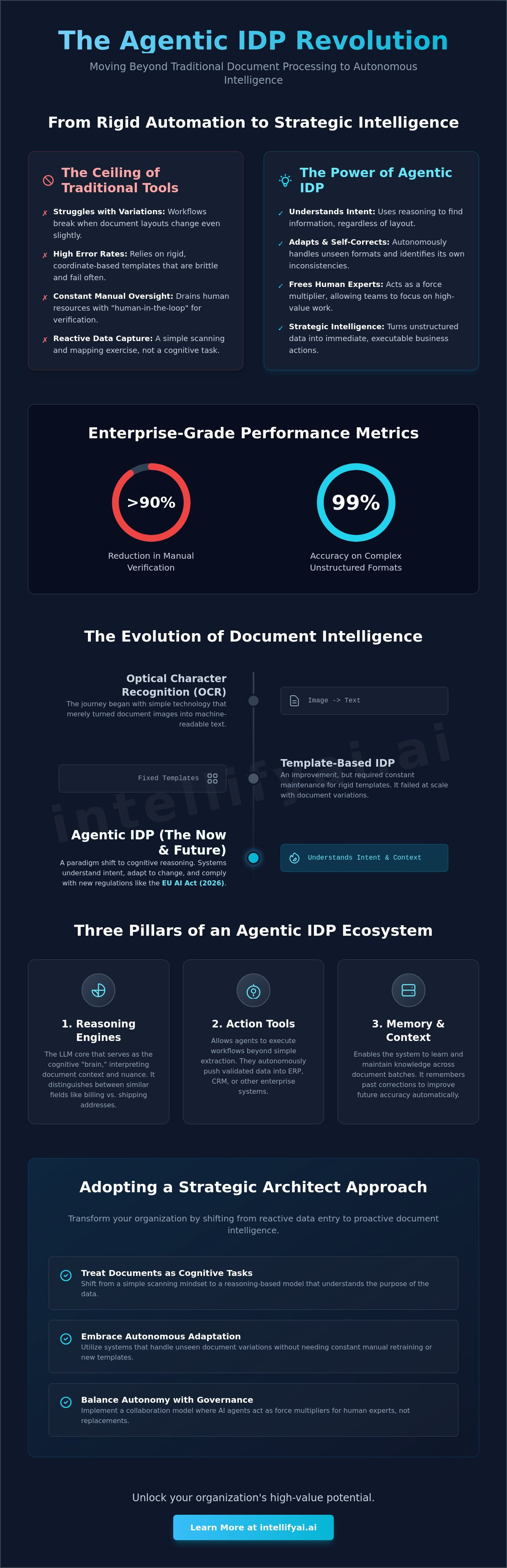
Traditional document processing has reached its ceiling, leaving enterprises trapped between rigid automation and expensive manual oversight. While standard tools struggle with minor document variations, the shift toward agentic idp solutions represents a fundamental move toward autonomous intelligence. You've likely experienced the frustration of workflows that break when a form changes or a field shifts. These high error rates and the constant need for human-in-the-loop verification don't just slow you down; they stifle your growth and drain your most valuable human resources.
An effective agentic ecosystem relies on three foundational pillars. First, reasoning engines serve as the LLM core. These models interpret the context of a document, such as distinguishing between a billing address and a shipping address in a complex logistics form. Second, action tools allow agents to execute workflows. They don't just extract data; they push it into your ERP or CRM systems autonomously. Finally, memory and context enable the system to maintain knowledge across document batches. For enterprises prioritizing security, NovaCortex offers a self-hosted, privacy-first memory layer designed specifically for AI agents. If an agent identifies a recurring error in a specific vendor's invoice, it remembers that context to improve accuracy in future runs. This creates a frictionless, automated future where document data becomes an immediate strategic asset.
We'll show you how agentic IDP moves beyond simple data extraction to provide autonomous reasoning and enterprise-grade accuracy. By implementing these cognitive engines, your organization can reduce manual verification by more than 90% and achieve 99% accuracy on complex, unstructured formats. This article previews the transition from reactive data capture to strategic document intelligence that turns information into immediate, executable business actions. We'll explore how this technology serves as a liberating force, allowing your team to focus on high-value work while the system handles the heavy lifting with precision and scale.
Key Takeaways
• Understand the fundamental shift from rigid, template-based extraction to a reasoning-based model that treats document processing as a cognitive task rather than a simple scanning exercise.
• Explore how agentic idp solutions handle previously unseen document variations and utilize autonomous self-correction to maintain enterprise-grade accuracy without constant manual retraining.
• Adopt a Strategic Architect approach to implementation, ensuring your document intelligence workflows are anchored in measurable business outcomes and high-velocity cloud-native scalability.
• Balance system autonomy with rigorous governance through a collaboration model where AI agents act as force multipliers for human experts rather than simple replacements.
• Learn how to transform unstructured data into immediate, executable intelligence to eliminate repetitive back-office burdens and unlock your organization's high-value creative potential.
What are Agentic IDP Solutions?
Agentic idp solutions represent a paradigm shift in how enterprises handle the deluge of unstructured data. Traditional Intelligent Document Processing (IDP) focused on digitizing text and mapping it to fixed fields. In contrast, an Intelligent Agent within an IDP framework does more than recognize characters; it understands intent. This fusion of autonomous AI agents with document workflows moves the needle from simple extraction to genuine reasoning. Large Language Models (LLMs) act as the cognitive core, providing the brain necessary to interpret nuances that legacy systems miss.
The value proposition is clear. While legacy OCR systems break when a vendor changes an invoice layout by a few pixels, agentic systems adapt. They don't rely on rigid coordinate-based templates. Instead, they use semantic understanding to find information wherever it resides. This allows businesses to stop managing software and start managing outcomes. It's the difference between a tool that follows a path and a partner that understands the destination.
To better understand the core mechanics of this technology, watch this helpful video:
The Evolution from OCR to Agentic Intelligence
The journey began with simple Optical Character Recognition (OCR), which merely turned images into text. We then moved to template-based IDP, which required constant maintenance and failed at scale. As we move through 2026, we've reached a tipping point. Regulation like the EU AI Act, taking effect August 2, 2026, demands higher data quality and human oversight. Agentic idp solutions meet these requirements by providing transparent reasoning and self-governing capabilities. The era of the rigid template is over. Businesses now require systems that can ingest complex, multi-page contracts or handwritten notes without needing a custom-built rule for every variation. This evolution reflects a broader commitment to Agentic AI Engineering Services that prioritize long-term viability over temporary fixes.
Key Components of an Agentic IDP Ecosystem
An effective agentic ecosystem relies on three foundational pillars. First, reasoning engines serve as the LLM core. These models interpret the context of a document, such as distinguishing between a billing address and a shipping address in a complex logistics form. Second, action tools allow agents to execute workflows. They don't just extract data; they push it into your ERP or CRM systems autonomously. Finally, memory and context enable the system to maintain knowledge across document batches. If an agent identifies a recurring error in a specific vendor's invoice, it remembers that context to improve accuracy in future runs. This creates a frictionless, automated future where document data becomes an immediate strategic asset.
Beyond OCR: How Agentic AI Redefines Document Intelligence
Most enterprises view Intelligent Document Processing as a series of disconnected steps: scan, extract, and validate. Legacy providers often treat Large Language Models as simple plugins or external layers. This approach is fundamentally flawed. True agentic idp solutions integrate the reasoning engine into the very core of the workflow. This integration allows the system to handle "unseen" document types without the need for manual retraining or template creation. If a vendor submits an invoice in a completely new format, the agent doesn't fail. It reasons through the visual and textual hierarchy to identify the necessary data points autonomously.
Self-correction is a hallmark of this new era. In traditional setups, a minor extraction error requires human intervention. Agentic systems, however, identify their own inconsistencies. If a calculated total doesn't match the sum of individual line items, the agent recognizes the discrepancy. It then re-examines the document or cross-references the data with internal records to resolve the issue. Research shows that this level of autonomy can reduce data extraction errors by over 45%. These systems are multi-modal by nature, seamlessly processing text, complex tables, and even handwritten notes within a single document batch. This versatility accelerates deployment from weeks to mere minutes, as the need for rigid templates vanishes.
Traditional IDP vs. Agentic IDP
The distinction between logic-based and reasoning-based processing is the difference between following a script and understanding a story. Traditional systems rely on "if-then" logic that breaks under pressure. Agentic systems utilize cognitive reasoning to maintain performance across diverse datasets.
| Feature | Traditional IDP | Agentic IDP |
|---|---|---|
| Primary Driver | Fixed Logic / Templates | Autonomous Reasoning |
| New Document Setup | Weeks of Retraining | Minutes (Zero-shot) |
| Error Handling | Manual Exception Queues | Autonomous Self-Correction |
Accuracy benchmarks now frequently surpass human-level precision in complex sorting tasks. While a human might miss a subtle detail in a hundred-page contract, an agentic layer maintains 98% classification accuracy even at high volumes. This level of dependability is why many leaders are moving toward specialized Agentic AI Engineering Services to modernize their back-office operations.
The Power of Contextual Reasoning
Contextual reasoning allows agents to understand implied data. For instance, an agent can identify a "high-priority claim" based on the tone of a letter or the presence of specific diagnostic codes, even if the document isn't explicitly labeled as such. By cross-referencing document data with external databases in real-time, the system validates information against the single source of truth. Document Reasoning is the ability of an AI to explain why it extracted a specific data point. This transparency ensures that every action is grounded in logic, providing the audit trails necessary for enterprise-grade compliance.
Strategic Implementation: Integrating Agentic IDP into Enterprise Workflows
Implementing agentic idp solutions requires more than a standard software installation. It demands a "Strategic Architect" mindset that prioritizes specific business outcomes over technical features. Instead of starting with what the tool can do, start with the friction points in your current workflow. Are you aiming for an 80% reduction in processing latency or a 77% lower operational cost? These measurable impacts serve as the North Star for your digital transformation, ensuring that the technology serves the bottom line.
Successful integration relies on a cloud-native foundation. Legacy on-premise systems often lack the computational elasticity required for high-velocity agentic workloads. By moving to the cloud, you enable server intelligence agents to manage processing loads dynamically. This ensures that peak document volumes don't result in system bottlenecks or degraded performance. For a deeper look at this architectural shift, explore our insights on Enterprise Modernization.
Continuous improvement is baked into the implementation through robust MLOps pipelines. These pipelines allow for automated model monitoring and retraining based on real-world edge cases identified by the agents. This isn't a one-time setup; it's a living system that matures alongside your business. Engaging in expert AI strategy consulting ensures that these technical decisions align with your long-term growth and financial returns, bridging the gap between abstract technology and practical execution.
Modernizing the Back Office with Cloud-Native IDP
Legacy systems were designed for structured data and predictable loads. They struggle with the heavy reasoning tasks inherent in agentic workflows. Cloud-native architectures provide the necessary scale to process complex document batches in seconds rather than hours. This transition removes the burden of infrastructure management, allowing your IT team to focus on high-value architectural improvements rather than routine server maintenance. It is a liberating shift that replaces technical debt with operational agility.
Data Engineering: The Foundation of Agentic Success
High-stakes agentic workflows are only as effective as the data they consume. Preparing unstructured data for agentic consumption involves building robust data pipelines that support real-time extraction. This foundation ensures that the information fed into the reasoning engine is clean and contextually relevant. By prioritizing data quality at the source, you achieve the 99% accuracy rates required for enterprise stability. We view data engineering not just as a technical requirement, but as a central business pillar for long-term viability.
Solving the Autonomy Paradox: Governance and Human-in-the-Loop
The central question for any enterprise leader isn't whether the technology works, but whether it can be trusted with sensitive data. Trusting autonomous agents with high-stakes documents requires a shift from blind faith to architectural governance. Modern agentic idp solutions aren't black boxes; they're transparent systems designed for rigorous oversight. By framing technology as a force multiplier for human experts, we resolve the autonomy paradox. Humans don't step away from the process; they step up to a more strategic role, overseeing the logic and ethical boundaries of the system.
Maintaining compliance is a non-negotiable pillar of enterprise modernization. With the EU AI Act's primary obligations coming into force on August 2, 2026, organizations must ensure their IDP frameworks meet strict standards for risk management and data quality. Agentic systems simplify this by generating automated audit trails for every decision made. Whether it's GDPR, SOC2, or the Texas Responsible AI Governance Act (TRAIGA) enacted on January 1, 2026, these tools provide the technical documentation necessary for full regulatory transparency. This level of accountability ensures that advanced technology remains a liberating force rather than a liability.
Strategic architects utilize confidence thresholds to manage risk effectively. When an agent encounters a document with high ambiguity, it doesn't guess. Instead, it triggers an automated escalation to a human expert. This ensures that 99% accuracy remains the standard, while the system handles the vast majority of routine tasks autonomously. To see how these governance frameworks can be tailored to your specific operational needs, explore our Agentic AI Engineering Services.
Ethical Autonomy and AI Governance
Implementing guardrails is essential to prevent hallucinations in document extraction. We use version control to maintain auditable AI models, ensuring that every update is tracked and reversible. This creates a transparent decision-making environment where you can always answer why an agent approved a specific invoice. By anchoring autonomy in logic, businesses achieve a frictionless future where security and efficiency coexist without compromise.
Optimizing Human-in-the-Loop (HITL) Workflows
We're moving workers from the role of "Reviewer" to "Strategist." This empowerment allows your team to focus on complex edge cases that require human nuance. Feedback loops ensure that when a human corrects an error, the agent learns from that interaction in real-time. The goal of HITL is the systematic elimination of its own necessity. As the system matures, the frequency of human intervention drops, allowing your organization to scale without a linear increase in headcount.
Intelligent Transformation with i_Nova: The Future of Agentic IDP
i_Nova is the flagship platform for comprehensive agentic idp solutions. While we've explored the theoretical shift from OCR to reasoning, i_Nova provides the tangible infrastructure to execute this transformation at scale. It extracts actionable intelligence from any unstructured format, serving as a central business pillar for the autonomous enterprise. This platform isn't a standalone tool; it integrates directly with our broader Agentic AI engineering services to ensure your document intelligence is built on a foundation of long-term viability. It represents the final step in removing the burden of repetitive tasks, allowing your organization to focus on high-value creative work.
The transition to an autonomous enterprise requires a partner that understands the stability and security of your operations. i_Nova acts as a bridge between abstract technical fields and the practical needs of a growing company. By turning document data into immediate, executable actions, the platform drives measurable financial returns. It embodies our philosophy that advanced technology should be a liberating force, not a daunting complexity. We position i_Nova as a lasting investment in relevance, ensuring your back-office remains ahead of the curve as the industry evolves.
Why Enterprise Leaders Choose i_Nova
Scalability is a core requirement for serious enterprises. i_Nova handles millions of documents across global operations without the latency typical of legacy systems. The platform allows for deep customization, where agents are tailored to specific industry terminologies and regional regulations. Integration is seamless. i_Nova connects with your existing voice agents and contact center technology to create a unified ecosystem of intelligence. This means your back-office data and front-office customer interactions share the same cognitive context, removing the silos that hinder enterprise growth.
Getting Started: From Proof-of-Value to Global Scale
Implementing agentic idp solutions shouldn't disrupt your current operations. We follow a logical roadmap that moves from a focused proof-of-value to global scale, ensuring stability at every stage of the digital transformation. This collaborative partnership is the bridge between abstract technical potential and practical execution. We provide the dependable expertise needed to modernize your operations while you focus on the bottom line. Contact IntellifyAi to architect your autonomous document workflow and reclaim your team's potential.
Scaling Document Intelligence for the Autonomous Enterprise
The transition from manual data extraction to autonomous document intelligence is no longer a distant vision; it's a strategic necessity for the modern enterprise. We've seen how agentic idp solutions replace rigid templates with cognitive reasoning, allowing your organization to handle complex, unstructured data with 99% accuracy. By leveraging the i_Nova platform and a cloud-native architecture, you can transform document workflows into a central business pillar that drives immediate financial returns.
This shift doesn't just improve efficiency; it liberates your human experts to focus on the high-value creative work that defines your competitive edge. Our Strategic Architect approach ensures that every implementation is anchored in long-term viability and global compliance standards. With our global expertise in Agentic AI engineering, we help you bridge the gap between abstract technical potential and practical results-oriented execution. The future of document processing is autonomous, secure, and ready for global scale. Now is the time to move beyond the limitations of legacy systems and embrace a frictionless, automated future. Architect your autonomous future with IntellifyAi and lead your industry into the next era of intelligence.
Frequently Asked Questions
What is the difference between IDP and Agentic IDP?
The primary difference lies in the shift from rule-based extraction to reasoning-based understanding. While traditional IDP relies on fixed templates that break with minor variations, agentic idp solutions utilize autonomous AI agents to interpret the semantic meaning of a document. This allows the system to handle unseen formats and make decisions based on the context of the data rather than its physical location on a page.
Can Agentic IDP solutions handle handwritten or low-quality documents?
Yes, these systems excel at processing handwritten and low-quality documents by leveraging multi-modal Large Language Models. These models don't just look for pixel patterns; they use linguistic context to "read" through smudges or messy handwriting. This capability ensures high accuracy even when the source material is physically degraded or non-standard, removing the need for manual data entry in difficult cases.
How does Agentic IDP improve enterprise compliance and auditing?
Agentic IDP improves compliance by generating comprehensive, automated audit trails for every extraction and decision. With regulations like the EU AI Act taking effect on August 2, 2026, transparency is a non-negotiable requirement. These systems provide clear documentation of the reasoning behind each action, ensuring your organization meets strict standards for data quality, risk management, and regulatory accountability.
Is it possible to integrate Agentic IDP with legacy ERP systems?
Integration with legacy ERP systems is entirely possible through the use of action-oriented agents and robust APIs. These agents act as a bridge, extracting intelligence from documents and pushing it directly into your existing infrastructure without requiring a rip-and-replace of your core systems. This approach preserves your previous investments while modernizing your back-office workflows for a more frictionless future.
What is the typical ROI for an Agentic IDP implementation?
Organizations typically see a significant return on investment through reduced operational costs and improved processing speeds. For example, some specialized agentic idp solutions have helped healthcare providers achieve a 77% reduction in operational costs and an 80% decrease in processing latency. By reducing manual verification by over 90%, businesses can reallocate their human capital to high-value strategic initiatives.
Does Agentic IDP require a complete overhaul of our current data strategy?
An agentic implementation doesn't require a complete overhaul of your data strategy. Instead, it serves as a sophisticated layer that enhances your existing data engineering pipelines. It transforms unstructured silos into executable intelligence, making your current data more accessible and valuable without forcing a total architectural redesign. This makes it a lasting investment in relevance rather than a temporary fix.
How do AI agents handle ambiguous information in unstructured documents?
AI agents handle ambiguity by using contextual reasoning and cross-referencing external databases in real-time. If a document contains contradictory information, the agent analyzes the surrounding text and historical data to determine the most likely correct value. This cognitive approach mimics human problem-solving to resolve discrepancies that would halt a traditional automation tool, ensuring the workflow continues without friction.
What role does human-in-the-loop play in an agentic workflow?
Human-in-the-loop serves as a critical governance layer and a force multiplier for the AI. Experts focus on complex edge cases where the system identifies a low confidence score, ensuring that 99% accuracy is maintained. Over time, the agent learns from these human corrections, systematically reducing the frequency of intervention required for similar future tasks and unlocking human potential for creative work.








.svg)