
By 2026, the primary threat to your digital transformation isn't a lack of innovation; it's the silent erosion of margins caused by unoptimized inference. You've likely felt the sting of unpredictable LLM token bills that seem disconnected from actual business value. It's a common frustration for leaders who see the immense potential of autonomous systems but struggle to attribute specific costs to individual business units. Implementing a robust ai finops strategy is no longer a luxury for the experimental phase. It's the foundational architecture required to ensure your agentic workflows remain profitable as they scale across the enterprise.
We'll show you how to move beyond passive cost-tracking and into the era of active resource orchestration. This guide provides the strategic framework you need to align every token consumed with direct revenue generation. You'll master the architectural and financial strategies necessary to manage high-scale AI spend while maintaining total visibility into your ROI. From automated cost-optimization for multi-agent ecosystems to precise budget forecasting, we're outlining the roadmap to turn your AI initiatives from a speculative expense into a high-performance financial asset.
Key Takeaways
• Shift your strategic perspective from static cloud resource management to the dynamic, token-based consumption models inherent in high-scale AI systems.
• Pinpoint specific financial leaks in your AI lifecycle by understanding why inference typically accounts for 90% of mature enterprise spend.
• Explore the role of autonomous agents in executing real-time provider switching and resource orchestration to secure the lowest possible cost per task.
• Master the core ai finops KPIs, such as token efficiency and cost per inference, to provide the board with clear, revenue-aligned reporting.
• Integrate financial governance directly into your engineering workflows to ensure that innovation remains a driver of profit rather than an unpredictable expense.
Beyond Cloud Costs: What is AI FinOps in 2026?
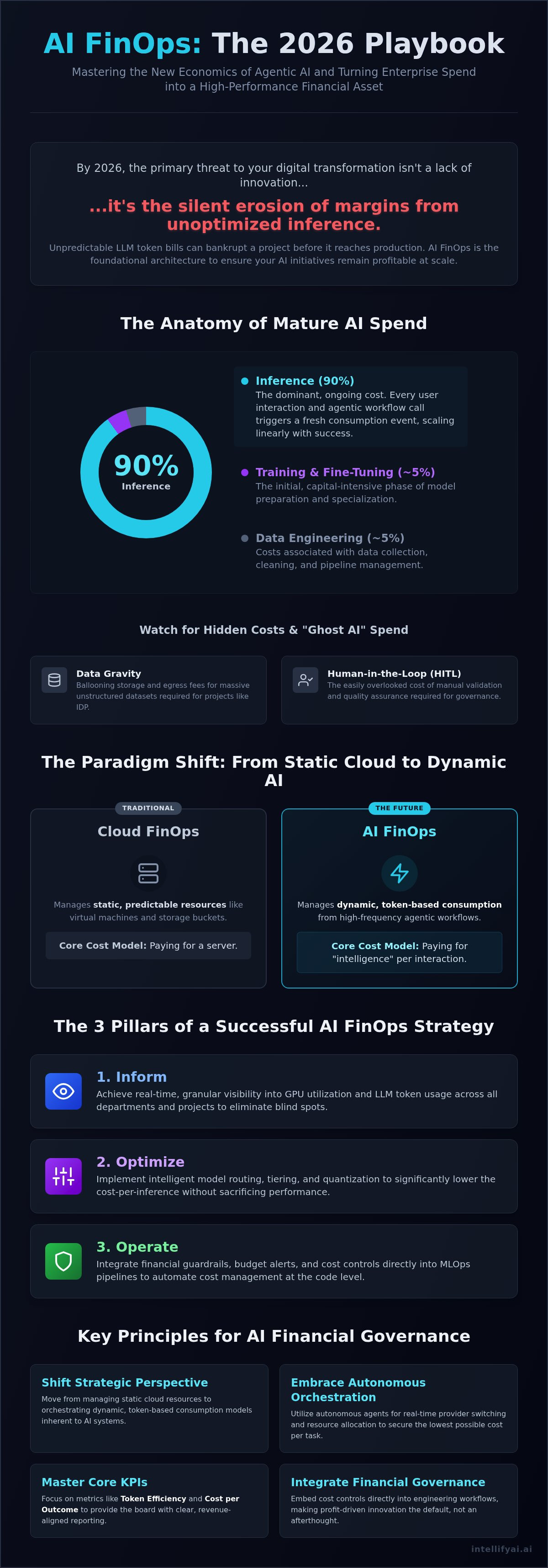
AI FinOps is the strategic intersection of AI engineering, corporate finance, and cloud operations. It's a disciplined evolution of the DevOps methodology, adapted for a world where compute isn't just a utility but a primary driver of competitive advantage. While traditional cloud FinOps manages static, predictable resources like virtual machines, ai finops addresses the dynamic, token-based consumption models of the agentic era. It's the difference between paying for a server and paying for the "intelligence" consumed during a single customer interaction.
The "Inference Tax" is a reality that many leaders overlook during the prototyping phase. A project that appears viable at a small scale can quickly become a financial liability when deployed across millions of transactions. Without a rigorous framework, unmanaged LLM calls can bankrupt a project before it ever reaches production-grade maturity. This makes the practice a critical pillar of Enterprise Modernization, ensuring that technological ambition doesn't outpace financial sustainability.
The Three Pillars: Inform, Optimize, Operate
Success requires a three-pronged approach to resource management. First, you must Inform. This involves achieving real-time visibility into GPU utilization and LLM token usage across various departments. Second, you must Optimize. By using intelligent model routing and quantization techniques, you can significantly lower the cost per inference without sacrificing performance. Finally, you must Operate. This means integrating financial guardrails directly into your MLOps Pipelines to automate cost control at the code level.
Why 2026 Requires a New Financial Framework
The complexity of AI spend has escalated. Multi-modal AI and high-frequency agentic workflows have created consumption patterns that traditional accounting can't track. We've shifted from a simple "Build vs. Buy" decision to a more nuanced "Fine-tune vs. Prompt" strategy. Each choice carries distinct long-term cost implications that affect your bottom line. Additionally, "Ghost AI" spend is rising. These are the hidden costs of experimental models running in silos, often bypassing central procurement and draining budgets without contributing to the enterprise's core objectives. Addressing these challenges requires a sophisticated ai finops framework that prioritizes transparency and accountability.
The Anatomy of AI Spend: Where the Money Goes
Understanding the AI lifecycle is the first step toward effective cost management. While the initial capital intensive phase of model training captures the most headlines, the operational reality of 2026 is far more nuanced. We categorize these costs into three primary buckets: Data Engineering, Training or Fine-tuning, and Inference. In mature enterprises, inference accounts for up to 90% of total AI spend. This shift occurs because once a model is deployed, every user interaction and agentic call triggers a fresh consumption event. As outlined by the FinOps Foundation in their overview of FinOps for AI, these costs aren't static; they scale linearly with your success unless you intervene with a mature ai finops practice.
Beyond the compute itself, "Data Gravity" presents a significant financial challenge. Storing the massive volumes of unstructured data required for Intelligent Document Processing (IDP) projects leads to ballooning storage and egress fees. There's also the hidden cost of human-in-the-loop (HITL) validation. Governance and quality assurance aren't free. They require human oversight that must be factored into your total cost of ownership (TCO) to avoid margin erosion during the scaling phase.
Inference Economics: Managing the Token Tsunami
In 2026, the cost delta between proprietary models like GPT-5 or Claude 4 and specialized open-source models is vast. Strategic leaders use "Model Tiering" to match task complexity to the most cost-effective resource. You don't need a frontier model to summarize a routine email. By routing simpler tasks to smaller, quantized models, you protect your budget for high-value reasoning. This makes Cost per Outcome the new north-star metric for the executive suite. Aligning these technical choices with business objectives is the core of our AI Strategy & Consulting methodology.
Infrastructure and GPU Orchestration
Compute efficiency is won or lost at the orchestration layer. For model training or heavy fine-tuning, the cost-benefit of reserved instances versus spot instances can mean the difference between a project's viability and its cancellation. We focus on leveraging advanced Data Engineering to reduce token waste through superior Retrieval-Augmented Generation (RAG). By ensuring only the most relevant data is sent to the LLM, you minimize unnecessary compute. Our i_Nova platform further optimizes document processing volume, ensuring that your infrastructure only works on high-quality, pre-filtered data streams.
Agentic AI FinOps: The Rise of Autonomous Cost Management
Manual monitoring is no longer sufficient for the velocity of 2026 enterprise operations. We're seeing the emergence of Agentic AI FinOps, where AI agents themselves handle the complexities of resource management. These agents don't just report on spend; they actively intervene. They monitor, alert, and re-route traffic in real-time to capitalize on the best available pricing. This shift from human-led observation to machine-led orchestration is the next frontier of ai finops maturity.
Imagine a system that evaluates the spot price of inference across multiple LLM providers every millisecond. Autonomous agents can switch between providers instantly based on current latency and cost, ensuring the enterprise always receives the highest value for its token spend. This dynamic orchestration is a core component of What Is Agentic AI? in a financial context. It allows businesses to maintain performance standards while ruthlessly cutting waste.
Beyond simple routing, we implement "Budget-Aware Agents." These systems understand their own consumption limits and the financial priority of their assigned tasks. When a specific project's threshold is reached, the agent can autonomously pause low-priority background processing while keeping mission-critical customer services online. This level of granular, automated control is highlighted in the FinOps Foundation's guide to AI cost management as a standard for high-maturity organizations looking to scale without financial friction.
Self-Optimizing Workflows
Agents use reinforcement learning to discover the most efficient path for complex queries. By analyzing thousands of previous interactions, they learn which specific model configurations yield the required accuracy at the lowest price point. This intelligence reduces the burden on your human teams. You'll see a significant decrease in "on-call" finance alerts because autonomous threshold management resolves spikes before they escalate into budget crises. In this framework, agentic FinOps transforms cost from a rigid constraint into a fluid competitive advantage.
Orchestrating Multi-Agent ROI
Managing a fleet of thousands of voice and text agents introduces exponential complexity. Centralized ai finops acts as the "Safety Rails" for these autonomous operations. It ensures that as agents branch out to perform various business functions, they don't drift into computational inefficiency. High-scale deployments require this rigorous oversight to maintain consistent ROI across diverse business units. For organizations ready to build these resilient systems, our Agentic AI Engineering Services provide the technical foundation for cost-optimized autonomy.
Building Your AI FinOps Roadmap: Governance and KPIs
Effective governance transforms cost management from a defensive posture into a strategic advantage. In 2026, high-performing enterprises have moved beyond tracking total cloud spend to monitoring a specific set of ai finops KPIs. These include Cost per Inference, Token Efficiency, and AI-Driven Revenue Growth. By focusing on these metrics, you align your technical consumption directly with your bottom line. Integrating this financial governance with our AI Strategy & Consulting ensures your board-level reporting reflects the true value realization of your AI portfolio.
A critical component of this roadmap is mastering the unit economics of AI. You must calculate the exact profit margin per automated interaction. This calculation isn't complete without factoring in compliance costs. Ensuring that SOC2 and GDPR audits are integrated into your financial model prevents surprise expenses during regulatory reviews. This holistic view allows you to scale projects based on their actual profitability rather than their experimental promise.
Governance as a Profit Center
Sophisticated governance structures do more than just limit spend. Automated lineage tracking significantly reduces the overhead of regulatory audits by providing a clear trail of data and model decisions. We also implement a "Kill Switch" protocol. This safety mechanism prevents runaway autonomous agent spend by automatically pausing processes that exceed predefined financial parameters. Additionally, strict version control ensures you're always running the most cost-effective iteration of a model without sacrificing performance.
Implementing the "Crawl, Walk, Run" Strategy
Your journey toward financial maturity follows a logical progression:
Crawl
Establish manual tagging and achieve baseline visibility into your current AI spend across all business units.
Walk
Deploy automated alerts and implement model-routing based on fixed operational rules.
Run
Transition to fully autonomous agentic orchestration with real-time ROI optimization.
Ready to secure your AI investments? Partner with our architects to build your custom financial roadmap.
Modernizing AI Operations with IntellifyAi
Our AI Strategy & Consulting services are built specifically for the era of agentic intelligence. We don't just deliver surface-level reports; we build the integrated frameworks that allow your finance and engineering teams to speak the same language. Central to this mission is our i_Nova platform. This technology provides the intelligent resource tracking and document processing capabilities necessary to identify and eliminate computational waste at the source. It's the foundational tool for a cost-aware enterprise where resource optimization is baked into the architecture itself.
Our Methodology: The Strategic Architect Approach
We align your technical MLOps pipelines directly with corporate financial objectives. This Strategic Architect methodology focuses on long-term viability rather than temporary fixes. We believe that advanced tools should unlock human potential, allowing your workers to focus on creative strategy while our autonomous systems handle the repetitive tasks of cost orchestration. With global delivery centers in the UK, USA, India, and the UAE, we provide continuous, managed ai finops oversight that keeps your operations running efficiently regardless of the time zone.
Scale Your AI Without the Financial Friction
A mature practice in financial optimization is your greatest competitive advantage. It allows you to innovate faster and scale further than competitors who are still struggling with unpredictable cloud bills. We invite you to begin this transformation with a Proof-of-Value (PoV) engagement. Our team will conduct a comprehensive audit of your current AI spend to identify immediate optimization opportunities and build a roadmap for sustainable growth. Don't let financial friction stall your progress. Reach out to us through the IntellifyAi Contact Page to schedule your custom audit today.
Architecting a Profitable Future for Enterprise Intelligence
Securing a competitive edge in 2026 requires more than just deploying advanced models. It demands a fundamental shift from passive observation to active, autonomous resource orchestration. We've explored how inference accounts for the vast majority of spend and why matching model complexity to task value is essential for maintaining margins. By integrating a mature ai finops strategy, you transform your AI initiatives from a speculative cost center into a high-performance engine for growth. To ensure your digital presence is equally optimized for performance, check out ResultFirst.
IntellifyAi provides the technical expertise in Agentic AI and Enterprise Modernization required to navigate this transition. We leverage the i_Nova platform, built with Red Dot level design thinking, and our global managed services across four continents to ensure your operations remain frictionless. Don't let unpredictable consumption stall your innovation. Master your AI economy. Schedule an AI FinOps consultation with IntellifyAi today.
The era of agentic intelligence offers a liberating force for your business. Take the first step toward a more predictable and profitable automated future.
Frequently Asked Questions
What is the difference between Cloud FinOps and AI FinOps?
AI FinOps differs from traditional Cloud FinOps by managing the dynamic, non-linear costs of token-based consumption and GPU orchestration. While Cloud FinOps focuses on static infrastructure like virtual machines, this specialized practice addresses the volatility of inference spend. It requires a deeper integration with engineering to optimize model selection and prompt efficiency in real-time.
How do I calculate the ROI of an Enterprise AI project in 2026?
ROI for enterprise AI projects in 2026 is calculated by measuring the profit margin per automated interaction. You must subtract the total cost of ownership, including token fees and human-in-the-loop validation, from the measurable revenue or efficiency gains. This outcome-based approach ensures that AI initiatives are judged by their financial contribution rather than just their technical performance.
Can AI FinOps help reduce the cost of Large Language Models (LLMs)?
Implementing an ai finops strategy reduces LLM costs by using model tiering to match task complexity with the most economical resource. You don't need a frontier model for every interaction. By routing routine queries to smaller, quantized models and using better retrieval techniques, you can significantly lower your aggregate inference tax while maintaining high accuracy.
What are the best KPIs for measuring AI financial performance?
The most effective KPIs for measuring AI financial performance are Token Efficiency, Cost per Inference, and AI-Driven Revenue Growth. These metrics provide a clear link between computational consumption and business value. Tracking these figures allows leadership to identify which models are delivering the highest ROI and which experimental projects require immediate optimization or decommissioning.
How does Agentic AI impact enterprise cloud consumption?
Agentic AI increases the frequency and autonomy of cloud consumption by allowing agents to trigger recursive, multi-step workflows. This complexity can lead to sudden spend spikes if left unmanaged. Mature organizations use autonomous guardrails to monitor these high-velocity agentic calls, ensuring that the fleet remains within predefined budget limits while performing complex business functions.
Is AI FinOps necessary for small-scale AI proof-of-concepts?
Establishing financial baselines during small-scale proof-of-concepts is essential for long-term viability. Even minor inefficiencies at the PoC stage can lead to massive losses when scaled to millions of interactions. Starting with a clear financial framework ensures that you understand the unit economics of your project before committing significant capital to full-scale production.
How do MLOps and FinOps work together in a production environment?
MLOps and FinOps work together in production by embedding financial guardrails directly into the automated deployment pipelines. While MLOps ensures the reliability and performance of the models, the FinOps layer manages cost-routing and resource allocation. This collaboration ensures that every model update is optimized for both technical accuracy and financial efficiency.
What role does the i_Nova platform play in cost optimization?
The i_Nova platform serves as the central hub for intelligent resource tracking and cost-aware document processing. It optimizes compute usage by ensuring that only high-quality, pre-filtered data enters your LLM pipelines. This reduces the volume of unnecessary tokens processed, directly lowering your operational expenses while improving the overall speed and accuracy of your enterprise-grade AI workflows.









.svg)