
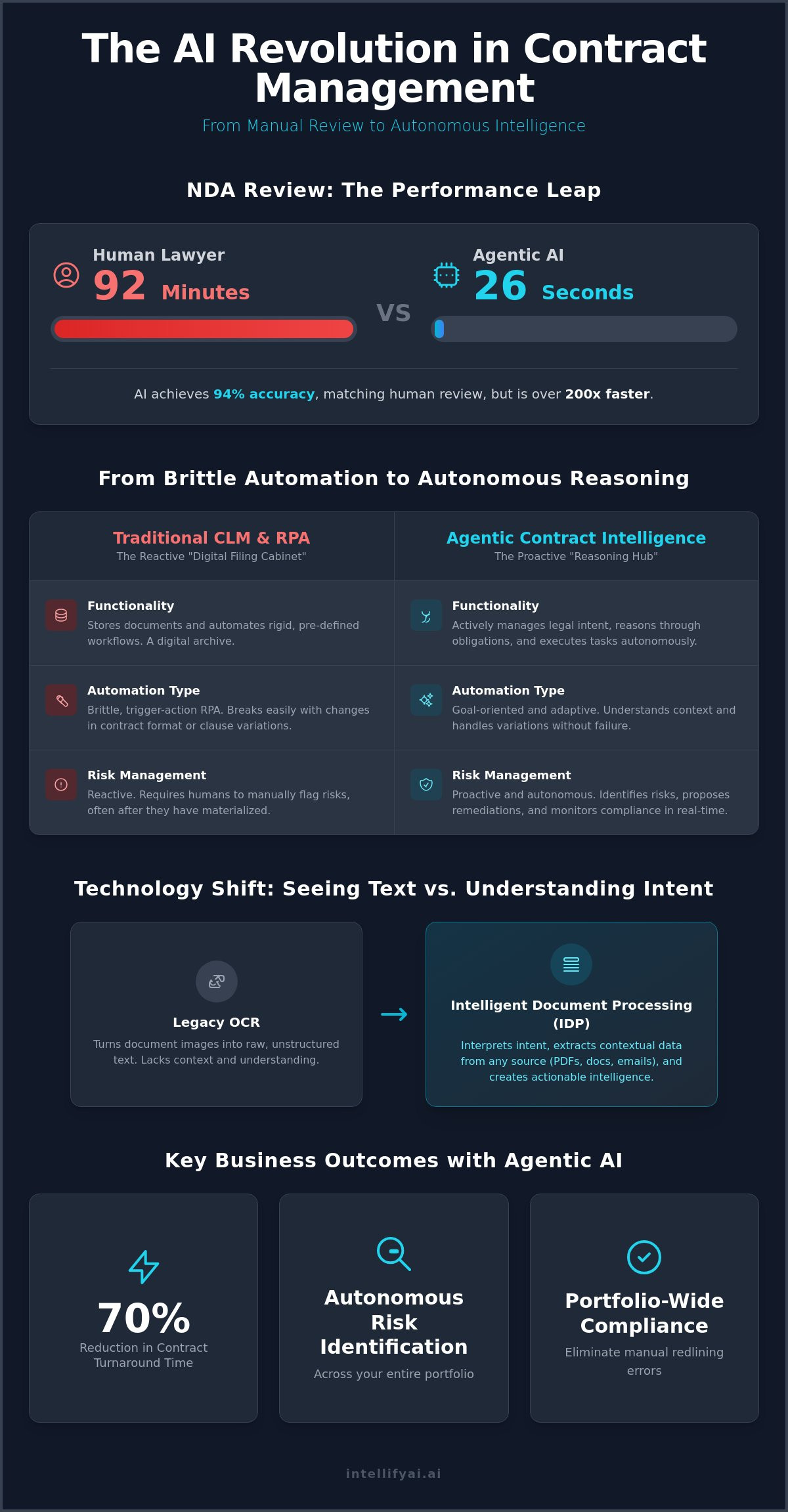
AI now reviews a standard Non-Disclosure Agreement in just 26 seconds with 94% accuracy; a human requires 92 minutes to reach a similar result. This disparity isn't just an efficiency metric. It represents a total paradigm shift in how we deploy ai for contract management. As we move through 2026, the gap between traditional repositories and autonomous systems is widening. You've likely experienced the friction of manual redlining bottlenecks slowing down high-value sales cycles or the anxiety of inconsistent compliance across thousands of legacy documents. Brittle automation that fails the moment a contract format changes is a liability your enterprise can no longer afford.
This guide explores how Agentic AI and Intelligent Document Processing (IDP) transform static files into autonomous, reasoning intelligence hubs. We'll outline a clear strategic roadmap to integrate these technologies into your enterprise modernization plan. You'll discover how to achieve a 70% reduction in contract turnaround time while establishing autonomous risk identification across your entire portfolio. It's time to move beyond simple storage and begin orchestrating legal intent with precision and scale.
Key Takeaways
• Master the transition from passive document storage to autonomous reasoning hubs that actively manage legal intent.
• Leverage i_Nova IDP to transform unstructured legal text into structured, actionable intelligence beyond the capabilities of traditional OCR.
• Identify the strategic advantages of goal-oriented ai for contract management over brittle, trigger-action automation.
• Establish a cloud-native roadmap for enterprise modernization that supports the seamless integration of autonomous agents.
• Align bespoke engineering services with your legal operations to eliminate manual redlining and ensure portfolio-wide compliance.
The Evolution of Contract Management: From CLM to Agentic Intelligence
The landscape of legal operations has shifted from passive record-keeping to proactive orchestration. For decades, Contract Lifecycle Management (CLM) served as a digital filing cabinet; it automated workflows but failed to understand the legal intent buried within the documents. In 2026, the rise of ai for contract management has introduced a new era: Agentic Contract Intelligence. Unlike traditional systems that follow rigid logic, agentic systems possess the cognitive capacity to reason through complex obligations and autonomously execute strategic tasks.
To better understand this concept, watch this helpful video:
Many organizations still rely on basic Generative AI for simple summarization. While helpful, this creates a "Cognitive Gap." Summarization identifies what a contract says, but it cannot determine what should be done about it in a high-stakes legal context. Agentic workflows bridge this gap by transforming the Office of the General Counsel into a hub of real-time intelligence. These systems don't just flag risks; they propose remediations based on historical portfolio data and current regulatory requirements. This modern application of ai for contract management ensures that legal teams focus on high-value strategy rather than administrative triage.
The Limits of Traditional Contract Automation
Traditional automation relies heavily on Robotic Process Automation (RPA) and legacy Natural Language Processing (NLP). These tools are inherently brittle. RPA breaks when a contract format deviates by a single margin. Legacy NLP often struggles with non-standard clause variations, leading to high "exception handling" costs. This hidden tax forces senior legal counsel to spend hours manually correcting machine errors. It's a reactive approach that fails to scale with the speed of modern global commerce.
Defining the Agentic Standard for 2026
An Agentic Contract Agent is a goal-oriented system capable of independent legal reasoning and autonomous task execution. These systems function as Server Intelligence Agents, monitoring contract compliance in real-time across the entire enterprise. They don't wait for a human trigger to identify a breach or an expiring clause. Instead, they actively safeguard the organization’s interests by initiating the necessary protocols. To understand the underlying technology driving these shifts, read our guide on What Is Agentic AI?.
Beyond OCR: How i_Nova IDP Powers Contract Extraction
Optical Character Recognition (OCR) was the first step in the digitization of legal departments. It turned images into text. But text without context is useless for modern legal teams. Strategic enterprises are now moving toward Intelligent Document Processing (IDP) to bridge the gap between raw data and actionable insight. This shift is revolutionizing contract management by allowing systems to understand the nuance of legal language rather than just its shape. Deploying advanced ai for contract management requires this leap from seeing characters to interpreting meaning.
The i_Nova platform serves as the core engine for this transformation. It doesn't just read documents; it ingests multi-modal data. Legal departments often deal with a fragmented ecosystem of scanned PDFs, redlined Word documents, and buried email correspondence. i_Nova creates a unified data layer from these disparate sources. This allows the General Counsel to query the entire portfolio as a single, coherent intelligence hub, removing the friction of manual data entry and cross-referencing.
The Mechanics of i_Nova: Contextual Extraction
i_Nova interprets the intent behind a clause rather than searching for specific keywords. Traditional tools might miss a "limitation of liability" if it's phrased as a "cap on financial exposure." i_Nova uses Large Language Models (LLMs) to map custom vendor terms directly to your corporate playbooks. Each extraction includes a Confidence Score. High scores trigger automated workflows, while low scores flag specific sections for human review. This ensures accuracy without sacrificing the velocity of your sales cycles.
Handling Unstructured Chaos in Legal Workflows
Roughly 80% of enterprise contract data remains unstructured and "dark." It sits in silos, unsearchable and unmanaged. IDP brings this data into the light by processing ancillary documents like Statements of Work (SOWs), amendments, and certificates of insurance. Effective implementation requires more than just software. It relies on robust Data Engineering Services to clean and structure the legal pipeline. If you're ready to modernize your repository, consider how a tailored AI strategy can align these tools with your specific business goals. This holistic approach ensures that your ai for contract management remains a lasting investment in enterprise relevance.
Comparing Traditional CLM vs. Agentic Contract Workflows
Strategic leaders must distinguish between simple automation and true cognitive autonomy. Traditional Contract Lifecycle Management (CLM) systems function as reactive "Trigger-Action" bots; they execute pre-defined tasks only when a specific condition is met. While this reduces some manual labor, it lacks the ability to reason through ambiguity. In contrast, ai for contract management in 2026 is defined by "Goal-Oriented" agents. These systems don't just follow rules; they understand the objective. This shift transforms your legal team from document checkers into strategic architects who design the logic of the enterprise rather than manually policing its outputs.
Cloud-native agentic workflows offer a level of scalability that resource-heavy on-premise customizations simply cannot match. Legacy systems often require months of custom coding to handle new contract types or regulatory shifts. Agentic AI adapts in real-time. It leverages a cloud-native architecture to deploy updates across your entire portfolio instantly. This ensures that your legal operations remain agile, secure, and always aligned with the latest corporate playbooks without the need for constant manual intervention.
Reasoning vs. Rules: The Strategic Differentiator
The core limitation of legacy bots is their reliance on rigid logic. They struggle when a vendor's invoice doesn't perfectly match the Master Service Agreement. Agentic systems autonomously handle "Three-Way Matching" between contracts, purchase orders, and invoices by reasoning through the underlying intent of the data. If a discrepancy exists, the agent analyzes the context to propose a resolution rather than just flagging an error. These agents also identify "Hidden Risk" by cross-referencing your portfolio against external regulatory changes, such as the Colorado AI Act or the EU AI Act. This proactive reasoning allows for deployment speeds that traditional ERP legal modules can't replicate.
Quantifying the Shift: ROI in 2026
Transitioning to an agentic model isn't just a technical upgrade; it's a financial imperative. Poor contract management practices can lead to a loss of 8-9% of annual revenue for companies. Agentic AI mitigates this by providing real-time obligation tracking, effectively sealing the gaps where revenue leakage occurs. You'll see a dramatic reduction in legal spend as autonomous first-pass reviews handle the bulk of routine redlining. To accurately measure the impact on your specific operations, engaging in AI Strategy Consulting is a critical first step. Defining these transformation metrics early ensures that your investment delivers measurable growth and long-term viability.
Implementation Roadmap: Modernising the Legal Tech Stack
Modernising the legal tech stack requires moving beyond the "document silo" mentality. You must transition from legacy legal repositories to a cloud-native, agentic architecture that treats contracts as live data streams. This shift is a core component of Enterprise Modernization. By building a foundation that supports autonomous agents, you're ensuring that your ai for contract management isn't just an isolated tool but a central pillar of your corporate strategy. Integrating these agents into existing platforms like Salesforce, SAP, or Workday allows for a frictionless flow of intelligence across the organization without disrupting established workflows.
The 4-Step Legal Transformation Framework
Step 1: Data Engineering Audit.
AI is only as effective as the data it consumes. You must structure your legal archive to ensure high-fidelity extraction and eliminate the "garbage in, garbage out" cycle.
Step 2: Pilot Agentic Redlining.
Start with high-volume, lower-risk workflows like NDAs or standard vendor agreements. This allows you to prove the reasoning capabilities of the system in a controlled environment.
Step 3: Integration & Orchestration.
Connect i_Nova to your core enterprise ERP. This creates a closed-loop system where contract obligations automatically trigger financial or operational actions.
Step 4: Continuous MLOps.
Refine agent reasoning through MLOps Pipelines. This ensures your agents stay aligned with changing legal playbooks and shifting market conditions.
Governance and Security in Autonomous Legal Ops
Security is the primary objection to autonomous legal operations. You must ensure SOC2 and GDPR compliance by design rather than as an afterthought. Agentic systems maintain an immutable audit trail, which is essential for Sarbanes-Oxley (SOX) compliance. While agents handle the heavy lifting of analysis, high-stakes negotiation approvals still require "Human-in-the-Loop" (HITL) protocols. This collaborative approach ensures that technology enhances human judgment. Version control in automated legal playbooks prevents "logic drift" and maintains consistency across global operations. To begin your transition to an autonomous legal architecture, explore our Agentic AI Engineering Services.
The IntellifyAi Advantage: Engineering the Future of Legal
The promise of ai for contract management is often diluted by one-size-fits-all software that fails to account for the unique complexities of an enterprise. True transformation requires a partner capable of building bespoke systems that integrate with the specific DNA of your organization. IntellifyAi provides Agentic AI Engineering Services that bridge the gap between abstract technical potential and concrete business impact. By combining the power of the i_Nova platform with custom-engineered reasoning models, we enable global legal operations to function with unprecedented precision. This synergy ensures that your legal department moves from a cost center to a strategic engine of growth.
Our vision is rooted in a collaborative relationship between technology and human intelligence. We don't view AI as a replacement for legal expertise. Instead, we frame advanced tools as a liberating force. By removing the burden of repetitive tasks and manual data extraction, we allow your legal professionals to focus on high-value creative work and complex negotiations. This shift doesn't just improve the bottom line; it elevates the role of the General Counsel within the enterprise. It creates a future where legal teams are no longer the bottleneck, but the architects of frictionless commerce. Outside the enterprise, these same principles of data-driven clarity are helping individuals navigate personal dynamics; for example, you can discover more about AI Relationship Intelligence Subscription to see how Ask Jenna brings analytical precision to emotional decision-making.
Why Bespoke Engineering Beats Generic SaaS
Generic SaaS platforms often force your legal team to adapt to their rigid, pre-defined workflows. Bespoke engineering reverses this dynamic. We design agents that adapt to your specific corporate voice and proprietary legal playbooks. This tailored approach ensures that autonomous redlining remains consistent with your unique risk appetite and internal standards. Beyond immediate efficiency, owning a custom AI ecosystem offers a superior long-term ROI compared to the escalating costs of perpetual seat-licensing fees. With a global presence across the UK, USA, India, and the UAE, we provide the technical depth required to support multi-jurisdictional law and complex cross-border compliance.
Next Steps: Navigating the Agentic Frontier
The transition to autonomous legal operations is a journey of digital maturity. We invite you to explore our AI Strategy Consulting services to define your specific transformation roadmap. A Proof-of-Value (PoV) engagement is the most effective way to witness autonomous redlining in action within your own environment. This collaborative approach allows your team to experience the precision of agentic intelligence firsthand. Don't let manual bottlenecks dictate your sales velocity or compromise your compliance standards. Schedule a Strategic Consultation today to begin engineering a frictionless, automated future for your legal enterprise.
Orchestrating the Future of Legal Intelligence
The shift from traditional document storage to reasoning intelligence hubs is no longer a theoretical choice; it's a strategic necessity for the modern enterprise. You've seen how the evolution of ai for contract management allows your legal team to move beyond manual redlining and brittle automation. By leveraging the flagship i_Nova IDP platform, you transform unstructured chaos into actionable data while maintaining enterprise-grade GRC and SOC2 compliance. This transition doesn't just reduce turnaround time. It liberates your high-value talent to focus on the creative strategy that drives growth.
IntellifyAi stands as your Strategic Architect in this digital transformation. Our global expertise in Agentic AI engineering ensures that your transition is secure, scalable, and focused on long-term viability. We bridge the gap between abstract technical complexity and practical, results-oriented execution. The era of the passive legal repository is over. It's time to build a reasoning intelligence hub that safeguards your interests autonomously. Your enterprise is ready to lead the agentic frontier.
Schedule a Strategic AI Consultation with our experts today to begin your journey toward a frictionless legal future.
Frequently Asked Questions
What is the difference between traditional CLM and Agentic AI for contracts?
Traditional CLM systems function as digital filing cabinets that follow rigid, rules-based workflows. Agentic ai for contract management represents a shift toward autonomous reasoning. These systems don't just follow "if-then" logic; they understand the underlying goal of a contract and independently execute tasks like risk remediation. This cognitive autonomy allows the system to adapt to non-standard clauses that typically break traditional automation.
How does Intelligent Document Processing (IDP) handle handwritten or scanned contracts?
IDP leverages multi-modal vision models to interpret data that traditional OCR often misses. It accurately extracts intent from scanned PDFs and handwritten notations by analyzing the spatial and contextual relationships of the text. This capability transforms "dark data" into structured intelligence. It ensures that your legacy archives become searchable assets rather than static liabilities within your legal tech stack.
Can Agentic AI integrate with my existing CRM like Salesforce or HubSpot?
Integration is a core pillar of agentic architecture. These systems function as an orchestration layer that connects directly with Salesforce, HubSpot, SAP, and Workday via cloud-native APIs. By embedding intelligence into your existing CRM, you ensure that contract data flows into your sales cycles without friction. This eliminates manual data entry and provides your teams with real-time visibility into obligation statuses.
Is AI-driven contract management secure enough for sensitive legal data?
Security is maintained through enterprise-grade governance frameworks that prioritize SOC2 and GDPR compliance. Agentic systems create an immutable audit trail for every action taken, which is critical for Sarbanes-Oxley (SOX) reporting. Data is processed within secure, cloud-native environments using advanced encryption and access controls. This ensures that sensitive information remains protected while providing the transparency required for rigorous regulatory audits.
How much can an enterprise save by modernising their contract workflows with AI?
Modernising your workflows can recover a significant portion of the 8-9% of annual revenue typically lost to poor contract management. By implementing ai for contract management, enterprises often achieve a 70% reduction in turnaround time. These savings stem from the elimination of manual redlining and the prevention of revenue leakage through real-time obligation tracking. It's a high-velocity investment that delivers measurable impact.
Does Agentic AI replace the need for in-house legal counsel?
Technology serves as a partner to human expertise rather than a replacement. Agentic AI handles the repetitive burden of first-pass reviews and data extraction, which allows in-house legal counsel to focus on high-value creative work. By automating routine administrative tasks, your team can pivot to strategic architecture and complex negotiations. This collaborative model unlocks human potential and ensures that professionals remain focused on high-stakes decision-making.
What is the typical implementation timeline for the i_Nova IDP platform?
Implementation follows a structured 4-step roadmap designed for minimal disruption to your operations. It begins with a data engineering audit to structure your legal archive, followed by a pilot phase for high-volume workflows like NDAs. Full orchestration with your enterprise ERP and continuous MLOps refinement follow. This layered approach ensures that you realize measurable value at every stage of the digital transformation journey.
How does AI help in identifying regulatory compliance risks across legacy contracts?
AI identifies risks by autonomously cross-referencing your entire portfolio against real-time regulatory updates. It flags inconsistencies with new mandates such as the EU AI Act or the Colorado AI Act. Instead of manually reviewing thousands of legacy documents, you can query the system to identify every clause that requires remediation. This proactive approach ensures total compliance across global operations without the need for massive manual audits.







.svg)