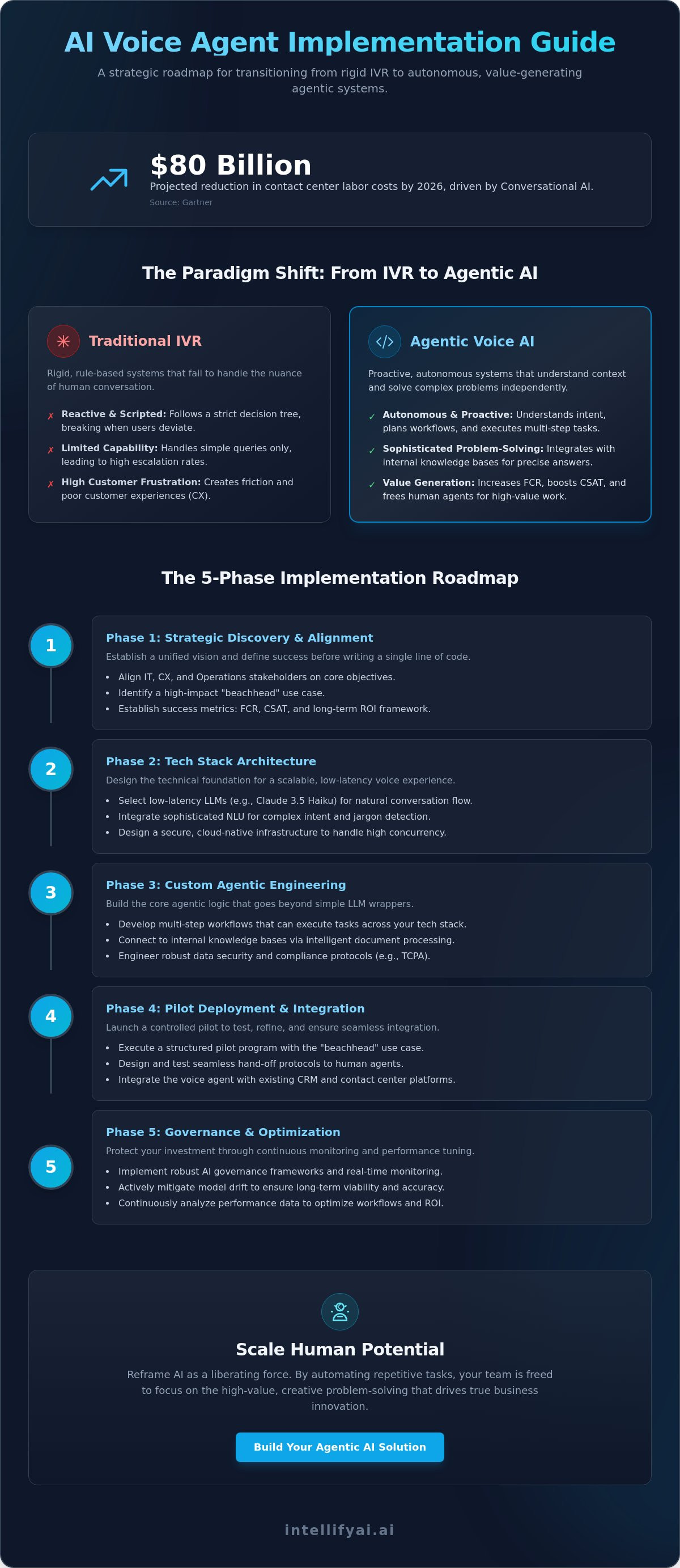
Gartner forecasts that conversational AI will reduce contact center labor costs by $80 billion by the end of 2026. You likely recognize that the era of rigid, scripted IVR systems is over. Customers now demand frictionless, intelligent interactions that legacy infrastructure simply cannot provide. This ai voice agent implementation guide addresses the high-stakes transition toward autonomous intelligence, helping you navigate concerns over LLM hallucinations and complex compliance requirements like the TCPA's evolving rulings on artificial voices.
This guide provides the strategic framework you need to deploy agentic voice intelligence that transforms your customer experience and drives measurable ROI. We will examine the requirements for a cloud-native infrastructure that scales with your enterprise while ensuring rigorous data security. You'll discover how advanced technology acts as a liberating force, removing the burden of repetitive tasks so your team can focus on high-value creative work. This is a roadmap for serious enterprises ready to bridge abstract technical fields with practical, bottom-line results.
Key Takeaways
• Transition from simple automation to value-generating agentic systems by aligning IT, CX, and Operations under a unified strategic vision.
• Optimize your technological stack by selecting low-latency LLMs and integrating sophisticated NLU for complex intent detection.
• Follow this ai voice agent implementation guide to execute a structured 5-phase roadmap, moving from strategic discovery to custom agentic AI engineering.
• Protect your investment through robust AI governance frameworks and real-time monitoring to mitigate model drift and ensure long-term viability.
• Reframe technology as a liberating force by designing seamless hand-offs that allow human staff to focus on high-value, creative problem-solving.
Defining the Strategic Blueprint for Agentic Voice Intelligence
Successful deployment starts with a fundamental shift in perspective. Most organizations view voice automation as a simple mechanism to trim operational overhead. This mindset is a trap. In 2026, the true objective is value generation through intelligent autonomy. This ai voice agent implementation guide frames the transition as an architectural evolution rather than a mere software upgrade. You're building a system that doesn't just answer questions but solves problems independently.
To succeed, you must adopt the mindset of a Strategic Architect. This involves aligning stakeholder expectations across IT, CX, and Operations from day one. When these departments share a unified vision, the technology becomes a liberating force rather than a point of friction. Start by identifying a "beachhead" use case. This should be a specific business challenge where the complexity is manageable but the potential impact is high. Balancing immediate wins with long-term scalability ensures your project maintains momentum.
To better understand the technical execution of these agents, watch this helpful tutorial:
The Shift from IVR to Agentic AI
Traditional IVR systems rely on rigid, rule-based decision trees. These systems fail in the modern enterprise because they can't handle the nuance of human conversation. When a customer deviates from the script, the IVR breaks. Agentic AI is different. It's proactive and autonomous. In the context of voice, "agentic" means the system understands context, plans multi-step workflows, and executes tasks without constant human intervention. It moves your contact center from reactive responses to sophisticated problem-solving.
Establishing Success Metrics and ROI Frameworks
Measuring performance in an autonomous environment requires updated KPIs. First Call Resolution (FCR) remains critical, but you must now evaluate how effectively the AI handles complex intents without escalating to a human. Calculating the long-term ROI of AI strategy consulting is equally vital. It's not just about the cost per minute; it's about the total value of recovered human time and increased customer lifetime value. High-performing systems balance operational efficiency with rising CSAT scores, ensuring that automation never comes at the expense of the customer experience.
Engineering the Stack: From LLM Wrappers to Agentic Architectures
Building a voice agent that truly understands your business logic requires more than a simple API connection to a popular model. Most off-the-shelf retail software lacks the depth needed for complex enterprise workflows. This ai voice agent implementation guide emphasizes the transition toward custom agentic architectures. You aren't just wrapping an LLM in a voice interface. You're architecting a system capable of executing multi-step tasks across your entire tech stack. Rule-based systems break under pressure. Agentic systems adapt.
Selecting the right foundational model is your first critical decision. For low-latency voice interactions, models like GPT-5.5 Instant or Claude 3.5 Haiku provide the rapid response times necessary to maintain natural conversation flow. However, the model is only one component. You must integrate sophisticated Natural Language Understanding (NLU) to detect intent when customers use industry-specific jargon or complex phrasing. True autonomy also requires access to your internal knowledge bases. By integrating voice with intelligent document processing, your agents can reference unstructured data in real-time to provide precise, context-aware answers.
Enterprise-grade performance demands more than just smart models. It requires a foundation of custom agentic AI engineering to ensure stability and security at scale.
Cloud-Native Infrastructure for Scalable Voice
Your infrastructure must handle high concurrency without sacrificing performance. Designing for low-latency voice requires a distributed architecture that processes audio streams in near real-time. This is where enterprise modernization becomes a strategic necessity. A cloud-native stack allows you to scale resources dynamically as call volumes fluctuate. Implement FinOps practices early to optimize cloud costs. This ensures your deployment remains financially viable as usage grows across the organization.
Data Engineering: The Lifeblood of Intelligent Agents
Data quality determines the success of your AI. Preparing your data pipeline for Real-Time Interaction (RTI) is essential for providing agents with up-to-the-second information. If your data is siloed or inaccurate, your voice agent will provide "garbage" results. Use MLOps to create a cycle of continuous model improvement. This framework allows you to monitor performance and retrain models based on actual customer interactions. Constant monitoring prevents model drift and ensures your agents remain aligned with your business objectives over time.
The 5-Phase Implementation Roadmap for Enterprise Deployment
Executing a successful deployment requires a transition from abstract vision to rigorous technical application. Many organizations falter by treating AI as a plug-and-play solution. This ai voice agent implementation guide outlines a structured, 5-phase approach designed to minimize risk while maximizing long-term ROI. By following this roadmap, you ensure that your autonomous agents are deeply embedded in your business logic and operational workflows. Success is found in the details of integration and the precision of your engineering strategy.
Phase 1 & 2: Strategic Foundation and Engineering
The journey begins with Discovery and Strategic Roadmap Development. You must move beyond surface-level goals to conduct a rigorous Proof-of-Value (PoV). This validates your core assumptions before you commit significant resources. Once the value proposition is clear, the focus shifts to Agentic AI engineering and prototyping. During this phase, you build custom agentic workflows that understand your specific business context. You also design a "Voice Persona" that reflects your brand identity. This isn't just about choosing a voice. It's about defining the tone, vocabulary, and personality that will represent your enterprise in every interaction.
Phase 3 & 4: Integration and Quality Assurance
Integration is the bridge between a technical demo and a functional enterprise solution. Your agents must connect seamlessly with your CRM, ERP, and internal knowledge bases to provide accurate, real-time responses. This phase involves deep technical work to ensure your cloud-native infrastructure communicates effectively with legacy systems. Following integration, you must move into rigorous testing and security hardening. Don't just test for common queries. Stress-test your agents for "edge cases" and evaluate their emotional intelligence during high-friction calls. Security audits are non-negotiable. Ensure your system meets SOC2 and GDPR compliance standards to protect sensitive voice data and maintain customer trust.
The final stage, Phase 5, involves managed deployment and continuous optimization. Deployment is not a one-time event. It's the start of a feedback loop where real-world data informs ongoing model refinement. A Forrester study found that organizations following a structured implementation can achieve an ROI of up to 391% over three years. By monitoring performance in real-time, you can identify model drift and correct it before it impacts the customer experience. This proactive approach ensures your investment remains relevant and continues to deliver value as market conditions and customer expectations evolve.
Optimizing Performance, Governance, and Long-Term ROI
Deploying a voice agent is only the beginning. True enterprise value is realized through the rigorous optimization of performance and the establishment of a robust governance framework. This ai voice agent implementation guide views governance not as a bureaucratic hurdle but as a foundational pillar for sustainable growth. Without a clear strategy for managing model drift and data privacy, even the most advanced agentic systems can become liabilities. You must transition from the "build" phase to a mindset of continuous architectural refinement.
Governance starts with compliance. The FCC's 2024 classification of AI-generated voices as "artificial" under the TCPA has fundamentally changed the legal landscape. Violations can now result in penalties between $500 and $1,500 per call. A proposed rule from September 2024 would even require mandatory disclosure at the start of every AI interaction. Serious enterprises must integrate these transparency requirements into their core logic. This ensures that your autonomous CX remains both ethical and legally sound across global jurisdictions, including those governed by the EU AI Act.
Governance and Ethical AI in Voice
Ethical AI in voice communication requires more than just legal compliance. You must actively mitigate bias in speech recognition and response generation. If your models aren't trained on diverse datasets, they may struggle with regional accents or non-native speakers, leading to friction in the customer journey. Managing data retention is equally critical in high-stakes industries like finance or healthcare. Your architecture must prioritize privacy by design, ensuring that sensitive information is handled with the same level of security as your most critical back-office systems.
Continuous Optimization and MLOps
To maintain a competitive edge, you need a system that learns from every interaction. Implementing MLOps pipelines allows your team to automate the feedback loop between AI performance and human oversight. When an agent escalates a call to a human expert, that data point should be captured and used to refine the model's logic. This iterative process prevents the stagnation that often plagues legacy IVR systems. Version control is also essential. You must be able to roll back voice prompts or agentic workflows instantly if a new deployment doesn't meet your performance benchmarks.
Scaling horizontally to meet global demand requires a cloud-native infrastructure that supports high-velocity updates without downtime. As a Strategic Architect, you aren't just managing the current system; you're planning for the next version of intelligence. This foresight ensures your CX infrastructure remains a lasting investment in relevance rather than a temporary fix. For organizations ready to formalize this process, our AI Strategy & Consulting services provide the roadmap for long-term governance and ROI.
Scaling Human Potential through Agentic Engineering
Advanced technology is not a replacement for human talent. It's a liberating force that allows your team to focus on high-value, creative work. This ai voice agent implementation guide concludes with the most critical element of any digital transformation: the synergy between autonomous systems and the people who manage them. By removing the burden of repetitive, low-complexity tasks, you empower your workforce to engage in the nuanced problem-solving that defines a superior customer experience. The goal is a frictionless collaboration where technology handles the volume and humans handle the complexity.
Change management is the bridge between technical deployment and organizational success. Successful leaders recognize that AI strategy and consulting plays a vital role in this transition. You must design seamless hand-offs that preserve context during the transfer from an AI agent to a human expert. When a customer is escalated, the human agent should receive a full transcript and intent summary. This eliminates the need for the customer to repeat themselves, maintaining the momentum of the interaction and preserving CSAT scores.
The Collaborative Workforce Model
Training your staff to work alongside autonomous agents is essential for building a future-proof workforce. In this model, AI voice agents handle the initial triage and routine data entry, which are often the primary sources of employee burnout. Industry data suggests that reducing these repetitive burdens leads to measurable improvements in employee satisfaction and retention. Your team becomes more than just call takers. They become strategic problem solvers who leverage AI as a sophisticated tool for better outcomes.
Partnering with IntellifyAi for Transformation
Generic retail solutions often fail to meet the specific security and operational requirements of serious enterprises. Our end-to-end approach moves beyond simple software installation to provide custom engineering and managed services tailored to your unique stack. We act as your Strategic Architect, ensuring that your CX infrastructure is built for long-term viability and measurable financial returns. Don't settle for temporary fixes. Contact our consultants today to start architecting a more intelligent, autonomous future for your enterprise.
Architecting Your Autonomous Future
Digital transformation is no longer a choice between human talent and machine efficiency; it's a strategic synthesis of both. By moving beyond basic LLM wrappers toward sophisticated agentic architectures, your enterprise can unlock new levels of operational agility and customer satisfaction. This ai voice agent implementation guide provides the framework to navigate this high-stakes transition with confidence and precision. Success is found in the details of your engineering strategy and the strength of your governance framework.
IntellifyAi brings deep technical expertise in Agentic AI and enterprise modernization to every partnership, supported by a global presence in the UK, USA, India, and the UAE. Our flagship i_Nova platform for intelligent document processing ensures your agents have the unstructured data they need to perform at an elite level. We act as your Strategic Architect, bridging abstract technical fields with the practical needs of your growing company. The path to autonomous CX is clear for those ready to lead.
Partner with IntellifyAi for your custom AI voice agent engineering and turn your visionary strategy into measurable results. Your journey toward a frictionless future begins today.
Frequently Asked Questions
How long does it take to implement an enterprise AI voice agent?
A full enterprise deployment typically requires 12 to 24 weeks from discovery to managed rollout. You can establish a Proof-of-Value in approximately 4 to 6 weeks to validate core assumptions and technical feasibility. The total timeline depends on the complexity of your legacy integrations and the specific regulatory requirements of your industry.
Can AI voice agents handle complex, multi-step customer inquiries?
Yes, agentic systems are specifically engineered to manage multi-step workflows and complex business logic. Unlike legacy IVR systems that rely on rigid scripts, these agents use advanced reasoning to plan and execute tasks. They can verify identity, query internal databases, and update account records in real-time without human intervention.
What is the difference between a standard chatbot and an Agentic AI voice agent?
The primary difference is the shift from reactive scripts to autonomous reasoning. Standard chatbots follow pre-defined decision trees that break when a customer deviates from the path. Agentic voice agents use large language models to understand context, handle interruptions, and navigate non-linear conversations. This ai voice agent implementation guide prioritizes these autonomous capabilities for enterprise scale.
How much does an enterprise AI voice agent implementation cost?
Total investment varies based on your architectural complexity, call volume, and the depth of custom engineering required. You must account for component costs such as speech-to-text (STT), large language model (LLM) tokens, and telephony usage. Serious enterprises focus on the total cost of ownership and the long-term ROI generated through recovered human time and increased operational efficiency.
Is AI voice agent implementation secure for regulated industries like finance?
Security is a foundational pillar of enterprise-grade AI architecture. Successful implementations utilize SOC2, GDPR, and HIPAA-compliant frameworks to ensure data privacy and integrity. You must prioritize encryption for voice data and establish clear governance protocols for data retention. This ensures your autonomous CX remains compliant with evolving federal and state-level regulations.
Will an AI voice agent replace my entire customer service team?
No, the technology acts as a liberating force for your existing workforce. It removes the burden of repetitive, low-value tasks like password resets or balance inquiries. This allows your human experts to focus on high-stakes, emotional, or highly nuanced problem-solving. The goal is a collaborative model where AI handles volume and humans handle complexity.
How do I measure the ROI of my AI voice agent implementation?
Measure success through a blend of operational and experience-centric KPIs. Focus on First Call Resolution (FCR), average handle time (AHT) reduction, and CSAT scores. Gartner predicts that conversational AI will reduce contact center labor costs by $80 billion in 2026. A successful ai voice agent implementation guide ensures these metrics align with your broader financial objectives.
What technical infrastructure is required for a low-latency voice agent?
You need a cloud-native, distributed architecture designed for high concurrency and real-time processing. This requires low-latency STT and TTS providers, along with robust API layers for seamless data exchange. Modernizing your stack ensures that your agents can access unstructured data through intelligent document processing, providing accurate responses in milliseconds to maintain natural conversation flow.








.svg)