Your legacy ECM isn't just an aging repository. In 2026, it's a structural liability that prevents your business from achieving true system autonomy. While 70% of new content systems now integrate AI capabilities, many organizations remain paralyzed by the high maintenance costs of on-premise servers. Successfully migrating from legacy ecm systems is no longer a simple IT task. It's a foundational data engineering exercise designed to fuel the next generation of agentic AI.
We understand the pressure to modernize while managing compliance risks like the EU's DORA requirements. It's frustrating to watch up to 80% of your tech spend vanish into legacy maintenance while your competitors leverage unstructured data for growth. This article provides a strategic roadmap to transform your stagnant archives into high-velocity assets. You'll learn how to achieve a seamless cloud-native transition that reduces your total cost of ownership and prepares your content for autonomous processing. We'll explore the specific steps to move from data silos to a unified, AI-ready environment.
Key Takeaways
• Reframe legacy ECM systems as structural liabilities that create an "Intelligence Gap" rather than business assets, and learn how to bridge that gap with API-driven access.
• Execute a strategic framework for migrating from legacy ecm systems that prioritizes intelligent discovery and data normalization over traditional "lift and shift" methods.
• Uncover and index "Dark Data" buried within proprietary schemas to ensure your entire content library is visible and ready for autonomous agentic processing.
• Implement autonomous document approval loops and agentic workflows that allow your team to focus on high-value strategy instead of repetitive administrative tasks.
• Leverage specialized Agentic AI Engineering Services to accelerate your modernization journey and turn unstructured data into a measurable competitive advantage.
The Imperative for Migrating from Legacy ECM Systems in 2026
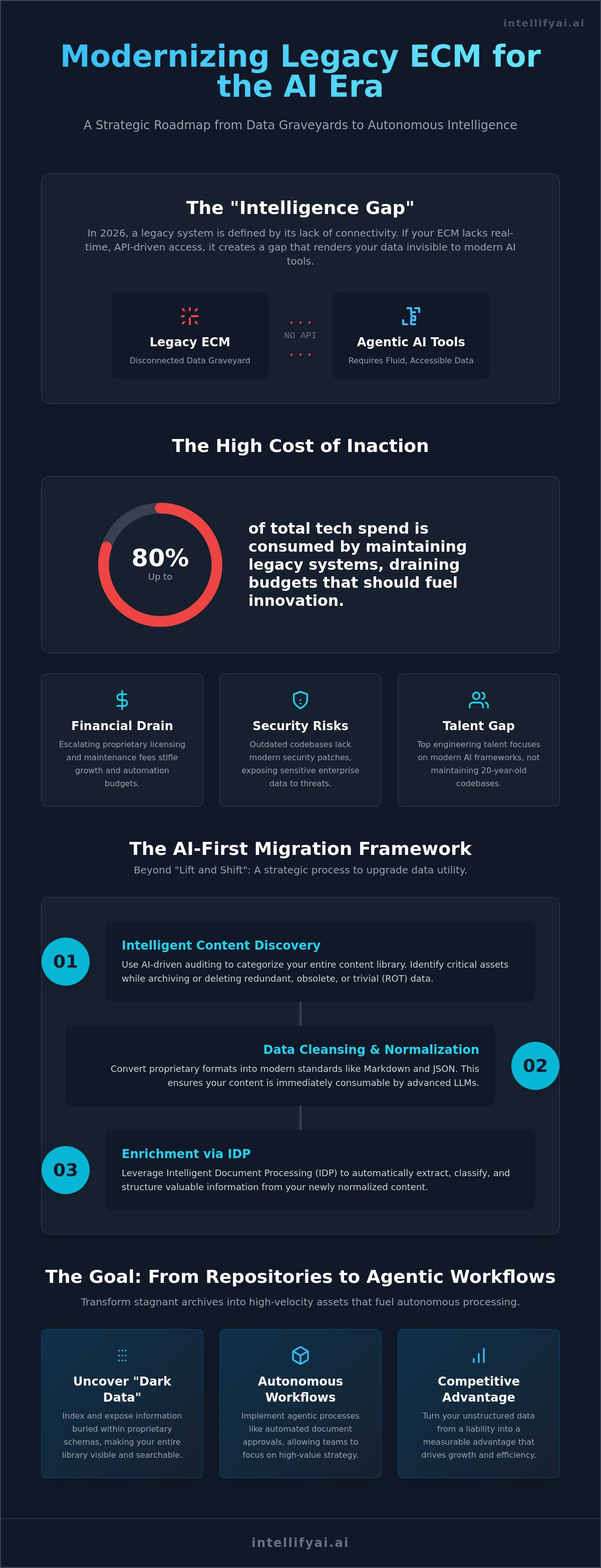
In 2026, the definition of a legacy system has evolved. It's no longer determined by the date of installation, but by its level of connectivity. If your Enterprise Content Management (ECM) platform cannot provide real-time, API-driven access to its contents, it's a legacy system. These environments create what we call an "Intelligence Gap." They function as data graveyards where unstructured information remains stagnant, rather than serving as dynamic assets for the enterprise.
The shift toward agentic AI has made content modernization a survival requirement. Migrating from legacy ecm systems allows organizations to transform these silos into accessible fuel for intelligent workflows. Without this transition, your proprietary data is essentially invisible to the very AI tools designed to optimize your business. Content must be fluid to be useful.
To better understand the mechanics of this transition, watch this helpful video:
The High Cost of Inaction
Maintaining on-premise infrastructure is becoming an unsustainable financial burden. Research shows that 70% to 80% of the total tech spend in many organizations is still consumed by legacy systems. This isn't just about electricity and floor space. It's about the escalating cost of proprietary licensing for software that no longer innovates. These fees drain budgets that should be allocated toward growth and automation.
Security risks also multiply as these systems age. Outdated codebases often lack the patches necessary to defend against modern threats, leaving your most sensitive data exposed. Additionally, the talent gap is widening. Finding engineers willing or able to maintain 20-year-old ECM codebases is nearly impossible. Most top-tier talent is focused on agentic frameworks, not legacy maintenance. Postponing the process of migrating from legacy ecm systems only increases the eventual cost of the technical debt you'll have to pay.
From Content Repositories to Intelligence Hubs
The traditional "store and retrieve" model is dead. In its place, 2026 demands an "analyze and execute" architecture. Modern systems don't just hold documents; they understand them. This evolution is at the heart of Enterprise Modernization. It shifts the focus from simple file storage to creating a centralized intelligence hub that interacts with your entire tech stack.
Migration is the catalyst for a broader AI strategy consulting roadmap. It prepares your unstructured data for ingestion by large language models and autonomous agents. By moving to a cloud-native environment, you turn every document into a high-velocity asset. This allows your team to focus on high-value creative work while AI handles the repetitive tasks of classification and extraction. The goal is no longer just to save files, but to empower people.
The AI-First Migration Framework: Beyond "Lift and Shift"
Traditional migration strategies often fail because they treat content as static objects rather than dynamic intelligence. A simple "lift and shift" rehosts your technical debt in a new environment without addressing the underlying lack of structure. In 2026, migrating from legacy ecm systems requires a five-step framework designed to turn every file into an AI-ready asset. This methodology ensures that the transition doesn't just move data but actually upgrades its utility for the entire organization.
Step 1: Intelligent Content Discovery.
Use AI-driven auditing to categorize your library. This allows you to identify critical assets while archiving or deleting redundant, obsolete, or trivial (ROT) data.
Step 2: Data Cleansing and Normalization.
Modern LLMs thrive on markdown and JSON. Converting proprietary formats into these standards ensures your content is immediately consumable by advanced models.
Step 3: Enrichment via IDP.
Extract metadata during the migration flight. This adds a layer of semantic meaning to otherwise "flat" files, turning them into searchable intelligence.
Step 4: Vectorization for RAG.
Prepare your content for Retrieval-Augmented Generation. Creating high-quality vector embeddings is essential for grounding AI outputs in your unique corporate knowledge.
Step 5: Validation and Governance.
Maintain SOC2 and GDPR compliance by verifying data integrity post-migration. Auditable records are non-negotiable in highly regulated sectors.
Leveraging IDP for Semantic Enrichment
Our i_Nova platform serves as the engine for this transformation. It goes beyond simple optical character recognition to extract actionable intelligence from unstructured documents as they move. This metadata is the primary map used by what is an ai agent to navigate and act upon your enterprise knowledge. Intelligent Document Processing (IDP) is the bridge between raw legacy files and structured AI insights. By enriching data at the point of ingestion, you ensure your future agents operate with maximum context and precision. This approach turns a routine move into a strategic upgrade.
Cloud-Native Modernization Strategies
Choosing the right architecture is a strategic decision that impacts long-term scalability. While public clouds offer unmatched flexibility, many enterprises are opting for Private AI Clouds to maintain tighter control over their models and data. A microservices-based approach allows you to decouple content services from specific applications, making your infrastructure resilient to future shifts in technology. Throughout the process of migrating from legacy ecm systems, maintaining data lineage is critical. You must be able to prove the provenance of every piece of data to satisfy both internal audits and external regulators. To ensure your architecture is built for this level of autonomy, consider exploring our Agentic AI Engineering Services for a custom modernization roadmap.
Overcoming the Challenges of Legacy Content Migrations
"Dark Data" is the silent killer of enterprise efficiency. Approximately 80% of the data generated daily by enterprises is unstructured and unindexed, leaving it invisible to modern analysis. When migrating from legacy ecm systems, this invisible mass creates a significant technical hurdle. You cannot simply move what you cannot see. Identifying and indexing this content is the first step in reclaiming your institutional knowledge.
Proprietary database schemas in platforms like FileNet or Documentum add another layer of complexity. These systems were built as closed ecosystems, making data extraction a delicate operation. Handling high-volume migrations at the petabyte scale requires a strategy that avoids system downtime entirely. A "big bang" cutover is rarely feasible for serious enterprises. Instead, we employ parallel processing and delta synchronization to keep operations running while the data moves. This ensures business continuity remains uncompromised.
The most common objection we encounter is the fear of losing a compliance trail. In a world governed by regulations like the EU's DORA, an auditable record is essential. You cannot afford to lose the historical context of a document during the move. Our framework treats the audit trail as a first-class citizen, ensuring that every signature, timestamp, and version history remains intact. Protecting this data lineage is a non-negotiable requirement for 2026 readiness.
Solving the Metadata Integrity Crisis
Maintaining context is the hardest part of any migration. We use automated mapping tools to bridge the gap between legacy fields and modern metadata schemas. By implementing automated MLOps pipelines, we ensure continuous data validation throughout the transfer. This isn't just about moving data; it's about re-tagging legacy content with modern compliance labels. This process ensures your data arrives in the cloud-native environment not just intact, but better organized than when it left.
Managing Stakeholder Resistance and Adoption
Technology is only half the battle. Success depends on human adoption. We minimize disruption by using phased "waves" of migration, allowing departments to transition at a manageable pace. If the new system feels more difficult than the legacy one, users will find workarounds that create new data silos. Priority must be given to a frictionless user experience. When presenting the ROI of migrating from legacy ecm systems to executive leadership, focus on the reduction in total cost of ownership. Remind them that while data cleansing can consume 15% to 25% of a migration budget, this is an investment in the long-term viability of the company's intelligence assets.
The Strategic Roadmap: From Repositories to Agentic AI Workflows
Modernization is not a destination. It's an enabling state. When migrating from legacy ecm systems, your content is no longer a collection of static files. It becomes the foundational layer for system autonomy. The goal is to transition from passive repositories to active "Agentic" workflows. In this model, AI doesn't wait for a human to open a file. It monitors the content stream and initiates actions based on what it finds. By leveraging our Agentic AI Engineering Services, enterprises can implement automated document approval loops that function without constant manual intervention. This moves your team away from administrative drudgery and toward high-value strategic execution.
Integrating this migrated data with enterprise communication tools like Slack or Microsoft Teams via AI agents creates a frictionless communication layer. Instead of searching through a database, employees interact with an agent that understands the entire corporate history. Your archive becomes a "living" entity that self-organizes as new data is ingested. This ensures that information is always where it needs to be before a human even asks for it. Successfully migrating from legacy ecm systems turns your data from a cost center into a high-velocity asset.
Building Autonomous Document Workflows
Imagine an agent that monitors your newly migrated invoice archive. It doesn't just store the PDF; it reads the line items, summarizes the terms, and files the record in the correct ledger automatically. This shift from manual searching to Natural Language Querying (NLQ) allows users to ask complex questions of their data rather than navigating rigid folder structures. By utilizing API-based Parsing Subscriptions to handle the underlying data extraction, Agentic AI transforms a document from a file into a trigger for a business process. This level of automation ensures that your modernized infrastructure is an active participant in your company's growth.
Future-Proofing with Generative AI
The application of generative ai allows you to extract fresh value from 20-year-old corporate records that were previously inaccessible. By fine-tuning Large Language Models (LLMs) on your specific migrated corpus, you create a proprietary intelligence that understands your unique business logic. This isn't a temporary fix. It's a long-term investment in relevance. As we look toward the trends of 2027, your infrastructure will be ready to support even more advanced autonomous agents. This roadmap ensures your enterprise remains ahead of the curve while maintaining the stability of your operations.
To begin architecting your autonomous future, consult with our experts on Agentic AI Engineering Services today.
Partnering with IntellifyAi for Enterprise Transformation
IntellifyAi isn't just another software vendor. We act as strategic architects for the modern enterprise. Successfully migrating from legacy ecm systems requires a holistic philosophy that balances high-level visionary thinking with clinical technical execution. Our methodology unifies strategic consulting with custom Agentic AI engineering to ensure your content doesn't just move; it matures. We provide comprehensive, end-to-end support that begins with a granular technical audit and extends far beyond the initial transfer to include post-migration AI model optimization. This rigorous approach ensures your new cloud-native environment remains a lasting investment in your company's relevance.
The i_Nova platform is a cornerstone of our technical delivery. It significantly accelerates the Intelligent Document Processing (IDP) phase, transforming unstructured archives into high-velocity, actionable assets. By extracting semantic meaning during the migration flight, we eliminate the "Intelligence Gap" that often plagues traditional IT projects. The ultimate goal is operational liberation. We aim to remove the burden of repetitive data management, allowing your human workforce to focus on the high-value creative work that drives growth. This transition isn't just about storage; it's about maximizing your financial returns and ensuring total compliance in an increasingly regulated landscape.
IntellifyAi’s Engineering Edge
Our engineering team possesses deep expertise in cloud-native modernization and large-scale data engineering. We maintain a global presence, which allows us to handle petabyte-scale enterprise projects with the precision and security serious organizations demand. We bridge the gap between abstract AI fields and the practical needs of a growing business. We don't speak to hobbyists; we partner with serious enterprises looking to lead their industries. We invite you to explore our consulting services to discover how we build roadmaps that respect your operational stability while aggressively pursuing innovation.
Next Steps: Initiating Your Modernization Audit
A full-scale migration is a complex strategic move. We recommend beginning with a Proof-of-Value (PoV) engagement. This focused period allows our specialists to assess your current ECM technical debt and demonstrate the measurable impact of our agentic framework on a specific segment of your data. It's a logical first step that validates the ROI and ensures the security of your operations before a global rollout. Don't let aging servers and unindexed data silos dictate your technical ceiling. It's time to turn your legacy content into a high-velocity asset. Contact our strategic architects to begin your transformation and secure your position in the autonomous future.
Architecting Your Autonomous Enterprise
The transition from stagnant repositories to dynamic intelligence hubs is the defining strategic shift of 2026. By migrating from legacy ecm systems, you eliminate the intelligence gap and reclaim the 80% of your enterprise data that currently remains unindexed. This process turns historical records into high-velocity assets that fuel autonomous workflows and advanced generative AI models. It's no longer enough to store information; you must activate it to maintain a competitive edge. Modernization allows your human workforce to step away from repetitive data retrieval and focus on high-value creative strategy.
IntellifyAi brings global enterprise transformation expertise to every engagement. Our flagship i_Nova IDP platform ensures your data is semantically enriched during the migration flight, while our specialists in agentic AI engineering bridge the gap between technical complexity and business-centric results. We provide the stability your operations require and the innovation your future demands. Success is within reach for those who view their content as a pillar of growth rather than a maintenance burden.
Request a Strategic Modernization Audit to assess your current technical debt and begin your journey toward system autonomy. We look forward to building your frictionless future together.
Frequently Asked Questions
What are the main risks when migrating from legacy ECM systems?
The primary risks include metadata corruption, loss of data lineage, and operational downtime. Without a strategic framework, proprietary schemas can lead to unreadable files in the destination system. We mitigate these risks by using parallel processing and automated validation pipelines. This ensures that your compliance trail remains intact while your business continues to function without interruption during the transfer.
How long does a typical enterprise ECM migration take in 2026?
A typical enterprise migration in 2026 takes between six and eighteen months. This timeline depends on the volume of data, the complexity of legacy schemas, and the required level of AI enrichment. While a simple lift and shift is faster, a strategic transition focused on AI readiness requires time for data cleansing and vectorization. We use high-velocity engineering to accelerate this timeline without compromising data integrity.
Can we migrate our legacy data directly into an AI-ready vector database?
Yes, you can migrate legacy data directly into a vector database through an automated engineering pipeline. This process involves extracting text, generating embeddings, and indexing content for Retrieval-Augmented Generation (RAG). Migrating from legacy ecm systems in this manner ensures your institutional knowledge is immediately accessible to agentic workflows. It transforms static archives into a searchable, high-velocity intelligence layer for your enterprise AI initiatives.
How does Intelligent Document Processing (IDP) differ from standard OCR during migration?
OCR merely converts images to text, while Intelligent Document Processing (IDP) extracts semantic meaning and structured metadata. IDP uses machine learning to understand the context of a document, such as identifying an invoice amount or a contract expiration date. During migration, IDP acts as the intelligence layer that categorizes and tags content automatically. This makes your data significantly more useful for autonomous agents than simple text extraction ever could.
What happens to our existing compliance and retention policies during the move?
Your existing compliance and retention policies are mapped and modernized during the transition. We use automated tools to carry over historical timestamps, signatures, and versioning records to the new cloud-native environment. This ensures that your organization remains compliant with regulations like the EU's DORA. By re-tagging content with modern labels, we actually improve your governance posture post-migration.
Is it possible to migrate from multiple legacy sources into a single unified platform?
Consolidation is a primary objective when migrating from legacy ecm systems. We frequently move data from multiple silos into a single, unified intelligence hub. This eliminates data fragmentation and provides a "single source of truth" for your AI agents. By normalizing diverse proprietary formats into a standard schema, we create a frictionless environment where information flows freely across the entire enterprise.
How do we calculate the ROI of a legacy ECM migration project?
ROI is calculated by measuring the reduction in total cost of ownership (TCO) alongside productivity gains from automation. You'll see immediate savings from eliminating legacy licensing fees and on-premise server maintenance, which often consume 70% of tech budgets. Long-term value is realized through the operational liberation of your workforce. Employees spend less time on manual document processing, allowing them to focus on high-value strategic work.
Will our employees need extensive training on the new AI-driven system?
Employees generally require less training than they did for legacy systems. Modern AI-driven platforms use Natural Language Querying (NLQ), allowing users to find information using simple conversational language. Instead of learning complex folder hierarchies, team members interact with intuitive AI agents. This shift reduces the learning curve and increases adoption rates. The technology adapts to the human worker, rather than forcing the human to adapt to the software.






.svg)