
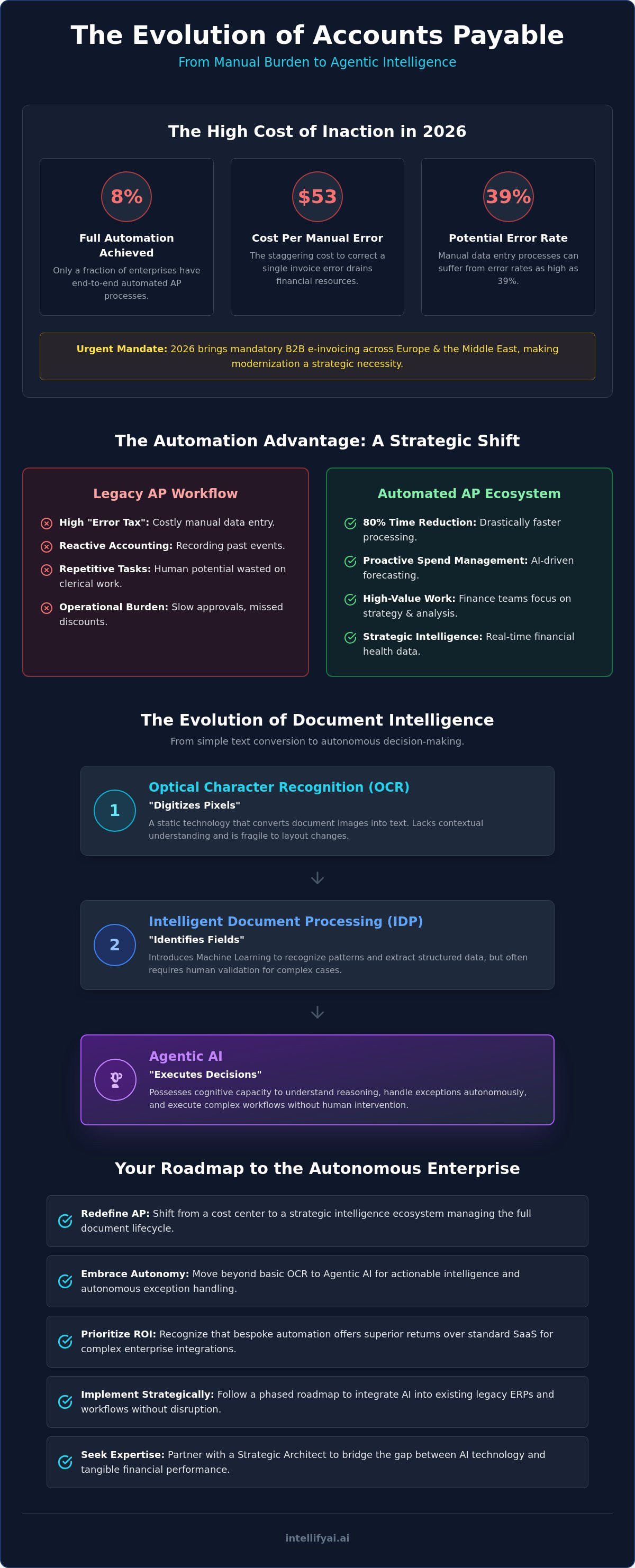
Only 8% of enterprises have achieved full, end-to-end automation, even as 2026 brings a wave of mandatory B2B e-invoicing across Europe and the Middle East. For most organizations, the cost to correct a single manual error remains a staggering $53. You likely recognize the friction caused by manual data entry and the persistent incompatibility between legacy ERPs and modern tools. Maintaining these stagnant processes isn't just an operational burden. It's a strategic risk in an era where invoice automation software must do more than just read text.
Discover how enterprise-grade automation and Agentic AI transform accounts payable from a cost center into a strategic engine for growth. This guide explores the shift from basic OCR to autonomous agents that execute strategy and handle exceptions independently. You'll learn how to achieve an 80% reduction in processing time and implement seamless 3-way matching. Build a foundation for the autonomous enterprise by removing the burden of repetitive tasks and unlocking human potential for high-value creative work.
Key Takeaways
• Redefine accounts payable as a strategic intelligence ecosystem that manages the complete document lifecycle from receipt to reconciliation.
• Discover how i_Nova moves beyond traditional OCR to provide actionable intelligence and autonomous exception handling.
• Identify why standard SaaS often fails complex integration requirements and how bespoke invoice automation software provides a superior ROI.
• Learn the two-phase implementation roadmap for integrating Agentic AI into your existing enterprise workflows and legacy ERPs.
• Recognize the role of a Strategic Architect in bridging the gap between abstract AI technology and practical financial performance.
The Strategic Imperative for Invoice Automation in 2026
Invoice automation software in 2026 is no longer a localized accounting utility. It has evolved into a comprehensive, AI-driven ecosystem that orchestrates the entire document lifecycle from initial receipt to final reconciliation. Forward-thinking leaders have shifted their focus from tactical cost-saving to strategic intelligence gathering. They treat accounts payable not as a back-office burden, but as a primary data source for real-time financial health and operational agility.
To better understand how this technology functions within a modern enterprise, watch this overview of automated processing:
Relying on manual AP workflows in 2026 creates a form of Strategic Debt that limits your ability to scale. This debt becomes particularly dangerous as global Electronic invoicing mandates take effect. From Belgium's Peppol network requirement to France's mandatory receipt laws starting in September 2026, compliance is now a matter of technical readiness. Organizations that fail to modernize their invoice automation software will find themselves locked out of domestic and international markets as digital-first regulations become the standard.
The Hidden Costs of Legacy AP Workflows
Manual data entry carries a heavy Error Tax that most enterprises underestimate. Research indicates that the cost to correct a single invoice error is approximately $53. When you consider that manual processing involves error rates as high as 39%, the financial drain is substantial. Beyond direct costs, slow approval cycles damage vendor relationships and cause you to miss out on early-payment discounts. Your finance team shouldn't spend their talent on repetitive clerical tasks. Every hour spent on manual entry is an hour lost to high-value financial analysis and strategy.
Invoice Automation as a Modernization Catalyst
Accounts payable is the ideal starting point for enterprise modernization because it transforms unstructured documents into actionable data. By automating this high-volume function, you create a data-rich environment that serves as the foundation for future AI-driven financial forecasting. You move from reactive accounting, where you simply record what happened, to proactive spend management. This shift allows your organization to identify procurement patterns, optimize cash flow, and execute strategy with a level of precision that legacy systems cannot match.
From Data Capture to Agentic Intelligence: How i_Nova Redefines IDP
The evolution of document handling is a progression from simple digitizing to autonomous reasoning. For decades, businesses relied on Optical Character Recognition (OCR) to convert images into text. While revolutionary at the time, OCR is fundamentally a static technology. It lacks the context to distinguish between a vendor name and a shipping address if the layout changes. Intelligent Document Processing (IDP) introduced machine learning to recognize patterns, yet it still often requires human oversight to validate complex data. OCR digitizes pixels. IDP identifies fields. Agentic AI executes decisions.
In 2026, the shift to Agentic AI redefines the category. Unlike its predecessors, Agentic AI possesses the cognitive capacity to understand the reasoning behind the data. It recognizes that a specific line item on a multi-page invoice relates to a contract term negotiated six months prior. High-volume systems, such as the Invoice Processing Platform (IPP) used by federal agencies, demonstrate the necessity of moving toward these robust, centralized digital environments to maintain security and efficiency at scale.
The i_Nova Advantage: Intelligent Document Processing
i_Nova represents the next generation of IDP. It utilizes Agentic AI to handle an infinite variety of document formats without the need for manual templating. This is essential for modern enterprises operating in multi-entity environments where vendors use disparate invoicing styles. i_Nova achieves high-precision extraction even from low-resolution scans or non-standard layouts. By automating 3-way matching at scale, the platform identifies discrepancies between purchase orders, receipts, and invoices instantly. This level of precision eliminates the "Error Tax" and ensures that only verified data enters your financial ecosystem.
Beyond Capture: Executing Autonomous Workflows
The true power of modern invoice automation software lies in its ability to act. AI agents within the i_Nova platform don't simply extract data and wait for a human to click "approve." They interact autonomously with your core ERP systems, including SAP, Oracle, and Microsoft Dynamics. For enterprises leveraging Salesforce for contract management or billing, working with a Platinum partner like Ignyto ensures these autonomous workflows are seamlessly integrated into your broader digital ecosystem. These agents evaluate historical data to determine the most efficient routing path based on strategic business rules. If a recurring invoice matches all parameters, the agent executes the process without human touch. Agentic AI reduces human intervention to "exception only" management, liberating your finance professionals for high-value analysis.
If your organization is struggling with the limitations of template-based tools, our Agentic AI Engineering Services can help you build a more resilient, autonomous document workflow.
Evaluating Invoice Automation: SaaS Features vs. Strategic AI Engineering
Selecting invoice automation software requires a fundamental shift in perspective. Most off-the-shelf SaaS solutions are designed for broad market appeal. This often leads to feature bloat while missing the specific nuances of a multi-entity enterprise. These generic tools struggle with deep integration into legacy ERP systems. They provide rigid connectors that fail when faced with non-standard workflows. A Strategic Architect understands that true efficiency comes from bespoke solutions. This is why Agentic AI engineering services are becoming the standard for serious organizations. You need a system that adapts to your business, not one that forces your business to adapt to its limitations.
Security remains a non-negotiable pillar of this transformation. As you centralize sensitive financial data, compliance with SOC2 and GDPR becomes a baseline requirement. However, in 2026, you must also consider AI governance. This involves ensuring that autonomous agents operate within ethical and operational guardrails. Scalability is equally vital. Your chosen platform must handle increasing document volumes without a degradation in performance. Evaluating peer reviews on platforms like Gartner Peer Insights can provide clarity on how these tools perform in real-world, high-pressure environments.
Critical Evaluation Framework for 2026
Prioritize API-first architectures over bolt-on connectors. Your automation should feel like a native extension of your existing stack. Customization is the next essential metric. Can the AI learn your specific General Ledger (GL) coding and project structures? If a tool requires you to manually map fields for every new vendor, it isn't truly intelligent. Finally, look for vendor stability and a clear roadmap for continuous MLOps optimization. The technology evolves rapidly. Your partner must be capable of maintaining that pace to ensure long-term relevance.
The Role of AI Strategy and Consulting
Success begins before you select a tool. Engaging in AI strategy consulting ensures that your automation roadmap aligns with broader corporate objectives. Define Proof-of-Value (PoV) metrics early. These should include specific targets for processing time reduction and error rates. This strategic alignment connects your back-office improvements to your overall CX improvement framework. You aren't just fixing accounting. You're building a foundation for a more responsive, data-driven enterprise that values the time and potential of its human workforce.
The Implementation Roadmap: Integrating Automation into Enterprise Workflows
Deploying advanced invoice automation software is a rigorous journey that moves beyond simple software installation. It is an architectural transformation. You are not just buying a tool; you are building a strategic asset that will define your operational agility for years to come. A successful rollout requires a phased approach that prioritizes data integrity and system synergy over rapid, shallow deployment. This methodology ensures that your automation remains a lasting investment in relevance rather than a temporary fix.
Phase 1 begins with a comprehensive audit of your current state. We evaluate your data engineering readiness to ensure your existing infrastructure can support the high-velocity requirements of modern invoice automation software. Phase 2 moves into custom Agentic AI engineering. Here, we configure the i_Nova platform to align with your specific General Ledger structures and vendor-specific nuances. Phase 3 focuses on integration with your broader cloud-native modernization initiatives. This ensures your AP engine is not a siloed utility but a core component of your digital ecosystem. Phase 4 establishes a continuous MLOps pipeline. We monitor for model drift and refine processing logic to maintain peak precision. Finally, Phase 5 scales these successes from accounts payable into broader procurement and supply chain automation, creating a truly autonomous enterprise.
Data Engineering: The Foundation of Automation
High-performance AI models require a clean, reliable foundation. We focus on cleaning legacy data to remove the inconsistencies that often hinder automation in multi-entity environments. By establishing robust data pipelines, we facilitate real-time invoice processing that maintains integrity across multiple ERP systems. This ensures your autonomous agents always act on a single, verified source of truth, eliminating the risk of fragmented financial reporting.
Once this foundation is established, platforms like Knowi enable organizations to query and visualize this unified data, turning a clean source of truth into actionable business intelligence.
Human-in-the-Loop: Redefining the AP Role
Technology should unlock human potential rather than replace it. We design intuitive interfaces that allow your team to collaborate with AI agents on complex exceptions. Your finance professionals transition from repetitive data entry to becoming "AI Orchestrators." This shift removes the clerical burden, significantly increasing employee satisfaction and allowing your talent to focus on high-value strategic growth and vendor relationship management.
To begin mapping your organization's path to autonomy, schedule a session for AI Strategy & Consulting with our expert team.
Partnering for Transformation: Why IntellifyAi is the Strategic Architect for AP
Modernizing your financial operations requires more than a simple tool. It demands a partnership with a Strategic Architect who understands the delicate balance between high-level vision and technical execution. IntellifyAi occupies a unique position in the market as both the developer of the i_Nova platform and a premier engineering firm. We don't just provide a login to a portal. We build the cognitive engine that drives your business forward. This dual role allows us to offer end-to-end service delivery, moving seamlessly from a strategic roadmap to fully managed AI services that evolve alongside your enterprise.
Our commitment to long-term viability ensures that your investment in invoice automation software remains relevant as technologies shift. We prioritize enterprise-grade security and rigorous AI governance to protect your sensitive financial data. By acting as a bridge between abstract technical fields and the practical needs of a growing company, we ensure that digital transformation is a liberating force rather than a daunting complexity. We treat our methodology as a holistic philosophy, positioning autonomous workflows as a central business pillar that removes the burden of repetitive tasks and unlocks the creative potential of your workforce.
Our Methodology: Strategy Meets Execution
Our consulting services eliminate the "black box" of AI implementation by providing a clear, logical framework for transformation. We focus on measurable financial returns and cloud cost optimization, often referred to as FinOps, to ensure your automation strategy is grounded in fiscal reality. Our global presence across the UK, USA, India, and the UAE ensures that you have access to localized compliance expertise and dependable support. We don't just solve today's bottlenecks. We build the infrastructure for future growth.
Next Steps for Your Enterprise
The journey toward a frictionless, automated future begins with a clear assessment of your current operational state. Schedule a strategic discovery session with our experts to evaluate your AP maturity and identify the highest-impact areas for automation. From there, we develop a customized Proof-of-Value (PoV) for the i_Nova platform, showing you exactly how Agentic AI will handle your specific document volumes and ERP integrations. This data-driven approach allows you to justify an enterprise-wide rollout with confidence and clarity.
Contact IntellifyAi today to begin your transition from manual processing to a strategic, autonomous accounts payable engine.
Building the Foundation for an Autonomous Enterprise
The shift from legacy manual processes to autonomous intelligence is a strategic mandate for 2026. By implementing sophisticated invoice automation software, enterprises eliminate the high costs and errors associated with stagnant accounts payable workflows. You've explored how the i_Nova platform moves beyond simple data capture to execute active reasoning and autonomous decision-making. This evolution requires more than generic software. It demands the precision of expert Agentic AI Engineering Services and the clarity of Global Enterprise AI Strategy Consulting.
Modernizing your financial operations is the catalyst for a broader digital transformation. This transition removes the burden of repetitive tasks and allows your human workforce to focus on high-value, creative contributions that drive growth. Book a Strategic AI Discovery Session with IntellifyAi to begin building your autonomous enterprise today. We're ready to help you turn your back-office operations into a strategic engine for performance.
Frequently Asked Questions
How does Agentic AI differ from traditional OCR in invoice processing?
Agentic AI differs from traditional OCR by moving beyond simple character recognition to contextual reasoning and autonomous execution. While OCR merely digitizes text, Agentic AI understands the relationship between data points and can initiate actions such as vendor inquiries or approval routing. This technology treats invoices as strategic data points rather than static images, allowing the system to handle complex decision-making tasks independently.
Can invoice automation software integrate with complex, legacy ERP systems?
Modern invoice automation software integrates with complex legacy ERPs through bespoke, API-first architectures and custom middleware. Instead of relying on rigid, off-the-shelf connectors that often fail, we engineer solutions that bridge the gap between older systems and modern AI agents. This approach ensures your existing infrastructure remains a functional part of an automated ecosystem without requiring a complete system overhaul.
What is the typical ROI timeline for an enterprise-scale invoice automation project?
The typical ROI timeline for an enterprise-scale project ranges from six to twelve months, depending on your document volume and workflow complexity. Initial gains are often realized through the immediate reduction in manual data entry and the elimination of the $53 average cost to correct a single invoice error. Long-term value stems from optimized cash flow and the redirection of human talent toward strategic analysis.
How does the i_Nova platform handle unstructured data in handwritten or non-standard invoices?
The i_Nova platform utilizes Intelligent Document Processing (IDP) to interpret unstructured data without the need for rigid templates. It identifies semantic meaning within non-standard layouts, handwritten notes, or low-quality scans by leveraging advanced machine learning models. This capability ensures high-precision extraction regardless of how a vendor formats their documents, maintaining a frictionless data flow into your financial systems.
What are the security and compliance requirements for AI-driven financial software?
Security for AI-driven financial software must include SOC2 Type II compliance, GDPR adherence, and robust AI governance frameworks. Protecting sensitive financial data requires end-to-end encryption and clear audit trails for every autonomous decision made by the system. These guardrails ensure your automation strategy remains compliant with both international regulations and internal risk management policies while maintaining data integrity.
What is the role of human-in-the-loop (HITL) in modern invoice automation?
Human-in-the-loop serves as the critical validation layer for complex exceptions that fall outside predefined confidence thresholds. Instead of performing data entry, your team acts as AI Orchestrators who resolve nuanced discrepancies. The system learns from these human interventions, continuously refining its own logic to reduce the frequency of future exceptions and improve the overall level of system autonomy.
How does IntellifyAi manage the ongoing optimization of AI models after deployment?
We manage ongoing optimization through a dedicated MLOps pipeline that monitors for model drift and performance degradation. Our engineering teams regularly refine the underlying algorithms to ensure the system adapts to new invoice types or changing business rules. This proactive maintenance guarantees your invoice automation software remains accurate and efficient as your enterprise continues to scale and your data environment evolves.
Is invoice automation software suitable for multi-entity organizations with different currencies?
Our solutions are specifically designed for multi-entity organizations that manage diverse currencies and localized tax regulations. The i_Nova platform handles complex cross-border billing logic and performs automated currency conversions based on real-time data. This capability allows global enterprises to centralize their accounts payable functions while maintaining precise financial control and compliance across all international subsidiaries and jurisdictions.









.svg)