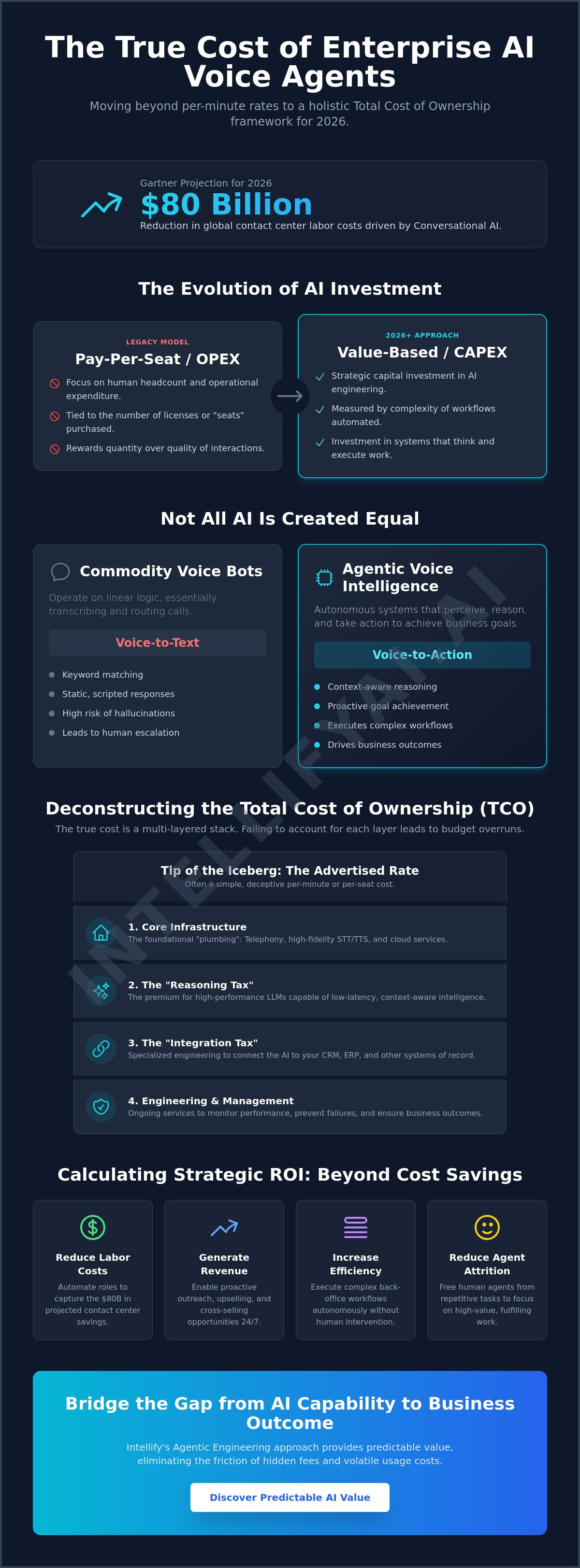
Gartner projects that conversational AI will reduce global contact center labor costs by $80 billion in 2026. This massive shift represents a fundamental change in how high-growth companies manage their back office and customer experience. You likely find that the current market is filled with opaque pricing models that obscure the true technical requirements of a production-grade system. Calculating the ai voice agent platform cost for enterprise requires a shift in perspective, moving from simple per-minute rates to a holistic Total Cost of Ownership framework.
You understand that high-performance technology isn't just about software; it's about the strategic engineering that makes it work. We'll provide the clarity you need to justify the agentic premium to your board by breaking down the costs of infrastructure, intelligence, and custom integration. This article outlines a precise model for comparing standard SaaS licensing against managed services, ensuring your investment delivers measurable financial returns without the friction of hidden fees. You'll gain a clear roadmap for scaling your operations while maintaining the stability and security your enterprise demands.
Key Takeaways
• Analyze the transition from legacy "pay-per-seat" models to value-based pricing that accounts for the superior autonomy of modern agentic systems.
• Identify the hidden infrastructure and intelligence layers required to calculate a realistic ai voice agent platform cost for enterprise at scale.
• Evaluate the financial trade-offs between volatile usage-based SaaS models and the predictable stability of strategic managed services.
• Quantify the long-term ROI by looking beyond simple contact center savings to include proactive revenue generation and reduced agent attrition.
• Discover how professional engineering services bridge the gap between abstract AI capabilities and sustainable, context-aware business outcomes.
The Evolution of Enterprise AI Voice Costs in 2026
Enterprise budgets in 2026 reflect a fundamental departure from legacy cost centers. We're seeing a migration from operational expenditure (OPEX) tied to human headcount toward strategic capital investment in AI engineering. This evolution isn't merely a software update; it's a structural realignment. When calculating the ai voice agent platform cost for enterprise, leaders must distinguish between superficial automation and deep, autonomous reasoning. The market has matured beyond simple chatbots, demanding systems that actually execute work rather than just routing calls.
Commodity voice bots, often billed at deceptively low rates, function on linear logic. They transcribe, match keywords, and provide static responses. In contrast, an Intelligent Agent possesses the capacity to perceive its environment and take proactive actions to achieve specific business goals. This distinction is the primary driver of price variance in the 2026 market. High-growth organizations are moving away from paying for "seats" and are instead investing in the engineering required to build systems that think.
To better understand how these platforms compare in a real-world enterprise setting, watch this helpful analysis:
Defining Agentic Voice Intelligence
Agentic AI is an autonomous system that executes complex workflows via voice. It doesn't just talk; it acts. The baseline ai voice agent platform cost for enterprise is heavily influenced by the "reasoning tax" associated with high-performance large language models. High-tier platforms prioritize low-latency reasoning over simple transcription. This allows the system to maintain context-aware intelligence, understanding not just the words spoken, but the customer's intent and history within the broader back office ecosystem. This shift from "voice-to-text" to "voice-to-action" justifies the premium paid for agentic capabilities.
The 2026 Market Landscape
Global adoption has accelerated as organizations realize that low-cost, unmanaged rates often mask the systemic expense of hallucinations and failed resolutions. A system that fails to resolve a ticket creates a compounding cost through human escalation and repetitive interactions. Forward-thinking firms are prioritizing enterprise modernization to eliminate technical debt. This strategic approach replaces the pay-per-seat contact center model with a value-based framework. Here, the investment is measured by the complexity of the workflows automated rather than the number of licenses purchased. Gartner projects that conversational AI will reduce global contact center labor costs by $80 billion in 2026, but capturing that value requires a partner who understands the engineering behind the voice.
Deconstructing the Cost Components: Infrastructure vs. Intelligence
Calculating the ai voice agent platform cost for enterprise requires looking past the marketing brochures. While base rates might suggest a simple per-minute model, the reality involves a multi-layered stack of technical dependencies. Each layer contributes to the total cost, and failing to account for any single component can lead to significant budget overruns during scaling. We view these costs through two primary lenses: the intelligence that drives the conversation and the infrastructure that carries it.
The "Integration Tax" is perhaps the most overlooked element in enterprise deployments. Connecting voice agents to your CRM or ERP isn't a "plug-and-play" exercise for serious business. It requires specialized Agentic AI Engineering Services to ensure the agent can read from and write to your system of record in real time. High-fidelity voice synthesis (TTS) also adds a premium, especially when using ultra-realistic neural voices designed to match your brand's specific identity. These components transform a basic bot into a professional representative of your company.
The Intelligence Layer: LLMs and Tokenomics
The "brain" of the agent is powered by Large Language Models. Proprietary models like GPT-4o or Claude 3.5 Sonnet offer high reasoning capabilities but carry a variable cost based on token volume. For enterprise applications, the cost of low-latency is a major factor. Achieving response times under 500ms requires high-performance infrastructure and optimized prompt engineering, which often commands a premium. Fine-tuned open-source models can offer long-term savings but require upfront investment in data engineering to ensure performance parity. According to this AI Agent Platform Pricing Guide, understanding these token dynamics is crucial for accurate TCO forecasting.
The Hidden Infrastructure of Voice
Telephony remains the silent driver of costs. Every minute of conversation incurs carrier fees, SIP trunking costs, and data egress charges. In a cloud-native environment, these expenses scale linearly with volume. Security and compliance add another layer of complexity. Maintaining a platform that is SOC2, GDPR, or HIPAA-ready involves rigorous auditing and specialized hosting. These are often bundled into higher enterprise tiers rather than base usage rates. When evaluating the ai voice agent platform cost for enterprise, you must account for these non-negotiable security requirements to ensure the stability and legality of your operations. If you're ready to architect a secure, high-performance system, consider exploring our AI Strategy & Consulting services to define your technical requirements.
Consider the following infrastructure essentials:
Concurrent Call Capacity
The ability to handle thousands of simultaneous sessions without latency degradation.
SIP Trunking
Professional-grade telephony connections that ensure crystal-clear audio for transcription accuracy.
Data Egress
The cost of moving large volumes of audio data between cloud providers and processing nodes.
Enterprise Pricing Models: SaaS vs. Strategic Managed Services
Predictability is the cornerstone of enterprise stability. The pay-as-you-go trap often lures teams with low entry costs, but it fails to account for the volatility of live production environments. Unpredictable call volumes can lead to massive invoice spikes that disrupt quarterly budgets. Calculating the ai voice agent platform cost for enterprise requires a shift from viewing AI as a utility to viewing it as a strategic asset. High-growth organizations require certainty, which is why tiered enterprise subscriptions and managed services are becoming the standard for 2026.
Strategic managed services bundle engineering, maintenance, and platform access into a single, transparent fee. This approach ensures that your ai voice agent platform cost for enterprise remains aligned with business value rather than fluctuating usage metrics. Custom MSA and DPA terms also represent a significant administrative investment. Standard SaaS platforms rarely offer the legal flexibility required by global compliance teams. Managed services include this overhead as part of the partnership, ensuring you're enterprise-ready from day one.
SaaS vs. Managed Services Comparison
| Feature | Self-Service SaaS | Enterprise Managed Services |
|---|---|---|
| Support Levels | Ticket-based / Community | Dedicated Engineering Lead |
| Uptime Guarantees | Best effort / Standard | 99.9% - 99.99% Custom SLAs |
| Custom Development | Internal resources only | Full Agentic Engineering |
| System Integration | Standard APIs | Deep System-of-Record Sync |
FinOps: Optimising Your AI Spend
FinOps is no longer optional for AI-driven organizations. Continuous model monitoring prevents cost drift, a phenomenon where slight changes in prompt length or model behavior inflate per-call expenses. By implementing robust MLOps pipelines, organizations can automate the optimization of their intelligence layer. This ensures that every token used contributes directly to a successful outcome.
Model distillation and response caching are critical for reducing TCO at scale. These techniques allow you to maintain high-quality reasoning while stripping away unnecessary computational waste. As outlined in this Complete TCO Framework, the most cost-effective platforms aren't always those with the lowest per-minute rates. They're the ones that provide the most efficient path to resolution. Managed service fees often result in a lower TCO because they eliminate the need for an expensive, in-house team of AI engineers to manage these optimizations manually.
Calculating Strategic ROI: Beyond the Call Centre
Measuring the ai voice agent platform cost for enterprise shouldn't stop at the bottom line. While initial assessments focus on technical expenses, the true value lies in the strategic outcomes these systems enable. IBM research indicates that conversational AI reduces the cost per contact by an average of 23.5% while simultaneously increasing revenue by 4%. This dual impact transforms the contact center from a cost sink into a sophisticated engine for growth and data intelligence.
Direct savings manifest primarily through the reduction of BPO reliance and the stabilization of human agent attrition. By automating high-volume, routine queries, you allow your human workforce to focus on complex, high-empathy resolutions. The "Data Dividend" created by these platforms is equally immense. Every interaction is converted from unstructured audio into structured, actionable data. This allows for real-time sentiment analysis and trend forecasting that legacy systems simply cannot match. Risk mitigation also improves significantly. Agentic systems ensure 100% compliance with regulatory scripts in every single interaction, removing the variance of human error.
The ROI of Human-AI Collaboration
AI voice agents liberate human workers for high-value creative tasks by removing the burden of repetitive, low-complexity interactions. This shift creates a measurable "CX Dividend" where reduced wait times and immediate resolutions directly correlate to increased Customer Lifetime Value (LTV). Transitioning a legacy call centre to an agentic workflow isn't just a technical upgrade; it's a fundamental improvement in how your brand interacts with the world. You aren't just saving minutes; you're buying back the time your team needs to innovate.
The Strategic Architect Framework
Evaluating your investment requires a clear look at the "Cost of Inaction." Staying on legacy IVR systems often leads to hidden losses in the form of customer churn and mounting technical debt. Long-term viability depends on custom engineering that ensures your systems remain relevant as consumer expectations evolve. Utilizing AI strategy consulting helps identify the highest-impact use cases within your specific back office operations. This ensures that your ai voice agent platform cost for enterprise is balanced against a roadmap of continuous value delivery. If you are ready to move beyond the pilot phase and into production-grade ROI, speak with our engineering team to architect your solution.
The IntellifyAi Approach: Predictable Value Through Agentic Engineering
Mastering the ai voice agent platform cost for enterprise requires moving beyond the allure of low-cost per-minute rates. In the 2026 landscape, the most expensive system is the one that fails to resolve complex customer needs, leading to human escalation and technical debt. We replace the uncertainty of off-the-shelf software with a disciplined engineering methodology. Our approach prioritizes transparent professional service fees for Proof of Value (PoV) and roadmap development, ensuring that every dollar spent is anchored in a measurable business outcome.
The i_Nova platform serves as the foundation for this transformation. By leveraging Intelligent Document Processing (IDP), we provide voice agents with the deep context necessary to handle sophisticated workflows. This isn't just about speaking; it's about understanding the specific documentation and history that define your enterprise operations. Our global delivery model is built on a framework of rigorous security, maintaining SOC2 compliance to protect your data and your reputation as you scale.
Custom Engineering vs. Off-the-Shelf
Generic bots often become a liability when they encounter the realities of a complex Back Office or legacy Contact Centre. We prioritize Agentic AI engineering services because they offer the flexibility required for deep system integration. While off-the-shelf retail software might seem faster to deploy, it lacks the autonomy to execute multi-step tasks within your existing infrastructure. Custom engineering is a lasting investment in relevance. It ensures that your AI agents function as true extensions of your team rather than temporary fixes that eventually require manual intervention. This strategic alignment is what differentiates a successful digital transformation from a failed pilot program.
Next Steps: From Roadmap to Deployment
Successful deployment starts with a structured Proof of Value engagement. This phase allows us to validate the financial and operational impact of the solution before committing to full-scale implementation. We move systematically from initial AI Strategy & Consulting to managed AI operations, providing end-to-end MLOps to ensure performance doesn't degrade as call volumes increase. This continuous monitoring is essential for maintaining the stability of your intelligence layer and the accuracy of your voice agents.
The transition from legacy systems to agentic intelligence doesn't have to be a daunting complexity. It's a liberating force that allows your business to focus on high-value creative work while we handle the repetitive tasks of customer interaction. If you're ready to define a clear TCO framework and build a secure, scalable voice platform, Consult with our Strategic Architects to begin your roadmap development today.
Secure Your Competitive Advantage in the Agentic Era
Transitioning to an autonomous voice ecosystem is a strategic move toward long-term operational resilience. You've seen that calculating the ai voice agent platform cost for enterprise requires a sophisticated balance of infrastructure, intelligence, and deep system integration. Success depends on moving beyond simple per-minute rates to embrace a managed framework that guarantees both performance and security. By prioritizing custom engineering over off-the-shelf limitations, your enterprise can finally unlock human potential and drive measurable financial growth.
IntellifyAi acts as your strategic architect with a global presence across the UK, USA, India, and the UAE. Our flagship i_Nova platform provides the intelligent data extraction necessary to power context-aware interactions. We bring deep expertise in Agentic AI and cloud-native modernization to ensure your systems remain viable for the long term. Take the next step in your digital transformation journey today. We look forward to helping you build a frictionless, automated future.
Architect Your Enterprise AI Voice Strategy with IntellifyAi
Frequently Asked Questions
What is the average per-minute cost for enterprise AI voice agents in 2026?
All-in rates for enterprise-grade voice agents typically fall between $0.12 and $0.45 per minute. This comprehensive figure accounts for the full technical stack, including speech-to-text, LLM reasoning, text-to-speech, and telephony carrier fees. While individual components have lower base rates, this realistic range ensures your budget covers a production-ready system capable of handling complex business logic.
How do professional service fees differ from platform subscription costs?
Professional service fees cover the strategic engineering and custom integration required to align the agent with your specific back office systems. Platform subscriptions provide the ongoing cloud-native infrastructure and software licenses. These are distinct investments; the platform provides the capability, but engineering services deliver the actual business solution and system-of-record synchronization.
Can I use my own LLM API keys to reduce platform costs?
Most sophisticated platforms support a "Bring Your Own Key" model that allows you to use your own LLM API credentials. This approach can reduce platform markups on intelligence layers and gives you direct control over your token expenditure. You'll need to weigh the potential savings against the administrative overhead of managing separate vendor relationships and billing cycles.
What are the most common hidden fees in AI voice platform contracts?
Common hidden costs include concurrency charges for handling high volumes of simultaneous calls and premium voice markups for ultra-realistic neural synthesis. You should also watch for one-time integration fees for connecting to enterprise CRMs and data egress charges for large-scale audio processing. Identifying these early is critical for accurately calculating the ai voice agent platform cost for enterprise before you reach the scaling phase.
How does Agentic AI reduce the total cost of ownership compared to traditional IVR?
Agentic AI reduces TCO by automating entire workflows rather than just routing callers to human agents. While the initial engineering investment is higher than a legacy IVR, the long-term savings are realized through higher resolution rates and reduced human intervention. IBM research indicates that conversational AI can reduce the cost per contact by an average of 23.5% while improving overall system efficiency.
Is there a minimum volume requirement for enterprise AI voice pricing?
Enterprise tiers typically involve a minimum monthly commitment to ensure dedicated infrastructure and priority support. These commitments often start around $3,500 per month for production-grade deployments. This structure provides the budget certainty that high-growth companies require for scaling their contact center operations without the volatility of pure usage-based models.
How do managed service fees help in cloud cost optimization?
Managed service fees provide a predictable cost structure that simplifies FinOps by bundling model monitoring and response caching. These services prevent "cost drift," a phenomenon where inefficient prompts or model changes inflate token usage over time. This architectural oversight ensures that your ai voice agent platform cost for enterprise remains optimized for performance rather than just raw volume.
What is the typical ROI timeline for a large-scale AI voice deployment?
Most enterprises achieve a positive ROI within 6 to 12 months of a full-scale deployment. This timeline includes the initial Proof of Value phase and the engineering of custom integrations. The primary drivers of this return include the significant reduction in BPO expenses and the increased revenue generated by 24/7 proactive lead qualification and outbound voice interactions.








.svg)