
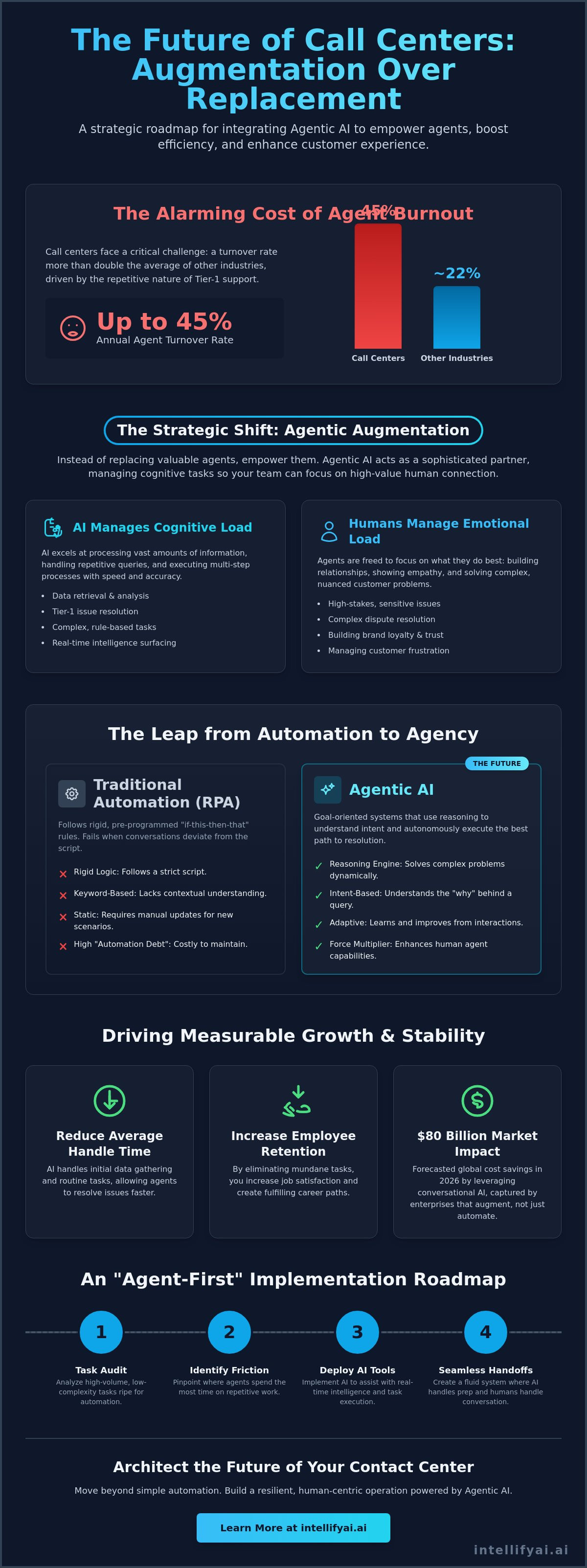
Call centers currently face a turnover rate of up to 45%, a figure more than double the average of other professional industries. This churn is largely driven by the exhaustion of managing repetitive Tier-1 queries that offer little professional fulfillment. You shouldn't have to choose between operational efficiency and your most talented staff. It's entirely possible to automate call center without replacing agents by deploying Agentic AI as a sophisticated layer of support rather than a human substitute.
Modern enterprise modernization is the non-negotiable prerequisite for effective AI. You cannot build a visionary CX on top of legacy silos. Breaking down the walls between your CRM and call center data allows the AI to access a single source of truth. Cloud-native architecture enables the real-time responsiveness required for modern agentic workflows. This is where GigitekAI excels, providing the enterprise-grade cloud infrastructure and intelligent AI systems necessary to support such high-performance environments. Data engineering services ensure that this flow of information is frictionless, allowing for instant decision-making at the edge of every customer interaction. Without this foundation, even the most advanced AI will struggle with latency and data inaccuracy.
We recognize the pressure to deliver a clear ROI while avoiding the "dumb" chatbot experiences that frustrate customers. This guide provides a strategic roadmap for leveraging agentic augmentation to eliminate mundane tasks and unlock human potential. You'll learn how to reduce Average Handle Time and increase employee retention through seamless handoffs between AI and people. We also examine how the 2026 regulatory environment and the One Big Beautiful Bill Act create a unique window for enterprise modernization that secures your long-term competitive advantage.
Key Takeaways
• Understand why the 2026 market landscape requires a shift toward augmentation, where AI manages cognitive load so humans can focus on high-value emotional connections.
• Distinguish between traditional if-this-then-that automation and goal-oriented Agentic AI that uses reasoning to solve complex customer problems.
• Learn the exact steps to automate call center without replacing agents by conducting a task audit to identify and eliminate high-volume friction points.
• Adopt an "Agent-First" implementation roadmap that prioritizes tools designed to assist your team with real-time intelligence before they even engage with a caller.
• Discover how a unified enterprise AI strategy integrates back-office efficiency with front-end CX to drive measurable growth and long-term stability.
The Strategic Shift: Why Augmentation Beats Replacement in 2026
The 2026 market landscape has moved past the era of the "dumb" chatbot. Today, customer service is defined by Agentic Augmentation. This paradigm shift focuses on offloading cognitive load to AI while reserving emotional load for humans. While machines handle complex data retrieval and multi-step reasoning, your agents manage the high-stakes, emotionally charged interactions that define your brand. The objective is clear. You must automate call center without replacing agents to ensure efficiency never comes at the expense of connection.
To better understand the practical implementation of these systems, watch this helpful video:
Total replacement strategies often collapse under the weight of "automation debt." This occurs when a business prioritizes immediate labor cost reduction over long-term brand equity. While conversational AI is forecasted to reduce global contact center labor costs by an estimated $80 billion in 2026, the companies that thrive are those maintaining a human touch. Integrating AI in the customer experience allows for a hybrid workforce where technology acts as a force multiplier rather than a substitute. This model acknowledges that while AI can process information at scale, it cannot replicate the trust built through human interaction.
The High Cost of Total Automation
Removing the human element entirely creates a dangerous empathy gap. Current models excel at information retrieval, yet they lack the lived experience required to handle a grieving customer or a complex billing dispute with genuine sensitivity. When you replace experienced staff, you also lose centuries of combined institutional knowledge. This specialized understanding of your business nuances cannot be easily replicated by a generic model. Poor AI experiences lead to immediate customer churn. This churn often costs far more than the salary of the agent you intended to replace. Brand erosion is silent but deadly for your bottom line.
The Value of the Human-in-the-Loop
A robust CX strategy relies on the human-in-the-loop (HITL) model. This framework positions human agents as the ultimate safety and quality assurance mechanism. Agents provide the contextual nuance that AI currently lacks, stepping in when a conversation deviates from standard logic. At IntellifyAi, our philosophy on human-AI collaboration centers on the belief that technology should liberate workers from drudgery. By allowing AI to handle the repetitive Tier-1 queries, you empower your team to act as high-value specialists. This approach ensures your call center remains a source of competitive advantage. It transforms a standard service hub into a center for strategic relationship management.
Understanding Agentic AI: The Technology Powering Human-Centric Automation
Traditional Robotic Process Automation (RPA) operates on a rigid if-this-then-that logic. It excels at repetitive data entry but fails the moment a conversation veers off-script. Agentic AI represents a fundamental shift. These systems are goal-oriented. They don't just follow a sequence; they use reasoning to determine the best path toward a specific outcome. To effectively automate call center without replacing agents, enterprises are now deploying voice agents that understand intent rather than just keywords. This technology allows the system to evaluate a customer's problem, access the necessary tools, and execute a resolution autonomously.
Security remains a primary concern for the modern enterprise. Current implementations favor Small Language Models (SLMs) over massive, generalized counterparts. These specialized models are trained on contact-center-specific datasets, ensuring high accuracy and lower latency. Because they're leaner, they can be deployed in secure, private environments. This ensures that sensitive customer data never leaves your controlled infrastructure. The integration of AI contact center technology has transformed the agent's role into that of a pilot, with AI serving as a sophisticated co-pilot. If you're ready to evaluate your current infrastructure, our AI strategy experts can help map your transition.
From Chatbots to Autonomous Voice Agents
The "dead-end" chatbot experience is a relic of the past. Reasoning AI agents don't get stuck in loops. They handle the bulk of Tier-1 issues, such as password resets or order tracking, while simultaneously preparing Tier-2 escalations for human intervention. By the time a human agent joins the call, the AI has already summarized the issue and retrieved the relevant customer history. Real-time sentiment analysis further empowers the staff. It provides instant cues on a caller's emotional state, allowing the agent to adjust their approach before a situation escalates. This synergy ensures that technology handles the logic while people handle the empathy.
Agentic Workflows vs. Static Automation
Agentic workflows are defined by their ability to use tools. Unlike static automation, an agentic system can search internal databases, update CRM records, and even interact with third-party APIs to resolve a ticket. This capability significantly reduces after-call work (ACW) for human staff. Data shows that teams supported by AI resolve tickets 52% faster than those without. By automating the documentation and administrative follow-ups, agents can immediately move to the next high-value interaction. For those looking to build these capabilities from the ground up, our Agentic AI Engineering Services provide the technical architecture required for custom, goal-oriented workflows that scale with your business needs.
Tactical vs. Strategic Automation: Finding the Balance
Tactical automation often results in fragmented silos that frustrate both customers and staff. Deploying "band-aid" fixes might solve a temporary volume spike, but it fails to address the underlying operational inefficiencies. A holistic enterprise AI strategy ensures that every implementation serves a broader business objective. Instead of isolated bots, the goal is to create an ecosystem where AI absorbs the friction of routine operations. This approach allows you to automate call center without replacing agents by clearly defining where technology stops and human expertise begins.
Strategic leaders categorize tasks based on their cognitive and emotional requirements. This clarity protects your human capital and ensures efficiency:
Prime for Automation
Data entry, appointment scheduling, shipment status checks, and routine password resets.
Human-Exclusive
Complex dispute resolution, high-value sales negotiations, and crisis management requiring deep empathy.
The success of this hybrid model depends on the hand-off protocol. When a query exceeds the AI's reasoning capabilities, the transition must be invisible. The human agent receives a comprehensive transcript, a sentiment profile, and suggested next steps before they even say hello. This eliminates the repetitive "can you explain your problem again?" friction that destroys customer satisfaction and agent morale.
The Role of Intelligent Document Processing (IDP)
Back-office bottlenecks frequently translate into front-office delays. Intelligent Document Processing (IDP) bridges this gap by extracting critical data from unstructured sources like emails, PDFs, and handwritten notes. Our i_Nova platform instantly retrieves this information, feeding it directly into agent dashboards. This significantly reduces hold times because agents aren't hunting for data while a customer waits. When i_Nova processes a complex claim document in seconds, it eliminates minutes of manual searching, allowing the agent to focus entirely on the resolution.
Building a Unified Data Foundation
Modern enterprise modernization is the non-negotiable prerequisite for effective AI. You cannot build a visionary CX on top of legacy silos. Breaking down the walls between your CRM and call center data allows the AI to access a single source of truth. Cloud-native architecture enables the real-time responsiveness required for modern agentic workflows. Data engineering services ensure that this flow of information is frictionless, allowing for instant decision-making at the edge of every customer interaction. Without this foundation, even the most advanced AI will struggle with latency and data inaccuracy.
A Roadmap to Implementation: Scaling Efficiency While Preserving Culture
Implementing advanced technology requires a phased approach. It's not a switch you flip; it's a culture you build. To successfully automate call center without replacing agents, you must prioritize the internal experience before the external one. This ensures your staff views AI as a liberation from drudgery rather than a threat to their livelihood. A structured roadmap transforms the daunting complexity of digital transformation into a series of manageable, high-impact milestones.
Step 1 & 2: Internal Optimization
Start with a comprehensive Task Audit. Analyze your call logs to identify the "low hanging fruit." These are the high-frequency, low-complexity interactions like shipment tracking or basic account inquiries that consume 88% of contact center capacity. Once identified, introduce "Agent-First" AI. These co-pilot tools provide real-time suggestions and automated note-taking during live calls. You sell this to your team by framing it as a workload reduction tool. It removes the administrative burden, allowing them to focus on the customer. Training is essential. Agents must learn to work alongside these co-pilots, moving from data entry specialists to supervisors of the technology. This collaborative model reduces burnout and increases retention by making the work more meaningful.
Step 3 & 4: External Scaling and Governance
Once your internal foundation is solid, deploy customer-facing voice agents. Keep these limited to bounded use cases where the path to resolution is clear. This cautious rollout prevents "uncanny valley" responses where customers feel misled by an overly human-like bot. Transparency is a strategic requirement. As of January 1, 2026, California’s SB 53 and other state-level laws require clear disclosure of AI interactions. This is where AI strategy consulting becomes vital. Experts help you navigate the shifting legal landscape, including the FTC's formal policy statements on consumer protection. Finally, maintain the system through robust MLOps pipelines. These pipelines ensure your models remain accurate, compliant, and secure as your business evolves. This phased approach allows you to automate call center without replacing agents while maintaining the high-touch empathy your brand is known for.
Ready to build your strategic roadmap? Contact our engineering team today to begin your enterprise modernization journey.
Architecting the Future: How IntellifyAi Transforms Contact Centres
IntellifyAi serves as a Strategic Architect for global enterprises seeking a competitive edge in customer experience. We recognize that true digital transformation requires more than just adding a few tools to an existing stack. It demands a fundamental redesign of how technology and humans interact. Our mission is to help you automate call center without replacing agents by building a system that respects both logic and empathy. We move beyond simple automation to create autonomous workflows that align with your specific business goals. This approach ensures that technology remains a liberating force rather than a daunting complexity.
Central to our approach is the i_Nova platform. This solution addresses the document-heavy side of customer service that often leads to high handle times and agent frustration. By automating the extraction and processing of data from unstructured sources, i_Nova ensures your team has the information they need the moment they need it. This integration of back-office efficiency with front-office engagement is what sets our CX improvement framework apart from generic competitors. We build the bridge between abstract technical capability and the practical needs of a growing company.
Custom Agentic AI for Enterprise Needs
Off-the-shelf bots often fail in complex enterprise environments because they lack the necessary contextual awareness. They can't navigate the unique business logic that defines your specific operations. We focus on Agentic AI Engineering Services that prioritize long-term viability over temporary fixes. Our custom builds are designed to scale across diverse sectors, ensuring your investment remains relevant as market conditions shift. Whether you operate a single contact centre or a global network, our engineering approach ensures your AI is as specialized as your best human agents. We don't believe in superficial patches; we build for the future of your enterprise.
Start Your Transformation Today
The transition to an augmented workforce begins with a clear-eyed assessment of your current performance metrics. We invite leaders to engage in a proof-of-value (PoV) session to witness the impact of agentic augmentation firsthand. This is an opportunity to see how reduced cognitive load directly correlates with higher employee retention and improved customer satisfaction. Reclaiming your agents' time allows them to focus on high-value creative work that drives growth. Contact our AI strategists today to develop a tailored roadmap for your enterprise. We deliver the efficiency your business demands and the empowerment your agents deserve.
Securing Your Competitive Edge Through Augmentation
The era of the binary choice between human talent and machine efficiency is over. Success in 2026 requires a sophisticated integration of both. By offloading cognitive tasks to reasoning-based systems, you can automate call center without replacing agents while elevating the quality of every interaction. This transformation protects your institutional knowledge and ensures your staff remains focused on high-value, emotionally nuanced work that machines cannot replicate.
IntellifyAi provides the technical foundation and strategic vision required for this transition. We leverage our global expertise in Agentic AI engineering and the i_Nova IDP platform to create frictionless data environments. Our consulting services prioritize long-term enterprise value, ensuring your modernization journey is both secure and scalable. It's time to move beyond the limitations of legacy systems and embrace a model that values human potential.
Architect your augmented contact centre with IntellifyAi today. The future of customer experience is collaborative, efficient, and ready for your leadership.
Frequently Asked Questions
How do I explain AI automation to my agents without causing panic?
Frame the implementation as a strategic investment in human potential rather than a cost-cutting measure. Emphasize that the goal is to automate call center without replacing agents by offloading high-volume, low-complexity tasks. This allows your team to focus on high-value interactions that require emotional intelligence. Clear communication regarding the co-pilot model helps staff view AI as a supportive partner that reduces burnout and increases professional fulfillment.
Can Agentic AI really handle complex customer complaints?
Agentic AI handles the cognitive logic of a complaint by retrieving data and suggesting resolutions, but humans manage the emotional resolution. These systems use goal-oriented reasoning to navigate multi-step issues autonomously. For high-stakes disputes or crisis management, the AI serves as a pre-processor. It gathers all necessary context so the human agent can step in with a complete understanding of the situation, ensuring a sophisticated resolution.
What is the difference between a chatbot and a voice agent?
Traditional chatbots follow rigid, script-based paths that often lead to customer frustration. In contrast, autonomous voice agents use reasoning and Small Language Models to understand intent and context. They don't just follow a decision tree; they act to achieve a specific goal. This technology allows for fluid, natural conversations that can handle Tier-1 issues from start to finish without the dead-end experience common in older systems.
How does Intelligent Document Processing (IDP) help my call centre agents?
Intelligent Document Processing (IDP) eliminates the need for agents to manually search through PDFs, emails, or handwritten notes during a call. Platforms like i_Nova extract critical data instantly and present it on the agent's dashboard. This reduces hold times and allows the agent to maintain focus on the customer. By automating the back-office documentation side, you provide your team with the real-time intelligence needed for immediate problem-solving.
Is it possible to integrate AI with our existing legacy CRM systems?
Integration is possible through a strategic enterprise modernization framework that bridges legacy systems and modern AI. We use custom APIs and data engineering to ensure your AI co-pilot has a single source of truth. This connectivity breaks down data silos, allowing the agentic system to update records and retrieve history in real time. A cloud-native foundation is the prerequisite for ensuring this responsiveness remains consistent across your entire infrastructure.
What is the typical ROI timeframe for a call centre augmentation project?
While specific timelines vary by enterprise scale, many organizations observe measurable productivity gains within the first six months. These returns are driven by a 14% average increase in productivity and a 52% faster resolution rate for AI-supported teams. Long-term ROI is realized through higher employee retention and reduced labor costs. To automate call center without replacing agents successfully, focus on the cumulative value of liberated human potential and improved brand loyalty.
How do we ensure AI-human handoffs are seamless for the customer?
Seamless handoffs rely on the immediate transfer of context from the AI to the human agent. The agent should receive a live summary, sentiment profile, and a history of the interaction before joining the call. This eliminates the need for the customer to repeat their problem. By architecting a warm transition, you maintain a frictionless experience that reinforces the customer's trust in your brand's technological sophistication and commitment to service.
What security measures are necessary when using AI in a contact centre?
Protecting customer data requires the deployment of Small Language Models (SLMs) within secure, private cloud environments. These models ensure that sensitive information remains under your direct control rather than being processed by public, generalized AI. Additionally, you must ensure compliance with 2026 regulations like California's SB 53 and the TCPA. Robust MLOps pipelines provide the necessary governance to monitor interactions and maintain data integrity across all automated workflows.









.svg)