
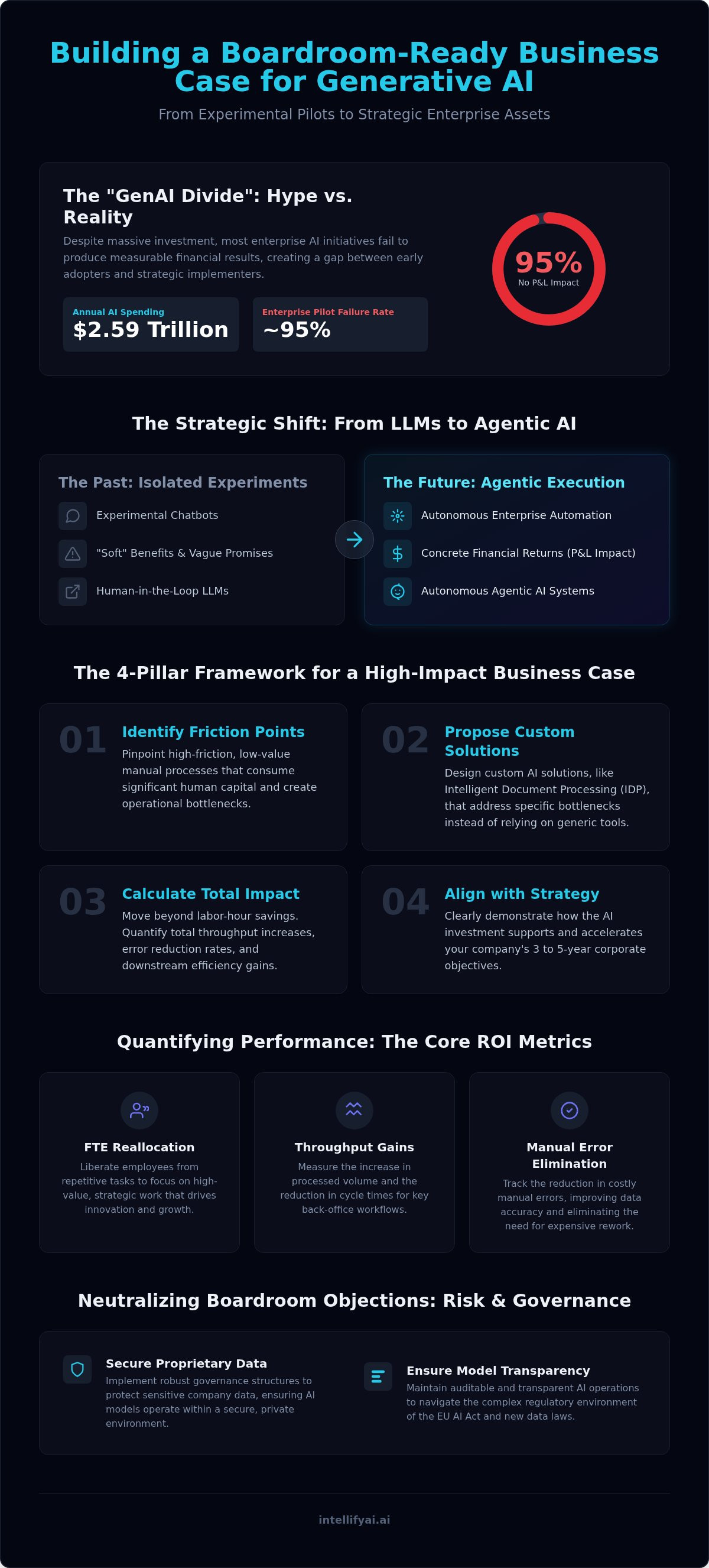
Despite the $2.59 trillion being poured into AI this year, nearly 95% of enterprise generative AI pilots fail to deliver a measurable impact on the bottom line. You've likely seen the initial excitement of a successful pilot vanish when faced with the cold reality of custom engineering costs and data security risks. It's frustrating to watch a breakthrough tool stall because the board can't see past the "soft" benefits of creativity or speed. Success in 2026 requires moving beyond the hype. Building a business case for generative ai is no longer about chasing a trend; it's about architecting a strategic asset that drives autonomous enterprise automation.
We understand that quantifying the value of a liberating technology can feel like an impossible task. This article provides the structured framework you need to turn speculative experiments into boardroom-ready investments. You'll learn how to navigate the complex regulatory environment of the EU AI Act and California's new transparency laws while securing high ROI. We'll provide a clear roadmap from pilot to production, including the specific metrics required to prove long-term viability. By the end of this guide, you'll have a template to transform advanced technology into a central pillar of your business growth.
Key Takeaways
• Shift your strategy from experimental chatbots to agentic execution to ensure long-term enterprise viability.
• Master the 4-pillar framework for building a business case for generative ai that prioritizes custom engineering over generic tools.
• Quantify performance by measuring FTE reallocation, throughput gains, and the elimination of manual errors in back-office workflows.
• Neutralize boardroom objections by implementing governance structures that secure proprietary data and ensure model transparency.
• Accelerate your roadmap by identifying high-volume document processes as immediate, high-ROI quick wins.
Beyond the Hype: Defining the Strategic Purpose of Generative AI in 2026
Enterprise technology has reached a critical inflection point. While Gartner forecasts worldwide AI spending to hit $2.59 trillion this year, a 2025 MIT report revealed a sobering reality: 95% of enterprise generative AI pilots delivered no measurable P&L impact. This "GenAI Divide" separates companies that use AI as a high-tech novelty from those that treat it as core infrastructure. Building a business case for generative ai in this climate requires a shift from curiosity to execution. You aren't just buying a software tool; you're architecting a system that ensures long-term viability in an increasingly automated market.
The 2026 boardroom no longer accepts vague promises of "improved efficiency." Leaders now demand a roadmap that moves beyond isolated experiments toward integrated, autonomous workflows. This requires the mindset of a Strategic Architect; for instance, you can learn more about how autonomous virtual receptionists provide 24/7 support to streamline enterprise communications. You must align every AI initiative with high-level business goals, ensuring that technology serves as a bridge between abstract potential and concrete financial returns. By positioning AI as a central pillar of your digital transformation, you move away from temporary fixes and toward a lasting investment in enterprise relevance.
The Evolution of Value: From LLMs to Agentic AI
The era of simple prompt-and-response models has passed. Success now depends on Agentic AI, which represents the natural progression of generative technology. Unlike standard Large Language Models (LLMs) that require constant human intervention, agentic systems operate with a degree of autonomy. They don't just generate text; they execute complex tasks, manage multi-step processes, and interface with existing enterprise software to achieve specific outcomes. You can explore the technical foundations of these systems in IntellifyAi's guide on Agentic AI. Transitioning to this model is essential for building a business case for generative ai that stands up to rigorous financial scrutiny.
Identifying the 'Why' Before the 'How'
Before selecting a model or engineering a solution, you must define the strategic purpose of the investment. Are you solving for cost reduction or revenue generation? While many organizations focus solely on cutting expenses, the most successful cases frame AI as a liberating force. By removing the burden of repetitive, low-value tasks, you unlock the creative potential of your workforce. This allows teams to pivot toward performance-driven initiatives, such as those facilitated by Indie Collaborates, which connects brands with vetted creators for impactful campaigns. For the 2026 boardroom, the strategic purpose of AI is to serve as an autonomous infrastructure layer that converts unstructured data into actionable outcomes while refocusing human capital on high-value strategic work. This clarity of purpose ensures that your AI roadmap remains grounded in measurable impact rather than technological aspiration.
The 4-Pillar Framework for a High-Impact AI Business Case
A successful business case is not a wishlist; it is a technical blueprint for enterprise modernization. To move beyond the pilot phase, your proposal must demonstrate a deep understanding of operational friction and strategic potential. Building a business case for generative ai requires a rigorous, four-step methodology. First, identify high-friction, low-value manual processes that consume significant human capital. Second, propose a custom solution that addresses these specific bottlenecks rather than relying on generic tools. Third, move beyond simple labor-hour savings to calculate total throughput increases and error reduction. Finally, demonstrate how this investment supports your three to five year corporate objectives. This structured approach moves the conversation from speculative spending to strategic investment.
Pillar 1: Solving the Unstructured Data Challenge with IDP
For many enterprises, the most significant "quick win" lies in Intelligent Document Processing (IDP). High document volume often acts as a massive bottleneck in the back office, where manual data entry leads to high error rates and slow processing times. Organizations can leverage the i_Nova platform to transform this unstructured data into actionable intelligence. By automating the extraction and classification of information from multi-format documents, you create an immediate, high-ROI entry point. This capability doesn't just save time; it provides the clean data foundation necessary for more advanced autonomous workflows. Focusing on IDP allows you to present a clear, measurable impact to the board within months rather than years.
Pillar 2: Custom Engineering vs. Retail Software
The choice between off-the-shelf retail software and custom engineering is a critical decision for long-term scalability. While retail tools offer a low barrier to entry, they often lack the security and specificity required for serious enterprise operations. Relying on "black box" models creates significant risks regarding data privacy and intellectual property. By utilizing Agentic AI engineering services, you can build proprietary models tailored to your unique operational requirements. Custom-built agents operate within your secure environment, ensuring that your data remains a private asset. This bespoke approach creates a unique competitive advantage that competitors using generic software simply cannot replicate. Off-the-shelf is a risk for long-term scalability because it forces your business processes to adapt to the software, rather than the technology adapting to your needs.
As you refine your proposal, remember that the most persuasive cases link technical capability directly to financial resilience. If you are ready to align your technological roadmap with your bottom line, our team can provide the AI strategy and consulting expertise needed to secure executive buy-in.
Measuring the Unmeasurable: Quantifying ROI and Performance
Quantifying the impact of advanced automation is the most critical hurdle for the Strategic Architect. You must establish a clear baseline by auditing existing workflows before any implementation begins. Without a documented "before" state, your "after" results will lack the authority needed to satisfy a CFO. Building a business case for generative ai depends on your ability to translate technical performance into financial outcomes. This involves measuring direct ROI through Full-Time Equivalent (FTE) reallocation and throughput increases, alongside indirect gains like decision-making speed and error reduction in complex back-office tasks.
The "Human-AI Collaboration" multiplier is another essential metric. When technology removes the burden of repetitive, low-value tasks, employee engagement and retention rates typically climb. You aren't just saving hours; you're protecting your most valuable assets and allowing them to focus on high-value creative work. To help your team focus on these higher-level tasks, check out Clarami, an intelligent workspace for professional research and writing. This shift represents a fundamental change in how enterprise value is generated and sustained.
Hard Metrics: Throughput and Accuracy in IDP
In the back office, manual document processing remains a primary source of friction. Comparing manual handling times against i_Nova-powered automated intelligence reveals immediate cost-per-page reductions. For example, if a manual review costs $5 per document and high-precision AI models reduce this to $0.50 while maintaining 99% accuracy, the throughput gain is undeniable. Reducing "rework" costs is another vital metric. When AI eliminates human error in data extraction, the downstream savings in corrected mistakes often exceed the initial engineering investment. This level of precision is what transforms a pilot into a production-ready asset.
Strategic Metrics: CX Improvement and Market Agility
Beyond the back office, strategic metrics define the long-term value of your AI roadmap. Implementing voice agents transforms the contact centre from a traditional cost centre into a proactive value driver. You measure this through improved customer satisfaction scores and reduced call handling times. Additionally, AI-driven insights accelerate your "Speed to Market" for new products, allowing your enterprise to pivot faster than less automated competitors. These initiatives should be viewed as part of broader enterprise modernization efforts, where the goal is a frictionless, responsive organization. By linking technical capability to market agility, you prove that AI is an investment in relevance rather than a temporary fix.
Risk Mitigation and Governance: Addressing the Board's Top Objections
The board's primary responsibility is risk management. When building a business case for generative ai, you must address the 'Black Box' problem with absolute clarity. Transparency and explainability aren't just technical requirements; they're fiduciary duties. Executives need to understand how decisions are reached to maintain trust in autonomous systems. By prioritizing model interpretability, you ensure that your AI initiatives remain accountable and aligned with corporate values.
Data privacy remains a non-negotiable priority for any serious enterprise. You must ensure that proprietary data is never ingested into public LLM training sets, as this could compromise your unique competitive advantages. Safeguarding your intellectual property requires a robust technical architecture that prioritizes security at every layer. Implementation success also depends on FinOps. Without continuous performance monitoring, cloud cost sprawl can quickly erode your projected ROI. MLOps frameworks provide the necessary version control and long-term model reliability to ensure your AI assets remain dependable as they scale.
Ensuring Ethical and Compliant AI Workflows
Navigating the complex GRC (Governance, Risk, and Compliance) landscape requires a specialized approach. Engaging in AI strategy consulting allows you to align your technological ambitions with evolving global regulatory standards. We recommend building 'Human-in-the-loop' systems as a critical safeguard. These systems mitigate the risk of hallucinations by keeping your subject matter experts at the center of the decision-making process. Robust data engineering is the only way to build the secure foundations required for these advanced workflows to function safely.
Managing the Financial Risks of AI Implementation
Financial exposure can be managed through strategic engagement models that prioritize validation over speculation. Proof-of-Value (PoV) engagements allow you to test your thesis in a controlled environment, limiting initial capital exposure while gathering critical performance data. Once a concept is proven, managed services provide the predictable cost structures needed for long-term maintenance and optimization. Integrating these solutions into a cloud-native framework further reduces technical debt, ensuring your infrastructure remains agile and cost-effective. If you are ready to secure your enterprise's future and validate your strategy, contact our experts to design your custom Proof-of-Value today.
From Proposal to Pilot: Executing Your Generative AI Roadmap
Execution is the bridge between a visionary strategy and measurable financial returns. While many organizations stall in a cycle of perpetual experimentation, a Strategic Architect understands that "starting small" still requires deep engineering complexity. Building a business case for generative ai must lead into a structured, multi-phase roadmap that prioritizes stability and scale from day one. You don't just deploy a tool; you integrate an autonomous capability into the fabric of your organization.
Your roadmap should follow four distinct phases. Phase 1 is Discovery and Roadmap, where you align stakeholders and identify your first "Quick Win," such as high-volume document processing. Phase 2 moves into a Proof-of-Value (PoV). This isn't a generic demo; it's a functional prototype built in a controlled environment to validate your specific business thesis. Phase 3 focuses on Scaling and Integration, shifting from isolated pilots to enterprise-wide adoption through cloud-native modernization. Finally, Phase 4 involves Continuous Optimization. By leveraging MLOps, you ensure iterative performance gains that keep your AI assets relevant as market conditions evolve.
Securing Executive Buy-in through Strategic Architecture
When you present your proposal to the board, focus on the measurable impact rather than the underlying technology. Executives are interested in how AI removes operational friction and unlocks human potential. A "Pilot-First" philosophy is essential here; it reduces the perceived risk for skeptical stakeholders by providing a clear, low-risk path to validation. You're not asking for a blind leap of faith but for a structured investment in a proven prototype. Positioning IntellifyAi as your partner ensures you have the technical expertise to manage this end-to-end transformation, from initial consulting to custom agentic engineering.
Your Next Steps: Building the Future of Work
The transition from a reactive to a proactive AI strategy is what defines market leaders in 2026. Waiting for off-the-shelf solutions to catch up to your enterprise needs is a recipe for obsolescence. The cost of inaction is no longer just a missed opportunity; it's a steady decline in competitive relevance. Start your journey by identifying the high-friction processes that currently drain your resources. We recommend beginning with a comprehensive AI strategy audit to map your existing workflows against autonomous possibilities. This first step provides the data needed for building a business case for generative ai that is both persuasive and grounded in reality. The future of work is automated, frictionless, and human-centric. It is time to architect that future today.
Securing the Future of Enterprise Intelligence
The transition from experimental pilots to autonomous enterprise workflows is the defining strategic shift of 2026. Success requires more than just a model; it demands a comprehensive architectural framework that aligns technical execution with financial performance. By focusing on agentic automation and solving the unstructured data challenge through our flagship i_Nova IDP platform, you move beyond curiosity into measurable impact. This same philosophy of automation is empowering tech professionals through QuickApply, which streamlines the application process. building a business case for generative ai is about proving that technology is a liberating force for your workforce. It's about removing repetitive burdens to unlock human potential and drive long-term viability.
As specialists in Agentic AI engineering with a global presence across the US, UK, India, and UAE, we provide the deep technical expertise needed to navigate this complex transition. Don't let your transformation stall at the pilot stage. Schedule a Strategic AI Consultation with IntellifyAi to validate your roadmap and architect a frictionless, automated future. Your enterprise is ready to lead the next era of professional excellence with confidence and clarity.
Frequently Asked Questions
What are the most common mistakes when building an AI business case?
The most common mistake is treating AI as a standalone technological experiment rather than a core business strategy. Many organizations fail by ignoring the hidden costs of data engineering and integration, which can be three to five times higher than the model itself. Avoid the trap of chasing "chatbot curiosity" without a clear path to agentic execution. Success requires aligning every initiative with a specific, high-friction bottleneck that has a direct impact on the P&L.
How do I calculate the ROI of Generative AI if the benefits are 'soft'?
Soft benefits like creativity or speed must be converted into quantifiable performance metrics. Measure the reduction in decision-making cycles or the increase in output volume per employee. For instance, if AI reduces the time to generate a product brief from days to minutes, calculate the accelerated speed-to-market value. building a business case for generative ai depends on your ability to translate these qualitative improvements into hard financial gains and increased market agility.
Is it better to build custom AI models or use off-the-shelf SaaS tools?
Custom models are superior for enterprises that require high security and unique competitive advantages. While off-the-shelf SaaS tools offer a low entry barrier, they often lack the transparency and data privacy required for serious operations. Custom engineering allows you to build proprietary agents that operate within your secure environment. This approach ensures your intellectual property remains protected and your workflows stay optimized for your specific organizational requirements rather than generic industry standards.
How long does it take to see a positive return on an AI investment?
Most enterprises see a positive return within six to twelve months when targeting high-volume quick wins like Intelligent Document Processing. While the initial build cost for mid-level applications typically ranges from $75,000 to $250,000, the throughput gains often offset these expenses rapidly. Long-term viability depends on continuous optimization through MLOps. By focusing on high-friction manual processes first, you can demonstrate immediate value to the board while building the foundation for broader enterprise-wide adoption.
What is the difference between a Pilot and a Proof-of-Value (PoV)?
A pilot focuses on technical feasibility, while a Proof-of-Value (PoV) measures the actual business impact in a controlled environment. Pilots often answer "can we build this?" whereas a PoV answers "should we scale this?" For the 2026 boardroom, a PoV is the more persuasive tool. It provides the concrete data needed to validate your financial assumptions and operational goals. This transition ensures that your AI roadmap is grounded in reality rather than technological aspiration.
How do I address concerns about AI replacing human jobs in my business case?
Frame AI as a liberating force that removes the burden of repetitive tasks rather than a replacement for human labor. Emphasize the Human-AI Collaboration multiplier, where technology allows employees to focus on high-value creative work. This shift improves employee retention and engagement by eliminating mundane manual processes. building a business case for generative ai should highlight how these tools unlock human potential, making your workforce more strategic and effective in a competitive landscape. This same principle allows creative professionals to launch new ventures, such as managing an AI music label; to learn more, click here.
What role does data engineering play in the success of a GenAI project?
Data engineering is the foundational layer that ensures model reliability and security. Without high-quality, structured data, even the most advanced agentic systems will struggle with hallucinations and poor performance. Robust engineering allows for the seamless integration of unstructured data into your autonomous workflows. It is the invisible infrastructure that supports everything from model training to real-time decision-making, ensuring that your AI strategy remains dependable and scalable as your enterprise grows.









.svg)